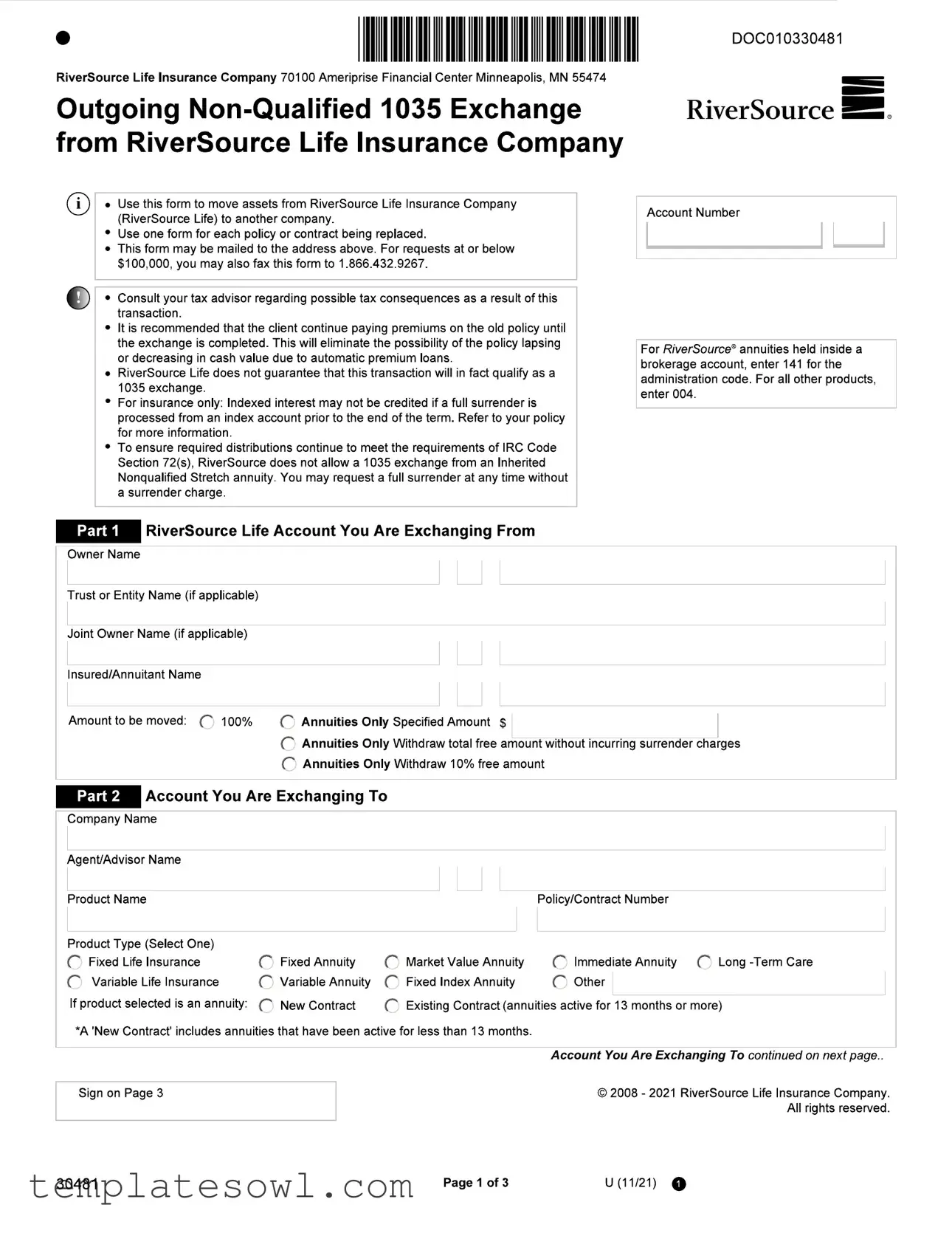
A 1035 exchange allows you to transfer funds from an existing life insurance policy or annuity into a new one tax-free under Internal Revenue Code Section 1035. However, hidden costs like premium loads—front-end or back-end sales charges on the new policy—can significantly reduce the value transferred, making it critical to evaluate these fees before proceeding.
Navigating the complexities of permanent life insurance requires understanding how tax codes and insurance structures intersect. Internal Revenue Code Section 1035 offers a valuable legal mechanism for policyholders who want to upgrade their coverage, switch to a policy with better performance, or move away from a failing product. Yet, pairing a 1035 exchange with a new contract that features a heavy premium load can introduce unexpected financial friction. Evaluating these mechanics ensures that the tax-free transfer actually serves your long-term financial goals rather than merely lining the pockets of an issuer through excessive fee structures.
The Foundations of an Internal Revenue Code Section 1035 Exchange
An Internal Revenue Code (IRC) Section 1035 exchange is a provision that permits the tax-free transfer of cash value from an existing life insurance policy, endowment contract, or annuity into a new, similar contract. The primary advantage is tax efficiency. Normally, if you surrender a permanent life insurance policy for its cash value, any gain—the amount by which the cash surrender value exceeds your cost basis (total premiums paid minus dividends received)—is treated as taxable ordinary income.
By utilizing a 1035 exchange, the IRS allows you to bypass this immediate tax event. The accumulated cash value rolls directly from the originating carrier to the receiving carrier. To qualify for this tax-free status, strict IRS rules apply:
- Like-Kind Requirement: You can exchange a life insurance policy for another life insurance policy, an endowment contract, or an annuity. You can also exchange an annuity for another annuity. However, you cannot exchange an annuity for a life insurance policy, as the tax-deferred nature of annuities cannot be used to purchase tax-free life insurance death benefits.
- Same Insured/Owner Rule: Generally, the obligee, insured, and owner of the old and new policies must be the same person. Changing ownership structures during an exchange can trigger unintended tax consequences or invalidate the 1035 status altogether.
- Direct Transfer: The funds must move directly from insurance company to insurance company. If the carrier sends a check directly to you, even if you intend to deposit it into the new policy within a specific timeframe, the IRS will likely treat it as a taxable distribution and a surrender.
Despite these rules, executing an exchange does not automatically mean the new policy is a superior financial vehicle. One of the most critical variables to analyze during this transition is how the new carrier handles expenses, particularly premium loads.
Defining Premium Load in Permanent Life Insurance
A premium load refers to the administrative fees, sales commissions, and acquisition expenses that an insurance company deducts from the money paid into a permanent life insurance policy, such as whole life, universal life, or variable universal life.
When you pay a premium or transfer a lump sum via a 1035 exchange, the insurance company rarely invests or credits 100% of that cash directly to your account value. Instead, they subtract the premium load first. Premium loads generally fall into two distinct categories:
Front-End Premium Loads
A front-end load is deducted immediately from every dollar that enters the policy. For example, if a policy has a 6% front-end load and you execute a 1035 exchange transferring $100,000 of cash value into the new contract, $6,000 is immediately deducted to cover administrative costs and agent commissions. Only $94,000 actually enters the policy's cash value account to begin earning interest or market returns.
Back-End Premium Loads or Contingent Deferred Sales Charges
Conversely, some policies utilize a back-end load structure, often tied to surrender charges. While less common as a direct "premium load," insurers may structure fees so that charges are levied if you withdraw funds or surrender the contract within a specified surrender period (often 10 to 15 years). In the context of a 1035 exchange, understanding whether your new policy assesses front-end charges on the incoming lump sum or imposes a new, extended surrender charge schedule is paramount.
How 1035 Exchanges and Premium Loads Interact
When you execute a 1035 exchange into a new policy, the receiving insurance company treats the incoming funds in specific ways. Depending on the product design, the transfer can trigger immediate friction if a front-end premium load applies.
Insurance agents often recommend 1035 exchanges to move clients out of older, underperforming universal life policies with skyrocketing internal costs of insurance (COI) into newer contracts. However, if the new policy imposes a steep front-end load on the incoming 1035 exchange funds, the policyholder takes an immediate principal reduction.
- Old Life Insurance Policy Cash Value
- Direct Trustee-to-Trustee Transfer
- New Life Insurance Policy Receiving Department
- Front-End Premium Load Deducted (e.g., 5% - 8%)
- Net Cash Value Deposited into Policy Sub-Accounts
- New Life Insurance Policy Receiving Department
- Direct Trustee-to-Trustee Transfer
Consider a practical financial comparison. Suppose Policyholder A has accumulated $150,000 in cash value inside an old whole life policy with a zero-cost exchange option, but the policy has low dividend projections. They execute a 1035 exchange into a modern Indexed Universal Life (IUL) policy. If that new IUL policy features a 5% premium load, $7,500 vanishes on day one. It will take several years of market indexing or credited interest simply for the cash value to break even with the pre-exchange starting point.
Comparative Fee Impact Table
| Policy Feature / Action | Low-Load / No-Load Policy | Traditional Policy with Premium Load |
|---|---|---|
| Initial Exchange Credit | 98% to 100% of transferred cash value | 90% to 94% of transferred cash value |
| Agent Compensation | Levelized, lower, or advisory fee-based | High initial commission deducted via load |
| Break-Even Horizon | Immediate to Year 1 | Years 3 to 7 (depending on returns) |
| Surrender Charge Schedule | Shorter duration or non-existent | Extended 10-to-15-year declining schedule |
The Hidden Costs: Surrender Charges, Cost of Insurance, and M&E Fees
A premium load is rarely the only fee associated with a new life insurance contract. When analyzing whether a 1035 exchange makes financial sense, you must evaluate the complete fee ecosystem of the new policy:
- Surrender Charges: Moving from one policy to another may incur a surrender charge on the old policy if you are still within its surrender period. Simultaneously, the new policy will likely impose its own brand-new surrender charge schedule, locking your money up for another decade.
- Cost of Insurance (COI): Older policies often suffer from rising COI charges as you age because the mortality risk increases. However, a new policy resets your age bracket or utilizes current underwriting assumptions. Even with a lower COI initially, a high premium load can wipe out any early savings.
- Mortality and Expense (M&E) Risk Fees: Common in Variable Universal Life (VUL) policies, these administrative fees compensate the insurer for managing the insurance risk and operational overhead.
According to consumer guidance provided by state departments of insurance and regulatory bodies like the Financial Industry Regulatory Authority (FINRA), agents are required to perform a suitability analysis before recommending a 1035 exchange. This includes demonstrating that the benefits of the new policy—such as better investment options or lower ongoing fees—outweigh the costs of the exchange, including surrender charges and premium loads.
Common Reasons to Execute a 1035 Exchange (and When to Avoid Them)
Policyholders and financial advisors look to 1035 exchanges for specific strategic reasons. Recognizing these catalysts helps determine if the transaction is justified despite potential premium loads.
Valid Scenarios for an Exchange
- Escaping Collapsing Policies: Older Universal Life policies written in the high-interest-rate environment of the 1980s and 1990s often suffered severe performance drops when interest rates fell, causing policies to underfund and risk lapse. Moving to a modern policy can save the contract.
- Seeking Better Investment Options: Upgrading from a rigid whole life policy to a Variable Universal Life (VUL) or Indexed Universal Life (IUL) policy to align with specific growth goals.
- Consolidation: Combining multiple small, underperforming policies into a single, streamlined contract to simplify estate planning.
When to Avoid an Exchange
- Short-Term Time Horizon: If you anticipate needing the cash value within the next 5 to 10 years, a 1035 exchange into a policy with a premium load and a new surrender charge period is typically detrimental.
- Insurability Issues: If your health has declined significantly since you purchased the original policy, applying for a new policy as part of the exchange could result in a much higher cost of insurance rate class.
- Minimal Improvement: If the net financial gain of the new policy's features is entirely neutralized by the combination of front-end premium loads and surrender fees, staying put is usually the prudent choice.
Step-by-Step Process to Execute a 1035 Exchange Safely
Executing a 1035 exchange requires precise administrative coordination between the old carrier, the new carrier, and the policyholder. Deviating from the exact procedural steps can result in severe tax penalties.
- Conduct a Policy Audit: Request an in-force illustration and a formal surrender quote from your current insurance provider. Identify your exact cost basis and verify whether any surrender charges still apply.
- Shop and Compare New Contracts: Review multiple receiving carriers. Inquire specifically about front-end premium loads, administrative fees, and ongoing management expenses. Consider seeking out fee-only fiduciary advisors who offer low-load or no-load insurance products.
- Submit the Application and 1035 Paperwork: Complete the application for the new policy alongside the specific 1035 exchange election forms provided by the new carrier. Do not cancel your old policy yet.
- Underwriting and Approval: The new carrier evaluates your health and financial profile. Once approved, the new policy is issued (often with a temporary or conditional receipt).
- Direct Transfer of Funds: The new insurance company sends a formal transfer request and absolute assignment form to the old carrier. The old carrier liquidates the cash value and wire-transfers or mails a check directly to the new carrier.
- Confirmation and Reconciliation: Verify with both companies that the transfer was processed as a direct, tax-free 1035 exchange. Review the confirmation statement to ensure the correct amount—minus any disclosed front-end load—was credited to your new policy.
Disclaimer: Life insurance products are complex financial instruments governed by federal tax laws and state regulations. Tax laws are subject to change. Policyholders should consult a certified financial planner, tax professional, or legal counsel before executing a 1035 exchange.
Frequently Asked Questions
What happens if I accidentally receive a check during a 1035 exchange?
If the insurance company sends the surrender check directly to you instead of the new carrier, the IRS generally views this as a taxable distribution. You have a strict 60-day window to roll those funds into a qualified contract, but direct trustee-to-trustee transfers are the only foolproof way to guarantee a tax-free transaction and avoid withholding mistakes.
Are all life insurance policies subject to premium loads?
No. While traditional policies sold through captive agents or brokers frequently feature front-end loads or heavy commission structures, modern fee-only or low-load insurance products exist. These policies eliminate or drastically reduce sales loads, relying instead on flat advisory fees paid directly to an independent financial planner.
Can I do a partial 1035 exchange?
Yes. The IRS permits partial 1035 exchanges for both life insurance and annuity contracts. However, the rules regarding partial annuity exchanges are stringent, and the IRS applies specific anti-abuse rules (such as a 180-day holding requirement) to prevent taxpayers from withdrawing gains tax-free while leaving principal untouched. Always verify partial exchange rules with the issuing carriers.
Do I have to undergo medical underwriting for a 1035 exchange?
Yes. Because a 1035 exchange involves replacing your existing policy with an entirely new contract from a new (or sometimes the same) carrier, you must submit a new application. This application requires medical underwriting. If your health has deteriorated since your original policy was issued, your new insurance rates may be higher.
How do premium loads affect the cash value growth of my new policy?
Premium loads reduce your starting principal on day one. For example, if a 6% front-end load is applied to a $100,000 transfer, only $94,000 goes to work in the market or earns credited interest. This creates a hurdle that your cash value must overcome through policy performance before your net account value matches your total transfer amount.
Next Actions and Strategic Recommendations
Before initiating a 1035 exchange, request an in-force ledger from your current provider and compare it side-by-side with a detailed product illustration from the proposed new carrier. Pay meticulous attention to the "Net Cash Surrender Value Year 1" row, which accounts for both surrender fees on the old policy and any premium loads on the new one. If the math demonstrates that the new policy's long-term performance benefits outweigh the immediate friction costs of the exchange, proceed via a direct trustee-to-trustee transfer. When in doubt, engage an independent fiduciary who can model multiple carrier options objectively without commission bias.