Progressive is widely recognized as the number one commercial auto insurer in the United States, commanding a significant share of the market by offering customized business vehicle policies, specialized coverages for diverse industries, and scalable options for fleets of all sizes.
Understanding Progressive's Position as the Leading Commercial Auto Insurer
When businesses look for protection for their vehicle fleets, they frequently encounter Progressive. The insurer's status as the top commercial auto carrier in the country is built upon decades of specialization, a diverse appetite for risk, and a robust digital and agent-driven distribution network. Achieving and maintaining this position requires more than just brand recognition; it demands a deep understanding of commercial driving risks, competitive pricing models, and specialized claims handling capable of minimizing business downtime after an accident.
Historical Context and Market Evolution
Progressive did not become the leading commercial auto insurer overnight. The company expanded its personal auto foundation by aggressively moving into the commercial sector decades ago, recognizing that small businesses, contractors, and large trucking operations had distinct insurance needs that standard personal policies could not address. By developing rating algorithms that accurately account for business use, vehicle weight classes, and driver experience, Progressive built a portfolio that appeals to both sole proprietors and enterprise-level logistics operations.
The expansion of the gig economy and last-mile delivery services further cemented this market position. As e-commerce accelerated, the demand for flexible commercial vehicle policies surged. Progressive adapted by creating tailored endorsements for delivery drivers, rideshare operators, and independent contractors, ensuring that commercial risks were properly rated and covered without leaving coverage gaps that standard personal auto policies typically exclude.
Scale, Capacity, and Financial Stability
Being the largest commercial auto insurer provides tangible benefits to policyholders. Insurance is ultimately a promise to pay claims, and a carrier's financial capacity dictates its ability to handle catastrophic losses or large fleet liability claims. Progressive maintains strong financial strength ratings from major agencies like AM Best, indicating a high capacity to absorb market shocks and pay out claims reliably.
This scale also translates into extensive infrastructure. Policyholders benefit from nationwide network coverage, which is essential for businesses operating across state lines. If a commercial truck or service van breaks down or gets into an accident hundreds of miles from its home base, Progressive's claims adjusters and repair networks can coordinate service, appraisals, and rentals across different jurisdictions.
Core Coverages Available Under Progressive Commercial Auto Policies
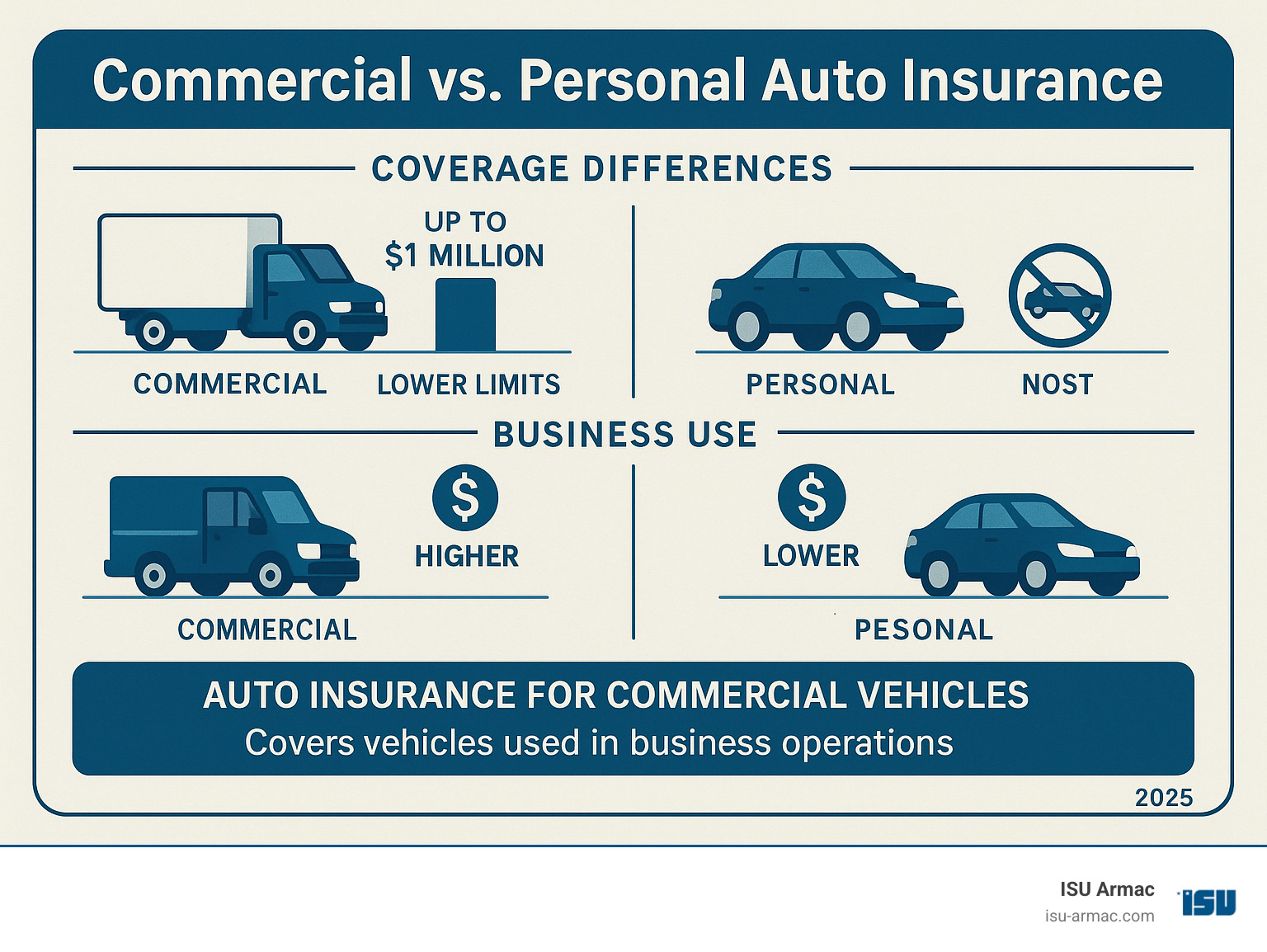
A commercial auto policy functions fundamentally differently than a personal auto insurance policy. While both protect against physical damage and liability, commercial policies must account for higher liability limits, specialized equipment, hazardous materials, and multiple drivers with varying motor vehicle records.
Liability Protection: Bodily Injury and Property Damage
At the heart of every commercial auto policy is liability coverage. If a business-owned vehicle—or a personal or rented vehicle being used for business purposes—causes an accident, liability insurance helps pay for the resulting injuries and property damage to others.
- Bodily Injury Liability: Covers medical bills, rehabilitation costs, lost wages, and legal defense fees if the business is sued following an accident where others are injured.
- Property Damage Liability: Pays for the repair or replacement of other vehicles, buildings, guardrails, or public property damaged by a covered business vehicle.
Commercial policies typically feature higher limits than personal policies, often starting at $300,000 combined single limit (CSL) and scaling up to $1,000,000 or more, depending on contractual requirements or federal and state regulations.
Physical Damage Coverage: Collision and Comprehensive
Businesses rely heavily on their vehicles to generate revenue. If a vehicle is wrecked, stolen, or damaged by a storm, the business suffers operational losses alongside asset damage. Progressive offers two primary physical damage coverages:
- Collision Coverage: Pays to repair or replace the business vehicle if it collides with another vehicle or object, such as a tree or a loading dock, regardless of fault.
- Comprehensive Coverage: Protects against non-collision events, including theft, vandalism, fire, windstorms, hail, or animal strikes.
Deductibles apply to both coverages. Businesses can select higher deductibles to lower their monthly premiums or lower deductibles to reduce out-of-pocket expenses in the event of a claim.
Specialized Coverages for Specific Industries
One reason Progressive maintains its top market share is its ability to tailor policies to specific commercial sectors. Standard business auto insurance is often insufficient for specialized trades or heavy transport.
| Coverage Type | Target Industry / Use Case | Primary Purpose |
|---|---|---|
| Motor Truck Cargo | Long-haul truckers, freight forwarders | Protects the goods and freight being hauled against theft, fire, or damage during transit. |
| Trailer Interchange | Drop-and-hook trucking operations | Covers trailers that a trucker pulls under a formal interchange agreement, protecting against physical damage while in their custody. |
| On-Hook Towing | Tow truck operators, roadside assistance | Covers customer vehicles while they are being towed or hauled, protecting against damage during transport. |
| Non-Trucking Liability | Independent owner-operators leased to a motor carrier | Provides liability coverage when the truck is being driven for personal use, outside of dispatch. |
| Medical Payments (MedPay) / PIP | All business vehicle operators | Covers medical expenses for the driver and passengers injured in a covered accident, regardless of fault. |
Evaluating Progressive Commercial Auto Insurance: Pros, Cons, and Considerations
Choosing the right commercial auto insurer requires weighing the advantages against potential limitations. While Progressive holds a dominant market position, business owners should analyze how the carrier aligns with their specific operational profile.
Advantages of Choosing Progressive
- Broad Risk Appetite: Progressive insures a wide array of businesses, from local landscapers with a single pickup truck to interstate trucking fleets with dozens of semi-trucks.
- Digital Tools and Policy Management: The online portal and mobile applications allow business owners to add drivers, print certificate of insurance (COI) documents, and manage billing without calling an agent.
- Electronic Logging Device (ELD) Integration: Progressive offers programs and potential discounts for commercial fleets that utilize compliant electronic logging devices, rewarding safe driving habits and operational transparency.
- Flexible Payment Options: Businesses can choose from various payment structures, including monthly reporting policies for certain types of trucking operations where premiums adjust based on monthly mileage or revenue.
Potential Limitations and Drawbacks
- Premium Variability: Because Progressive prices risk granularly, businesses with high-risk drivers, historical loss runs, or operations in congested urban centers may experience substantial premium increases.
- Underwriting Strictness: While they accept diverse risks, severe motor vehicle violations by primary drivers can lead to declinations or non-renewals, requiring the business to seek specialized high-risk pools.
- Customer Service Experiences: As a massive enterprise, customer service interactions can occasionally feel transactional rather than advisory, making the choice of an independent insurance agent critical for hands-on support.
Factors That Influence Commercial Auto Insurance Costs
Commercial auto insurance premiums are calculated based on a complex matrix of risk factors. Understanding these variables helps business owners manage and potentially reduce their insurance expenditures.
Vehicle Characteristics and Classification
The type of vehicles a business operates heavily dictates the cost of insurance. A fleet of compact cars used for local sales calls carries a significantly lower risk profile than a fleet of heavy-duty dump trucks or tractor-trailers.
- Radius of Operation: Vehicles operating locally (within a 50-mile radius) generally cost less to insure than long-haul vehicles crossing state lines, due to reduced exposure time and lower accident severity potential.
- Vehicle Weight and Use: Gross Vehicle Weight Rating (GVWR) determines class, and service-use classifications (e.g., commercial delivery versus retail transport) adjust the baseline risk calculation.
Driver History and MVRs
The individuals behind the wheel are often the most critical variable in commercial auto pricing. Insurers pull Motor Vehicle Records (MVRs) for all listed drivers.
- Experience: Drivers with years of commercial driving experience and clean records command lower rates.
- Violations: Speeding tickets, reckless driving citations, and Driving Under the Influence (DUI) convictions severely impact premiums or render a driver ineligible under standard underwriting guidelines.
Frequently Asked Questions
What constitutes a commercial auto vs. personal auto policy?
A personal auto policy is designed for everyday commuting, errands, and personal travel. A commercial auto policy is required when vehicles are registered to a business corporation, used to transport goods or equipment for a fee, operated by employees, or exceed standard weight thresholds established by insurance regulations.
Can I get commercial auto insurance if I am a sole proprietor?
Yes. Sole proprietors, freelancers, and independent contractors who use their personal vehicles for business tasks—such as a handyman carrying tools or a consultant traveling to client sites—frequently purchase commercial auto insurance or business use endorsements to ensure coverage is not denied after an accident.
How do certificates of insurance (COIs) work with Progressive?
A Certificate of Insurance is an official document verifying that a business carries active insurance coverage. Progressive allows policyholders and their authorized agents to generate, download, and send COIs instantly through online portals, satisfying client requirements before starting contracted work.
Does Progressive cover rented or leased business vehicles?
Yes, commercial auto policies can be structured to cover hired and non-owned autos (HNOA). This protects the business if an employee drives a rented vehicle, borrowed vehicle, or their personal car on company business and causes an accident where the business is held liable.
What is a combined single limit (CSL) policy?
A combined single limit policy establishes a single dollar amount that applies to any combination of bodily injury and property damage liability claims resulting from a single accident, simplifying coverage limits compared to split-limit policies.
Next Actions for Securing Commercial Auto Coverage
When seeking commercial auto insurance, business owners should gather fleet inventories, vehicle identification numbers (VINs), driver's license numbers, and historical loss run reports before requesting quotes. Consulting with an independent insurance broker or working directly with commercial specialists can help clarify specific endorsements required for your industry, ensuring your operations remain fully protected and compliant with state and federal regulations.