API gateway security is the architectural discipline of protecting application programming interfaces (APIs) at the network and application ingress point. It consolidates authentication, fine-grained authorization, rate limiting, traffic inspection, threat detection, and transport-layer encryption into a centralized management layer before incoming traffic reaches upstream microservices or internal backends.
The Role of API Gateways in Modern Application Security
Modern application architectures rely heavily on distributed microservices, serverless functions, and third-party integrations. Exposing each internal service directly to the public internet creates an unmanageable attack surface, requiring every development team to independently implement security controls, logging, and traffic management.
An API gateway acts as a reverse proxy sitting between client applications—such as mobile apps, single-page web applications, and external partner systems—and internal backend services. By terminating external connections at the edge, the gateway enforces a single, standardized boundary for security policies.
- Client Requests
- API Gateway (Auth, Rate Limiting, WAF, Encryption)
- Internal Services
Centralizing security at the gateway delivers several core operational benefits:
- Attack Surface Reduction: Internal network topology, service locations, and private endpoints remain concealed behind the gateway boundary.
- Decoupled Security Logic: Microservice developers focus on core business domain rules rather than re-implementing complex OAuth token validation, mutual TLS handshakes, or web application firewall (WAF) rules.
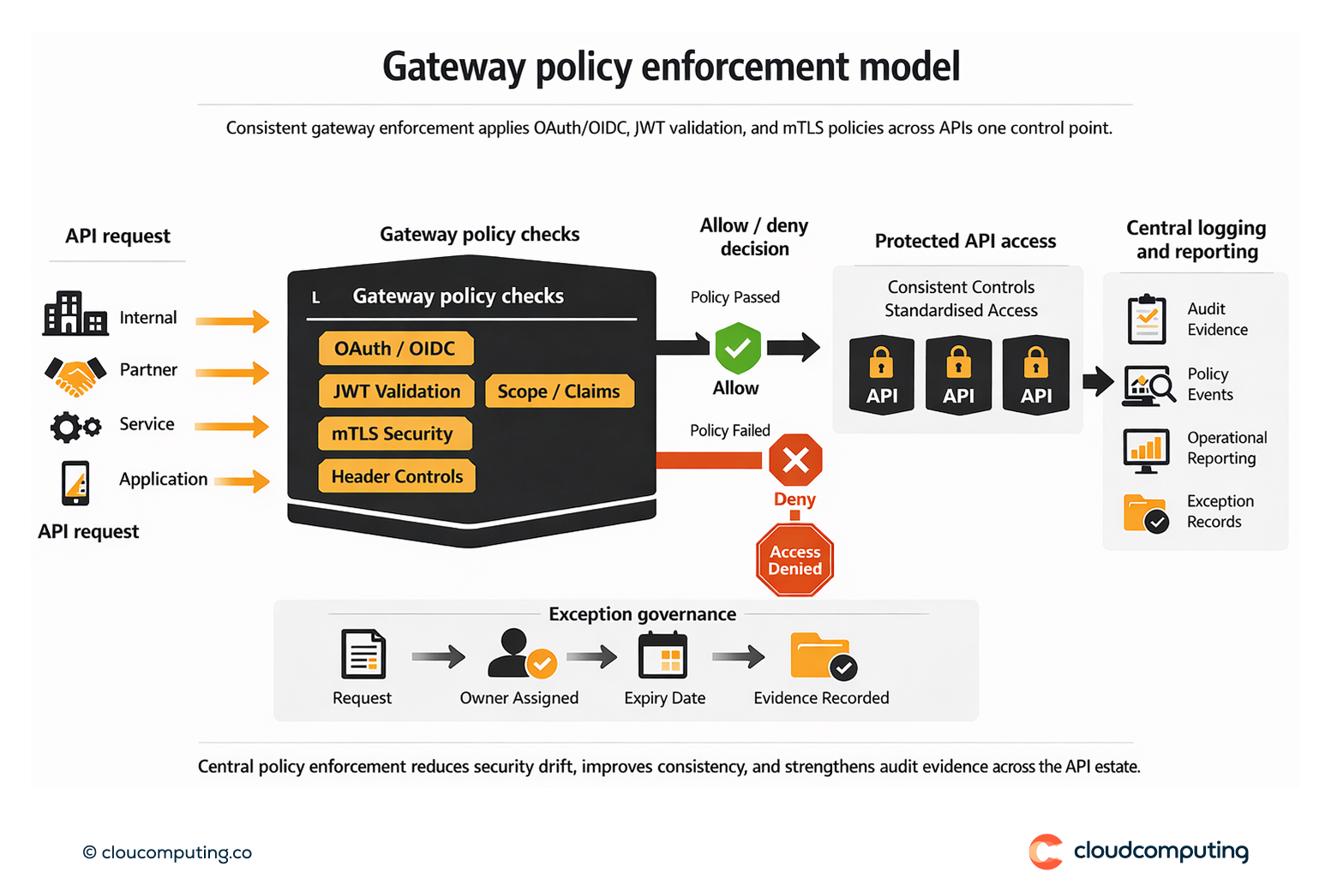
- Consistent Governance: Security policies, cryptographic compliance standards, and access control rules apply uniformly across all exposed APIs regardless of the underlying backend technology stack.
- Centralized Observability: High-fidelity audit logs, security event metrics, and telemetry gather at a single entry point, simplifying real-time threat analysis and compliance audits.
Perimeter Security vs. Zero Trust Microservices
While an API gateway provides a robust perimeter, modern enterprise security models treat the gateway as the first layer of a broader Zero Trust Architecture. Under Zero Trust principles, network location inside the perimeter does not confer implicit trust.
The API gateway handles primary edge authentication, validating public client identities and scrubbing bad actors. It then passes authenticated context downstream using secure context tokens (such as cryptographically signed JSON Web Tokens). Internal microservices rely on this contextual data while enforcing their own local access rules and utilizing mutual Transport Layer Security (mTLS) for east-west (service-to-service) communication.
Key Threat Vectors Targeted at API Gateways
Understanding API gateway security requires analyzing the vector paths attackers use to exploit application interfaces. The OWASP API Security Project documents the most critical security risks facing modern web APIs.
Broken Object Level Authorization (BOLA)
BOLA occurs when an API endpoint exposes identifiers for objects without verifying whether the requesting user has permission to access that specific object. Attackers manipulate resource identifiers (such as user IDs or order numbers) in request URIs or payloads to access unauthorized data. While deep object ownership validation often requires backend domain logic, API gateways mitigate BOLA by validating path parameters against token scopes and user context before forwarding requests.
Broken Object Property Level Authorization
This threat encompasses both mass assignment (where an attacker injects unauthorized fields like is_admin: true into an update request) and improper data disclosure (where an API returns excessive properties in a response). API gateways mitigate this risk by enforcing strict request and response schema validation using OpenAPI definitions, stripping unexpected input parameters, and filtering sensitive fields from outbound responses.
Unrestricted Resource Consumption
Without strict traffic controls, APIs are vulnerable to Denial of Service (DoS), resource exhaustion, and automated credential stuffing. Attackers exploit endpoints by sending high-frequency requests, payload sizes that consume excess memory, or complex queries that overload backend databases. API gateways counter this by enforcing granular rate limits, request payload size limits, and execution timeouts.
Server-Side Request Forgery (SSRF)
SSRF occurs when an API fetches a remote resource without fully validating the user-supplied URL. Attackers use this to force the API backend to read sensitive internal infrastructure endpoints, metadata services, or local resources. API gateways defend against SSRF by validating incoming request structures, enforcing strict egress rules, and restricting URL parameters to pre-approved allowlists.
Core API Gateway Security Mechanisms
Protecting an API infrastructure demands a Defense-in-Depth approach. API gateways enforce five core foundational security mechanisms at the ingress layer.
- Incoming Request
- Transport Layer Security (TLS 1.3 / mTLS)
- WAF & Schema Validation (Payload Sanitization)
- Authentication & Token Management (OAuth 2.0 / OIDC)
- Fine-Grained Authorization (RBAC / Policy-as-Code)
- Traffic Control & Rate Limiting (Token Bucket)
- Upstream Backend Service
1. Authentication and Identity Token Management
Authentication verifies the identity of the client or user making the request. API gateways should never rely on legacy, static API keys for end-user authentication; instead, they act as OAuth 2.0 Resource Servers or OpenID Connect (OIDC) enforcement points.
The IETF published guidance on OAuth 2.0 Security Best Current Practice, emphasizing token validation rigor. When a client submits a JSON Web Token (JWT) in the HTTP Authorization: Bearer header, the gateway validates:
- Cryptographic Signature: Verifies the token was issued by a trusted Identity Provider (IdP) using public keys fetched via Json Web Key Sets (JWKS).
- Expiration Time (
exp): Ensures the token is currently valid and rejects stale assertions. - Not Before (
nbf): Confirms the token activation window has passed. - Audience (
aud): Confirms the token was specifically intended for the target API. - Issuer (
iss): Verifies the token originated from an authorized identity server.
2. Fine-Grained Authorization and Policy Enforcement
Authentication establishes who the caller is; authorization determines what they can do. Gateways implement authorization through multiple models:
- Role-Based Access Control (RBAC): Restricts access based on predefined roles assigned to users (for example,
admin,editor,viewer). The gateway checks token claims against endpoint access matrices. - Attribute-Based Access Control (ABAC): Evaluates context, such as caller IP address, time of day, client device posture, and user attributes, to make dynamic access decisions.
- Policy-as-Code (OPA): Enterprise gateways increasingly delegate policy evaluation to external engines like Open Policy Agent (OPA). The gateway passes request context (headers, path, client identity) to OPA via high-performance gRPC calls, receiving a binary pass/fail or dynamic filter decision based on centralized declarative policies.
3. Rate Limiting, Throttling, and DDoS Mitigation
Traffic management prevents system degradation and controls infrastructure spending. Gateways execute rate limiting using algorithms such as the Token Bucket or Leaky Bucket patterns:
- Token Bucket: Tokens are added to a bucket at a fixed rate. Each incoming request consumes a token. If the bucket is empty, the gateway immediately returns an HTTP
429 Too Many Requestsstatus code. This allows for managed traffic bursts. - Leaky Bucket: Requests enter a queue and process at a continuous, smooth rate. Bursts above queue capacity are shed immediately.
Rate limits should apply hierarchically across multiple dimensions:
- Global Limits: Protecting overall upstream cluster capacity.
- Per-Authenticated User / Tenant Limits: Preventing single-tenant resource starvation in multi-tenant SaaS applications.
- Per-IP Address Limits: Mitigating unauthenticated brute-force attacks and web scrapers.
- Per-Endpoint Limits: Applying lower thresholds to expensive operations (such as PDF generation or report exports) and higher thresholds to simple read operations.
Distributed gateways use centralized, low-latency datastores such as Redis to synchronize rate limit counters across multiple gateway nodes in real time.
4. Transport Layer Security and mTLS Implementation
All traffic traversing the API gateway must be encrypted in transit using modern Transport Layer Security (TLS 1.3 or TLS 1.2 with secure cipher suites). Legacy protocols (TLS 1.0 and 1.1) and weak ciphers (such as RC4 or static RSA key exchange) must be explicitly disabled.
For high-security environments—such as open banking, healthcare interfaces, and B2B partner networks—gateways enforce Mutual TLS (mTLS). In standard TLS, only the server proves its identity via a public certificate. In mTLS:
- The gateway requests a client X.509 certificate during the TLS handshake.
- The gateway validates the client certificate against a trusted Certificate Authority (CA) chain.
- The gateway checks certificate revocation lists (CRLs) or uses the Online Certificate Status Protocol (OCSP).
- The connection establishes only if the cryptographic identity is fully verified.
This provides cryptographically strong client identity verification independent of application-layer headers.
5. Request Validation and Payload Inspection
Attackers frequently inject malicious content into headers, query parameters, or request bodies. API gateways protect upstream services by performing strict edge validation:
- Schema Enforcement: The gateway validates incoming JSON or XML payloads against predefined OpenAPI schemas. Requests with missing required fields, unexpected additional attributes, or incorrect data types are rejected immediately with HTTP
400 Bad Request. - Input Sanitization and WAF Rules: Integrating Web Application Firewall engines directly into the gateway allows deep inspection for SQL Injection (SQLi), Cross-Site Scripting (XSS), Command Injection, and Path Traversal patterns before requests touch internal code.
- Payload Size Restrictions: Setting explicit maximum request size limits (for example, limiting standard JSON POST bodies to 1 MB) blocks memory-exhaustion vector attacks.
API Gateway Security Architecture Matrix
The following table compares primary API security mechanisms, detailing their operational scope, target threats, and typical implementation methods.
| Security Mechanism | Operational Layer | Primary Threat Vector Addressed | Standard Implementation Method | Performance Impact |
|---|---|---|---|---|
| OAuth 2.0 / OIDC | Application (HTTP) | Impersonation, Unauthorized Access | JWT Validation, JWKS Key Verification | Low (Local Signature Checks) |
| Mutual TLS (mTLS) | Transport (TLS) | Man-in-the-Middle (MitM), Spoofing | X.509 Client Certificate Handshake | Moderate (Initial Handshake CPU) |
| Token Bucket Rate Limiting | Network / App | DoS, Brute-Force, Resource Exhaustion | Redis-backed distributed counters | Very Low (< 2ms lookup overhead) |
| OpenAPI Schema Validation | Application (HTTP) | Mass Assignment, Format Injection | Strict JSON/XML schema evaluation | Moderate (Payload parsing load) |
| Web Application Firewall | Application (HTTP) | OWASP Top 10 (SQLi, XSS, Path Traversal) | Deep Packet & Body Regex Inspection | Moderate to High (Complex regex) |
| Policy-as-Code (OPA) | Application (HTTP) | Complex BOLA, Unauthorized Actions | External engine lookup via gRPC | Low to Moderate (Network latency) |
Implementation Strategy: Building a Hardened Ingress Layer
Implementing gateway security requires deliberate pattern choices to avoid performance bottlenecks and architectural fragility. Guidelines published in the NIST SP 800-204 Series on Microservices Security highlight specific implementation strategies.
The Phantom Token Pattern
Passing public, standard JSON Web Tokens directly to client-side single-page apps or mobile devices risks exposing sensitive user claims or scopes if tokens are intercepted. Furthermore, large JWTs bloat request header sizes across every internal microservice hop.
To solve this, secure architectures use the Phantom Token Pattern (or Token Exchange):
Public Edge: The client authentication flow returns an opaque, random reference token (a string with no readable internal structure or claims) stored securely by the client (e.g., inside an
HttpOnly,SameSite=Strictcookie).Gateway Ingress: The client sends the opaque token to the API gateway.
Token Exchange: The gateway intercepts the opaque token, validates it against a fast caching layer or token introspection endpoint, and exchanges it for a short-lived, cryptographically signed internal JWT.
Downstream Propagation: The gateway strips the opaque token and forwards the internal JWT upstream. Backend microservices receive a validated, standardized identity context while client applications never gain access to internal token structures.
Client App sends Opaque Token to API Gateway
API Gateway performs Look up & Exchange Token
API Gateway sends Signed Internal JWT to Backend Service
Observability, Threat Monitoring, and Log Sanitization
An API gateway serves as the primary audit engine for all application traffic. Security log generation must balance deep observability with strict privacy controls:
- Correlation IDs: The gateway must inject a unique trace identifier (such as an
X-Request-IDor W3Ctraceparentheader) into every incoming request. This ID passes through all downstream microservices, allowing security engineers to trace a single transaction across complex distributed environments during incident response. - PII Masking and Data Scrubbing: Logs must never capture sensitive credentials, OAuth refresh tokens, credit card numbers, or personally identifiable information (PII). Gateway logging filters should strip
Authorizationheaders, sensitive cookie strings, and specific JSON fields (likepasswordorssn) prior to sending streams to SIEM platforms. - Security Information and Event Management (SIEM) Integration: High-frequency event streams (such as repeated HTTP 401/403 responses, sudden spikes in HTTP 429 rate limits, or WAF block events) must stream directly to centralized security analytics platforms for real-time automated threat correlation and IP blacklisting.
Common Security Pitfalls and How to Avoid Them
Even with robust API gateway software, implementation mistakes can introduce critical security vulnerabilities.
1. Leaking Verbose Internal Error Stacks
When an upstream service fails with an HTTP 500 error, raw stack traces may disclose database technology, file system paths, framework versions, or internal IP addresses.
- Remediation: The API gateway must intercept generic 5xx errors from backend services, scrub all internal details, and return standardized, sanitized error payloads (following RFC 7807 Problem Details standards) to the external caller.
2. Misconfigured Cross-Origin Resource Sharing (CORS)
Overly permissive CORS rules allow unauthorized third-party websites to execute requests against APIs using an authenticated user's browser session. Common mistakes include setting Access-Control-Allow-Origin: * while enabling Access-Control-Allow-Credentials: true.
- Remediation: Enforce explicit domain allowlists within the API gateway's CORS policy module. Dynamically check incoming
Originheaders against trusted domains, and reject wildcards whenever credentialed requests are permitted.
3. Missing Signature Algorithm Verification (alg: none)
Weak JWT validation libraries or misconfigured gateways can accept unsigned tokens if an attacker modifies the token header to specify "alg": "none".
- Remediation: Explicitly configure the gateway's token validation engine to enforce trusted signature algorithms (such as
RS256,ES256, orEdDSA). Reject any token that specifies asymmetric/symmetric mismatches or thenonealgorithm.
4. Shadow APIs and Unmapped Endpoints
New endpoints added to backend microservices may accidentally become publicly accessible if the API gateway uses catch-all routing rules without explicit security policy bindings.
- Remediation: Adopt a "Default Deny" posture. Configure gateway routes explicitly using declarative configuration files tied to OpenAPI specifications. Unmapped routes must return an automatic
404 Not Foundor403 Forbiddenresponse at the gateway boundary.
Frequently Asked Questions
What is the difference between an API Gateway and an Ingress Controller?
An Ingress Controller is a specialized component that manages external access to services within a container orchestration cluster (such as Kubernetes), operating primarily at network Layers 4 and 7 for basic routing and TLS termination. An API Gateway sits at higher application layers, offering advanced security and operational capabilities such as complex OAuth 2.0 validation, fine-grained authorization, API key management, request transformation, web application firewall rules, and monetization rate limits. Modern cloud-native tooling often combines both roles into an API Gateway Ingress Controller.
Should token validation happen at the API Gateway or inside microservices?
Token validation should occur at both layers following a defense-in-depth design. The API Gateway performs primary validation—checking signature integrity, expiration times, revocation status, and coarse permissions—to drop invalid traffic immediately at the edge. Downstream microservices then parse the validated user context passed by the gateway to enforce domain-specific, fine-grained data ownership permissions (such as verifying if User A owns Account B).
How does an API gateway protect against automated bot attacks?
API gateways mitigate automated bot activity through a combination of IP reputation filtering, global and per-client rate limiting, payload validation, and integration with specialized Bot Management or WAF solutions. Advanced gateways evaluate client behavioral telemetry, HTTP header consistency, dynamic CAPTCHA challenges, and request velocity patterns to identify and block automated scrapers, credential-stuffing tools, and distributed brute-force attacks.
Why is static API Key authentication considered insufficient for high-security applications?
Static API keys are long-lived strings that do not encapsulate short expiration times, fine-grained scopes, or verified user identities. If an API key leaks (for example, hardcoded into a public code repository or mobile binary), an attacker gains unrestricted, long-term access until the key is manually revoked. Modern applications use short-lived OAuth 2.0 access tokens, which limit exposure windows, tie actions to specific user identities, and support dynamic cryptographic rotation.
How do modern API gateways support Zero Trust Architecture?
In a Zero Trust Architecture, the API gateway serves as the Policy Enforcement Point (PEP) at the network ingress. It verifies identity, checks device health headers, evaluates access policies dynamically, and terminates public TLS traffic. It then re-encrypts traffic using Mutual TLS (mTLS) and forwards requests to upstream internal services alongside cryptographically signed identity context tokens, ensuring internal communications remain protected even if an attacker gains access to the local network.
Strategic Next Actions for API Security Alignment
To harden an enterprise API gateway deployment, technical teams should execute the following operational steps:
- Conduct an API Endpoint Inventory: Audit all public and internal routing rules within your gateway configuration to ensure no unmapped or unauthenticated "shadow" endpoints exist.
- Enforce Strict OpenAPI Schema Validation: Upload and bind validated OpenAPI (Swagger) specifications directly to your API gateway routes to automatically block malformed requests, SQL injections, and mass assignment attacks at the perimeter.
- Transition to Short-Lived Tokens and mTLS: Replace static API keys with OAuth 2.0 / OIDC asymmetric access tokens featuring maximum lifetimes of 1 hour or less. Implement mTLS for all backend microservice communications and partner-facing API integrations.
- Implement Centralized Policy-as-Code: Decouple authorization logic from application code by integrating policy evaluation engines (such as Open Policy Agent) with your gateway pipeline to maintain uniform access governance across all digital products.