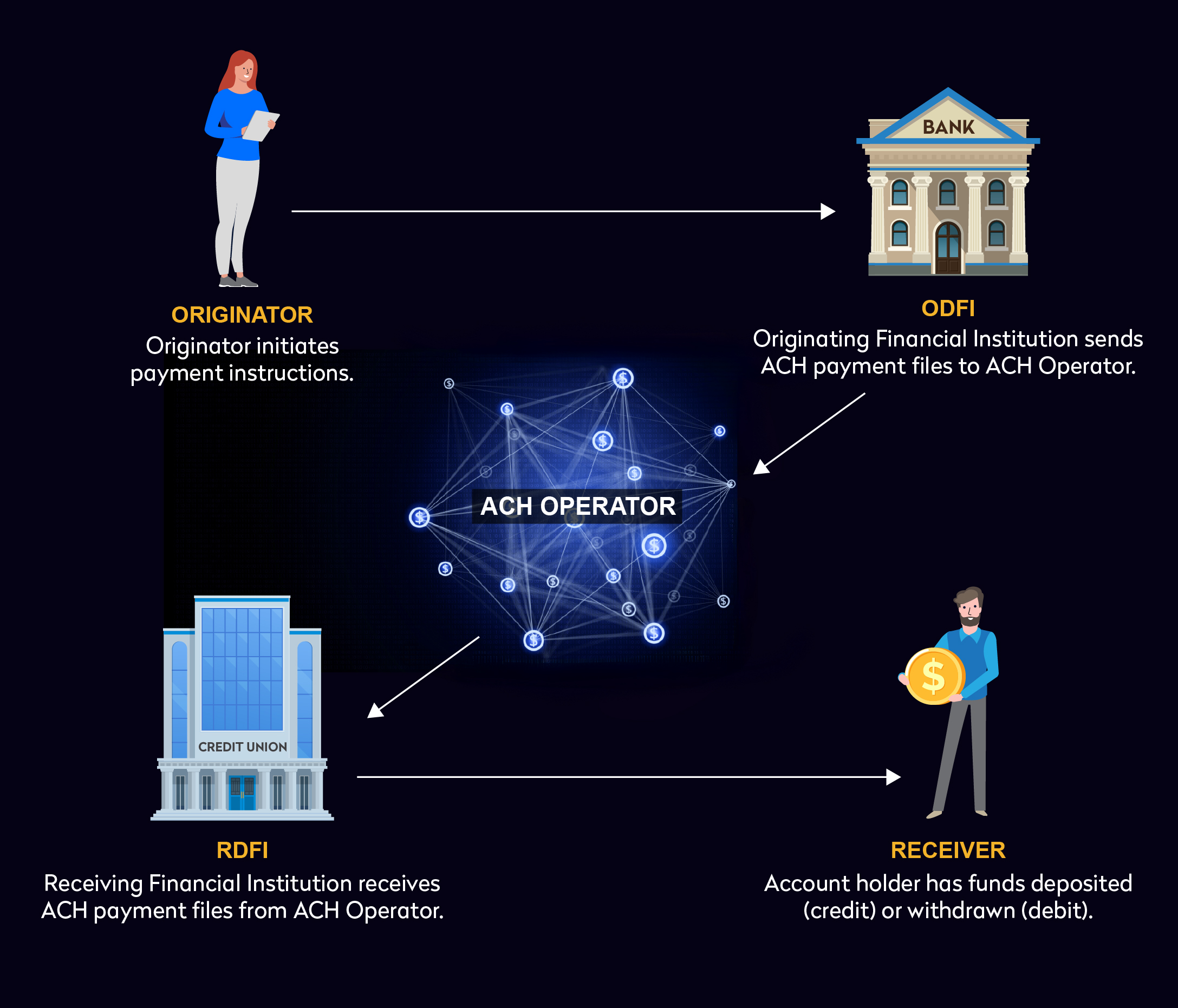
The Automated Clearing House (ACH) network has evolved from a legacy batch-processing system into the backbone of modern mobile payments. By bridging the gap between traditional banking infrastructure and the demand for real-time digital liquidity, the system now enables everything from peer-to-peer (P2P) transfers to expedited business-to-consumer (B2C) payouts through mobile interfaces.
The Origins of the ACH Network
To understand how ACH functions within a mobile context today, one must first look at its origins. Developed in the early 1970s, the ACH network was designed to replace paper checks with electronic batches. Managed by Nacha (formerly the National Automated Clearing House Association), the system was built for stability and high-volume, low-cost processing rather than speed. For decades, it operated as a "store-and-forward" network, meaning transactions were collected throughout the day and processed in batches, typically taking one to three business days to clear.
In the pre-mobile era, this latency was an acceptable trade-off for the security and reliability of the banking system. However, the rise of smartphones shifted consumer expectations. As users adopted mobile banking apps, they demanded the same immediacy from bank-to-bank transfers that they saw in social media or instant messaging. This pressure forced the ACH system to undergo a series of technical and regulatory evolutions to remain the dominant force in domestic electronic payments.
The Transition to Same-Day ACH
The most significant catalyst for modernizing ACH for mobile use was the introduction of Same-Day ACH. Before this, a mobile user initiating an ACH transfer might wait until Wednesday for a transaction started on Monday. In 2016, Nacha implemented the Same-Day ACH rule, which allowed files to be processed and settled on the same business day.
This evolution turned the ACH network into a viable competitor to real-time payment rails. For mobile developers, this meant they could finally build applications—like gig-economy payment platforms or instant loan disbursement apps—that relied on the ACH network for "near-instant" fund movement. By 2026, the volume of Same-Day ACH transactions has become a standard feature for most financial institutions, serving as the bridge between legacy infrastructure and the mobile-first economy.
How Mobile Apps Integrate with ACH Rails
Integration between a mobile application and the ACH network is rarely direct. Because the ACH network is a closed system restricted to financial institutions and specific corporate entities, most mobile apps interface with the network through an API (Application Programming Interface) provided by a banking partner or a financial infrastructure provider.
The technical workflow for an ACH mobile payment generally follows these steps:
- Tokenization and Authentication: When a user links a bank account via a mobile app, sensitive data like the Routing Number and Account Number are rarely stored directly. Instead, they are tokenized—often using services like Plaid or Finicity—which creates a secure, encrypted bridge between the user's bank and the app.
- Origination: The mobile app acts as the ODFI (Originating Depository Financial Institution) client. It sends an instruction to the payment processor to "pull" or "push" funds.
- Batch Processing: Even in a mobile context, the transaction is formatted into a NACHA-compliant file. The processor bundles these instructions into a batch.
- Clearing and Settlement: The files are sent to an ACH Operator (such as the Federal Reserve or The Clearing House). The operator clears the transaction, and the funds are settled between the ODFI and the RDFI (Receiving Depository Financial Institution).
Key Differences: ACH vs. Card Rails
A common point of confusion for consumers is why an "ACH mobile payment" feels different than a mobile wallet payment made with a credit card. The primary difference lies in the underlying rails.
| Feature | ACH Network | Card Rails (Visa/Mastercard) |
|---|---|---|
| Speed | 1–3 business days (or same-day) | Near-instant authorization |
| Cost | Extremely low (cents per transaction) | High (percentage-based + fixed fee) |
| Reversibility | Possible within specific windows | Easier to dispute via chargebacks |
| Primary Use | Bill pay, payroll, P2P transfers | Point-of-sale, e-commerce, subscriptions |
For businesses, the evolution of ACH into the mobile space provides a critical cost-saving mechanism. Because ACH transactions avoid the heavy interchange fees associated with card networks, merchants and service providers are increasingly incentivized to nudge customers toward "bank account payments" within their mobile apps.
Security and Risk Management in Mobile Environments
The movement of funds via mobile apps introduces significant risk vectors that did not exist when ACH was purely a desktop or paper-check environment. With mobile devices, risks include unauthorized app access, malware that intercepts transaction data, and "account takeover" (ATO) scenarios.
To mitigate these risks, the financial industry has adopted several layers of defense:
- Multi-Factor Authentication (MFA): Accessing the ACH origination features of a mobile app now universally requires biometric or hardware-token authentication.
- Real-time Fraud Monitoring: Modern payment processors use machine learning to analyze the "velocity" of transactions. If a user typically initiates a $50 ACH payment but suddenly triggers a $5,000 transfer from a new location, the system can automatically flag or hold the transaction.
- Nacha Rules Compliance: Nacha continuously updates its operating rules to mandate stricter data encryption and fraud detection capabilities for entities that originate ACH entries.
The Role of Real-Time Payment (RTP) and FedNow
While ACH has evolved significantly, it is important to distinguish it from the newer "Real-Time Payment" (RTP) and "FedNow" networks. By 2026, these networks operate alongside ACH, offering 24/7/365 instant settlement.
However, ACH remains the dominant system because of its deep integration and low cost. Most mobile apps currently support a "hybrid" model: they use the RTP/FedNow network for instant transfers where available and fall back to the ACH network for standard transfers or when the transaction volume makes RTP fees prohibitive. Understanding this distinction is essential for developers and businesses mapping out their payment strategies.
Troubleshooting Common ACH Mobile Issues
Users often encounter delays or failures when using ACH for mobile payments. Understanding the "Why" behind these issues can help in troubleshooting:
- Insufficient Funds: Unlike card transactions which authorize in real-time, an ACH transaction may be submitted, only to return as an "NSF" (Non-Sufficient Funds) error 24–48 hours later. Mobile apps are increasingly using predictive analytics to check bank balances before initiating the transfer to avoid these issues.
- Incorrect Routing/Account Numbers: Because mobile interfaces rely on user input, typos are common. The use of "instant account verification" (IAV) services has drastically reduced this error rate by allowing users to log into their bank portal directly within the app rather than typing in numbers.
- Holding Periods: To protect against fraud, many mobile apps place a "hold" on funds moved via ACH. This is not a failure of the ACH network itself but a risk management policy enforced by the platform to ensure the ODFI is not exposed to losses if the transaction is reversed.
The Future of the Infrastructure
As we look at the financial landscape in 2026, the ACH network has successfully transitioned from a legacy batch system to the engine powering the modern mobile economy. The system is currently focused on interoperability. The goal for the next phase of development is to make the "ACH mobile payment" experience indistinguishable from a credit card payment—fast, secure, and intuitive—while maintaining the low-cost structure that makes the network uniquely valuable.
If you are a business owner or app developer integrating these services, prioritize the use of APIs that support "instant" account verification. This reduces the friction of the user onboarding experience and significantly lowers the rate of transaction failures. If you are a user, always ensure your mobile banking app is updated to the latest version, as these updates often contain critical patches for the security protocols governing your ACH transactions.
Frequently Asked Questions
Why does my mobile app transfer still take time if it uses the ACH network? Even with Same-Day ACH, the system is fundamentally a settlement-based network rather than a real-time authorization network. Settlement involves the actual movement of money between banks, which is governed by banking hours and liquidity verification.
Is it safe to link my bank account to mobile apps? When using reputable platforms that utilize encrypted tokenization services (like Plaid or bank-native tools), your actual banking credentials are never shared with the merchant or the app developer. This makes it safer than using paper checks.
Can an ACH payment be cancelled after it is sent from my phone? Generally, no. Once a request is sent to the ODFI, the transaction is queued. You may be able to contact your bank immediately to stop a payment, but once the batch is processed, the transaction is irreversible through the mobile app interface.
What is the difference between an ACH pull and an ACH push? An ACH "pull" is an electronic debit, where you authorize an entity to take money from your account. An ACH "push" is a credit, where you instruct your bank to send money to a recipient. Pushes are generally considered lower risk.
Does ACH work on weekends or holidays? While the internal ACH network may process files, actual settlement between banks only occurs on banking business days. Payments initiated on weekends are typically queued for the next business day.
Practical Next Steps
If you are looking to integrate ACH mobile payments into your workflow or business, begin by auditing your current payment processor’s support for Same-Day ACH. Verify that their API supports modern account authentication protocols to ensure the highest security standards. If you are a consumer experiencing delays, check your mobile app’s "Activity" or "Transaction" status; if a payment is marked as "Pending," this is a standard wait period inherent to the settlement cycle and usually requires no action on your part.