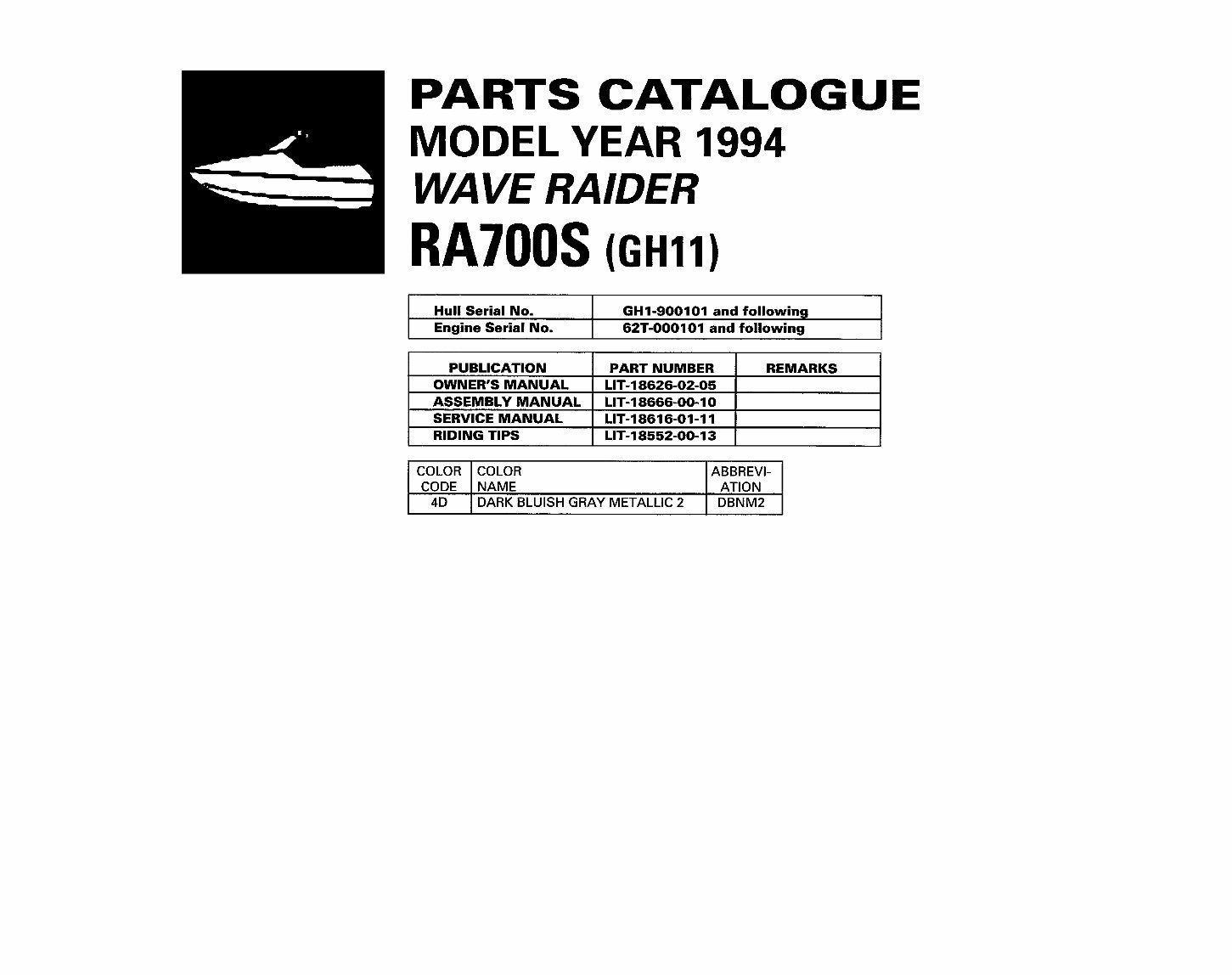
The 1994 Yamaha WaveRaider (RA700) was a revolutionary personal watercraft that marked Yamaha's transition from recreational runabouts to high-performance "V-hull" speedsters. Featuring the legendary 701cc twin-cylinder engine and a lightweight Sheet Molded Compound (SMC) hull, it achieved speeds over 50 mph, setting a new standard for mid-90s maritime agility and power.
The Historical Significance of the WaveRaider Series
To understand the 1994 Yamaha WaveRaider, one must look at the landscape of the personal watercraft (PWC) industry in the early 1990s. At the time, the market was shifting away from the "stand-up" models that dominated the 1980s toward "sit-down" runabouts. Yamaha had seen success with the WaveRunner III and the nimble WaveBlaster, but they lacked a dedicated high-speed, two-person performance craft that could compete with the aggressive hull designs emerging from competitors like Sea-Doo.
The introduction of the WaveRaider in 1994 represented a clean-sheet approach to hull design. While previous Yamaha models often used "square" or flatter hull profiles that prioritized stability and dry rides, the WaveRaider utilized a deep-V hull. This design was specifically engineered to slice through chop and lean into turns, mimicking the physics of a high-performance motorcycle on water. It wasn't just a new boat; it was the flagship of a new philosophy that prioritized top-end speed and aggressive handling over pure utility.
By 2026, the 1994 WaveRaider has reached "vintage" status, yet it remains one of the most sought-after hulls for enthusiasts. This longevity is due to its simplicity, the reliability of its drivetrain, and a power-to-weight ratio that remains competitive for entry-level recreational riding even three decades later.
Technical Specifications: The 701cc Powerplant
The heart of the 1994 WaveRaider is the Yamaha 701cc marine engine. This specific engine is widely considered one of the most reliable and influential two-stroke engines ever produced for the marine environment. In the 1994 RA700 model, Yamaha utilized the "61X" engine case configuration.
Engine Architecture
The 701 is a two-cylinder, two-stroke engine. In its 1994 WaveRaider iteration, it featured a single Mikuni Super BN 44 carburetor. This setup was designed to provide a balance of crisp throttle response and fuel efficiency. The engine produced approximately 73 horsepower at 6,300 RPM. While later versions of the WaveRaider (like the 1995 Deluxe) moved to a dual-carburetor "62T" case design for more power, the 1994 single-carb setup is prized today for its ease of tuning and maintenance.
Cooling and Exhaust
The 1994 WaveRaider used an open-loop water cooling system, drawing water directly from the jet pump to cool the engine cylinders and the exhaust manifold. The exhaust system featured a water-jacketed expansion chamber that was tuned to maximize low-end torque, which was necessary to get the hull "on plane" quickly.
The Jet Pump
To translate that 73 horsepower into thrust, Yamaha equipped the WaveRaider with a 144mm axial flow, single-stage jet pump. The stainless steel impeller was a significant upgrade over the aluminum versions found on cheaper models of the era, offering better resistance to cavitation and erosion from sand or debris.
Hull Design and Material Science
The "Raider" hull was a departure from everything Yamaha had built previously. Measuring approximately 112 inches in length and 42 inches in width, it was compact compared to modern three-seater PWCs, but it was wide enough to offer two-person capacity.
SMC Construction
The hull was constructed using Sheet Molded Compound (SMC). At the time, this was a high-tech alternative to traditional hand-laid fiberglass. SMC is a ready-to-mold glass-fiber reinforced polyester material. This allowed Yamaha to produce hulls that were lighter, stronger, and more uniform in thickness than previous methods allowed. The 1994 WaveRaider had a dry weight of roughly 385–400 pounds, which is exceptionally light by modern standards, contributing to its "flighty" and fast feel on the water.
Deep-V Performance
The WaveRaider featured a deep-V entry that transitioned to a flatter section toward the stern. This allowed the craft to track straight in rough water while still being able to slide the tail in a sharp turn if the rider shifted their weight correctly. However, this hull design was also known for "porpoising"—a rhythmic bouncing of the bow at high speeds. Riders often had to learn how to trim the boat using body position or aftermarket "ride plates" to keep the hull glued to the water surface.
| Feature | 1994 Yamaha WaveRaider (RA700) |
|---|---|
| Engine Type | 2-Cylinder, 2-Stroke, 701cc (61X) |
| Horsepower | 73 HP @ 6,300 RPM |
| Top Speed | 50–53 MPH (Optimal Conditions) |
| Fuel Capacity | 10.6 Gallons (40 Liters) |
| Oil System | Oil Injection (Variable Ratio) |
| Hull Material | SMC (Sheet Molded Compound) |
| Dry Weight | ~388 lbs (176 kg) |
| Rider Capacity | 1 or 2 Persons |
Handling Characteristics: Speed and Agility
The 1994 WaveRaider was marketed as a "performance runabout," and for the time, its handling was aggressive. Unlike the WaveRunner III, which felt like riding a stable bench, the Raider felt like a sportbike.
Cornering Dynamics
When a rider initiates a turn on a WaveRaider, the V-hull allows the craft to lean inward. This reduces the centrifugal force on the rider and allows for much tighter turns than flat-bottomed boats. However, because the hull is relatively narrow and the center of gravity is higher than a stand-up ski, it requires active rider input. Beginners often find the 1994 Raider "tippy" at slow speeds, particularly when trying to re-board from the water.
Stability vs. Speed
While the WaveRaider was fast, it was not the most stable platform for towing or carrying two large adults. It was designed for the solo enthusiast who wanted to go fast and jump wakes. At its top speed of roughly 52 mph, the 1994 Raider feels much faster than a modern PWC doing the same speed because the rider is closer to the water and the hull is highly reactive to every ripple.
Ownership and Maintenance in 2026
As we look at the 1994 WaveRaider from the perspective of 2026, it has become a classic "entry-level" vintage PWC. For someone looking to get into the hobby without spending tens of thousands on a new 4-stroke model, the RA700 is a premier choice.
Mechanical Simplicity
The 701cc engine is famously easy to work on. There are no electronic fuel injection (EFI) systems, no superchargers, and no complex engine management computers. Most repairs can be performed with a basic set of metric sockets and a screwdriver. This makes it a favorite for DIY mechanics.
The Ethanol Challenge
One of the primary concerns for owning a 1994 WaveRaider in the current era is fuel quality. The original rubber fuel lines and carburetor diaphragms were not designed for high-ethanol gasoline. Owners in 2026 must ensure they replace the original "grey" fuel lines (which degrade internally) with modern ethanol-resistant lines. Using ethanol-free fuel or high-quality fuel stabilizers is mandatory to prevent the Mikuni carburetors from gumming up.
Availability of Parts
Because Yamaha used the 701cc engine in various models (including the SuperJet) for decades, engine parts are still widely available. However, hull-specific parts for the 1994 Raider—such as the plastic trim, seats, and decals—are increasingly difficult to find. Most owners rely on the used market or 3D printing for specialized plastic components.
Common Issues and Troubleshooting
Despite its legendary reliability, the 32-year-old 1994 WaveRaider has specific areas that require attention:
- Oil Injection Failure: The original oil injection pumps are generally reliable, but the small plastic lines that carry the oil to the intake can become brittle and snap. If this happens, the engine will run without lubrication and seize. Many owners "delete" the oil pump and switch to "pre-mixing" the oil and gas in the fuel tank at a 50:1 ratio.
- Exhaust Manifold Corrosion: If the craft was used in saltwater and not flushed properly, the aluminum exhaust manifold can develop internal corrosion, eventually leading to water entering the cylinders.
- Crankshaft Seals: In two-stroke engines, the crankshaft seals must be airtight. After 30+ years, these rubber seals can dry out. If they leak, the engine will run "lean," which can cause overheating and piston damage.
- Porpoising: As mentioned, the 1994 hull is prone to bouncing at high speeds. This is often solved by installing an aftermarket extended ride plate or by adding "sponsons" to the sides of the hull to increase lateral stability.
Comparison: 1994 vs. Later WaveRaider Models
In 1995, Yamaha expanded the WaveRaider line, which often leads to confusion for buyers.
- 1994 WaveRaider 700 (RA700): The original. Features the 61X 701cc engine with a single carb. Simple, light, and reliable.
- 1995 WaveRaider 1100 (RA1100): A much larger, triple-cylinder version. It was faster (60+ mph) but significantly heavier and more complex to maintain. It used a different, larger hull.
- 1995-1996 WaveRaider 700 Deluxe: This version upgraded the 701cc engine to the "62T" cases with dual 38mm carburetors, boosting horsepower to roughly 80 HP.
For a purist or a beginner, the 1994 model is often preferred because the single-carb engine is the most "bulletproof" of the entire range. It lacks the complex trim systems found on the 1100, meaning there are fewer mechanical parts to fail over time.
Frequently Asked Questions
What is the top speed of a 1994 Yamaha WaveRaider 700?
In stock configuration and perfect conditions (smooth water, solo rider, light fuel load), a well-maintained 1994 WaveRaider 700 will reach speeds between 50 and 53 mph. Speedometer readings on the dashboard are often optimistic, so GPS verification is recommended for accuracy.
Does the 1994 WaveRaider require premium gasoline?
While the 701cc engine was designed to run on 87-octane fuel, the use of 91-octane (premium) ethanol-free gasoline is highly recommended in 2026. This prevents detonation and protects the aging fuel system components from the corrosive effects of ethanol.
Can the 1994 WaveRaider be used in saltwater?
Yes, the WaveRaider was designed for both fresh and saltwater use. However, because it uses an open-loop cooling system, it must be thoroughly flushed with fresh water after every saltwater outing to prevent salt crystallization and corrosion within the engine block and exhaust.
Is the 1994 Yamaha WaveRaider a good boat for beginners?
The 1994 WaveRaider is an excellent boat for beginners who want to learn about PWC mechanics and enjoy spirited solo riding. However, it is less stable than modern three-seater PWCs. If your primary goal is to carry passengers or tow tubers, a larger, modern four-stroke model would be more appropriate.
How many people can fit on a 1994 WaveRaider?
The 1994 WaveRaider is officially rated for two people. However, with two adults on board, the craft sits very low in the water and becomes significantly more difficult to balance. It is best enjoyed as a solo machine or with one adult and one child.
Practical Recommendations for Buyers and Owners
If you are looking to purchase or restore a 1994 Yamaha WaveRaider in 2026, prioritize the engine's compression. A healthy 701cc engine should show roughly 145–150 PSI in both cylinders. If the compression is uneven or below 120 PSI, a top-end rebuild is likely necessary.
Furthermore, immediately inspect the fuel system. Replace any original translucent lines with high-quality automotive fuel hoses. If the craft still has the original oil injection system, consider the "pre-mix" conversion for peace of mind, especially if the history of the oil pump is unknown.
The 1994 WaveRaider remains a testament to Yamaha’s engineering prowess. It offers a raw, tactile riding experience that modern, heavy, computer-controlled PWCs simply cannot replicate. For those who value mechanical purity and historical significance, the RA700 is a classic that continues to earn its place on the water.