The H-1B visa process spans roughly 10 weeks from initial registration to final adjudication when leveraging the expedited Premium Processing service. This timeframe encompasses the electronic registration lottery, petition preparation, Form I-905 filing with United States Citizenship and Immigration Services (USCIS), and the final petition approval notice, making meticulous planning essential for employers and foreign national professionals.
Navigating the United States nonimmigrant worker system requires an acute understanding of statutory deadlines, administrative procedures, and documentary compliance. For specialized occupation workers and corporate immigration teams, understanding the mechanics of a streamlined 10-week H-1B visa process timeline helps mitigate compliance risks, avoid critical operational bottlenecks, and ensure uninterrupted employment authorization.
Understanding the H-1B Cap and the Registration Foundation
Before initiating any employment-based petition timeline, petitioners must understand the structural framework governing the H-1B specialty occupation visa program. Congress limits the annual issuance of new H-1B visas under the regular cap (65,000 visas) and the advanced degree exemption (20,000 visas for individuals holding a master's degree or higher from a U.S. institution of higher education). Because demand routinely exceeds these statutory numerical limitations, USCIS utilizes an electronic registration system rather than requiring employers to submit full petitions upfront.
The registration phase typically occurs in March of each calendar year. During this mandatory window, prospective employers or their legal counsel must submit basic organizational and beneficiary data through the USCIS online portal, accompanied by a registration fee per beneficiary. Once the registration period closes, USCIS conducts a random computer-generated lottery to select the beneficiaries eligible to file a cap-subject H-1B petition.
Prerequisites for Filing
Success within an expedited or standard window relies heavily on foundational preparations completed well before the official filing season opens. Employers and applicants must verify several statutory and regulatory compliance metrics:
- Specialty Occupation Qualification: The position offered must require theoretical and practical application of a body of highly specialized knowledge, necessitating a minimum of a bachelor’s degree or higher in a specific specialty.
- Beneficiary Credentials: The foreign national must possess the required U.S. degree or an equivalent foreign degree evaluated by a recognized credential evaluation service.
- Labor Condition Application (LCA): Prior to filing any petition with USCIS, the employer must submit an LCA via the United States Department of Labor (DOL) FLAG system, certifying prevailing wage compliance, working conditions, and absence of a strike or lockout.
Phase-by-Phase Breakdown of the 10-Week Timeline
When a beneficiary is selected in the random lottery, USCIS issues a selection notice accompanied by a designated filing window—usually lasting 90 days—during which the employer can submit the formal Form I-129 petition. To achieve a streamlined 10-week lifecycle, stakeholders must synchronize internal document gathering with USCIS premium adjudication cycles.
[Weeks 1-2] LCA Certification & Document Gathering [Weeks 3-4] Form I-129 Compilation & Form Filing (Premium Processing) [Weeks 5-8] USCIS Adjudication, RFE Resolution, or Approval [Weeks 9-10] Visa Stamping, Port of Entry, or Change of Status Finalization
Weeks 1 to 2: LCA Certification and Initial Evidence Gathering
The initial fortnight of the active filing timeline focuses entirely on wage compliance and documentary collection. The employer must submit Form ETA-9035/9035E (LCA) to the DOL. The DOL typically processes and certifies LCAs within seven business days, provided the wage offered meets or exceeds the prevailing wage determined by the Occupational Employment and Wage Statistics (OEWS) survey for the specific metropolitan statistical area (MSA).
Simultaneously, the immigration team collects academic transcripts, educational equivalency evaluations, detailed position descriptions, corporate financial documents (if establishing the petitioner's ability to pay the offered wage), and personal identification records from the foreign national.
Weeks 3 to 4: Form I-129 Compilation and Premium Submission
With an approved LCA in hand, legal counsel compiles the comprehensive Form I-129 Petition for a Nonimmigrant Worker, alongside the H-1B Data Collection and Filing Fee Exemption Supplement, supporting corporate exhibits, and exact filing fees.
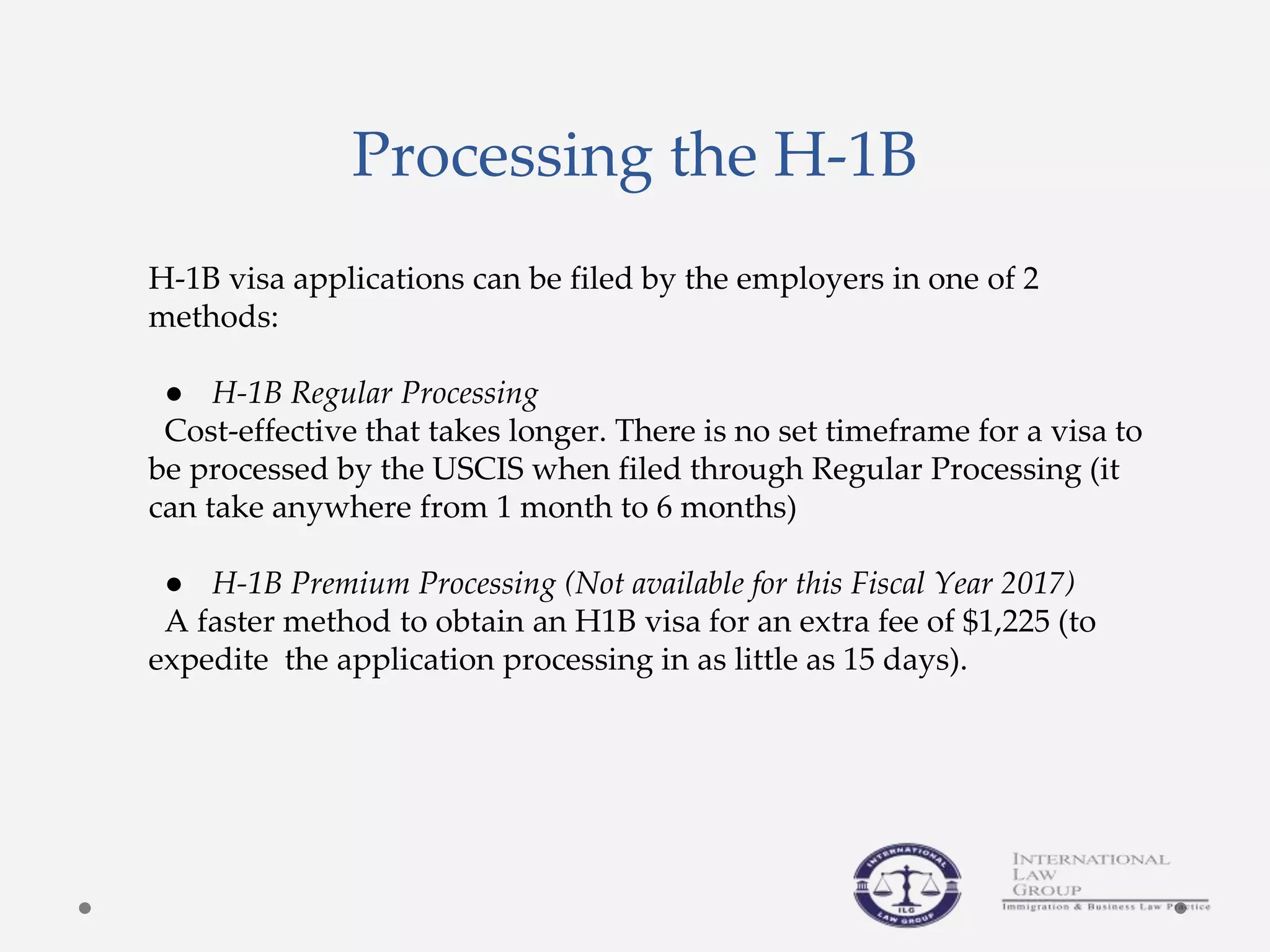
To maintain a strict 10-week horizon, the petitioner concurrently files Form I-907, Request for Premium Processing Service. Opting for premium processing requires an additional statutory fee but legally binds USCIS to adjudicate, issue a Request for Evidence (RFE), or issue a Notice of Intent to Deny (NOID) within a guaranteed calendar timeframe (typically 15 calendar days for standard premium petitions, though certain fee categories or subclassifications may alter processing days).
Weeks 5 to 8: USCIS Adjudication and RFE Navigation
Upon receipt and intake at a USCIS Service Center (such as the California, Vermont, Nebraska, or Texas Service Center), an adjudications officer reviews the petition for legal sufficiency. During this window, three primary outcomes may occur:
- Direct Approval: The officer determines the position qualifies as a specialty occupation and the beneficiary is fully qualified, resulting in an approved Form I-797 Notice of Action.
- Request for Evidence (RFE): If the record lacks sufficient documentation regarding specialty occupation status or employer-employee relationship, USCIS pauses the adjudication clock and issues an RFE. The employer is given a strict deadline (usually 30 to 84 days, depending on current regulatory guidelines) to submit rebuttals and supplemental evidence. Premium processing clocks reset once the RFE response is received by USCIS.
- Notice of Intent to Deny (NOID): A more severe administrative hurdle indicating that the petition contains deficiencies that may warrant formal denial unless successfully rebutted within a prescribed period.
Weeks 9 to 10: Finalization, Change of Status, or Consular Processing
The final phase solidifies the legal status of the foreign national. If the beneficiary is currently inside the United States on another valid nonimmigrant status (such as F-1 Optional Practical Training or H-4) and requested a Change of Status (COS), the approved Form I-797 will include an attached I-94 arrival/departure record indicating the official start of H-1B status.
Conversely, if the beneficiary is located abroad, the approved petition is forwarded to the National Visa Center (NVC) and subsequently to the designated U.S. Embassy or Consulate. The candidate must complete the online Form DS-160, pay the machine-readable visa fee, schedule an in-person consular interview, and obtain the physical H-1B visa counterfoil before entering the United States.
Comparative Matrix of H-1B Processing Pathways
Choosing the correct processing pathway dictates the operational predictability of onboarding international talent. The following table contrasts standard processing against premium processing models.
| Parameter | Standard Processing Timeline | Premium Processing Timeline (10-Week Target) |
|---|---|---|
| Adjudication Duration | 2 to 6 months (variable by service center) | 15 calendar days (accelerated via Form I-907) |
| Filing Fee Burden | Base filing fee, Fraud prevention fee, ACWIA training fee | Base fees + mandatory Form I-907 premium processing fee |
| Predictability | Low; subject to shifting USCIS backlogs | High; legally mandated statutory response window |
| Operational Impact | Potential start-date delays and staffing uncertainty | Rapid onboarding and secure planning horizons |
| RFE Vulnerability | Standard issuance rate based on evidentiary weight | Immediate identification of evidentiary gaps via rapid review |
Financial Considerations and Fee Structures
Executing an H-1B petition involves multiple mandatory government filing fees paid by the employer (per statutory regulations, employers cannot pass certain training and fraud fees to the employee). Understanding these costs prevents administrative delays that can derail the 10-week timeline.
- Base Filing Fee: Form I-129 requires a foundational filing fee, which supports general agency operations.
- ACWIA Training Fee: Employers with 26 or more full-time equivalent employees generally pay a higher training fee, while smaller employers may qualify for a 50% reduction.
- Fraud Prevention and Detection Fee: Mandated for initial cap-subject petitions and first-time change of employer filings.
- Public Law 114-113 Fee: Applicable to petitioners who employ a high percentage of H-1B or L-1 nonimmigrant workers.
- Premium Processing Fee: The optional fee required to secure the 15-calendar-day adjudication guarantee that anchors the 10-week timeline.
Employers should verify current fee schedules directly via the official USCIS Fee Schedule page prior to drafting financial instruments, as fee adjustments occur periodically through regulatory rulemaking.
Common Pitfalls and Troubleshooting Strategies
Even with premium processing, administrative missteps can trigger delays that compromise the 10-week timeline. Identifying these vulnerabilities beforehand ensures robust petition assembly.
Inaccurate Labor Condition Application Wage Levels
A frequent cause of petition rejection or delay is an improperly matched prevailing wage level. If the job duties require independent judgment and advanced technical proficiency, filing under a Level 1 entry-level wage frequently triggers a specialty occupation RFE questioning whether the position truly requires complex specialized knowledge. Employers must align job duties meticulously with the appropriate SOC (Standard Occupational Classification) code and wage level.
Missing Corporate Relationship Documentation
For corporate entities undergoing mergers, acquisitions, or restructuring, establishing the petitioner's legal existence and "ability to pay" the proffered wage is critical. Failure to provide complete corporate tax returns, audited financial statements, or annual reports often results in evidentiary requests that pause the adjudication cycle.
Electronic System Submissions Errors
During the initial registration phase, typographical errors in the beneficiary's passport details, legal name, or date of birth can invalidate a selection notice. Legal and human resources teams must implement rigorous cross-verification protocols before submitting electronic registrations or formal petition packets.
Frequently Asked Questions
Can an H-1B petition be filed without winning the lottery selection?
No. For cap-subject petitions, registration and subsequent selection in the annual lottery conducted by USCIS are absolute prerequisites. Petitions filed without a valid selection notice are rejected outright. Cap-exempt employers—such as institutions of higher education, nonprofit research organizations, or governmental research entities—are exempt from the lottery and can file at any time.
What happens if USCIS issues an RFE during the 10-week timeline?
If USCIS issues a Request for Evidence, the initial adjudication clock pauses. The 15-calendar-day premium processing clock stops on the date the RFE is issued and resumes once USCIS physically receives the complete employer response. Consequently, an RFE will extend the total timeline beyond the standard 10 weeks.
Can a beneficiary begin working as soon as the H-1B petition is filed?
No. Employment authorization does not begin upon filing. For change of status applicants inside the U.S., employment can commence on the approved petition's validity start date (typically October 1 for cap petitions, or upon approval for cap-exempt filings). For consular processing candidates, employment is authorized only after entering the U.S. with a valid H-1B visa stamp and being admitted by Customs and Border Protection.
What is the maximum cumulative duration of an H-1B visa?
The H-1B visa is granted for an initial period of up to three years and may be extended for an additional three years, bringing the maximum standard cumulative stay to six years. Extensions beyond the six-year limit are available under specific provisions of the American Competitiveness in the Twenty-first Century Act (AC21) if the beneficiary has an active PERM labor certification or Form I-140 immigrant petition pending under specific statutory timelines.
Conclusion and Next Actions
Mastering the 10-week H-1B visa process timeline requires rigorous synchronization between Department of Labor wage filings, meticulous documentary compilation, and strategic use of USCIS premium processing services. Employers and international professionals should audit foundational academic credentials, verify prevailing wage compliance, and retain experienced immigration counsel early in the calendar year to ensure seamless execution when filing windows open.