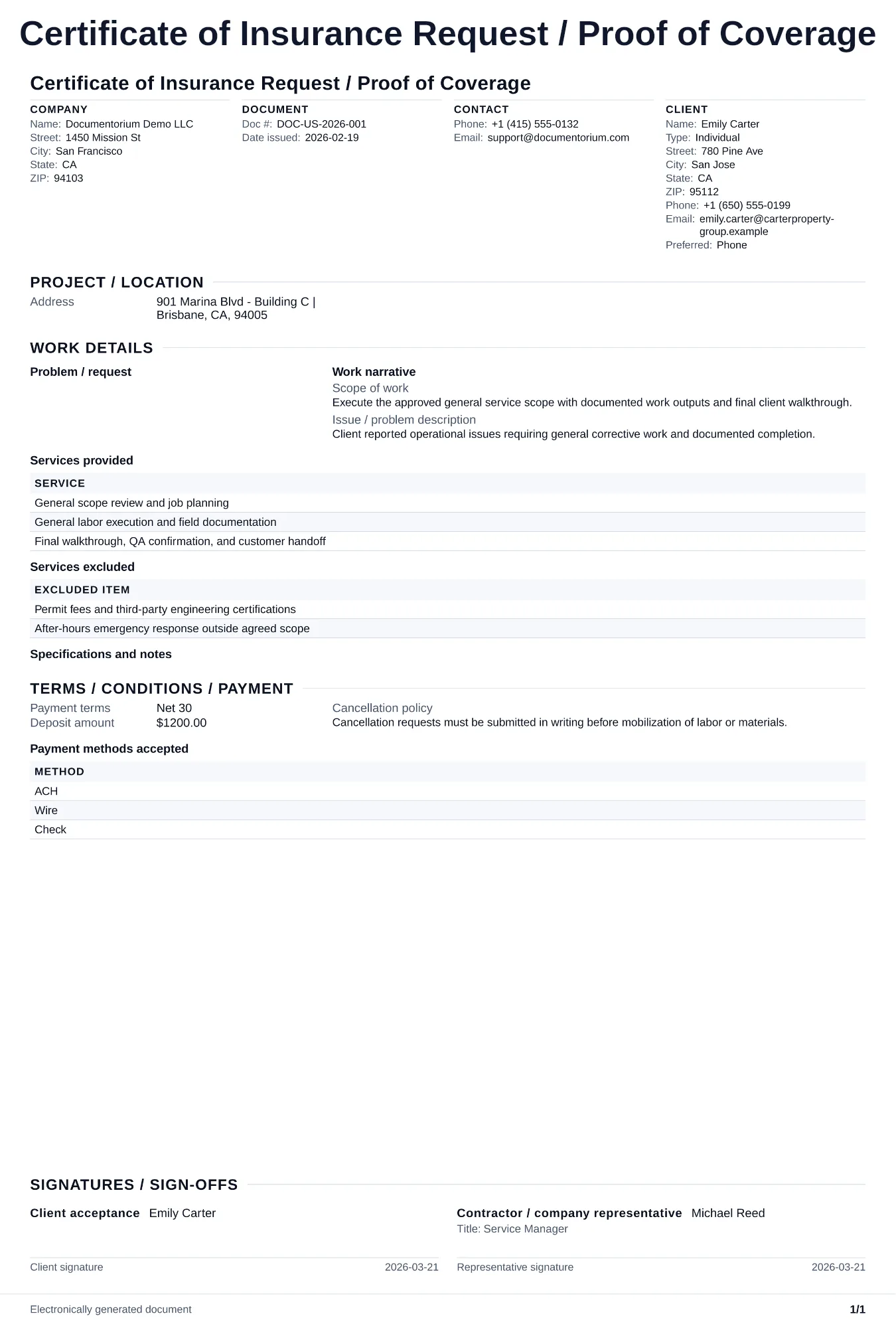
A certificate of insurance (COI) is a standardized summary of an insurance policy’s key details, providing proof of coverage to third parties. Issued by an insurer or broker, it verifies that a policy is active, outlines coverage limits, and identifies the parties protected, facilitating trust and risk mitigation in business transactions.
In the complex landscape of 2026 business operations, the certificate of insurance remains the primary tool for verifying financial responsibility. Whether you are a small business owner, a general contractor, or a commercial landlord, understanding that a certificate of insurance is a written document that matters is essential for protecting your assets and ensuring regulatory compliance. This document serves as the first line of defense against third-party liability, providing a "snapshot" of a policyholder's coverage without requiring the disclosure of the entire, often confidential, insurance contract.
The Fundamental Anatomy of a Certificate of Insurance
To understand why this document is so significant, one must first understand what it contains. In 2026, while many verification processes have become digitized or automated via blockchain-based ledgers, the standard format—primarily the ACORD 25 form—remains the industry benchmark in the United States.
Identifying the Parties Involved
A COI identifies four distinct entities, each with specific rights and responsibilities. The Insurer (or Insurance Company) is the entity providing the financial backing. The Producer is typically the insurance agent or broker who facilitates the policy and issues the certificate. The Insured is the individual or business that purchased the policy. Finally, the Certificate Holder is the party requesting the document to verify that the Insured has the necessary coverage to perform a task or enter a contract.
Policy Types and Limits
The document lists the specific types of insurance in force. This typically includes General Liability, Automobile Liability, Workers' Compensation, and Umbrella or Excess Liability. For each type, the COI specifies the Policy Number, the Effective Date, and the Expiration Date. Crucially, it lists the Limits of Insurance, which represent the maximum amount the insurer will pay for a single occurrence or in the aggregate during the policy period.
The Description of Operations
Perhaps the most scrutinized section of the document is the "Description of Operations" box. This area is used to clarify specific project names, locations, or special requirements requested by the Certificate Holder. It is here that endorsements, such as "Additional Insured" status or "Waiver of Subrogation," are often mentioned, although the mention alone does not always grant those rights without a corresponding policy endorsement.
Why a Certificate of Insurance Matters for Risk Management
The phrase "a certificate of insurance is a written document that matters" is not merely a legalism; it is a practical reality of risk transfer. Without a COI, a business takes on "unfunded liability"—the risk of paying for damages caused by a contractor or partner out of their own pocket or through their own insurance premiums.
Shifting the Burden of Liability
When you hire a subcontractor, you expect them to be responsible for their own mistakes. If a subcontractor causes property damage or an injury on a job site, their insurance should be the primary source of recovery. By requiring a COI, the hiring party ensures that the subcontractor has the financial means (via an insurance carrier) to cover these losses. If the subcontractor is uninsured, the liability often "climbs the ladder" to the general contractor or property owner, leading to increased premiums and potential legal complications for the hiring entity.
Ensuring Contractual Compliance
Most modern commercial contracts include an insurance requirement clause. These clauses specify the types of insurance the performing party must maintain. The COI serves as the objective evidence that the party is in compliance with the contract. In 2026, many automated procurement systems will automatically "flag" or "block" payments to vendors if a valid, current COI is not on file, highlighting the document's role as a gatekeeper for cash flow and project progression.
Professional Credibility and Trust
For the party providing the COI, the document is a badge of professionalism. It demonstrates that the business is legitimate, financially stable enough to maintain premiums, and compliant with state and federal laws—particularly regarding Workers' Compensation. In a competitive market, the ability to produce a clean, comprehensive COI quickly can be the deciding factor in winning a contract.
The Legal Reality: COI vs. The Actual Policy
It is a common misconception that holding a certificate of insurance is the same as being covered by the policy. This is a dangerous assumption. Legally, a COI is an informational document; it is not the insurance policy itself and generally cannot change, expand, or alter the terms of the underlying contract.
The Disclaimer Clause
Almost every standard COI contains a prominent disclaimer stating that the certificate is "issued as a matter of information only and confers no rights upon the certificate holder." This means that if there is a conflict between what is written on the COI and what is written in the actual insurance policy, the policy almost always wins. For example, if a COI incorrectly states that a policy has a $2 million limit, but the actual policy is only for $1 million, the insurer is generally only obligated to pay the $1 million.
The Role of Endorsements
To gain actual rights under someone else's policy—such as being protected if you are sued for their actions—you must be named as an Additional Insured via an endorsement. While a COI might state "Certificate holder is added as additional insured," this statement is often legally insufficient unless the insurance company has actually issued an endorsement to the policy. This is why sophisticated risk managers in 2026 often request copies of the actual endorsements in addition to the COI.
Notice of Cancellation
Another critical limitation involves the "Notice of Cancellation." Most COIs state that the insurer will "endeavor" to notify the certificate holder if the policy is canceled before the expiration date. However, many policies do not actually require the insurer to provide this notice to anyone other than the First Named Insured unless a specific endorsement is purchased. Consequently, a certificate holder might be holding a document for a policy that was canceled for non-payment weeks prior.
Critical Differences in Coverage Requirements
Not all certificates are created equal. Depending on the industry, the "matters" in "a certificate of insurance is a written document that matters" takes on different technical meanings.
| Feature | General Liability COI | Workers' Comp COI | Professional Liability COI |
|---|---|---|---|
| Primary Purpose | Covers bodily injury and property damage to third parties. | Covers medical costs and lost wages for injured employees. | Covers errors, omissions, or negligence in professional services. |
| Common Limits | $1M Per Occurrence / $2M Aggregate. | Statutory Limits / $1M Employers Liability. | Varies widely ($1M to $10M+). |
| Key Endorsement | Additional Insured (Standard). | Waiver of Subrogation (Common). | Typically "Claims-Made" basis. |
| 2026 Significance | Essential for all physical job sites and retail spaces. | Mandatory in most states; prevents "ghost policies." | Critical for tech, medical, and legal consultants. |
How to Verify and Manage Certificates in 2026
As of 2026, the manual filing of paper certificates has largely been replaced by digital ecosystems. However, the requirement for human oversight remains.
- Direct Issuance: Always ensure the COI comes directly from the insurance broker or the carrier’s secure portal. Certificates provided directly by the insured (the contractor) are more susceptible to unauthorized alterations.
- Check the AM Best Rating: The COI lists the "Insurer(s) Affording Coverage." Use these names to check the financial strength of the carriers via AM Best or similar rating agencies. A policy from an insolvent or lowly-rated carrier offers little real protection.
- Verify Dates: Ensure the "Policy Effective" date has passed and the "Policy Expiration" date is in the future. For multi-year projects, set a calendar alert for 30 days prior to expiration to request an updated certificate.
- Confirm Additional Insured Language: Look for specific language that matches your contract requirements. Use the International Risk Management Institute (IRMI) resources to understand specific wording for endorsements like CG 20 10 (ongoing operations) vs. CG 20 37 (completed operations).
- Look for Ghost Policies: In the realm of Workers' Compensation, "ghost policies" are common among sole proprietors to satisfy the letter of the law without providing actual coverage for any employees. Ensure the COI reflects an active payroll-based policy if the contractor has staff.
Common Pitfalls and the Risk of Fraud
Because a certificate of insurance is a written document that matters so much to the start of a project, it is a frequent target for forgery. In the past, this meant using white-out on a photocopy; today, it involves sophisticated PDF editing.
Detecting Forgery
Signs of a fraudulent COI include mismatched fonts, blurry logos, or policy numbers that don't match the carrier's standard format. In 2026, many carriers provide a QR code on the COI that, when scanned, links directly to a live verification page on the insurer's server. If a QR code is missing or leads to a generic website, it is a significant red flag.
The Danger of "Expired" Coverage
A COI is only a snapshot of a single moment in time. A policyholder could provide a valid COI on Monday and cancel the policy on Tuesday for a premium refund. This is why "Continuous Monitoring" services have become the standard for large enterprises. These services link directly to broker databases to provide real-time alerts if a policy lapses, ensuring the document "matters" for the duration of the risk, not just at the time of signing.
Inadequate Limits
A contractor may have insurance, but is it enough? If a crane operator has a $1 million limit but is working on a $50 million high-rise, the COI reveals a massive gap in coverage. Risk managers must compare the limits on the COI against the maximum potential loss of the project, not just the contract value.
Practical Recommendations for Businesses
To effectively use certificates of insurance in 2026, consider the following actions:
- Standardize Your Requirements: Create an "Insurance Requirements" sheet that you attach to every contract. This should specify the minimum limits and necessary endorsements you require.
- Use a Management Platform: If you manage more than ten vendors, use a COI tracking software. These platforms automate the request, verification, and renewal process, reducing the risk of human error.
- Request the Policy for High-Risk Work: For high-stakes contracts, do not rely on the COI alone. Request a redacted copy of the actual policy and all relevant endorsements to ensure the exclusions don't negate the coverage you expect.
- Consult with Your Broker: Your own insurance broker is an underutilized resource. Ask them to review the COIs provided by your major partners to identify potential gaps in your overall risk transfer strategy.
Professional Advice Limitation
This article provides general information regarding insurance practices and document verification. It does not constitute legal or financial advice. Insurance regulations and requirements vary significantly by jurisdiction and industry. Always consult with a licensed insurance professional or legal counsel before making decisions regarding risk management or contractual insurance obligations.
Frequently Asked Questions
Can a certificate of insurance be used to file a claim?
No, a certificate of insurance cannot be used to file a claim directly. To file a claim, you must contact the insurance carrier listed on the COI and provide the specific policy number. The COI merely serves as a reference point to identify which company holds the policy and what the coverage parameters were at the time the document was issued.
Is a COI the same as an insurance binder?
No. An insurance binder is a temporary document issued by an agent that serves as the actual (though short-term) insurance policy until the formal policy is written. A COI, conversely, is an informational summary of an existing, permanent policy. A binder grants coverage; a COI merely reports it.
Why do some people ask to be a "Certificate Holder" instead of "Additional Insured"?
"Certificate Holder" status simply means you are the person receiving the document. It grants no legal protection under the policy. "Additional Insured" status means the policy has been modified to provide you with coverage for certain types of claims. Most businesses should request both: to be the Certificate Holder (so they get the document) and to be an Additional Insured (so they get the protection).
What happens if the COI is incorrect?
If a COI contains an error regarding the coverage limits or dates, the terms of the actual policy will generally prevail in court. This is why it is vital to verify the information with the issuing broker if something looks suspicious. You cannot legally force an insurance company to provide coverage that wasn't in the policy just because a broker made a typo on the COI.
Does a COI guarantee that the premiums have been paid?
Not necessarily. A COI indicates that a policy is "in force" as of the date the certificate was issued. It does not provide a guarantee that future premium installments will be made. If a policy is canceled for non-payment shortly after the COI is issued, the certificate holder may not be notified unless specific endorsements are in place.
Is a digital COI as valid as a paper one?
Yes, in 2026, digital COIs are the industry standard and are legally valid. In many cases, they are more secure than paper documents because they can be verified through encrypted portals or blockchain verification systems that provide a "single source of truth" for the policy status.