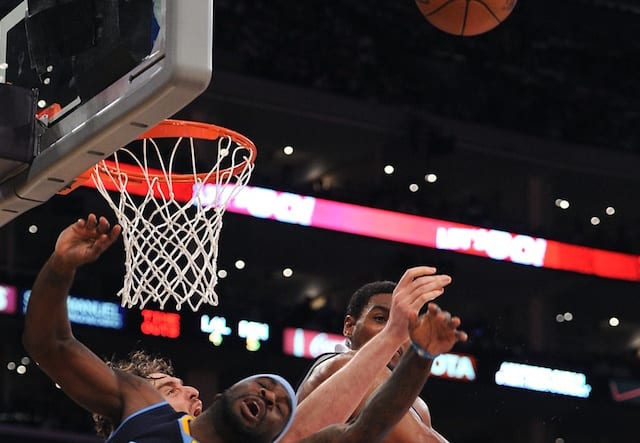
Andrew Bynum won two NBA championships as the starting center for the Los Angeles Lakers in 2009 and 2010. While he was a crucial physical anchor during the franchise’s back-to-back titles, his career remains a subject of intense debate due to chronic injuries, a short-lived prime, and questions regarding his long-term dedication to the sport.
The Ascent of the Youngest Player in NBA History
To understand the weight of Andrew Bynum’s championships, one must first look at the unprecedented nature of his entry into the league. Drafted 10th overall by the Los Angeles Lakers in 2005, Bynum became the youngest player to ever appear in an NBA game at 18 years and 6 days old.
The Lakers’ decision to draft a high schooler directly into a championship-obsessed culture was a massive gamble. However, the organization invested heavily in his development, even hiring Hall of Fame center Kareem Abdul-Jabbar to mentor the young big man. By the 2007-2008 season, Bynum had begun to show flashes of dominance, providing a legitimate post presence that the Lakers had lacked since the departure of Shaquille O’Neal. His development was so rapid that he became a primary reason the Lakers felt confident in navigating the post-Shaq era alongside Kobe Bryant.
The 2009 Championship: Redemption and Resilience
The 2008-2009 season was a turning point for the Lakers organization. After a painful loss to the Boston Celtics in the 2008 Finals—a series Bynum missed entirely due to a knee injury—the pressure was on for the team to secure a title.
Bynum’s role in the 2009 championship was defined more by his presence than his individual statistics. He suffered a torn MCL in his right knee in January 2009, which sidelined him for 32 games. He returned just before the playoffs, but he was clearly not at 100% mobility. Despite the physical limitations, his 7'0" frame and 285-pound build were essential for the Lakers' defensive schemes.
Impact Against the Orlando Magic
In the 2009 NBA Finals, the Lakers faced the Orlando Magic, led by Defensive Player of the Year Dwight Howard. While Pau Gasol took on much of the scoring load, Bynum’s job was to provide a physical deterrent in the paint.
- The Physicality Factor: Bynum’s ability to absorb fouls and occupy space limited Howard’s efficiency.
- The Psychological Edge: Having a second legitimate seven-footer allowed Phil Jackson to deploy "Twin Towers" lineups that Orlando simply could not match.
The Lakers won the series 4-1, earning Bynum his first championship ring. While he averaged only 6.3 points and 3.7 rebounds in the Finals, his return from injury was viewed as a major psychological boost for a team that had lacked interior size the previous year.
The 2010 Championship: Playing Through the Pain
If 2009 was about returning to the court, the 2010 championship was about Bynum’s grit. This championship is often cited by his supporters as proof of his competitive fire, countering the narrative that he did not care about the game.
During the first round of the 2010 playoffs against the Oklahoma City Thunder, Bynum suffered a torn meniscus in his right knee. In a decision that likely altered the trajectory of his long-term health, Bynum chose to delay surgery and play through the injury for the remainder of the postseason.
The Gritty 2010 Finals vs. Boston
The 2010 Finals was a brutal, defensive-minded rematch against the Boston Celtics. Bynum was visibly hobbled, often limping during dead balls and requiring frequent drainage of fluid from his knee. However, his contribution was vital:
- Rim Protection: Bynum’s presence forced the Celtics' guards, particularly Rajon Rondo and Ray Allen, to alter their shots in the paint.
- Game 7 Contribution: In one of the most famous Game 7s in NBA history, Bynum played 18 minutes. While he scored only 2 points, he finished with a +/- of +11. His defensive positioning in the fourth quarter helped the Lakers overcome a 13-point deficit to win 83-79.
Winning his second ring solidified Bynum as a "winner," but the physical toll of that 2010 run would eventually haunt the rest of his career.
Statistical Comparison: Bynum’s Championship Years
The following table outlines Bynum's contributions during the two seasons in which he earned his championship rings. It highlights the discrepancy between his regular-season potential and his playoff availability due to injury.
| Category | 2008-2009 Regular Season | 2009 Playoffs | 2009-2010 Regular Season | 2010 Playoffs |
|---|---|---|---|---|
| Games Played | 50 | 23 | 65 | 23 |
| Points Per Game | 14.3 | 6.3 | 15.0 | 8.6 |
| Rebounds Per Game | 8.0 | 3.7 | 8.3 | 6.9 |
| Blocks Per Game | 1.8 | 0.9 | 1.4 | 1.6 |
| Field Goal % | 56.0% | 45.7% | 57.0% | 53.7% |
| Minutes Per Game | 28.9 | 17.4 | 30.4 | 24.4 |
The Peak: 2011-2012 and the All-Star Nod
The debate surrounding Andrew Bynum often ignores that his "best" individual season actually came after his two championship wins. In the 2011-2012 season, Bynum finally stayed relatively healthy and put up elite numbers.
He averaged 18.7 points, 11.8 rebounds, and 1.9 blocks per game, earning a starting spot in the All-Star game and a selection to the All-NBA Second Team. During this window, many analysts argued that Bynum had surpassed Dwight Howard as the best traditional center in the NBA. He famously recorded a 30-rebound game against the San Antonio Spurs in April 2012, a feat that remains one of the most dominant rebounding performances of the modern era.
The Downfall: Trade, Injuries, and Early Retirement
In August 2012, the Lakers traded Bynum to the Philadelphia 76ers in a massive four-team deal that brought Dwight Howard to Los Angeles. This trade is widely considered one of the most significant "what-if" moments in 21st-century basketball history.
Bynum never played a single game for the Philadelphia 76ers. His knees, already compromised by the 2010 championship run and a series of freak accidents (including a well-documented bowling injury), failed him completely. After brief and unsuccessful stints with the Cleveland Cavaliers and Indiana Pacers, Bynum was effectively out of the league by age 26.
The Ongoing Debate: Analyzing Bynum’s Legacy
As of 2026, the discourse surrounding Andrew Bynum usually falls into two distinct camps. One side views him as a tragic figure whose body betrayed a Hall of Fame talent; the other sees him as a talented but disinterested athlete who lacked the professional discipline to sustain a long career.
The "Injuries Destroyed Greatness" Argument
Proponents of this view point to the 2012 season as evidence. Bynum was a behemoth with a soft touch, excellent footwork (learned from Kareem), and elite shot-blocking timing. Had he played in an era with modern sports medicine—or had he not sacrificed his knees for the 2010 title—he might have been the bridge between the old-school centers and the modern era. They argue that his two rings are a testament to his value, as the Lakers could not have beaten the Magic or Celtics without his size.
The "Lack of Maturity and Passion" Argument
Critics often cite Bynum’s off-court behavior and on-court lapses in judgment. Notable incidents include:
- The Bowling Incident: Missing an entire season in Philadelphia partly due to a bowling injury sustained while already rehabbing his knees.
- The Bizarre Three-Pointer: Taking an ill-advised transition three-pointer against the Warriors, which led to his benching by coach Mike Brown.
- The JJ Barea Foul: A flagrant, dangerous foul on JJ Barea in the 2011 playoffs that saw Bynum ejected and widely condemned for his lack of composure.
This camp suggests that Bynum viewed basketball as a job rather than a passion, which contributed to his rapid exit from the league once the physical toll became too high.
How Bynum Compares to Other Lakers Big Men
The Los Angeles Lakers are known as the "Home of the Centers," boasting a lineage that includes George Mikan, Wilt Chamberlain, Kareem Abdul-Jabbar, Shaquille O’Neal, and Anthony Davis.
Within this context, Bynum occupies a unique middle ground. He is not a Hall of Famer like the names above, but he was more than just a "role player." He was a pillar of a championship era. While he lacks the longevity of Kareem or the sheer dominance of Shaq, his two rings put him ahead of many "better" individual players in the franchise's history who never secured multiple titles as a starter.
Summary of Historical Facts
- Total NBA Rings: 2 (2009, 2010).
- All-Star Appearances: 1 (2012).
- All-NBA Honors: 1 (Second Team, 2012).
- Key Teams: Los Angeles Lakers (2005–2012).
- Retirement Status: Retired from the NBA following the 2013-2014 season.
Frequently Asked Questions
How many rings does Andrew Bynum have?
Andrew Bynum has two NBA championship rings. He won them in consecutive years, 2009 and 2010, while playing for the Los Angeles Lakers alongside Kobe Bryant and Pau Gasol.
Did Andrew Bynum play in the 2010 NBA Finals?
Yes, Andrew Bynum played in all seven games of the 2010 NBA Finals against the Boston Celtics. He played through a torn meniscus, which required him to have his knee drained of fluid multiple times throughout the series.
Why did Andrew Bynum retire so early?
Bynum essentially retired due to chronic knee issues. By 2013, he had undergone multiple surgeries and lacked the cartilage necessary to play at a professional level without significant pain. His final NBA game was in 2014 at the age of 26.
Was Andrew Bynum considered a "bust"?
No, Bynum is generally not considered a draft bust because he was a starting center on two championship teams and earned an All-NBA Second Team selection. However, he is often cited as one of the greatest "what-if" stories due to his career ending during what should have been his physical prime.
What was Andrew Bynum's relationship with Kareem Abdul-Jabbar?
Kareem Abdul-Jabbar was hired by the Lakers specifically to mentor Bynum. While Kareem helped develop Bynum’s offensive post moves, their relationship was reportedly professional but sometimes strained, as Kareem occasionally critiqued Bynum’s focus and work ethic in the media.
What is Andrew Bynum's highest-scoring game?
Andrew Bynum's career-high in points is 42, which he achieved against the Los Angeles Clippers on January 21, 2009. His most famous statistical feat, however, was his 30-rebound game against the San Antonio Spurs in 2012.
Final Perspective
The story of Andrew Bynum’s rings is a story of a window that opened wide and slammed shut with startling speed. In 2026, he remains a symbol of the "Twin Towers" era of basketball—a final gasp of traditional, bruising post play before the league shifted toward "Pace and Space." Whether you view him as a warrior who gave his knees for the Lakers' 15th and 16th titles or a player who never fully realized his potential, his two championship rings remain unassailable facts in the history of the NBA.