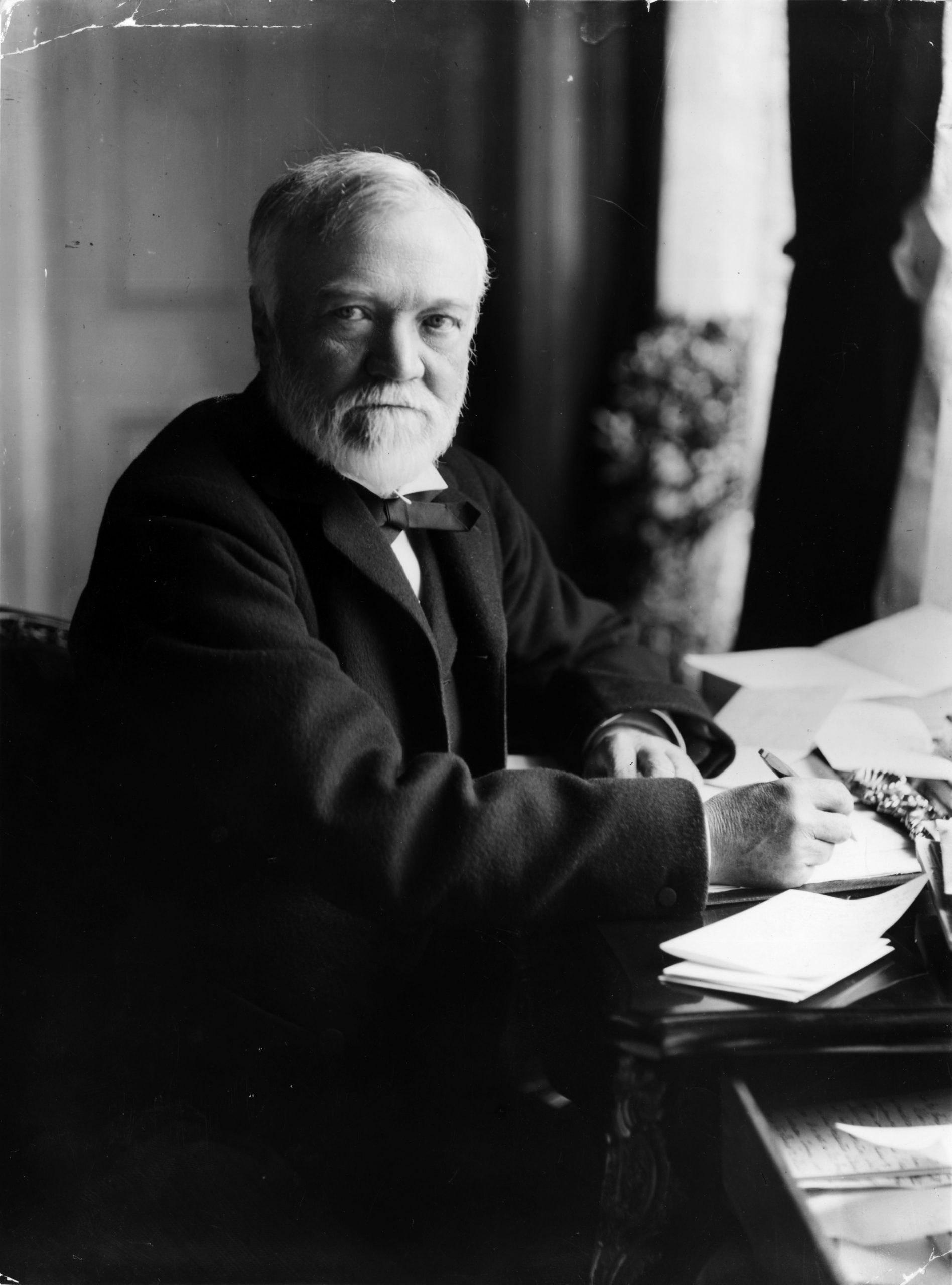
When Andrew Carnegie died in 1919, his remaining net worth was approximately $22 million to $30 million. This final figure was a deliberate result of his "Gospel of Wealth" philosophy, as he had already given away over $350 million—roughly 90% of his peak fortune—to various charitable foundations, libraries, and educational institutions before his passing.
The story of Andrew Carnegie’s wealth is not merely a record of accumulation but a historical study in calculated distribution. To understand the value of his estate at the time of his death, one must distinguish between his peak net worth, the nominal value of his assets in 1919, and the modern-day equivalent of those figures in 2026 dollars. Carnegie’s financial legacy remains a cornerstone of American industrial history and philanthropic theory.
The Peak of Carnegie’s Wealth: The 1901 Sale
The foundation of Carnegie’s massive fortune was Carnegie Steel Company. In 1901, at the age of 65, Carnegie decided to retire and sold his company to a syndicate organized by J.P. Morgan. This transaction led to the creation of U.S. Steel, the world’s first billion-dollar corporation.
Carnegie’s personal share of the sale was $480 million (some sources cite $492 million). Unlike modern acquisitions involving stock swaps or complex equity structures, Carnegie’s payment was primarily in the form of 5% gold bonds. These bonds were held in a specialized vault built in Hoboken, New Jersey, specifically to house his wealth.
At that moment in 1901, Carnegie was widely considered the richest man in the world, briefly surpassing his rival John D. Rockefeller. To put the $480 million figure into perspective, the total United States federal budget in 1901 was approximately $517 million. Carnegie’s personal wealth was nearly equivalent to the annual operating costs of the entire U.S. government.
The Gospel of Wealth: Why He Died with "Only" $30 Million
Carnegie famously wrote in his 1889 essay, The Gospel of Wealth, that "the man who dies thus rich dies disgraced." He believed that the surplus wealth of the few should be used for the benefit of the many. Following the 1901 sale, Carnegie spent the remaining 18 years of his life systematically dismantling his fortune.
Philanthropic Distributions
By the time of his death on August 11, 1919, Carnegie had donated roughly $350 million. His giving was not random; it was structured to promote "improvement" rather than "alms." Major distributions included:
- Carnegie Corporation of New York: Established in 1911 with an initial endowment of $125 million, this was the first great philanthropic foundation intended to promote the advancement of knowledge.
- Public Libraries: He funded the construction of 2,509 libraries across the English-speaking world, spending approximately $56 million.
- Education: He founded the Carnegie Institute of Technology (now Carnegie Mellon University) and the Carnegie Institution for Science, and provided massive grants to the Universities of Scotland.
- The Carnegie Foundation for the Advancement of Teaching: This organization created the first widespread pension system for professors in the United States.
- International Peace: He donated $10 million to establish the Carnegie Endowment for International Peace and funded the construction of the Peace Palace in The Hague.
Because of this aggressive divestment, his personal estate at death was valued at a fraction of his peak. The approximately $22 million to $30 million remaining in his estate was primarily used for bequests to his family, staff, and a few final institutional grants.
Comparative Wealth Table: Carnegie vs. Modern Standards
When discussing Carnegie’s net worth, historians often use two different metrics: the Consumer Price Index (CPI) adjustment and the "Share of GDP" adjustment. The latter is often considered more accurate for comparing the social and economic power of historical figures to modern billionaires.
| Metric | 1901 Value (Peak) | 1919 Value (At Death) | Estimated 2026 Value (CPI) |
|---|---|---|---|
| Nominal Net Worth | $480 Million | ~$30 Million | ~$17 Billion (Peak) / ~$550 Million (Death) |
| Total Philanthropy | N/A | $350 Million | ~$12 Billion - $15 Billion |
| Share of GDP Adjustment | ~2.1% of US GDP | N/A | ~$400 Billion - $500 Billion |
Note: The "Share of GDP" calculation suggests that at his peak, Carnegie’s wealth relative to the size of the U.S. economy would make him significantly wealthier than modern figures like Elon Musk or Jeff Bezos.
The Disposition of the Remaining Estate
While $30 million was a "small" amount for Carnegie, it was still an immense fortune in 1919. According to the terms of his will and the accounting of his executors, the remaining funds were distributed to ensure the comfort of his survivors and the completion of his philanthropic goals.
Bequests to Family and Staff
Carnegie’s wife, Louise Whitfield Carnegie, received their Fifth Avenue mansion (now the Cooper Hewitt, Smithsonian Design Museum) and a substantial trust fund. However, Carnegie had already made extensive provisions for his wife and daughter, Margaret, through separate trusts created years prior.
His will also included significant annuities for long-time employees, friends, and even public figures he admired, such as the widows of former Presidents Theodore Roosevelt and Grover Cleveland. He also left funds for his household staff, ensuring they were pensioned for life.
Final Institutional Grants
The residue of his estate—the money left over after all specific bequests and taxes were paid—was directed to the Carnegie Corporation of New York. This ensured that even the very last of his liquid assets would be used according to his lifetime principles of social improvement.
Historical Context: The 1919 Economy
To understand why $22 million to $30 million was significant in 1919, we must look at the economic environment of the time. The United States was emerging from World War I and facing significant inflation.
In 1919, the average annual salary for a worker in the U.S. was approximately $1,200. A brand-new Ford Model T cost about $500. Carnegie’s remaining $30 million could have purchased 60,000 automobiles or paid the annual salaries of 25,000 workers. While he had successfully avoided "dying disgraced" by his own definition, he remained one of the wealthiest individuals in the country at the moment of his death.
The Role of the Carnegie Corporation
The most significant portion of Carnegie’s wealth did not "die" with him; it was transferred to the Carnegie Corporation of New York. In 2026, this institution remains one of the most influential philanthropic organizations in the world.
By placing the bulk of his bonds into a perpetual trust, Carnegie ensured that his wealth would continue to generate income and fund social projects for centuries. This move was a technical masterpiece in asset protection and legacy building. It allowed the principal to remain intact while the interest was distributed annually—a model that almost every major modern foundation follows today.
Challenges in Calculating Historical Net Worth
Determining the exact dollar amount of Carnegie's estate at death involves navigating historical probate records which can be interpreted in several ways. Some records focus on "liquid assets" (cash and bonds), while others include the valuation of real estate holdings like Skibo Castle in Scotland and his Manhattan townhouse.
- Valuation of Real Estate: Carnegie owned significant property that wasn't necessarily "liquid." Skibo Castle, for instance, required immense upkeep and was a liability as much as an asset.
- Tax Implications: The federal estate tax had been introduced in 1916. Carnegie’s estate was among the first massive American fortunes to be subject to these modern tax structures, which affected the final "net" figure reported to the public.
- Prior Transfers: Because Carnegie had moved so much money into trusts and foundations between 1911 and 1919, that money was technically no longer his "net worth," even though he controlled its direction until his death.
FAQ: Andrew Carnegie’s Wealth
Was Andrew Carnegie richer than John D. Rockefeller?
At certain points, yes. After the sale of Carnegie Steel in 1901, Carnegie’s liquid wealth (cash and bonds) surpassed Rockefeller’s. However, Rockefeller’s wealth in Standard Oil continued to grow through the early 20th century, and most historians agree that Rockefeller eventually became the wealthier of the two in total lifetime accumulation.
How much would Andrew Carnegie’s wealth be in 2026?
If you adjust his peak fortune of $480 million for inflation using the CPI, it is roughly $17 billion to $20 billion. However, if you measure it as a share of the Gross Domestic Product (GDP), it would be equivalent to over $400 billion, potentially making him the wealthiest person in modern history.
Did Carnegie’s children inherit his billions?
No. Carnegie was a staunch opponent of inherited wealth, believing it "spoiled" the recipient. He provided a trust for his daughter, Margaret, that ensured she lived very comfortably, but he did not leave her the bulk of his fortune. The vast majority went to the public through his foundations.
What happened to Carnegie Steel?
Carnegie Steel was merged with several other companies to form U.S. Steel. The buyout was orchestrated by J.P. Morgan. U.S. Steel became the first corporation in history to have a market capitalization exceeding $1 billion.
How many libraries did Andrew Carnegie fund?
Carnegie funded 2,509 libraries between 1883 and 1929. Of these, 1,689 were built in the United States. He provided the funds for the buildings, provided the local community agreed to provide the land and an annual operating budget equal to 10% of the construction cost.
Summary of Financial Legacy
Andrew Carnegie’s net worth at the time of his death was a deliberate $22–$30 million, a figure that serves as a testament to his commitment to philanthropy. By divesting nearly $350 million during his lifetime, he transformed the role of the American businessman from a mere "Captain of Industry" to a "Patron of Progress."
For those researching historical wealth or the history of American industry, the most important takeaway is the distinction between accumulation and distribution. Carnegie was a master of both. He built the most efficient industrial machine of the 19th century and then applied that same efficiency to the systematic distribution of his assets for the public good.
Next Action for Researchers: If you are investigating the specific legal breakdown of his bequests, the original probate records are held in the New York County Surrogate's Court. Additionally, the Carnegie Corporation of New York maintains extensive archives on the transition of his personal wealth into foundational endowments.