AIG (now primarily operating its life insurance division as Corebridge Financial) offers guaranteed issue life insurance designed for seniors who cannot qualify for traditional policies due to health issues. These policies provide up to $25,000 in coverage with no medical exams or health questions, featuring a two-year graded death benefit and fixed premiums that never increase.
Guaranteed issue life insurance is a specific subset of permanent life insurance intended to cover "final expenses," such as funeral costs, medical bills, or small outstanding debts. Because the insurer assumes a high level of risk by not asking medical questions, these policies have specific mechanics—most notably the graded death benefit—that applicants must understand before purchasing. In the current 2026 insurance market, AIG’s product remains a benchmark for those aged 50 to 80 who require immediate acceptance regardless of their medical history.
The Evolution of AIG to Corebridge Financial
To understand AIG guaranteed issue life insurance in 2026, it is essential to clarify the brand's identity. In 2022, AIG rebranded its Life and Retirement division as Corebridge Financial. While many consumers and agents still refer to the product as "AIG Guaranteed Issue," the policies are legally issued and serviced by American General Life Insurance Company, a subsidiary of Corebridge Financial.
This transition did not change the fundamental nature of the product. The guarantees, policy language, and financial backing remain tied to the same institutional strength that established AIG as a leader in the senior market. When you apply for an AIG guaranteed issue policy today, you are engaging with a multi-billion dollar entity optimized for long-term claims-paying ability.
Core Features of AIG Guaranteed Issue Life Insurance
AIG’s approach to guaranteed issue coverage is defined by its simplicity and the removal of barriers to entry. Unlike "simplified issue" policies, which still ask a few health questions, "guaranteed issue" means exactly what it says: if you meet the age and residency requirements, you cannot be turned down.
1. No Medical Exams or Health Inquiries
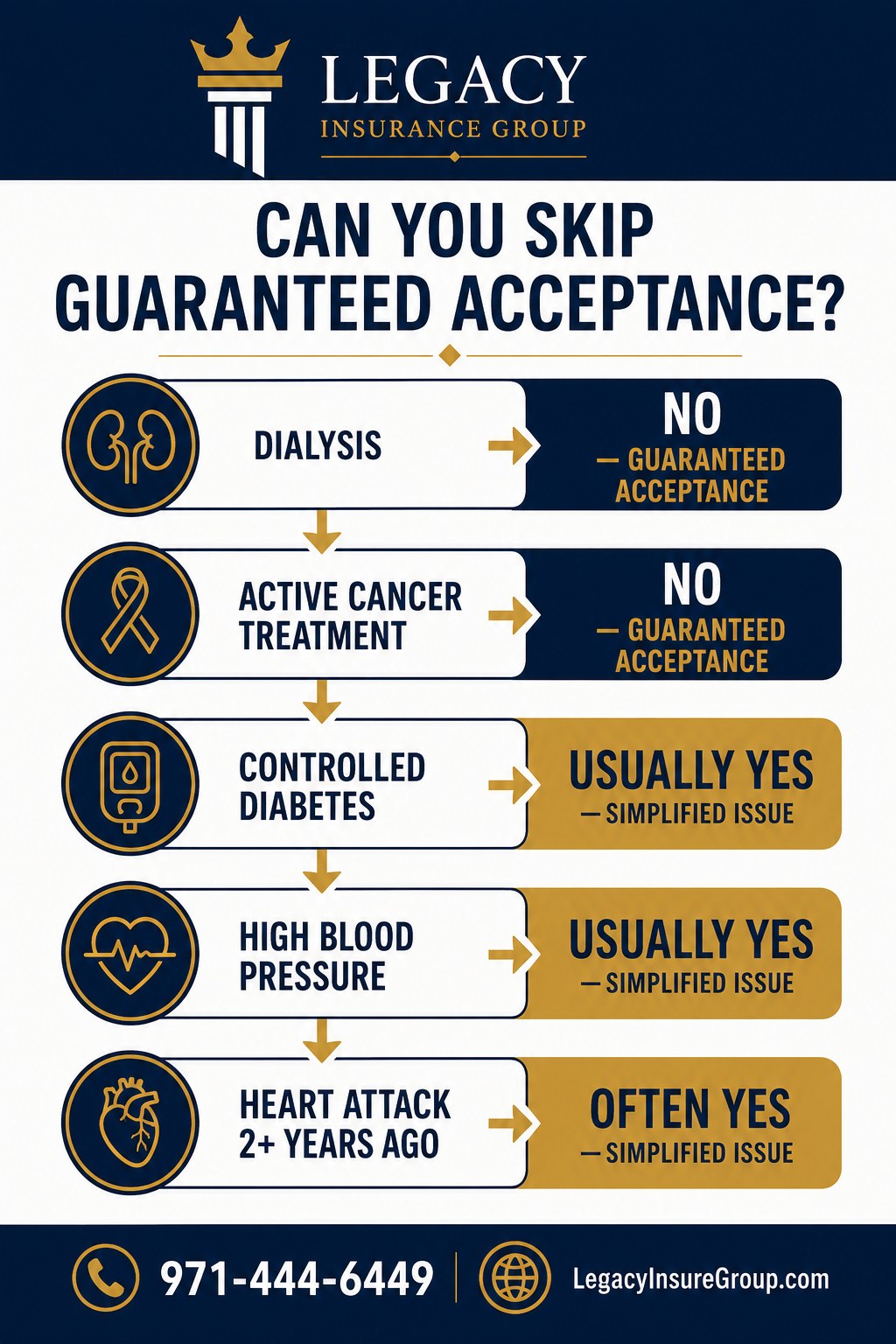
The most significant feature is the total absence of underwriting. There are no blood tests, urine samples, or physical examinations. Furthermore, there are no questions about your prescription history, past surgeries, or chronic conditions. This makes it a "last resort" solution for individuals with conditions that would trigger an automatic decline elsewhere, such as active cancer treatment, congestive heart failure, or dialysis.
2. Fixed Premiums for Life
Once the policy is issued, the monthly premium is locked in. As long as you continue to pay the premiums, the cost will never increase, regardless of how your health changes or how much time passes. In 2026, where inflationary pressures affect many service sectors, the stability of a fixed-premium whole life policy provides a predictable financial anchor for seniors on a fixed income.
3. Permanent Cash Value Accumulation
Because this is a form of whole life insurance, the policy builds a modest amount of cash value over time. While this is not an investment vehicle and the cash value grows slowly, it does provide a source of "surrender value" if the policy is cancelled, or the option to take a policy loan in an emergency.
The Two-Year Graded Death Benefit Mechanism
The "graded death benefit" is the most critical concept to understand when evaluating AIG's product. Because the company does not screen for health, they must protect themselves against "adverse selection"—the risk that someone buys a policy knowing they are near death.
- Years 1 and 2: If the insured dies of natural causes (illness, old age, etc.) within the first 24 months of the policy, the beneficiary does not receive the full face value. Instead, they receive a refund of all premiums paid to date, plus an additional 10% interest.
- Accidental Death: If the insured dies due to an accident (e.g., a car crash or a fall) at any time, even within the first two years, the full death benefit is paid out immediately.
- Year 3 and Beyond: Once the policy has been active for two full years, the "grading" period ends. From day 731 onward, the full face value is paid for death by any cause.
This structure is standard across the guaranteed issue industry, but AIG's 10% interest return is considered competitive compared to smaller carriers that may only offer 5% or simply return the premiums.
Included Living Benefits: Chronic and Terminal Illness Riders
One factor that distinguishes AIG from many competitors is the inclusion of "living benefits" at no additional premium cost. These riders allow the policyholder to access a portion of the death benefit while they are still alive if they meet specific health criteria.
Chronic Illness Rider
If a physician certifies that the insured can no longer perform at least two of the six "Activities of Daily Living" (ADLs)—such as bathing, dressing, or eating—or if they have severe cognitive impairment, the policyholder can request an accelerated payment. AIG typically returns the premiums paid for the policy in this scenario, providing liquidity for long-term care or home modifications.
Terminal Illness Rider
If the insured is diagnosed with a terminal illness and given a life expectancy of 24 months or less (this may vary by state), the policy allows for the acceleration of up to 50% of the death benefit. This can be used to settle medical bills or arrange for end-of-life care, with the remaining balance paid to beneficiaries upon the insured's passing.
Comparison of AIG Guaranteed Issue vs. Market Alternatives
When shopping for final expense insurance in 2026, it is helpful to see how AIG stacks up against other major players in the guaranteed issue space.
| Feature | AIG (Corebridge) | Mutual of Omaha | Gerber Life |
|---|---|---|---|
| Issue Age | 50 – 80 | 45 – 85 | 50 – 80 |
| Coverage Limits | $5,000 – $25,000 | $2,000 – $25,000 | $5,000 – $25,000 |
| Graded Period | 2 Years (110% Return) | 2 Years (110% Return) | 2 Years (110% Return) |
| Living Benefits | Included (Chronic/Terminal) | Generally None | None |
| Application Type | Digital / Paper | Digital / Phone | Digital / Paper |
| State Availability | Available in 49+ States | High Availability | High Availability |
AIG is often the preferred choice when the applicant wants the added security of living benefits. However, for those under age 50 or over age 80, Mutual of Omaha may be a necessary alternative due to their broader issue age range.
Eligibility and Application Requirements
Applying for AIG guaranteed issue life insurance is one of the most streamlined processes in the industry. Because there is no underwriting, the "approval" is essentially an administrative check of your identity and age.
- Age Verification: You must be between the ages of 50 and 80. Your age is calculated based on your last birthday.
- State Residency: You must reside in a state where the product is approved. AIG is licensed in almost every U.S. state, though specific rider language (like the Chronic Illness rider) may vary in places like New York or California.
- Ownership: You can purchase a policy for yourself, or an adult child can purchase a policy for a parent, provided the parent signs the application and consents to the coverage.
- Payment Method: AIG generally requires a bank draft (ACH) for monthly premium payments. Credit card payments may be restricted to the initial premium or may not be available in all jurisdictions.
Common Mistakes to Avoid
While the product is straightforward, several common errors can lead to dissatisfaction or issues during the claims process.
Buying Without Checking for "Simplified Issue"
The biggest mistake is buying a guaranteed issue policy if you are relatively healthy. Guaranteed issue is the most expensive type of life insurance per dollar of coverage because the insurance company is "flying blind" regarding your health. If you can answer "no" to basic health questions (e.g., "Do you have HIV?" or "Are you currently in a nursing home?"), you may qualify for a simplified issue policy. Simplified issue policies often provide immediate full coverage (no 2-year wait) and lower premiums.
Misunderstanding the Two-Year Wait
Many beneficiaries are surprised when a claim is denied for the full amount because the insured died 18 months into the policy. It is vital to communicate the "graded" nature of the policy to your family so they understand the 110% premium return rule during the first two years.
Letting the Policy Lapse
Because these policies are small ($10k–$25k), people sometimes stop paying the premiums during financial hardship. While the policy builds cash value, it is rarely enough to keep the policy in force for long. If the policy lapses, you lose the "time" you put into the two-year waiting period. If you buy a new policy later, the two-year clock starts all over again.
FAQs About AIG Guaranteed Issue Life Insurance
Does the policy expire at age 85 or 90?
No. This is a whole life insurance policy, meaning it is designed to stay in effect for your entire life. As long as you pay the premiums, the coverage will remain active until you pass away, regardless of your age.
Can I increase my coverage amount later?
AIG generally limits each individual to a maximum of $25,000 in total guaranteed issue coverage. If you initially buy $10,000 and later want more, you can apply for an additional $15,000, provided you are still within the issue age (up to 80). You cannot, however, exceed the $25,000 cap across their guaranteed issue portfolio.
What happens if I move to a different state?
Your coverage moves with you. Since the policy is a legal contract established at the time of purchase, moving to a different state does not change your premiums or your death benefit. You simply need to update your address with Corebridge Financial's customer service department.
Are there any "hidden" exclusions?
Beyond the two-year graded period for natural death, there is a standard suicide exclusion (typically two years) found in almost all life insurance policies. Outside of these, there are no exclusions for specific diseases or high-risk hobbies, which is why this product is favored by those with complex medical histories.
How fast are the claims paid?
Once the two-year graded period has passed, AIG is known for relatively efficient claims processing. Beneficiaries typically receive funds within 7 to 14 business days after the company receives the death certificate and the completed claim forms.
Is the death benefit taxable?
Under current 2026 federal tax law, life insurance death benefits are generally paid to beneficiaries income tax-free. However, if the death benefit is paid to the "estate" rather than a named individual, it could be subject to estate taxes if the total estate exceeds federal or state thresholds.
Expert Recommendation: How to Proceed
If you are a senior aged 50–80 with significant health challenges—such as a history of heart disease, stroke, or diabetes—AIG’s guaranteed issue policy is a top-tier choice. The inclusion of living benefits for chronic and terminal illness provides a layer of "useable" value that most other final expense companies do not offer.
Next Steps:
- Inventory Your Health: Confirm that you actually need "guaranteed issue." If you haven't been hospitalized in the last two years and don't have a terminal diagnosis, check if you qualify for a "simplified issue" policy first.
- Determine Your "Need" Amount: Calculate the cost of a modern funeral (which in 2026 often averages $10,000 to $15,000) and add a buffer for final medical bills.
- Verify the Brand: When looking at quotes, don't be confused if you see the name Corebridge Financial. This is the correct and current entity for AIG's life insurance products.
- Set Up Automatic Payments: To ensure the two-year waiting period is never interrupted, use an automated bank draft to prevent accidental policy lapses.