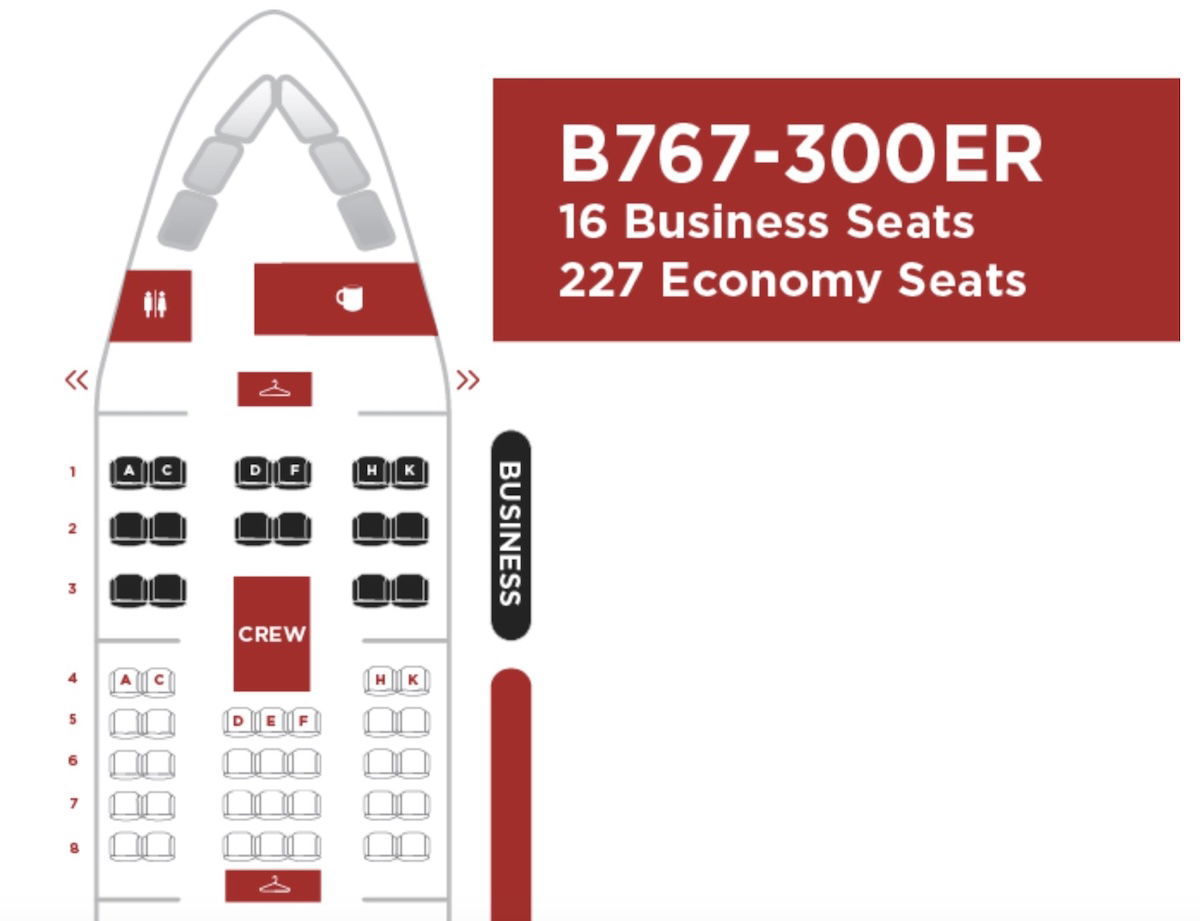
The Boeing 767-200 seat map typically features a signature 2-3-2 "seven-abreast" configuration in the economy cabin, which remains a favorite among passengers for providing an aisle or window to approximately 86% of the travelers. In a standard two-class layout, the aircraft accommodates roughly 180 to 225 passengers, depending on the specific airline's pitch and galley requirements.
As of 2026, the Boeing 767-200 remains a legendary figure in aviation history. While many of these airframes have been transitioned to freighter roles or retired, several remain in service for specialized charter operations, military transport, and niche international carriers. Understanding the seat map of this specific wide-body aircraft requires an analysis of its unique fuselage width, which distinguishes it from both narrow-body aircraft like the 737 and larger wide-bodies like the 777.
The Architectural Foundation of the 767-200 Cabin
The Boeing 767-200 was the first of the 767 family, designed to bridge the gap between single-aisle aircraft and the massive "jumbo" jets. Its cabin width—approximately 15 feet 6 inches (4.72 meters)—dictates the possibilities for seat mapping. Unlike the Airbus A330 or the Boeing 777, the 767's dimensions are optimized for a seven-abreast layout in economy.
This specific width is crucial for passenger comfort. In a 2-3-2 arrangement, there is only one "middle seat" in each row (the center seat of the triple block). For travelers, this means a significantly higher probability of avoiding the cramped experience of being sandwiched between two other people. When analyzing a 767-200 seat map, the primary benefit is this architectural spaciousness.
Economy Class Configuration (The 2-3-2 Layout)
In the economy section of a 767-200, the layout is almost universally 2-3-2. The "A" and "B" seats are on the left side (window and aisle), "C", "D", and "E" are in the center block, and "F" and "G" are on the right side.
- Seat Pitch: Usually ranges from 30 to 32 inches.
- Seat Width: Typically 17.5 to 18 inches.
- Aisles: Two distinct aisles allow for faster boarding and deplaning compared to single-aisle aircraft of similar capacity.
Business and First Class Variations
Because the 767-200 is often used for long-haul or high-end charter flights in 2026, the premium cabin configurations vary wildly.
- 2-2-2 Layout: This is the most common premium layout for older or regional configurations. It offers wider seats (20-21 inches) but lacks direct aisle access for window passengers.
- 1-2-1 Layout: In modernized retrofits, some operators have installed staggered or herringbone suites. This significantly reduces the total seat count but provides "all-aisle access," which is the gold standard for business class in the current era.
- 2-1-2 Layout: A rare but comfortable configuration found in some boutique or executive 767s, providing a "throne" seat in the center.
Critical Rows and Seat Map Landmarks
When looking at a 767-200 seat map, certain rows act as "landmarks" for navigation and comfort. Identifying these early in the booking or boarding process is essential for a better travel experience.
Bulkhead Rows
These are the seats located directly behind the physical walls (bulkheads) that separate different cabins (e.g., separating Business from Economy).
- Pros: No one can recline their seat into your space. There is often extra knee room.
- Cons: You cannot store personal items under the seat in front of you during takeoff and landing. The tray tables are usually stored in the armrest, making the armrests immovable and slightly reducing the seat width.
- Ideal for: Taller passengers and those traveling with infants (as these rows often house bassinet attachments).
Emergency Exit Rows
On a 767-200, emergency exits are typically located over the wings. These rows are highly sought after for their significant legroom.
- Requirements: Passengers must be able-bodied and willing to assist the crew in an emergency.
- The "Cold" Factor: Exit doors often leak a small amount of cold air during high-altitude flight, so passengers in these rows may want to keep a blanket handy.
- Proximity to Engines: Exit rows on the 767-200 are near the wing's leading edge, meaning they can be noisier due to engine roar.
The Rear Section and Galleys
The rear of the 767-200 typically houses the main economy lavatories and the aft galley.
- Row Tapering: As the fuselage narrows toward the tail, the last few rows might transition from a 2-3-2 to a 2-2-2 or even a 2-2 layout. While these seats might seem cramped, they sometimes offer more side-wall storage.
- Noise and Traffic: Seats near the rear galleys and lavatories experience constant foot traffic and noise from flush mechanisms and crew preparations.
Technical Specifications Comparison
To understand how the 767-200 fits into a fleet, it is helpful to compare its seating and physical metrics with its sister aircraft.
| Feature | Boeing 767-200 | Boeing 767-300ER | Boeing 757-200 (Comparison) |
|---|---|---|---|
| Typical Seating (2-class) | 181 - 214 | 218 - 269 | 160 - 200 |
| Cabin Width | 15 ft 6 in | 15 ft 6 in | 11 ft 7 in |
| Exit Row Count | 2 - 4 | 4 - 6 | 2 - 4 |
| Standard Layout | 2-3-2 | 2-3-2 | 3-3 |
| Max Range (Full Load) | ~3,900 - 6,600 nmi | ~5,900 nmi | ~3,900 nmi |
Note: The 767-200ER (Extended Range) version shares the same seat map as the standard -200 but carries more fuel, allowing for longer transoceanic flights.
Best and Worst Seats on the 767-200
Selecting a seat on a 767-200 depends on your priorities: sleep, work, or quick deplaning.
The Best Seats
- Windows in the 2-block (Seats A or G): Because of the 2-3-2 layout, if you are traveling as a couple, the side blocks (A/B or F/G) offer incredible privacy. You only have to climb over one person (or have one person climb over you) to reach the aisle.
- Over-wing Exit Rows: These provide the maximum legroom in the economy cabin. For long-haul flights, the ability to fully stretch your legs is worth the potential lack of floor storage.
- Forward Economy Rows: Being closer to the front allows for a quieter flight (ahead of the engine noise) and ensures you are among the first to receive meal service and deplane.
The Worst Seats
- Center Seat "D": This is the "true" middle seat of the aircraft. Being in the center of a triple block means you have neighbors on both sides, negating one of the primary benefits of the 767's wide-body design.
- Last Row of Economy: These seats often have limited or no recline due to the wall behind them. They are also the closest to the smells and sounds of the aft lavatories.
- Seats with Misaligned Windows: On some 767-200 seat maps, certain rows (often near the wing roots or bulkhead transitions) are missing windows or have windows that are poorly aligned with the seat, requiring you to lean forward or backward to see outside.
Operational Context in 2026
In 2026, finding a passenger 767-200 is becoming increasingly rare. Most of the fleet has been converted to the 767-200BDSF (Bedek Special Freighter) or other cargo variants. However, for those who find themselves on a charter flight (often used by sports teams or government agencies), the seat map is usually configured for maximum comfort rather than maximum density.
Specialized operators like Omni Air International or Atlas Air may still utilize these aircraft for troop movements or high-capacity charters. In these cases, the seat map is often a "high-density" economy layout, pushing the capacity closer to the 250-passenger limit allowed by FAA safety regulations.
The KC-46 Pegasus Connection
It is worth noting that the United States Air Force's KC-46 Pegasus tanker is based on the 767-2C, which is a hybrid of the 767-200 and 767-300. While its primary mission is refueling, its "seat map" can be reconfigured with palletized seating for personnel transport, showcasing the versatile interior space of the -200 airframe.
Seat Map Verification and Tools
Before flying on a 767-200, it is vital to verify the specific layout used by the carrier. Airlines frequently change interior configurations during "C-checks" or mid-life retrofits.
- Official Airline Website: Always the most accurate source. Look for "Our Fleet" or "Aircraft Information" sections.
- Seat Map Aggregators: Use platforms that allow you to enter your flight number. They provide user-submitted comments on specific seat defects (e.g., "this seat has a box for the entertainment system taking up foot space").
- Check-in Counter Inquiry: If you have not been assigned a seat, ask the gate agent specifically for the "over-wing exit" or "forward bulkhead."
Frequently Asked Questions
Is the Boeing 767-200 still safe to fly in 2026?
Yes. Age in aviation is measured in flight cycles and hours rather than years. As long as an aircraft is maintained according to FAA or EASA standards, it remains airworthy. Many 767-200s have undergone extensive life-extension programs, including structural reinforcements and avionics upgrades.
Does the 767-200 have power outlets at every seat?
In 2026, most passenger-carrying 767-200s have been retrofitted with at least USB charging ports, even in economy. However, because this is an older airframe, universal AC power outlets are typically reserved for Business or First Class. It is always recommended to carry a portable power bank.
How does the 767-200 seat map compare to the 767-300?
The cabin width and the 2-3-2 layout are identical. The primary difference is the length of the aircraft. The 767-300 is approximately 21 feet longer than the -200, which translates to roughly 6 to 10 more rows of seating. If you are familiar with the -300, the -200 will feel exactly the same, just shorter.
Are there "middle seats" on a 767-200?
Yes, but only in the center section of the 2-3-2 layout. Seat "D" is the middle seat. The advantage of the 767 is that there is only one middle seat per row, whereas a 777 or A350 might have three or four middle seats per row in a 3-3-3 or 3-4-3 configuration.
Why is the 767-200 seat map popular for long-haul charters?
The aircraft's size is "just right" for groups of 150-200 people. It offers the stability and range of a wide-body jet without the massive overhead costs of operating a 747 or A380. The 2-3-2 layout also ensures that groups can be seated together easily.
Expert Recommendation for Travelers
If you are booking a flight on a Boeing 767-200 in 2026, prioritize seats in the 2-seat side blocks (A/B or F/G). These rows offer the best balance of privacy and ease of movement. If you are traveling solo and cannot secure an exit row, aim for an aisle seat in the center section (C or E); this ensures you only have one neighbor and direct access to the aisle. Always check the seat map 24 hours before departure, as equipment swaps or blocked rows for weight and balance may open up better seating options at the last minute.