When evaluating cloud contact center software, examining authentic user feedback reveals the platform's practical strengths and operational limitations. Reviews of Five9 consistently highlight five critical themes: omnichannel routing performance, user interface complexity, reporting capabilities, system reliability, and overall deployment costs. These insights help prospective buyers determine whether the enterprise-grade solution aligns with their operational scale, technical infrastructure, and agent workflows.
Understanding Five9: Identity, Scope, and Enterprise Positioning
Five9 is a prominent provider of cloud contact center software (CCaaS), delivering an artificial intelligence and customer engagement platform designed to handle high volumes of inbound and outbound customer interactions. Organizations across retail, financial services, healthcare, and telecommunications utilize its suite to manage voice calls, emails, live chats, SMS, and social media channels through a unified web-based interface.
Evaluating a software platform of this scale requires looking past marketing claims to examine real-world user feedback. Enterprise software reviews aggregate the daily experiences of contact center supervisors, IT administrators, frontline agents, and executive decision-makers. By analyzing these evaluations, prospective buyers can identify recurring patterns in system performance, customer support responsiveness, and administrative overhead.
Key Point 1: Omnichannel Routing and AI Automation Performance
One of the most frequently discussed elements in Five9 reviews is its omnichannel routing engine and integrated artificial intelligence (AI) toolkit. Users consistently evaluate how effectively the platform directs customer interactions to the most qualified agent based on skills, priority, and historical data.
Intelligent Interaction Distribution
For organizations managing high-volume inbound queues, Five9's skills-based routing receives praise for reducing average handle times and minimizing customer wait periods. Reviewers note that the system handles voice and digital channels smoothly, ensuring that agents do not become overwhelmed by disparate communication streams.
AI and Automation Impact
The platform's virtual assistants and workflow automation tools—often grouped under Five9 Intelligent Virtual Agent (IVA)—elicit mixed yet generally positive feedback. Advanced users appreciate the natural language processing capabilities that deflect routine inquiries, allowing human agents to focus on complex, high-value problem-solving. However, setup and fine-tuning require dedicated technical expertise. Organizations without internal AI specialists frequently report a steeper learning curve when configuring custom intents and conversational flows.
Key Point 2: User Interface, Agent Experience, and Navigation
The frontline agent experience (Agent Desktop Plus) directly influences operational efficiency, training costs, and employee retention within contact centers. Five9 user reviews offer detailed perspectives on day-to-day usability.
Interface Modernization
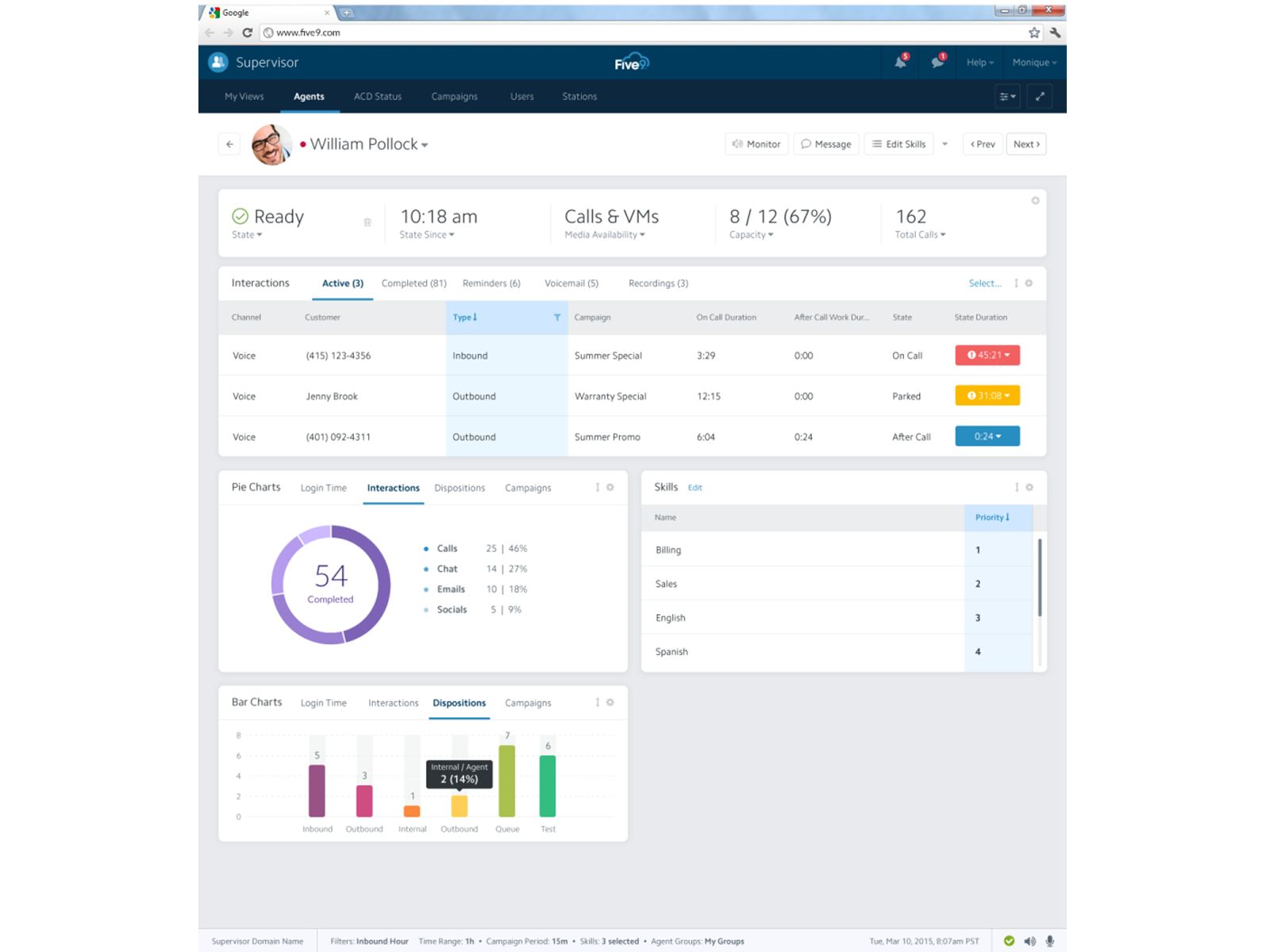
Recent evaluations highlight the transition toward more streamlined, browser-based agent desktops. Users note that consolidating CRM data, customer interaction history, and communication controls into a single window reduces the need to toggle between multiple applications.
Customization Versus Complexity
While power users value the extensive configurability of the workspace, smaller teams or those with limited technical resources sometimes find the platform overwhelming. Reviewers point out that managing multiple administrative menus, campaign settings, and routing rules demands significant onboarding time. Organizations must invest in thorough training programs to ensure supervisors and agents fully utilize the interface without productivity dips during the transition phase.
Key Point 3: Reporting, Analytics, and Data Visibility
Contact center managers rely heavily on real-time dashboards and historical reports to monitor Key Performance Indicators (KPIs) such as First Contact Resolution (FCR), Average Speed of Answer (ASA), and agent occupancy rates. Five9's reporting infrastructure is a central talking point across professional review forums.
Real-Time Monitoring
Supervisors praise the visual appeal and responsiveness of real-time wallboards and custom dashboards. Being able to track queue thresholds and agent states instantly allows management to adjust staffing levels dynamically and intervene during critical service level drops.
Historical Reporting Depth
While the sheer volume of data captured by Five9 is extensive, users frequently mention that extracting specific custom reports can be cumbersome. Building advanced analytics queries or integrating data lakes often requires specialized reporting expertise. Reviewers suggest that organizations with rigorous compliance and custom reporting requirements should allocate dedicated analyst resources to maximize the platform's analytical utility.
Key Point 4: System Reliability, Uptime, and Enterprise Scalability
For mission-critical customer support environments, unscheduled downtime translates directly into lost revenue and damaged brand reputation. System stability is therefore a heavily scrutinized metric in Five9 reviews.
Cloud Infrastructure and Uptime
Enterprise-grade buyers generally express confidence in Five9's cloud architecture, noting stable voice quality and reliable connectivity across distributed or remote workforces. The platform's ability to scale elastically during seasonal traffic spikes or unexpected demand surges receives strong validation from large retail and financial institutions.
Technical Support and Maintenance
Opinions diverge when examining customer support and issue resolution times. While enterprise clients with dedicated account managers report rapid response times and smooth patch deployments, smaller organizations occasionally note delays in troubleshooting complex backend routing anomalies. Reviewers emphasize that maintaining optimal performance requires proactive monitoring and clear communication channels with Five9's support ecosystem.
Key Point 5: Implementation Costs, Licensing, and Total Cost of Ownership
Pricing structures and deployment investments represent major decision points for any enterprise software acquisition. Five9 reviews frequently address the financial commitment required to implement and maintain the platform.
Transparent Versus Hidden Costs
Reviewers note that Five9 operates on a tiered licensing model, with costs scaling based on the feature sets required (such as advanced AI automation, omnichannel routing, or workforce management tools). While base licensing is competitive within the CCaaS market, buyers advise budgeting for implementation services, custom CRM integrations, and ongoing administrative training.
Return on Investment (ROI)
Despite the initial setup costs, long-term users typically report a positive return on investment through reduced telecommunications hardware expenses, improved agent productivity, and enhanced customer retention metrics. Organizations transitioning from legacy on-premise PBX systems experience the most dramatic operational savings.
Comparative Overview of Five9 Review Themes
The following table summarizes the core review dimensions, highlighting common user sentiments, operational impacts, and recommended organizational prerequisites.
| Review Dimension | Primary User Sentiment | Operational Impact | Recommended Prerequisite |
|---|---|---|---|
| Omnichannel & AI | Highly effective routing; AI requires fine-tuning. | Reduces wait times; deflects routine inquiries. | Dedicate resources for prompt engineering and intent training. |
| Agent Interface | Unified workspace praised; administrative depth adds complexity. | Speeds up interaction handling; increases onboarding time. | Develop structured, ongoing internal training programs. |
| Reporting & Analytics | Strong real-time dashboards; complex historical custom queries. | Improves operational visibility; requires analytical effort. | Appoint a dedicated data analyst for advanced report generation. |
| Reliability & Scale | Stable cloud uptime; variable support responsiveness. | Ensures business continuity for distributed workforces. | Establish clear escalation pathways with account representatives. |
| Cost & Value | Competitive baseline; implementation and add-ons increase costs. | Delivers strong long-term ROI for legacy system migrations. | Conduct comprehensive TCO forecasting including integration fees. |
Common Mistakes to Avoid When Evaluating Five9
Organizations reviewing Five9 often fall into predictable evaluation traps. Avoiding these missteps ensures a more accurate assessment of platform suitability:
- Underestimating Implementation Timelines: Treating a CCaaS migration like a simple software download leads to missed deadlines. Complex CRM integrations and routing rule creation require weeks of rigorous testing.
- Overlooking Training Needs: Assuming agents will intuitively master an enterprise-grade dashboard without dedicated practice results in decreased initial productivity.
- Ignoring Integration Dependencies: Failing to verify API compatibility with existing helpdesk software, payment processors, or telephony providers can cause unexpected data silos.
Frequently Asked Questions
Is Five9 suitable for small businesses or strictly for large enterprises?
While Five9 historically targeted large enterprise contact centers, the platform scales effectively for mid-market organizations. However, smaller businesses with fewer than 20 agents should carefully evaluate whether the administrative overhead and feature depth justify the investment compared to simpler, out-of-the-box helpdesk tools.
How does Five9 handle remote and hybrid agent workforces?
Because Five9 is a cloud-native CCaaS platform, agents can connect securely from any location with a stable broadband internet connection using WebRTC technology. Reviews confirm that remote performance remains consistent, provided agents have adequate headset equipment and network bandwidth.
What CRM systems integrate natively with Five9?
Five9 offers out-of-the-box integrations with major enterprise CRM platforms, including Salesforce, ServiceNow, Microsoft Dynamics 365, and Zendesk. These native connectors allow screen pops, automatic call logging, and synchronized customer record updates without custom API development.
How steep is the learning curve for contact center supervisors?
Supervisors familiar with traditional contact center management tools will find the monitoring and scheduling interfaces logical. However, mastering the full suite of real-time reporting customizers, workforce management modules, and administrative permissions requires formal training and hands-on practice.
Does Five9 provide built-in workforce management (WFM) tools?
Yes, Five9 offers integrated workforce management and workforce optimization (WFO) capabilities as part of its broader suite, though certain advanced scheduling and adherence features may require higher-tier licensing or add-on packages.
Next Actions for Prospective Buyers
Organizations considering Five9 should begin by mapping their exact customer journey touchpoints, channel volume distribution, and existing technical debt. Request a targeted, customized software demonstration that reflects your actual daily workflows rather than a generic vendor walkthrough. Finally, engage stakeholders across IT, customer service management, and finance to ensure total alignment on budgeting, security requirements, and implementation milestones before signing a service agreement.