Navigating an Individual Retirement Account (IRA) rollover requires careful coordination, particularly when aiming to maximize capital through cash bonuses or promotional interest rates. Financial institutions frequently offer targeted incentives to attract transferred or rolled-over retirement funds from external brokerages and employer-sponsored plans like 401(k)s or 403(b)s. When evaluating these offers, investors must balance promotional cash payouts or yields against long-term account fees, investment selection, and platform usability. Choosing the right institution ensures that short-term rewards do not become offset by high expense ratios, trading commissions, or restrictive holding periods.
Financial institutions implement IRA rollover promotions as a competitive strategy to capture large blocks of retirement assets. These offers typically take the form of cash bonuses tiered according to the total deposit amount, or promotional Annual Percentage Yields (APYs) on uninvested cash sweeps. To qualify, investors must usually initiate a direct or indirect rollover from a qualified retirement plan and maintain the funds in the new account for a specified retention period—frequently ranging from 12 to 24 months. Understanding how these promotions operate, what eligibility criteria apply, and how specific platforms stack up is essential for retirement savers looking to optimize their portfolio transition.
Disclaimer: This article is for informational and educational purposes only and should not be construed as professional financial, tax, or legal advice. Retirement account rollovers involve complex tax rules, potential fees, and strict regulatory deadlines governed by the Internal Revenue Service (IRS). Always consult a certified financial planner or tax professional before initiating a retirement account transfer.
Understanding IRA Rollover Promotions
An IRA rollover promotion is a financial incentive provided by brokerages, banks, and robo-advisors to encourage individuals to move their retirement savings from one custodian to another. These incentives are designed to offset the friction and administrative hassle of moving funds, such as coordinating with previous plan administrators, completing paperwork, and tracking tax reporting documents.
Promotions generally fall into two primary categories: tiered cash bonuses and enhanced cash sweep yields. Tiered cash bonuses pay a flat monetary reward based on the total net transfer value. For example, a brokerage might offer $100 for a $25,000 transfer, scaling up to $1,000 or more for transfers exceeding $250,000. Enhanced cash sweep yields, conversely, provide a higher-than-average interest rate on cash holdings within the IRA for a promotional window, which appeals to conservative investors or those waiting for specific market entry points.
Direct vs. Indirect Rollovers and Tax Implications
Executing a rollover correctly is critical to avoiding unintended tax liabilities and IRS penalties. There are two primary methods for moving funds from an employer-sponsored plan or existing IRA to a new promotional account:
- Direct Rollover: The administrator of the old retirement plan issues a check made payable directly to the new custodian for the benefit of the account owner, or transfers the funds via an electronic wire. This is the safest and most efficient method because the money never passes through the account holder's personal bank accounts, eliminating the risk of mandatory tax withholding or missed deadlines.
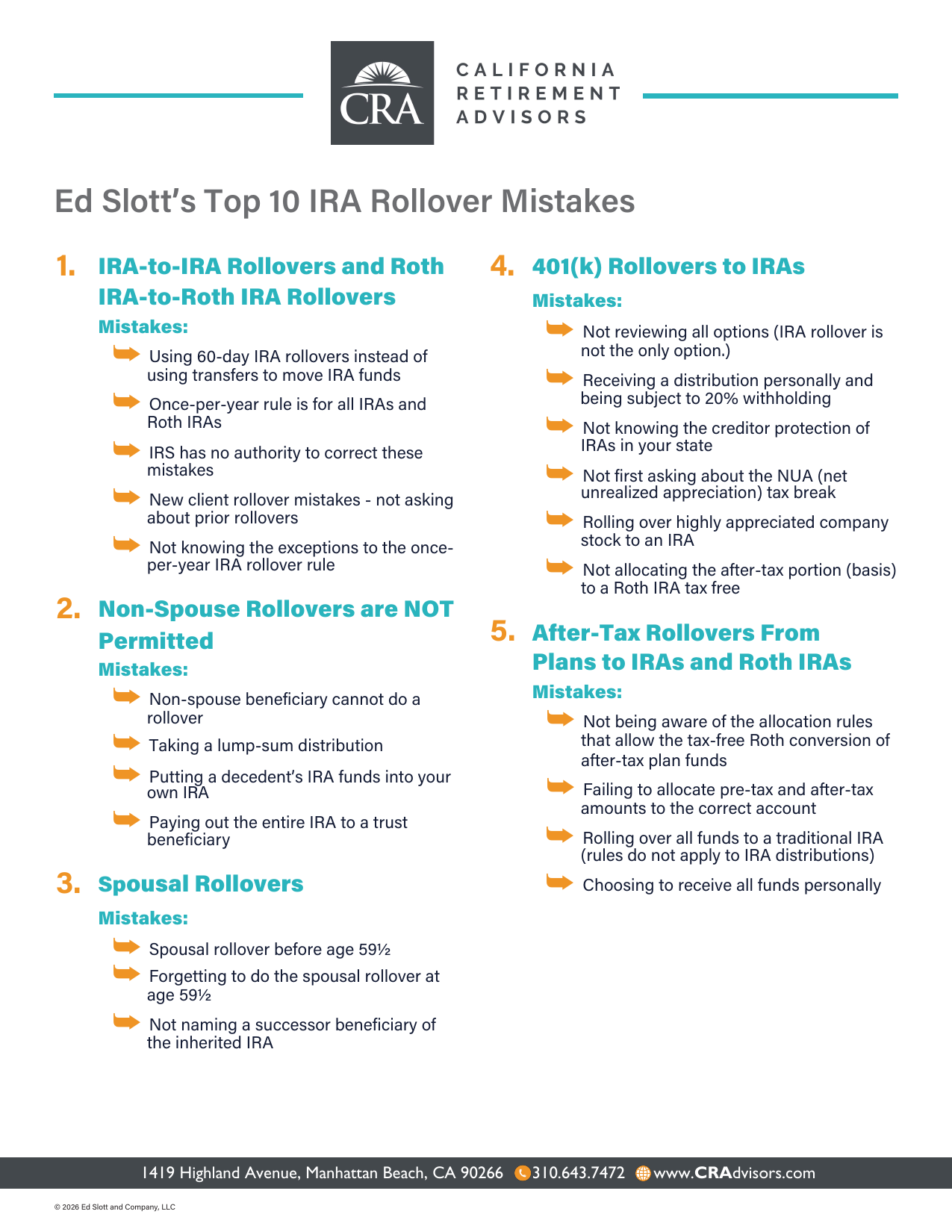
- Indirect Rollover: The old custodian issues a check directly to the account holder. The investor then has exactly 60 calendar days to deposit the full amount into a new eligible retirement plan. If the funds are not deposited within this 60-day window, the IRS treats the distribution as taxable income, subjecting it to ordinary income taxes and, if the investor is under age 59½, a 10% early withdrawal penalty. Furthermore, for employer plan distributions, custodians are generally required to withhold 20% for federal taxes on indirect rollovers, meaning the investor must out-of-pocket fund that 20% deficit to successfully roll over the full balance.
Understanding these mechanics ensures that investors do not accidentally trigger costly tax events while chasing a promotional bonus.
Key Criteria for Evaluating Rollover Offers
When comparing IRA rollover promotions, looking beyond the headline cash bonus is essential. A large bonus attached to a restrictive or high-cost platform can cost an investor more over the long term than a smaller bonus paired with a low-cost, feature-rich brokerage.
Holding Periods and Clawback Clauses
Virtually all financial institutions enforce a holding period requirement to prevent "churners" from depositing funds, collecting the bonus, and immediately transferring the assets out. These holding periods typically last between 365 and 730 days. If an investor withdraws the funds or transfers them away before the holding period expires, the institution reserves the right to claw back the cash bonus by deducting it directly from the account balance or billing the client.
Fee Structures and Expense Ratios
Account maintenance fees, trade commissions, and investment product expense ratios directly impact long-term wealth accumulation. Investors must evaluate whether a prospective platform charges annual custodial fees, wire transfer fees, or out-of-network advisory fees. Even a seemingly minor 0.25% difference in annual advisory fees can easily eclipse a one-time $500 cash bonus over a 10-year investment horizon.
Investment Selection and Account Types
The versatility of the receiving platform matters significantly. Some promotions are restricted strictly to Traditional IRAs or Roth IRAs, while others accommodate Rollover IRAs or inherited IRAs. Additionally, investors should verify whether the platform permits self-directed trading across equities, exchange-traded funds (ETFs), mutual funds, options, and fixed-income products, or if the promotional funds must remain locked in proprietary managed portfolios.
Comparative Overview of Top IRA Rollover Platforms
The financial landscape features several major institutions offering competitive promotions for retirement account rollovers. The following comparison highlights how prominent brokerages structure their promotional offerings, keeping in mind that exact bonus thresholds and promotional windows are subject to periodic updates by the respective institutions.
| Institution | Promotion Type | Typical Bonus Structure | Key Requirements | Holding Period |
|---|---|---|---|---|
| M1 Finance | Tiered Cash Bonus | Up to $500 based on net deposit | Minimum transfer of $10,000; specific subscription tier required | 1 year |
| Interactive Brokers | Asset-Based Credit | Varies by net transfer value | Automated clearing house or wire transfer of eligible assets | 1 year |
| Robinhood | Match Bonus | 1% to 3% match on incoming transfers | Gold subscription required for higher match tiers | 2 years |
| Webull | Cash/Stock Voucher | Tiered cash or fractional shares | Minimum net deposit thresholds met within specified window | 270 days to 1 year |
| E*TRADE (Morgan Stanley) | Tiered Cash Bonus | Ranging from $200 to $3,500+ | Minimum deposit of $25,000+ | 1 year |
Note: Promotional terms, exact payout tiers, and eligibility criteria vary based on current marketing campaigns and regulatory updates. Always review the custodian's specific terms and conditions page before initiating a transfer.
Detailed Review of Leading IRA Rollover Promotions
Analyzing individual provider offerings helps clarify which platform aligns best with specific investing styles, whether an investor prefers automated portfolio management, self-directed options trading, or low-cost index fund accumulation.
M1 Finance
M1 Finance appeals to investors who prefer a hybrid approach combining automated investing with customizable portfolios, known as "Pies." Their promotional structure frequently centers around tiered cash bonuses that scale with the size of the incoming transfer.
- Pros: Highly customizable automated investing, fractional shares, and competitive margin rates for taxable accounts (though margin rules do not apply directly to IRAs).
- Cons: Requires participation in their paid subscription tier to unlock maximum promotional benefits and advanced features. Strict adherence to holding periods is enforced to prevent bonus clawbacks.
- Best Suited For: Intermediate to advanced self-directed investors who want automated portfolio rebalancing without paying traditional asset-under-management (AUM) advisory fees.
Interactive Brokers
Interactive Brokers (IBKR) is widely recognized for servicing active traders, professionals, and cost-conscious investors seeking access to global markets and advanced analytics. While IBKR less frequently runs flashy retail cash bonus campaigns, they routinely offer competitive pricing structures and asset transfer credits that offset external transfer fees charged by outgoing custodians.
- Pros: Extremely low margin rates, access to global exchanges, sophisticated trading platforms (Trader Workstation), and robust analytical tools.
- Cons: Steep learning curve for beginner investors; interface and toolsets can feel overwhelming for passive retirement savers.
- Best Suited For: Experienced traders and high-net-worth individuals who prioritize low transaction costs, sophisticated analytical tools, and broad asset access.
Robinhood
Robinhood has captured significant market share by introducing aggressive promotional incentives, most notably their IRA match programs. For retirement accounts, Robinhood frequently offers a percentage match (such as 1% for standard users and up to 3% for Robinhood Gold subscribers) on all incoming IRA contributions and eligible rollovers.
- Pros: User-friendly mobile interface, straightforward match bonuses that immediately boost account capital, and simplified crypto and equity trading.
- Cons: Long holding periods (typically two years) required to keep the match bonus; limited traditional advisory support or complex fixed-income offerings compared to legacy wirehouses.
- Best Suited For: Retail investors and younger savers who prefer mobile-first investing and want an immediate percentage boost on transferred retirement funds.
Webull
Webull provides robust charting tools and extended-hours trading capabilities, complemented by promotional campaigns targeting asset transfers. Their promotions frequently feature tiered cash or stock vouchers based on total net deposits, appealing directly to active self-directed retail participants.
- Pros: Advanced charting capabilities, zero-commission trading on US-listed stocks and ETFs, and accessible promotional structures for moderate deposit sizes.
- Cons: Customer support can be slower during peak periods; platform is heavily geared toward active trading rather than long-term wealth planning.
- Best Suited For: Active self-directed traders who value technical analysis tools and want immediate promotional incentives for smaller-to-moderate transfer amounts.
E*TRADE (Morgan Stanley)
As an established legacy brokerage backed by Morgan Stanley, E*TRADE offers a robust ecosystem for both self-directed investors and those seeking professional guidance. Their tiered cash bonus promotions are among the largest in the industry, frequently scaling significantly for high-net-worth rollovers exceeding $100,000 or $1,000,000.
- Pros: Comprehensive educational resources, extensive research reports, robust mutual fund and bond selections, and optional access to human advisors.
- Cons: Standard commission-free trading is competitive, but specialized broker-assisted trades or certain advisory services carry higher fees.
- Best Suited For: Conservative and long-term retirement investors looking for a stable, full-service brokerage with strong research capabilities and substantial cash bonus potential for large account balances.
Step-by-Step Guide to Executing an IRA Rollover
Executing a rollover smoothly minimizes administrative delays and ensures compliance with tax laws. Follow this systematic approach to complete your rollover successfully:
- Open the Destination Account: Establish the correct type of account (e.g., Traditional IRA or Roth IRA) with your chosen receiving institution before initiating any transfer from your old custodian. Ensure the account registration matches the ownership of the existing account.
- Request a Direct Rollover: Contact the new custodian's transfer department and complete an ACATS (Automated Customer Account Transfer Service) or direct rollover form. Provide your old account number and most recent account statement.
- Monitor the Transfer: Track the progress through your new broker's dashboard. Direct transfers typically take between 5 to 15 business days depending on whether the old custodian uses electronic rails or physical checks.
- Verify Bonus Application: Confirm that the promotional bonus has been correctly logged to your account. Note the date when the official holding period begins to ensure compliance with the custodian's terms.
- Deploy the Capital: Once the funds have cleared into the new account, allocate them according to your target asset allocation strategy rather than letting them sit indefinitely in uninvested cash sweeps.
Common Mistakes to Avoid During a Rollover
Avoiding avoidable administrative and tax errors safeguards your retirement savings from unnecessary friction:
- Triggering an Accidental Indirect Rollover: Always opt for a direct custodian-to-custodian transfer to eliminate the risk of missing the 60-day IRS window and triggering mandatory tax withholding.
- Overlooking Fee Implications: Never choose a brokerage solely for a $200 bonus if the platform's underlying mutual fund fees or annual service charges will cost you more over a multi-year horizon.
- Ignoring the Holding Period: Withdrawing funds prematurely can lead to the institution clawing back the promotional cash bonus, leaving you with an unexpected deficit in your account balance.
- Failing to Match Account Types: Rolling a Traditional pre-tax 401(k) directly into a Roth IRA without a formal Roth conversion strategy will trigger immediate, massive ordinary income tax liabilities. Ensure pre-tax funds roll into Traditional IRAs and Roth funds roll into Roth IRAs.
Frequently Asked Questions
Are IRA rollover bonuses considered taxable income by the IRS?
Generally, cash bonuses paid by brokerages for opening or funding an account are treated by the IRS as miscellaneous income or interest rather than taxable retirement distributions, because they are paid as promotional incentives by the institution rather than withdrawn from the retirement corpus itself. Custodians typically issue a Form 1099-INT for bonuses exceeding $10. However, tax treatment can vary based on individual circumstances, so consulting a tax professional is recommended.
Can I roll over multiple 401(k) accounts into a single IRA to qualify for a larger bonus?
Yes. Most brokerages allow you to aggregate multiple external retirement accounts (such as old traditional 401(k)s from past employers) into a single incoming transfer or multiple simultaneous transfers to hit higher promotional bonus tiers. Always check the custodian's specific terms regarding whether multiple accounts can be combined within the qualification window.
What happens if I withdraw my money before the promotional holding period ends?
If you withdraw or transfer out funds before the mandatory retention period expires, the financial institution will typically reverse the promotional bonus. They will either deduct the bonus amount directly from your remaining cash balance or send an invoice for the promotional value. This can result in a negative cash balance or unexpected account complications.
Is a direct rollover reported to the IRS?
Yes. Both the distributing custodian and the receiving custodian report rollover transactions to the IRS using Form 5498 (for contributions and rollovers received) and Form 1099-R (for distributions sent). While direct rollovers are non-taxable events, accurate IRS reporting ensures that the transaction is correctly documented as a tax-free transfer rather than a taxable distribution.
Do robo-advisors offer better IRA rollover promotions than traditional brokerages?
Robo-advisors occasionally offer promotional cash bonuses or fee-free management for a specified period (such as the first six months of asset management). However, traditional brokerages more frequently offer larger upfront cash bonuses for self-directed accounts. The choice depends on whether you prefer automated algorithmic management or self-directed trading control.
Conclusion and Next Actions
Maximizing an IRA rollover promotion requires balancing immediate financial incentives with long-term portfolio costs, platform usability, and investment flexibility. Investors should begin by auditing their existing retirement accounts, identifying current custodian fees, and selecting a receiving institution that matches their trading or investing style. Prioritize direct custodian-to-custodian transfers to eliminate tax compliance risks, carefully note the custodian's holding period requirements, and ensure that transferred capital is strategically deployed rather than left idle. By approaching the rollover process methodically, retirement savers can successfully capture promotional rewards while safeguarding their long-term financial growth.