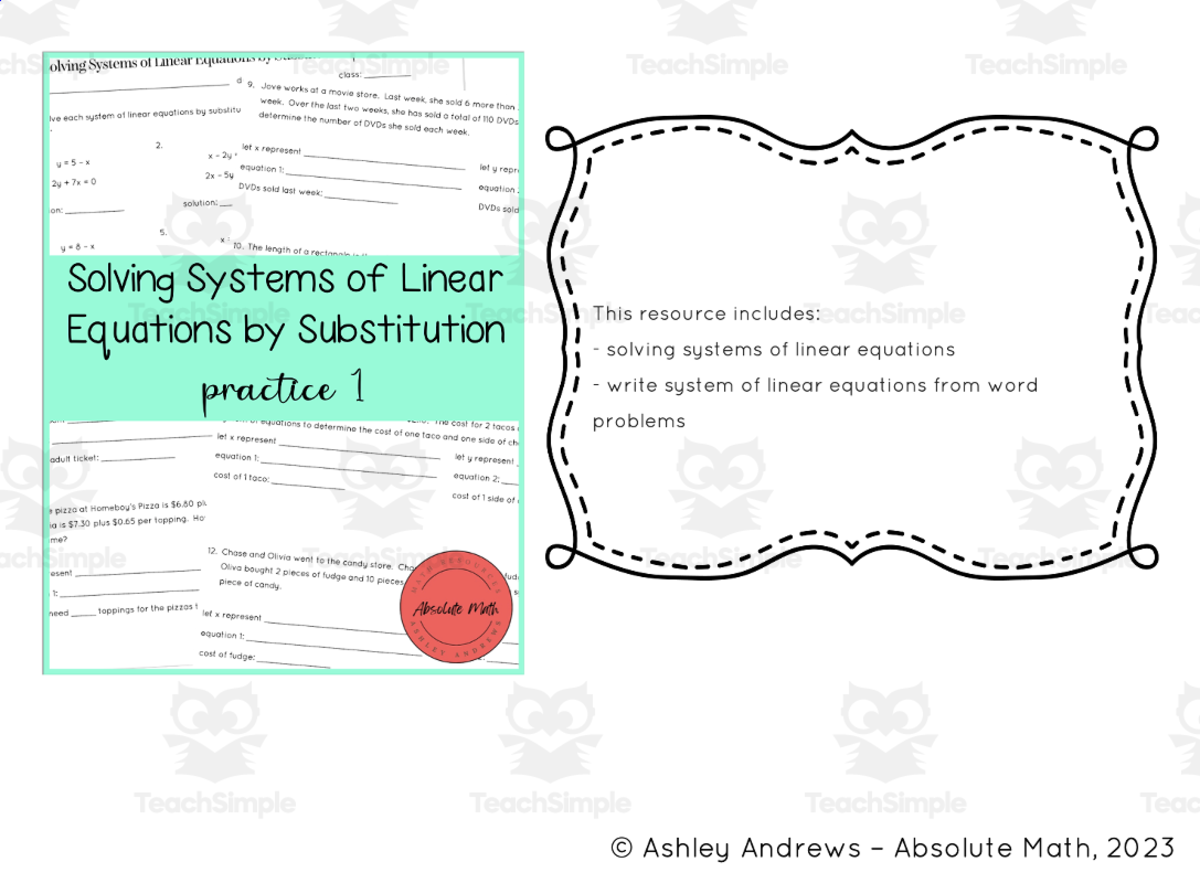
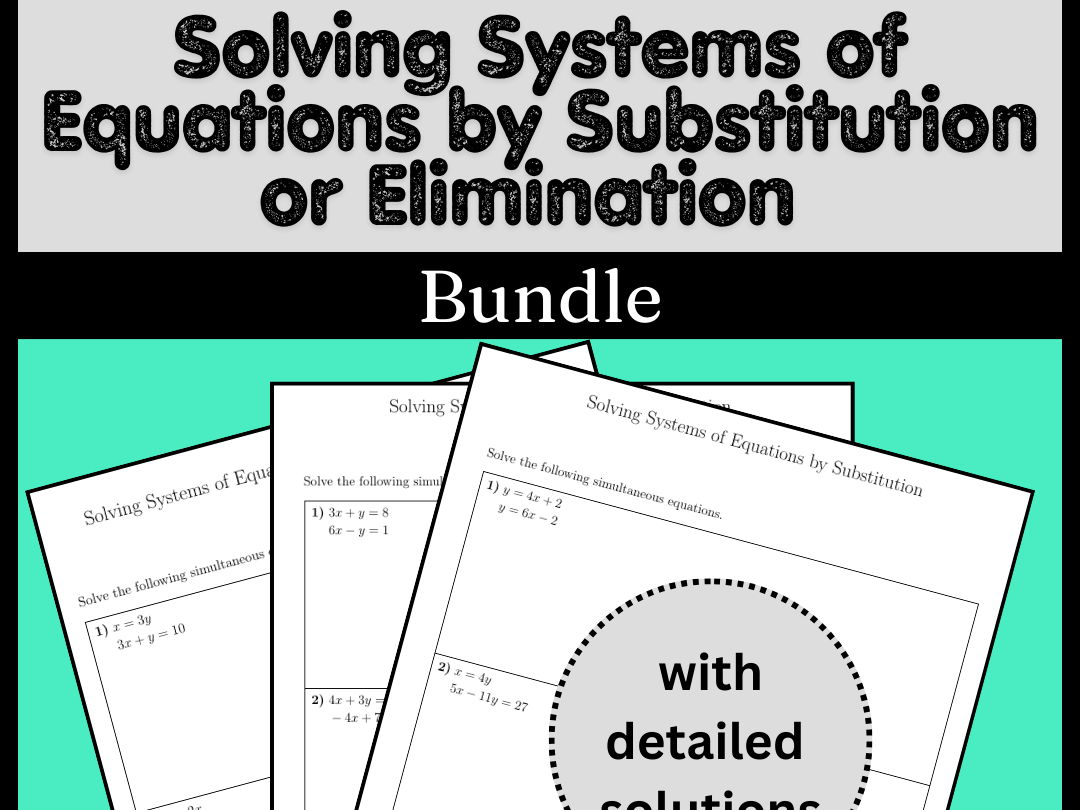
A worksheet on solving systems of equations by substitution is a structured practice document designed to help students master an algebraic method where one variable is isolated and substituted into another equation to find a simultaneous solution. This educational tool typically features step-by-step problem sets, ranging from basic introductory drills with pre-isolated variables to complex word problems requiring careful multi-step manipulation.
Introduction to the Substitution Method
Algebraic systems of linear equations appear across middle school, high school, and introductory college mathematics. While graphing provides a visual approach and elimination offers a quick computational route under specific alignments, the substitution method remains a cornerstone of algebraic reasoning. A dedicated worksheet on solving systems of equations by substitution serves as the primary instrument for students to build fluency, test their understanding, and correct conceptual errors.
To utilize these worksheets effectively, learners must understand the underlying rationale: substitution allows us to reduce a two-variable system ($x$ and $y$) down to a single-variable equation. Once that single variable is solved, back-substitution reveals the value of the second variable, completing the coordinate pair $(x, y)$ that satisfies both equations simultaneously.
Prerequisites and Foundational Concepts
Before tackling a rigorous worksheet on solving systems of equations by substitution, students must master several foundational algebraic skills. Jumping into simultaneous equations without these prerequisites often leads to frustration, sign errors, and conceptual confusion.
Isolating Variables in Linear Equations
The entire mechanism of substitution rests on the ability to manipulate an equation to isolate a single variable. For instance, given the equation $2x + y = 7$, a student must instantly recognize how to isolate $y$ by subtracting $2x$ from both sides, resulting in $y = -2x + 7$. Fluency with inverse operations, combining like terms, and handling fractional coefficients is non-negotiable.
Understanding Coordinate Pairs and Solutions
A system of equations consists of two or more equations sharing common variables. The solution to a linear system is the exact point of intersection on a Cartesian plane, represented as an ordered pair $(x, y)$. Students must understand that substituting the resulting values back into both original equations serves as a definitive check of their work.
Recognizing Equivalent Expressions
Substitution is essentially the act of replacing a variable with an expression of equal value. If $y = 3x - 1$, then $3x - 1$ and $y$ are completely interchangeable. Comprehending this substitution property of equality prevents errors where students substitute an expression into the same equation it came from, which inevitably leads to unhelpful identities like $0 = 0$.
Anatomy of a Well-Structured Worksheet
Educational materials vary wildly in quality. A high-quality worksheet on solving systems of equations by substitution is carefully scaffolded, moving the learner from guided practice to independent mastery.
Scaffolded Difficulty Levels
Effective worksheets do not throw complex fractions and word problems at the learner immediately. They follow a predictable progression:
- Level 1: Pre-Isolated Variables. One equation already has a variable isolated (e.g., $y = 2x + 3$ and $4x + 5y = 11$). This allows the learner to practice the mechanics of substitution without getting bogged down in preliminary algebraic isolation.
- Level 2: One-Step Isolation. Both equations are in standard form ($Ax + By = C$), but one variable has a coefficient of $1$ or $-1$, requiring a single quick step to isolate.
- Level 3: Multi-Step and Fractional Coefficients. Both equations require careful manipulation, often introducing fractions or decimals that test precision and arithmetic endurance.
- Level 4: Special Cases and Applications. Systems that yield no solution (parallel lines) or infinite solutions (identical lines), alongside real-world word problems.
Answer Keys and Worked Examples
A proper instructional worksheet always includes at least one fully worked-out example at the top of the page, demonstrating proper formatting, parentheses placement, and distribution of negatives. Furthermore, a comprehensive answer key showing intermediate steps—not just final coordinate pairs—is essential for self-assessment and remediation.
| Difficulty Level | Equation Structure | Primary Skill Tested | Common Pitfall |
|---|---|---|---|
| Beginner | $y = 3x - 2$$5x + 2y = 13$ | Basic substitution and distribution | Forgetting to distribute negative signs |
| Intermediate | $2x + y = 7$$3x - 4y = -5$ | Variable isolation and integer arithmetic | Isolating the wrong variable, creating fractions |
| Advanced | $4x - 3y = 11$$2x + 5y = 1$ | Multi-step manipulation and fractions | Arithmetic errors during clearing of denominators |
| Special Cases | $2x - y = 4$$4x - 2y = 10$ | Recognizing parallel or identical lines | Confusing no solution with zero as a valid coordinate |
Step-by-Step Guide to Solving Using Substitution
To master the contents of a substitution worksheet, students should follow a rigorous, repeatable algorithmic workflow. Skipping steps or failing to use parentheses is the primary source of error.
Step 1: Isolate a Variable
Examine both equations and select a variable with a coefficient of $1$ or $-1$ if possible. This minimizes the introduction of fractions. Rearrange the chosen equation so that the target variable stands alone on the left side.
Step 2: Substitute the Expression
Take the algebraic expression equivalent to the isolated variable and substitute it into the other equation in place of that variable. Crucial Rule: Always wrap the substituted expression in parentheses to ensure proper distribution, especially when a negative sign or a coefficient precedes the variable.
Step 3: Solve for the Remaining Variable
Simplify the resulting single-variable equation by distributing terms, combining like terms, and isolating the variable. You will now have the numerical value for the first coordinate.
Step 4: Back-Substitute to Find the Second Coordinate
Take the numerical value obtained in Step 3 and plug it back into the isolated equation from Step 1. Compute the arithmetic to find the value of the second variable. Write the final answer as an ordered pair $(x, y)$.
Step 5: Verify the Solution
Substitute both coordinates into both original equations. If both equations produce true statements (e.g., $5 = 5$), the solution is verified. If an identity like $0 = 0$ or a contradiction like $3 = 7$ appears, check for arithmetic errors or recognize a special system.
Common Mistakes and Troubleshooting
When reviewing completed worksheets, educators and self-directed learners frequently encounter recurring error patterns. Identifying these pitfalls accelerates correction.
Neglecting Parentheses and Distribution Errors
The most frequent mechanical error occurs when substituting an expression into an equation preceded by a negative sign. For example, substituting $y = x + 4$ into $3x - 2y = 5$ requires writing $3x - 2(x + 4) = 5$. Failing to distribute the $-2$ to both the $x$ and the $4$ leads to $3x - 2x + 4 = 5$, which ruins the entire calculation.
Substituting Back into the Same Equation
If a student isolates $x$ from Equation A and substitutes that expression back into Equation A, they are merely undoing their own work, resulting in a redundant statement like $5 = 5$ or $0 = 0$. Substitution must cross over from one equation to the other.
Misinterpreting Special Cases
Not every linear system has a single unique solution. When solving a system, variables may completely cancel out, leaving a numerical statement.
- If the statement is true (e.g., $4 = 4$), the lines are identical, yielding infinitely many solutions (dependent system).
- If the statement is false (e.g., $0 = 6$), the lines are parallel, yielding no solution (inconsistent system).
Frequently Asked Questions
When should I use substitution instead of elimination?
Substitution is most efficient when one of the variables in the system already has a coefficient of $1$ or $-1$, or when one equation is already explicitly solved for a variable (e.g., $y = mx + b$). If both equations are cleanly aligned in standard form ($Ax + By = C$) with matching integer coefficients, the elimination method is often faster.
How do I handle fractions on a substitution worksheet?
If isolating a variable forces you to work with fractions, you can either embrace fractional arithmetic by finding common denominators during substitution, or you can multiply the entire equation by the least common multiple (LCM) to clear the fractions before beginning the substitution process.
What does it mean if my variables cancel out completely?
If all variables disappear during the substitution and simplification process, you have encountered a dependent or inconsistent system. A true numerical statement indicates infinite solutions, while a false numerical statement indicates no solution.
Can substitution be used for systems with three variables?
Yes. The substitution method scales up to three-variable systems ($x$, $y$, and $z$), though it becomes computationally intensive. For three or more variables, matrix methods or Gaussian elimination are typically preferred for efficiency and organization.
How can I check my work without an answer key?
You can verify any solved coordinate pair by plugging the $x$ and $y$ values back into both original equations. Both equations must produce mathematically true statements simultaneously. You can also graph both equations on a coordinate plane or graphing calculator to confirm that their point of intersection matches your solved coordinate pair.
Conclusion and Next Actions
Mastering a worksheet on solving systems of equations by substitution requires patience, strict adherence to algebraic rules, and meticulous attention to signs and parentheses. To solidify this knowledge, begin with pre-isolated problem sets, progress through standard multi-step equations, and finish by testing your skills on word problems and special cases. For further study, explore graphical verification techniques and transition into the elimination method to expand your algebraic toolkit.