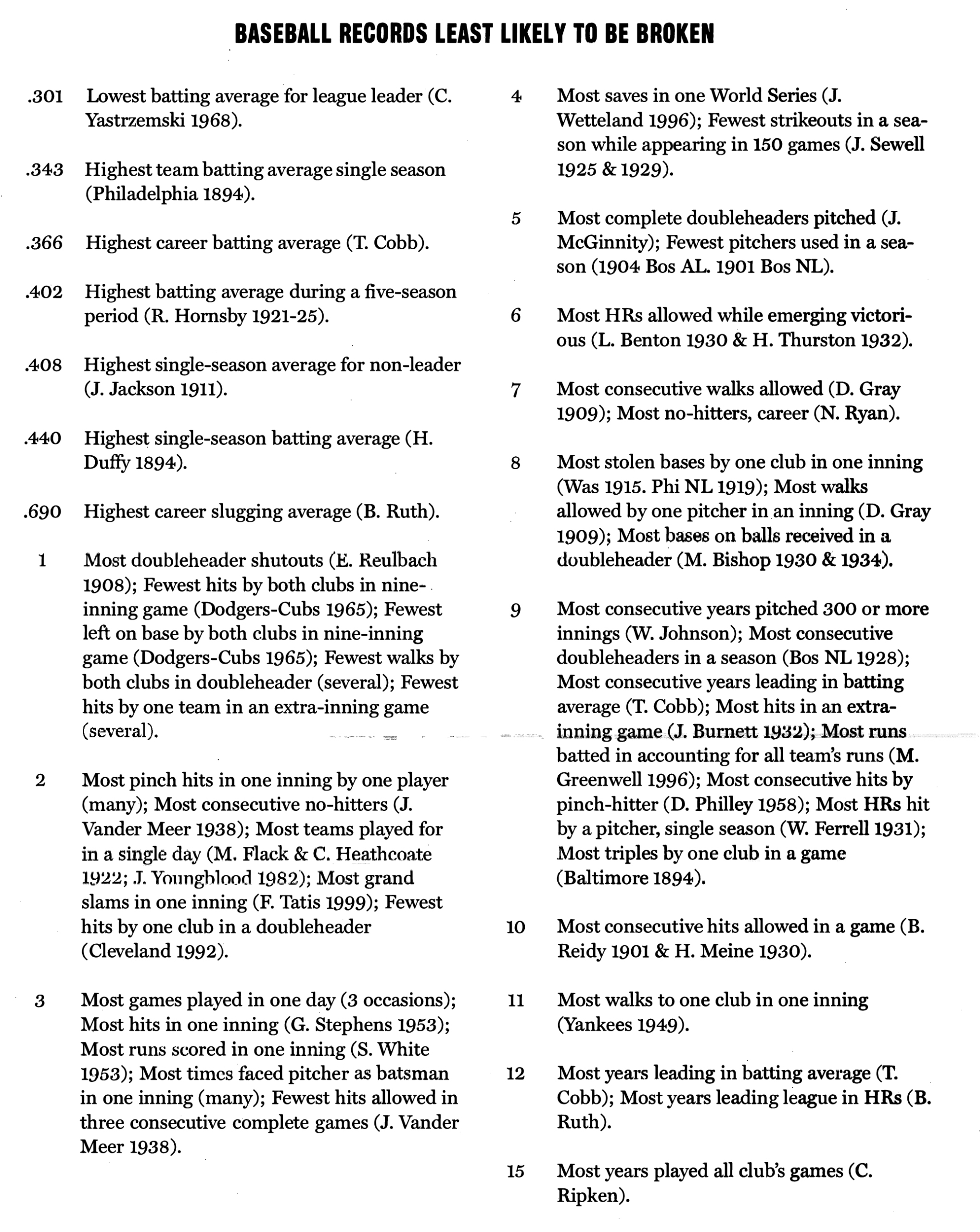
The question of whether Major League Baseball (MLB) records categorized as "unbreakable" remain safe in 2026 is answered by a clear distinction between physical limitations and evolving game strategy. While individual skill ceilings remain high, structural changes in pitching usage, roster management, and analytical approaches have effectively immunized many historical marks against modern pursuit.
The history of Major League Baseball is built on staggering statistics that appear as relics of a different era. Records such as Cy Young’s 511 career victories or Cal Ripken Jr.’s 2,632 consecutive games played are frequently cited as the pinnacle of impossibility. As we enter the 2026 season, these marks remain untouched, not merely because the talent level has dropped, but because the fundamental operational mechanics of the sport have shifted to make chasing them mathematically and strategically irrational.
The Structural Anchors of "Unbreakable" Status
To understand why records like Cy Young’s wins or Nolan Ryan’s 5,714 strikeouts remain secure, one must look at the structural evolution of the game. In the early 20th century, pitchers were expected to finish what they started. The modern era, by contrast, is defined by the specialization of the bullpen and the rigorous protection of arm health through pitch counts and innings limits.
When a starting pitcher in 2026 is pulled after five or six innings, it is rarely due to poor performance; it is a calculated decision based on the efficiency of the middle-reliever corps and the high velocity required to generate swings and misses. A starting pitcher today would need to maintain an improbable level of durability and performance for three decades to challenge the top of the leaderboard. Even if a pitcher were to win 20 games a season for 25 consecutive years, they would still fall short of Young’s record. The sheer volume of volume-based records—those requiring high counts over long spans—is incompatible with modern orthopedic standards and front-office risk management.
Categories of Records and Their Stability
Not all records are created equal. Some are protected by the way the game is played, while others are protected by the nature of the statistical category itself. We can categorize the most famous "unbreakable" marks into three distinct groups:
1. The Volume-Dependent Records
These are records that rely on an accumulation of stats that require a player to be on the field constantly for two decades or more.
- Cy Young’s 511 Wins: Requires an average of 25 wins a year for 20 years.
- Ty Cobb’s 4,189 Hits: Requires an average of 200 hits per season for 21 years.
- Nolan Ryan’s 5,714 Strikeouts: Requires an average of 285 strikeouts per season for 20 years.
These are the safest records in the game. In 2026, the reliance on high-velocity bullpens and the analytical focus on "Three True Outcomes" (home runs, walks, and strikeouts) makes the kind of consistent contact hitting required for the hit record almost impossible to achieve in a modern lineup.
2. The Efficiency-Dependent Records
These records are defined by a singular, anomalous level of excellence that hasn't been matched because the context of the sport makes it unsustainable.
- Joe DiMaggio’s 56-Game Hitting Streak: While not physically impossible, the analytical focus on defensive positioning, pitcher velocity, and specialized relief pitching makes stringing together hits over two months statistically daunting.
- Hack Wilson’s 191 RBIs: The shift toward on-base percentage and power-hitting means that players with the potential to drive in that many runs are often hitting in spots where they simply do not receive enough at-bats with runners on base.
3. The "Legacy" Records
These are records that are unlikely to be broken because the rules of the game have evolved, rendering the previous standard obsolete.
- Cal Ripken Jr.’s 2,632 Consecutive Games: Modern sports medicine and the emphasis on load management and injury prevention make it virtually certain that no team will ever allow a player to play every single day for 16 years, even if that player were healthy. The risk of burnout and long-term injury is considered too high a cost for an organization.
Comparing Modern Barriers to Historical Context
The table below outlines why some of the most famous records appear to be permanently out of reach in the 2026 landscape.
| Record | Holder | Primary Barrier to Entry |
|---|---|---|
| Career Wins | Cy Young | Usage limits, 5-man rotations, relief specialization |
| Career Hits | Ty Cobb | Shift to launch angle and exit velocity over contact |
| Career Strikeouts | Nolan Ryan | Pitch counts and modern arm-health protocols |
| Consecutive Games | Cal Ripken Jr. | Load management and injury prevention culture |
| Season RBIs | Hack Wilson | Modern lineup construction and batting order theory |
The barrier in each of these cases is not a lack of effort or talent; it is the institutionalization of player longevity. In the past, the "Iron Man" mentality—playing through minor injuries and exhaustion—was rewarded. Today, teams prioritize the peak performance of their assets. A player who tries to play every game at the risk of a season-ending injury would likely be sidelined by their own coaching staff for the sake of the team's long-term competitive window.
Are There Records That Might Still Fall?
While the "Mount Rushmore" of records seems untouchable, the 2026 game environment has created new pathways for other types of marks to be broken. Records involving pure speed, such as stolen bases, were once thought to be static, but changes in base dimensions and pick-off limitations have revitalized the stolen base game.
Similarly, home run records are always under threat as long as the ball-to-bat mechanics continue to be optimized by launch angle theory. The records that remain "breakable" are those that depend on talent-to-ball interaction rather than those requiring decades of extreme physical endurance.
Expert Guidance: Interpreting Modern Baseball Statistics
When evaluating the likelihood of a record being broken in 2026, analysts should look at three primary drivers:
- Rule Changes: How do the rules regarding base size, pitch clocks, or ball composition influence the frequency of the event?
- Roster Construction: Are teams building rosters that encourage the pursuit of individual milestones, or is the focus entirely on team-based platoon advantages?
- Advanced Metrics: How does modern data interpretation change how managers prioritize player usage?
If a record requires a player to buck the trend of modern optimization, it is likely safe. If a record is based on an outcome that is currently being incentivized by the rules and strategies of the modern game, it is only a matter of time before it is eclipsed.
Common Misconceptions
A frequent error in discussing "unbreakable" records is the assumption that players are somehow less skilled today than in the past. This ignores the reality of the 2026 scouting and development pipeline, which is more robust and technologically advanced than ever before.
The issue is not that today's pitchers cannot throw a complete game; it is that their value to the team is maximized by having them leave the game while they are still at their peak, rather than pushing them through a third or fourth trip through the batting order. The records remain intact because the game is optimized for team victory, not for individual accumulation of historical statistics.
Frequently Asked Questions
Why aren't players trying to break the hitting streak record anymore? Players still attempt to hit safely in every game, but the modern defensive environment, which utilizes extreme shifting and specialized relief pitchers who throw high-velocity secondary pitches late in the game, makes it statistically harder to record a hit in every single at-bat over such a long duration.
Will the 500-win record ever be challenged? No. In 2026, a starting pitcher is rarely on track to win more than 15-18 games a year. To reach 500, a player would need to win 20 games for 25 consecutive years. With modern pitch counts and six-man rotations often being utilized, the math is simply impossible.
Does load management mean Cal Ripken Jr.'s record is the safest in sports? It is arguably the safest in baseball. While some players have shown immense durability, the front-office philosophy of prioritizing postseason readiness over individual game streaks means no modern organization would allow a player to push through significant fatigue or minor injury just to keep a streak alive.
Can home run records be broken in 2026? Yes. While home run records are prestigious, they rely on individual performance and hitting philosophy rather than the long-term, multi-decade durability required for win or hit totals. As long as the physical training and swing mechanics continue to evolve toward power, these records remain the most susceptible to being surpassed.
What is the most "breakable" of the seemingly unbreakable records? Records involving seasonal performance are the most likely to fall. Because a player only needs one exceptionally "hot" season or a perfect storm of health and opportunity to break a single-season record, these remain much more attainable than the career-long totals of the legendary players of the past.
Final Assessment: The Future of Records
As we navigate the 2026 season, the divide between "breakable" and "unbreakable" records has never been wider. The records that require extreme, multi-decade usage are protected by the culture of sports medicine and team-first analytics. They are not merely records; they are monuments to an era where the game functioned on fundamentally different economic and physical logic. While individual performance will continue to push the boundaries of what is possible in a single season or a specific game, the pursuit of the all-time career benchmarks remains effectively halted by the structural requirements of modern baseball.
To gain a deeper appreciation of these records, observe the current leaders in active service. Watch their pitch counts, their usage in the bullpen, and their team’s approach to rest days. You will find that even the most talented players are operating within a framework that purposefully precludes the pursuit of the records held by Young, Cobb, and Ripken. These historical marks are not just records; they are reminders of how the sport has transitioned from a game of human endurance to a game of tactical precision.