The relationship between Alveda King and Donald Trump is a long-standing political and social alliance rooted in shared conservative values, particularly regarding pro-life advocacy, religious freedom, and economic empowerment. As the niece of Dr. Martin Luther King Jr., Alveda King has consistently defended Trump against allegations of racism while serving as a key advisor on minority engagement and faith-based initiatives.
The alliance between Alveda King and Donald Trump represents one of the most prominent connections between the civil rights legacy and modern American conservatism. While the King family is often associated with progressive politics, Alveda King’s public support for Trump has challenged traditional political alignments, focusing instead on specific policy achievements and ideological synergies. To understand this relationship, one must look at the convergence of pro-life activism, criminal justice reform, and the strategic effort to diversify the Republican voter base.
The Origins of the Alveda King and Donald Trump Connection
The relationship began to gain national traction during the 2016 United States presidential campaign. Alveda King, already a well-known conservative activist and former Georgia State Representative, emerged as a vocal surrogate for then-candidate Donald Trump. Her support was not merely a reaction to the political landscape but a calculated decision based on what she described as "biblical values" and the "sanctity of life."
King’s endorsement was significant because of her lineage. As the daughter of A.D. King and the niece of Dr. Martin Luther King Jr., her alignment with a Republican candidate provided a layer of historical and moral credibility that the Trump campaign actively sought. She argued that the Democratic Party had moved too far away from the core values of the civil rights movement, particularly concerning the protection of the unborn. This ideological shift provided the foundation for a relationship that would span over a decade.
During the 2016 election cycle, King participated in numerous rallies and media appearances, framing Trump as a leader who would address the "silent" needs of the African American community. She often cited the high abortion rates in minority communities as a primary reason for her support, finding a partner in Trump, who moved to the right on abortion issues to secure the evangelical and pro-life vote.
Shared Policy Priorities: The Pro-Life Movement
The most enduring pillar of the Alveda King and Donald Trump relationship is their shared commitment to the pro-life movement. Alveda King has spent decades as a pro-life activist, working with organizations such as Priests for Life and Silent No More. When Donald Trump assumed the presidency, he prioritized judicial appointments that mirrored King’s anti-abortion stance.
King frequently praised the Trump administration for its appointment of conservative judges to federal courts, including the three Supreme Court Justices—Neil Gorsuch, Brett Kavanaugh, and Amy Coney Barrett. From King's perspective, these appointments were the fulfillment of a promise to protect the most vulnerable. Her relationship with Trump was reinforced every time the administration took a stand on "Right to Life" issues, such as the expansion of the Mexico City Policy or the support for the March for Life, where Trump became the first sitting president to attend in person.
The synergy here was clear: King provided the activist energy and the moral narrative, while Trump provided the executive power to enact the policy changes King had championed for years. This mutual reinforcement turned a political alliance into a deep-seated professional partnership.
Criminal Justice Reform and the First Step Act
Another critical area where the Alveda King and Donald Trump relationship yielded tangible results was criminal justice reform. Alveda King was an early and consistent advocate for the First Step Act, which was signed into law by President Trump in December 2018.
This legislation aimed to reduce recidivism and reform federal sentencing laws, which had disproportionately affected minority communities for decades. King worked alongside other advocates, including Van Jones and Kim Kardashian, but her role was uniquely focused on the spiritual and familial restoration of those incarcerated. She frequently met with the President and his senior advisors, including Jared Kushner, to discuss the moral imperatives of reform.
King viewed the First Step Act as a direct continuation of the civil rights work started by her father and uncle. By helping Trump navigate the complexities of this issue, she helped him secure a significant legislative victory that appealed to bipartisan interests. This collaboration demonstrated that their relationship was not just about rhetoric or campaign optics but was capable of producing substantial policy shifts.
The Frederick Douglass Bipartisan Renaissance Interagency Council
In 2018, the relationship between King and Trump was formalized through an official appointment. President Trump appointed Alveda King to the Frederick Douglass Bipartisan Renaissance Interagency Council. The council was established to focus on economic and social issues affecting urban and distressed communities, drawing inspiration from the legacy of Frederick Douglass.
King’s role on this council involved advising the administration on:
- Opportunity Zones: Targeted tax incentives to encourage long-term investments in low-income communities.
- Educational Choice: Supporting policies that allowed parents in underserved areas to choose private or charter schools.
- HBCU Support: Strengthening the funding and sustainability of Historically Black Colleges and Universities.
Through this council, King had a direct line to the White House, allowing her to shape the administration's "Urban Agenda." This formal role solidified her status as one of Trump’s most trusted advisors on minority affairs and demonstrated the President’s willingness to incorporate her specific brand of conservative civil rights advocacy into his administration’s framework.
Defending the President Against Accusations of Racism
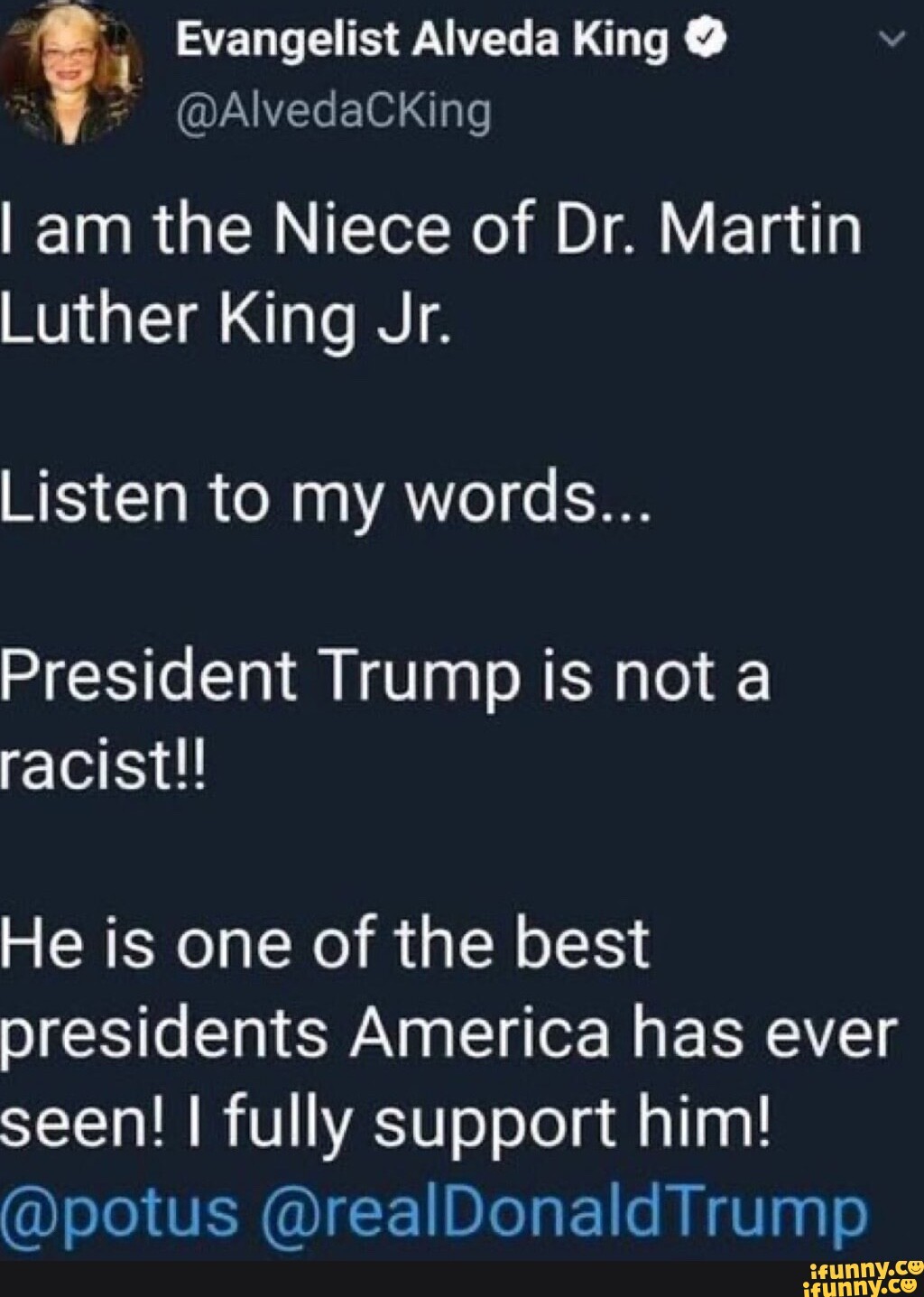
One of the most controversial aspects of the Alveda King and Donald Trump relationship has been King’s steadfast defense of the President against charges of racism. Throughout Trump’s first term and subsequent political activities, he faced intense criticism for his rhetoric and policies regarding immigration and racial tensions.
Alveda King consistently pushed back against these narratives. In numerous interviews, she famously stated, "Donald Trump is not a racist." Her defense was typically built on three arguments:
- Economic Performance: She pointed to the record-low unemployment rates for African Americans, Hispanics, and Asian Americans during the pre-pandemic years of the Trump presidency.
- Policy Results: She cited the First Step Act and the funding for HBCUs as proof of the President’s commitment to minority communities.
- Personal Interactions: She frequently spoke of her personal interactions with Trump, describing him as respectful, attentive, and genuinely concerned about the issues she raised.
This defense was vital for Trump, as it came from a member of the King family—the most iconic name in the struggle for racial equality. While other members of the King family, such as Bernice King and Martin Luther King III, often voiced disagreement with Trump’s rhetoric, Alveda King’s vocal support created a complex internal dynamic within the King family legacy that the media frequently highlighted.
Key Events in the Alveda King and Donald Trump Relationship
To visualize the progression of their alliance, the following table outlines the major milestones of their collaboration:
| Year | Event / Milestone | Role of Alveda King | Impact / Focus Area |
|---|---|---|---|
| 2016 | Presidential Campaign | Surrogate / Endorser | Outreach to faith-based and minority voters. |
| 2017 | Inauguration & Early Advice | Informal Advisor | Focus on pro-life policy and judicial picks. |
| 2018 | First Step Act | Policy Advocate | Criminal justice reform and recidivism reduction. |
| 2018 | Frederick Douglass Council | Official Appointee | Urban renewal and economic opportunity zones. |
| 2019 | Black Voices for Trump | Advisory Board Member | Strategic voter engagement for the 2020 cycle. |
| 2020 | Republican National Convention | Keynote Speaker | Defending the President’s record on civil rights. |
| 2024 | Re-election Campaign Support | Senior Surrogate | Maintaining the conservative minority coalition. |
The "Black Voices for Trump" Initiative
As the 2020 election approached, the relationship between Alveda King and Donald Trump became even more strategically focused. King was a founding member of the Black Voices for Trump advisory board. This initiative was designed to increase the President’s share of the African American vote by highlighting the economic and social gains made during his first term.
King’s participation in this initiative was not just about winning votes; it was about shifting the political culture. She often spoke at "Black Voices for Trump" events, emphasizing a message of self-reliance, entrepreneurship, and traditional family values. She argued that the Republican Party was the natural home for many African Americans who held conservative religious views but had been historically tied to the Democratic Party.
This effort saw a measurable shift in the 2020 and 2024 election cycles, where Trump’s support among Black men, in particular, showed an upward trend. Many analysts point to the persistent grassroots work of surrogates like Alveda King as a contributing factor to this demographic shift.
Tensions and Contrasts Within the King Family
It is impossible to discuss the Alveda King and Donald Trump relationship without acknowledging the friction it caused within the broader King family. The King family has never been a political monolith, but the divide became particularly stark during the Trump era.
While Alveda King was a fixture at the White House, her cousins—the children of Dr. Martin Luther King Jr.—often took a different path. For example, Bernice King frequently used her platform to criticize the administration’s handling of social justice issues and racial rhetoric. This created a public contrast: one side of the family emphasizing the "Beloved Community" through traditional civil rights activism and the other (represented by Alveda) emphasizing it through conservative policy and economic empowerment.
Alveda King addressed these differences by stating that her family is allowed to disagree, but she remained firm in her conviction that the "Trump Agenda" was the most effective way to realize her uncle’s dream in a modern context. She focused on the "sanctity of life from the womb to the tomb," a phrase she used to bridge her pro-life work with her social justice advocacy.
The Relationship in 2026: A Reflective View
As of 2026, the relationship between Alveda King and Donald Trump remains a cornerstone of conservative minority outreach. While Trump’s formal time in the White House during his first term ended in 2021, their collaboration continued through his subsequent political activities and the 2024 campaign.
King remains a frequent commentator on conservative media outlets, where she continues to uphold the Trump legacy. The relationship has evolved from a candidate-surrogate dynamic into a seasoned partnership between two veteran figures of the American political right. Their bond has survived multiple election cycles, impeachments, and the shifting tides of public opinion, largely because it is built on a shared ideological foundation rather than mere political convenience.
Frequently Asked Questions
Is Alveda King still supportive of Donald Trump in 2026?
Yes, Alveda King has remained one of Donald Trump's most consistent and vocal supporters. Her support is based on their shared views on pro-life issues, religious freedom, and economic policies that she believes benefit minority communities.
What was Alveda King's official role in the Trump administration?
She was appointed by President Trump to the Frederick Douglass Bipartisan Renaissance Interagency Council. Additionally, she served on the advisory board for the "Black Voices for Trump" campaign initiative.
How does Alveda King respond to claims that Trump is divisive?
Alveda King typically responds by pointing to specific policy results. She argues that economic empowerment (like Opportunity Zones) and criminal justice reform (the First Step Act) are more indicative of a leader's character than media portrayals or rhetoric.
Does the rest of the King family support Alveda's relationship with Trump?
Generally, no. Other prominent members of the King family, such as Bernice King and Martin Luther King III, have been more critical of Donald Trump. Alveda King has acknowledged these differences but maintains that her family respects each other's right to their own political opinions.
What is the most significant policy they worked on together?
The First Step Act is often cited as the most significant legislative achievement resulting from their collaboration. It represented a major overhaul of the federal prison system and was a goal King had advocated for long before Trump took office.
Practical Recommendation for Further Study
To gain a deeper understanding of the Alveda King and Donald Trump relationship, researchers and interested citizens should examine the official transcripts of the Frederick Douglass Bipartisan Renaissance Interagency Council and the public records of the First Step Act. These documents provide the most objective view of the policy-driven aspects of their partnership. Additionally, reviewing Alveda King’s speeches at the 2016, 2020, and 2024 Republican National Conventions offers insight into the evolving narrative she used to connect the King legacy with the Trump presidency.