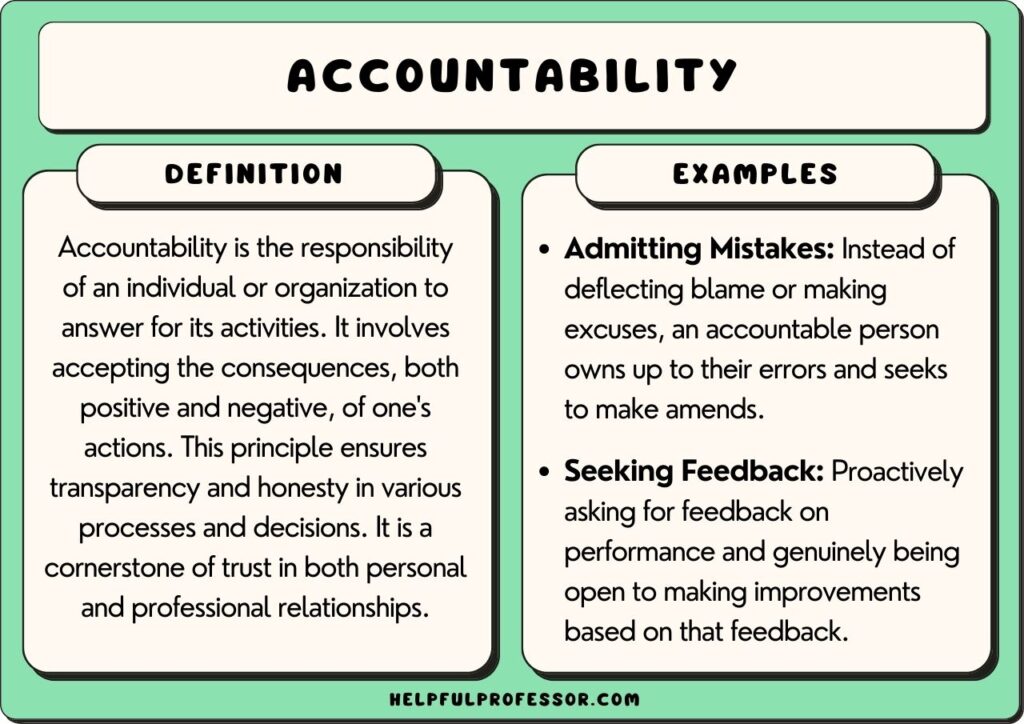
An accountability statement is a formal declaration that defines an individual's or organization's commitment to specific outcomes, ethical standards, and responsibilities. It serves as a transparent roadmap for success, ensuring that performance is measurable and that there is a clear understanding of who is answerable for particular results or behaviors.
In the professional landscape of 2026, the distinction between "responsibility" and "accountability" has become a cornerstone of effective management. While responsibility refers to the obligation to perform a task, accountability is the obligation to account for the results of those tasks. A well-crafted accountability statement bridges the gap between intention and execution, providing a framework for integrity in leadership, individual performance, and corporate governance.
The Core Components of an Effective Accountability Statement
To be effective, an accountability statement must go beyond vague promises. It requires a structure that allows for objective evaluation. Whether you are writing a personal statement for a performance review or a corporate declaration for an annual report, the following elements are essential:
- Ownership of the Outcome: The statement must clearly define the "what." This isn't just a list of duties; it is a declaration of the final result for which the person is answerable.
- Scope and Boundaries: It should delineate the specific areas of influence. For example, a department head might be accountable for the budget of their specific unit but not the entire corporation.
- Measurable Standards (KPIs): Without metrics, accountability is subjective. High-quality statements include Key Performance Indicators (KPIs) or specific benchmarks that signify success.
- Timeframe: Every commitment needs a deadline. This could be a quarterly review, a project completion date, or an ongoing daily standard.
- Transparency and Reporting: The statement should mention how progress will be communicated and to whom. This ensures that the "accounting" part of accountability actually takes place.
Accountability Statement Examples for Leadership
Leadership accountability is about more than hitting financial targets; it involves the culture, safety, and development of a team. In 2026, leadership is increasingly scrutinized through the lens of emotional intelligence and sustainable growth.
Example 1: Executive Leadership (CEO/COO)
"As the Chief Operating Officer, I am accountable for the operational efficiency and safety of our regional distribution centers. I commit to maintaining an OSHA-recordable incident rate of less than 1.5 per 100 employees through the 2026 fiscal year. I will provide monthly transparency reports to the Board of Directors regarding our progress toward net-zero carbon emissions in our logistics chain, ensuring we meet our 15% reduction goal by December 31, 2026."
Why this works: It names specific metrics (OSHA rates, carbon reduction percentages) and identifies the reporting structure (Board of Directors).
Example 2: Mid-Level Management (Team Lead)
"I am accountable for the professional development and output of the Software Engineering team. I commit to ensuring that 100% of my direct reports have a customized career development plan in place by the end of Q1 2026. Furthermore, I take ownership of the 'Project Apex' delivery timeline, ensuring that all sprints are completed within the 10% variance of the original budget and schedule."
Why this works: It focuses on the "human" element of management—development plans—while maintaining a firm grip on project management metrics.
Individual Contributor and Employee Examples
For individual employees, accountability statements are powerful tools for career advancement. They demonstrate a high level of professional maturity and a proactive approach to performance.
Example 3: Sales Professional
"I am accountable for generating $1.2M in new contract value during the 2026 calendar year. I will maintain a CRM hygiene score of 95% or higher, ensuring all client interactions are documented within 24 hours. I am answerable for the accuracy of my quarterly sales forecasts and will provide a variance explanation for any deviation exceeding 5%."
Example 4: Customer Support Specialist
"I take ownership of the customer experience for the Tier 2 support queue. I am accountable for maintaining a Customer Satisfaction (CSAT) score of 4.8/5.0 and ensuring that the average first-response time remains under two hours. If these benchmarks are not met, I am responsible for identifying the root cause and presenting a remediation plan to the department head within 48 hours."
Why this works: It includes a "troubleshooting" clause. Accountability isn't just about succeeding; it's about what you do when things go wrong.
Corporate and Organizational Accountability Statements
Organizations use these statements to build trust with stakeholders, including investors, customers, and the public. In 2026, these are often integrated into ESG (Environmental, Social, and Governance) reports.
Example 5: Environmental Stewardship
"Our organization is accountable to the communities in which we operate. We commit to a 30% reduction in water consumption across all manufacturing facilities by the end of 2026. We will publish an independently audited water-usage report annually to remain transparent and answerable to local environmental regulators and the public."
Example 6: Diversity and Inclusion
"We hold ourselves accountable for creating an inclusive workplace. By the end of 2026, we commit to increasing the representation of underrepresented groups in senior management roles by 20%. Our progress will be monitored by an external Diversity Audit Committee, and findings will be shared in our public Annual Impact Report."
Specialized Examples: Healthcare and Education
In sectors where the stakes involve human life or societal development, accountability statements are often governed by ethical codes and regulatory mandates.
Example 7: Healthcare Administration
"As the Chief Nursing Officer, I am accountable for the implementation of patient safety protocols across the surgical wing. I commit to a 'Zero-Harm' initiative for the 2026 period, specifically targeting a 0% rate of preventable hospital-acquired infections. I will lead weekly 'Safety Huddles' to ensure every staff member is empowered to report risks without fear of retribution."
Example 8: Higher Education Faculty
"I am accountable for the academic integrity and learning outcomes of the 'Data Ethics 401' course. I commit to providing substantive feedback on all student assessments within seven days of submission. I am answerable for ensuring that the curriculum remains current with 2026 industry standards, evidenced by a mandatory bi-annual review of course materials by the Departmental Advisory Board."
Comparison of Accountability Statement Types
The following table compares the different focus areas of accountability statements based on their intended audience and scope.
| Statement Type | Primary Audience | Key Focus Area | Typical Review Frequency |
|---|---|---|---|
| Personal | Self / Mentor | Behavioral habits and integrity | Weekly or Monthly |
| Professional | Manager / HR | KPIs, deliverables, and growth | Quarterly |
| Leadership | Team / Board | Culture, strategy, and safety | Monthly or Quarterly |
| Corporate | Public / Investors | ESG, financial ethics, and impact | Annually |
| Project-Based | Stakeholders | Deadlines, budget, and quality | Milestone-based |
How to Draft Your Own Accountability Statement
Drafting a statement requires introspection and a clear understanding of your role's impact. Follow these steps to create a document that carries weight and drives action.
Step 1: Identify Your Primary Objective
Ask yourself: "If I fail at only one thing this year, what would be the most damaging?" That is likely your primary area of accountability. Narrow your focus to 2–3 high-level outcomes rather than a laundry list of daily tasks.
Step 2: Define the "Success Criteria"
You must be able to prove you met your commitment. Use the SMART (Specific, Measurable, Achievable, Relevant, Time-bound) framework. Instead of saying "I am accountable for sales," say "I am accountable for $500,000 in revenue by Q4 2026."
Step 3: Determine the Consequences and Adjustments
True accountability involves a "What if?" scenario. If the goal is missed, what is the protocol? This doesn't have to be punitive; it can be a commitment to a "Post-Mortem" analysis or a formal pivot strategy.
Step 4: Seek Feedback and Sign-off
An accountability statement is a contract. If you are an employee, share it with your manager. If you are a leader, share it with your team. Alignment ensures that everyone agrees on what "success" looks like.
Common Pitfalls to Avoid in Accountability
Even with the best intentions, accountability statements can fail if they fall into certain traps.
- The "Vagueness" Trap: Statements like "I will try my best to improve communication" are impossible to measure. Replace "try my best" with "I will host a 15-minute daily stand-up meeting."
- The "Blame Shifting" Trap: Accountability is about what you control. Avoid statements that depend entirely on the actions of others without defining your role in influencing those actions.
- The "Set It and Forget It" Trap: An accountability statement is a living document. In the fast-paced environment of 2026, a statement written in January may need adjustment by June if market conditions or organizational priorities shift.
- Confusing Activity with Achievement: Being "busy" is not the same as being "accountable." Your statement should focus on the value created, not just the hours logged.
Frequently Asked Questions
What is the difference between an accountability statement and a job description?
A job description is a broad list of duties and qualifications required for a role. An accountability statement is a specific, time-bound commitment to results. While a job description might say "Responsible for managing the budget," an accountability statement would say "Accountable for maintaining a 5% profit margin on the $2M 2026 operational budget."
Can an accountability statement be used for personal goals?
Yes. Personal accountability statements are excellent for health, finance, or habit-building. For example: "I am accountable to my health; I commit to 150 minutes of moderate exercise per week through 2026 and will track this via my digital health log for monthly review."
How often should an accountability statement be updated?
In most professional settings, a formal review should happen quarterly. However, if you are in a high-growth startup or a rapidly changing industry, bi-monthly updates may be necessary to ensure the goals remain relevant to the organization's needs.
Is an accountability statement legally binding?
Generally, no. In a corporate context, it is a management tool and a performance contract rather than a legal document. However, for executives and boards of directors, certain accountability statements regarding financial reporting (like Sarbanes-Oxley requirements) carry significant legal weight and potential penalties for non-compliance.
How do I handle a situation where I cannot meet my accountability statement goals?
The essence of accountability is communication. As soon as you realize a goal is at risk, notify the relevant stakeholders. Provide a transparent explanation of the obstacles and present a revised plan. Accountability isn't about perfection; it's about being answerable for the outcome, even when that outcome is a failure.
Recommendation for Next Actions
To implement accountability effectively in 2026, start by drafting a "Micro-Accountability Statement" for the next 30 days. Focus on a single, measurable deliverable that is entirely within your control. Once you have successfully managed the reporting and "accounting" for that small goal, expand the scope to a quarterly or annual statement. For organizations, consider implementing a standardized template for all leadership roles to ensure a culture of transparency and shared ownership across departments.