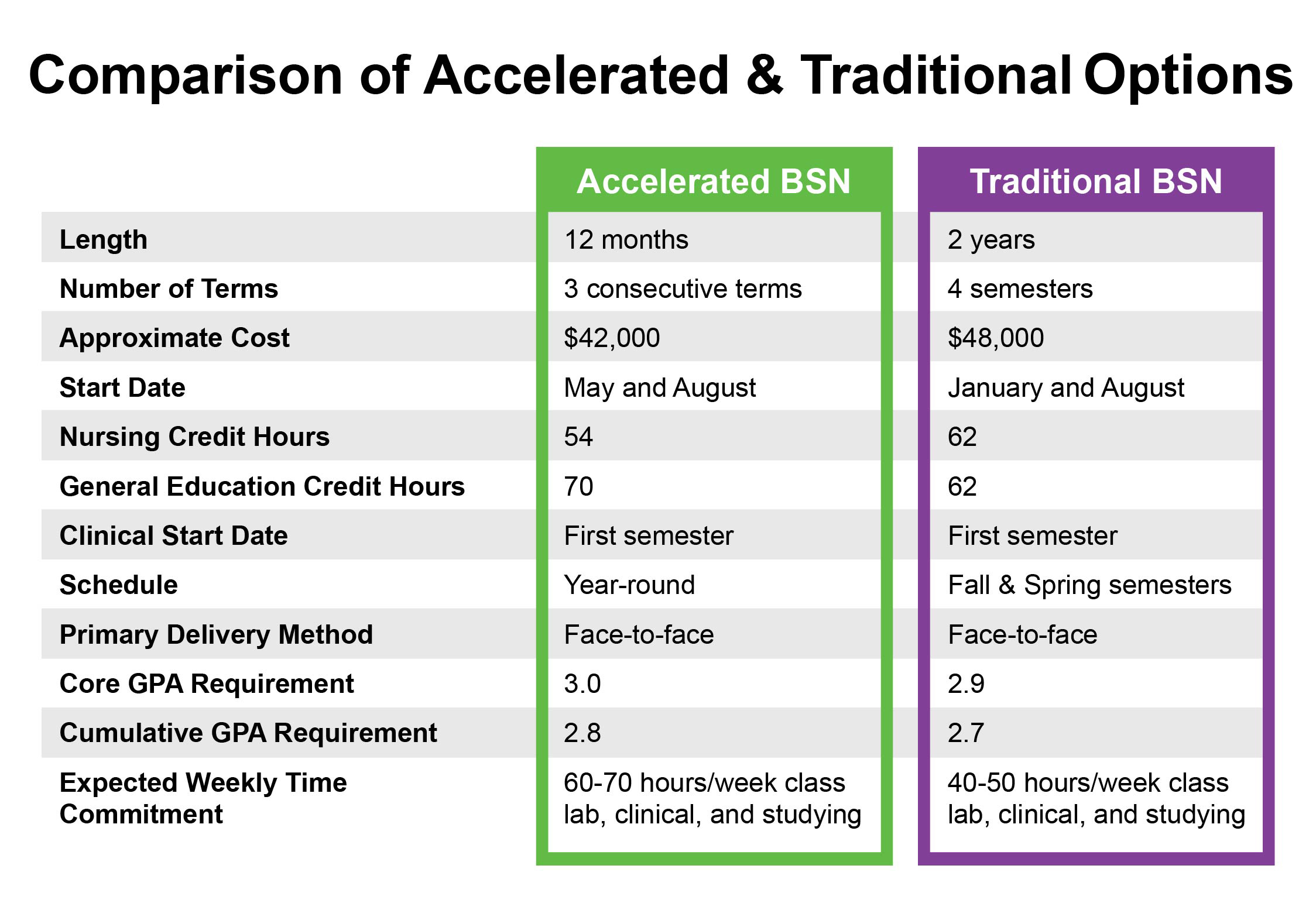
Accredited online accelerated Bachelor of Science in Nursing (ABSN) programs allow individuals who already hold a non-nursing bachelor's degree to transition into the nursing profession in 11 to 18 months. These hybrid programs combine remote didactic coursework with in-person clinical rotations, ensuring students meet the rigorous standards required to sit for the NCLEX-RN licensure examination.
Understanding the Accelerated BSN (ABSN) Model
The Accelerated Bachelor of Science in Nursing (ABSN) is specifically designed for "career changers"—professionals who have already completed a four-year degree in a field such as biology, psychology, or even the liberal arts, and now wish to enter the healthcare sector. Because these students have already fulfilled general education requirements during their first degree, the ABSN curriculum focuses exclusively on nursing science and clinical practice.
As of 2026, the demand for registered nurses (RNs) remains at an all-time high. The ABSN model addresses this shortage by condensing a traditional four-year BSN curriculum into a fraction of the time. This intensity requires a full-time commitment, often precluding students from working while enrolled. The "online" component of these programs refers to the delivery of theoretical lectures and assignments, while the "accredited" status ensures the program meets national quality standards for nursing education.
The Hybrid Reality of Online Nursing Education
It is essential to clarify that no 100% online ABSN program exists for initial licensure. Nursing is a hands-on, clinical profession that requires physical presence in healthcare settings. "Online" ABSN programs are technically hybrid; students participate in synchronous or asynchronous digital classrooms for their theory-based courses but must attend local hospitals, clinics, or simulation labs to complete their clinical hour requirements.
In 2026, many leading institutions utilize advanced telehealth simulations and virtual reality (VR) modules to supplement learning. However, these technologies enhance rather than replace the mandatory 500 to 1,000 clinical hours typically required by state boards of nursing for licensure eligibility.
The Critical Role of Accreditation in 2026
Accreditation is the most vital factor when selecting an accelerated nursing program. It serves as a rigorous peer-review process that evaluates a program’s curriculum, faculty qualifications, student outcomes, and resources. There are two primary bodies responsible for nursing accreditation in the United States:
- Commission on Collegiate Nursing Education (CCNE): An autonomous accrediting agency that ensures the quality and integrity of baccalaureate, graduate, and residency programs in nursing.
- Accreditation Commission for Education in Nursing (ACEN): This body accredits all levels of nursing education, including diploma, associate, and bachelor’s programs.
Why Accreditation Matters for Your Career
Choosing a non-accredited program can have devastating consequences for a student’s professional future. Most State Boards of Nursing will only grant an RN license to graduates of accredited programs. Furthermore, if you plan to pursue an advanced degree later—such as a Master of Science in Nursing (MSN) or a Doctor of Nursing Practice (DNP)—graduate schools will generally not accept credits or degrees from non-accredited institutions.
Furthermore, federal financial aid is almost exclusively reserved for students attending accredited colleges. Employers, particularly high-ranking Magnet hospitals, use accreditation as a primary screening tool during the hiring process to ensure their nursing staff has received a standardized, high-quality education.
Core Curriculum and Prerequisites
The curriculum of an online ABSN is fast-paced and scientifically dense. Before gaining admission, students must typically complete a series of prerequisite courses. In 2026, most programs require these credits to be no more than five to seven years old to ensure the information is current.
Common ABSN Prerequisites
- Anatomy and Physiology I & II (with labs): Essential for understanding the human body’s structure and function.
- Microbiology (with lab): Focuses on pathogens and the biological basis of infectious diseases.
- Chemistry (General or Organic): Provides the foundation for pharmacology and biochemistry.
- Statistics: Necessary for understanding evidence-based practice and medical research.
- Human Growth and Development: Covers the lifespan from infancy to geriatrics.
- Nutrition: Explores the role of diet in health maintenance and disease management.
The Professional Nursing Sequence
Once admitted, the program moves through several core areas. Students begin with "Fundamentals of Nursing," which covers basic patient care, safety, and hygiene. This is followed by "Pharmacology," where students learn the mechanisms of drug actions and safe administration. Advanced coursework includes "Medical-Surgical Nursing," "Pediatric Nursing," "Obstetric Nursing," and "Psychiatric-Mental Health Nursing." The program usually concludes with a "Leadership and Capstone" course designed to prepare students for the transition into professional practice.
Clinical Rotations and Distance Learning
A major logistical challenge for students in "online" ABSN programs is the clinical rotation. When a program is based at a university in one state but accepts students from across the country, the school must facilitate clinical placements in the student's local area.
How Clinical Placements Work
Accredited programs typically employ Clinical Placement Coordinators. These professionals work to establish contracts between the university and healthcare facilities near the student. However, students should be aware that some "distance" programs require them to travel to the university campus for intensive week-long "skills labs" several times a year. In these labs, students practice procedures like catheterization, IV insertion, and wound care on high-fidelity manikins before entering a real hospital setting.
The 2026 Clinical Landscape
In 2026, the competition for clinical spots in major metropolitan hospitals is fierce. Some online programs now offer "guaranteed placement" within a certain radius of the student’s home, while others may require the student to assist in identifying potential sites. Prospective students must verify how a program handles these placements to avoid delays in graduation.
Cost and Financial Considerations for 2026
The cost of an online ABSN program can vary significantly based on whether the institution is public or private. On average, in 2026, tuition for these programs ranges from $40,000 to $85,000 for the entire duration of the course.
Typical Cost Breakdown
| Expense Category | Estimated Range (2026) | Notes |
|---|---|---|
| Tuition | $40,000 – $85,000 | Varies by state residency and institution type. |
| Prerequisite Courses | $2,000 – $6,000 | Can be taken at community colleges to save costs. |
| Nursing Kits & Gear | $500 – $1,200 | Includes scrubs, stethoscopes, and lab supplies. |
| Textbooks & Software | $1,500 – $3,000 | Increasingly digital and subscription-based. |
| NCLEX Prep & Fees | $500 – $1,000 | Includes study resources and state licensing fees. |
Financing Your Degree
Since ABSN students already have a bachelor's degree, they may have reached their lifetime limit for certain federal undergraduate loans. However, they are still eligible for Federal Direct Unsubsidized Loans and Private Student Loans. Many healthcare systems in 2026 offer tuition reimbursement or "work-for-repayment" programs, where the hospital pays for the degree in exchange for a multi-year employment commitment after graduation.
Evaluating Program Quality: Key Metrics
When researching accredited online ABSN programs, two metrics are paramount: NCLEX-RN pass rates and graduation rates.
- NCLEX-RN Pass Rates: The National Council of State Boards of Nursing (NCSBN) tracks how many graduates pass the licensure exam on their first attempt. A pass rate consistently above 90% is a strong indicator of a high-quality curriculum and effective student preparation.
- Graduation Rates: Because these programs are exceptionally rigorous, some have high attrition rates. Look for programs with a graduation rate above 80%, which suggests the university provides adequate tutoring, faculty mentorship, and emotional support for its students.
Admission Requirements and the Application Process
Admission to accredited online ABSN programs is highly competitive. In 2026, many programs have moved toward a holistic review process, but academic performance remains a primary filter.
- Undergraduate GPA: Most programs require a minimum cumulative GPA of 3.0, though the most competitive schools often look for 3.3 or higher.
- Prerequisite Grades: Often, schools require at least a "B" in science prerequisites (Anatomy, Microbiology, Chemistry).
- Personal Statement: A narrative explaining the motivation to transition into nursing.
- Letters of Recommendation: Usually from academic or professional sources who can vouch for the applicant's ability to handle an intense workload.
- Background Check and Drug Screen: Since students will be working with vulnerable populations in clinical settings, these are mandatory before the first clinical day.
Pros and Cons of the Online ABSN Path
Deciding on an accelerated nursing path requires a balanced view of the benefits and the sacrifices involved.
Advantages
- Speed: It is the fastest route to becoming an RN for those who already have a degree.
- Flexibility: Online lectures allow students to study when they are most productive, provided they meet deadlines.
- Career Advancement: A BSN degree opens doors to management, specialized clinical roles, and graduate school.
Challenges
- Intensity: The pace is relentless. Students often cover a week's worth of material in two or three days.
- No Income: Most students find it impossible to work even part-time, leading to a temporary financial strain.
- Travel Requirements: Even "online" students must travel for clinical rotations and on-campus residencies.
Frequently Asked Questions
1. Is an online ABSN degree viewed differently by employers?
No. As long as the program is accredited by CCNE or ACEN, the degree is identical to one earned through a traditional on-campus program. Employers in 2026 prioritize your RN licensure, clinical experience, and performance during the interview. The "online" designation usually does not even appear on the final diploma.
2. Can I take my clinical rotations at any hospital?
No. Clinical rotations must be completed at healthcare facilities that have a formal legal agreement with your university. While many online programs help you find a local placement, you are restricted to the sites within the university's partner network or sites that they can successfully vet and contract.
3. How many hours a week should I expect to study?
Most ABSN students report spending between 40 and 60 hours per week on coursework and clinicals. It is essentially a full-time-plus commitment. The accelerated nature means there are very few breaks between terms.
4. What is the difference between CCNE and ACEN accreditation?
Both are highly respected and recognized by the U.S. Department of Education. CCNE focuses specifically on baccalaureate and higher-degree programs, whereas ACEN covers all levels of nursing education. For an ABSN student, either accreditation is sufficient for licensure and most graduate school applications.
5. Are there any 100% online ABSN programs?
No. Any program that claims to be 100% online without a clinical component is likely not accredited and will not lead to RN licensure. Nursing requires physical clinical hours mandated by law.
Final Recommendation for Prospective Students
If you are pursuing an accredited online ABSN program in 2026, your first step should be to verify the accreditation status via the CCNE directory or the ACEN search tool. Once accreditation is confirmed, evaluate the program's NCLEX-RN pass rates and the specifics of their clinical placement process. Before applying, complete as many prerequisites as possible at a community college to reduce costs, and ensure you have a financial plan that accounts for 12 to 18 months of intensive study without full-time employment.