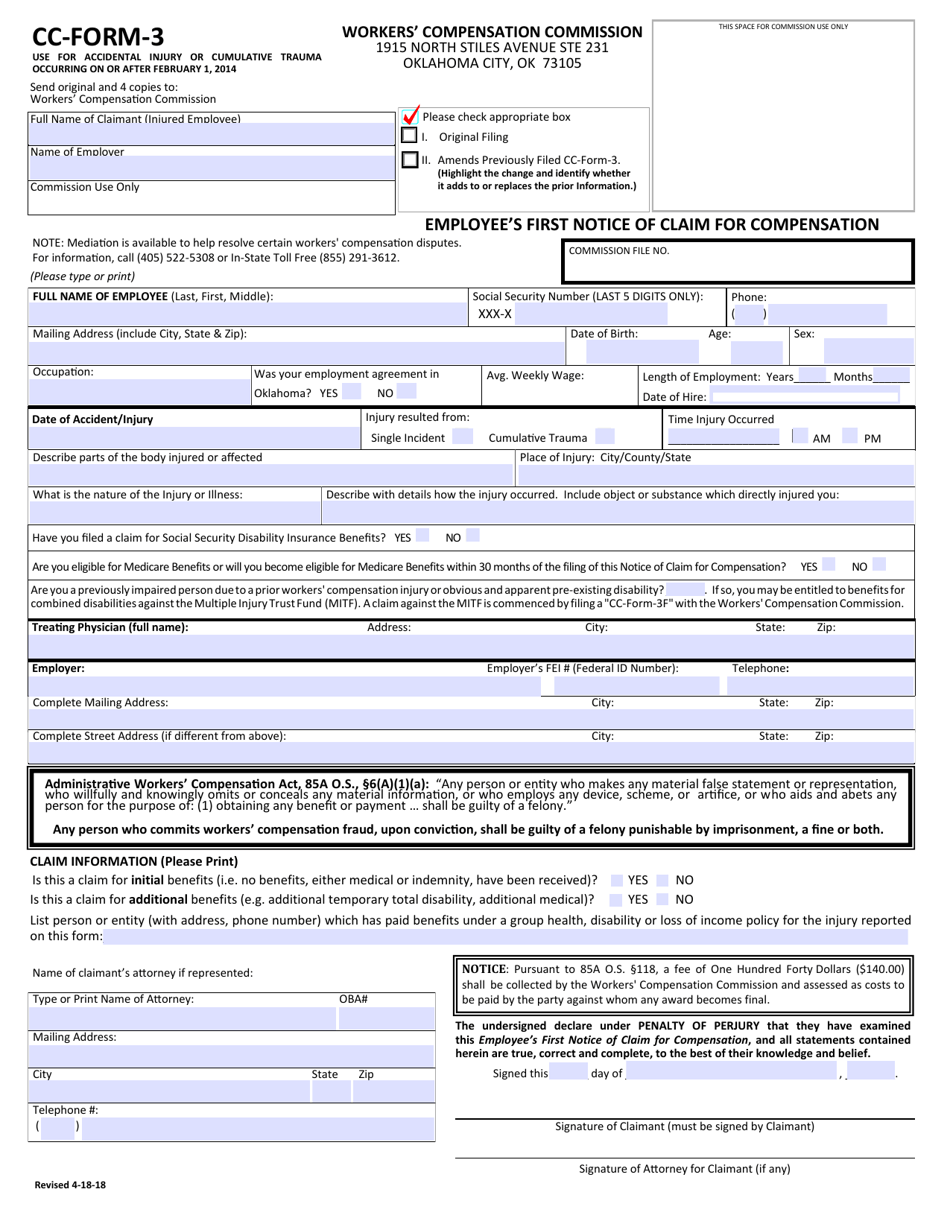
Securing an Oklahoma Form 3 for workers' compensation involves formally notifying the Oklahoma Workers' Compensation Commission of a workplace injury and initiating a claim for benefits, which requires completing the official document with precise employment, medical, and accident details, and filing it directly with the state regulatory body within statutory deadlines.
Navigating the aftermath of a workplace injury can feel overwhelming, particularly when dealing with physical recovery alongside complex administrative requirements. In Oklahoma, the workers' compensation system governs how injured employees receive medical treatment, temporary disability benefits, and permanent compensation. Central to this legal and administrative framework is Oklahoma Form 3, formally titled the "Employee's Notice of Claim for Compensation." Understanding what this document is, why it matters, and how to execute each step correctly is essential for protecting your legal rights and ensuring your claim is processed efficiently.
This guide provides a comprehensive, step-by-step breakdown of how to secure and file an Oklahoma Form 3, outlines the prerequisites, details common pitfalls to avoid, and explains what happens after the document is submitted to the Oklahoma Workers' Compensation Commission (OWCC).
Understanding Oklahoma Form 3 and Its Purpose
Oklahoma Form 3 is the foundational legal document an injured worker uses to formally initiate a claim for workers' compensation benefits through the state's regulatory system. While reporting an injury to your employer is an immediate, mandatory first step following a workplace accident, filing Form 3 submits your claim directly to the Oklahoma Workers' Compensation Commission.
The form acts as a formal legal pleading. It notifies the Commission, your employer, and your employer's insurance carrier that you sustained a work-related injury or occupational disease and are seeking statutory benefits. These benefits may include:
- Medical care and treatment related to the injury.
- Temporary total disability (TTD) benefits if you miss work while recovering.
- Temporary partial disability (TPD) benefits if you return to work at reduced wages.
- Permanent partial disability (PPD) or permanent total disability (PTD) compensation if the injury results in lasting impairment.
Filing Form 3 is distinct from the internal accident report filed with a supervisor or human resources department. While the internal report starts the internal corporate process, Form 3 activates the state's legal mechanisms for resolving disputes, enforcing compliance, and securing benefits if your claim is delayed, denied, or underpaid.
Step 1: Fulfill Prerequisites and Gather Essential Information
Before attempting to complete Oklahoma Form 3, you must ensure that preliminary requirements have been met and that you have gathered all necessary information. Attempting to fill out the form with incomplete or estimated details can result in processing delays, requests for clarification, or formal challenges from the employer's insurance defense counsel.
Mandatory Prerequisites
- Workplace Injury or Illness: You must have sustained a physical injury, psychological trauma recognized under Oklahoma law, or an occupational disease arising out of and in the course of your employment.
- Employer Notice: Under Oklahoma law (Title 85A of the Oklahoma Statutes), you generally must provide written notice of the injury to your employer within 30 days of the accident. Failing to notify your employer within this statutory window can jeopardize your right to benefits.
- Medical Evaluation: While you can file Form 3 independently, having an initial medical record establishing a causal link between your employment and your condition strengthens your filing.
Information Required for the Form
To complete Form 3 accurately, compile the following details before you begin:
- Personal Identification: Full legal name, current residential address, telephone number, email address, Social Security number, and date of birth.
- Employer Details: The exact legal business name of your employer at the time of the injury, their physical address, telephone number, and the specific department or location where you worked.
- Insurance Details (If Known): The name of your employer’s workers' compensation insurance carrier or third-party administrator (TPA), which can usually be obtained from your employer's human resources department or the workplace posting notice.
- Accident Specifications: The exact date, time, and location of the incident, alongside a detailed, concise description of how the accident occurred and what body parts were injured.
- Medical Treatment History: Names and addresses of any physicians, clinics, or hospitals where you received treatment, including the dates of service.
Step 2: Obtain the Official Oklahoma Form 3 Document
Using the correct, current version of the form is critical. Using outdated versions or unofficial templates can lead to rejection by the Oklahoma Workers' Compensation Commission.
Where to Find the Form
The official Oklahoma Form 3 is maintained by the State of Oklahoma and is publicly accessible.
- Primary Source: You can download the PDF version directly from the official Oklahoma Workers' Compensation Commission website. Navigate to their forms section, where you will find Form 3 designated for employee claims.
- Alternative Access: Legal aid organizations, labor unions, and licensed Oklahoma workers' compensation attorneys also maintain accessible copies of the document.
Technical Formats Available
The Commission typically provides Form 3 in a fillable PDF format. This allows you to type your information directly into the fields before printing, which improves legibility and reduces the risk of manual data-entry errors by commission staff. If you prefer, you can print a blank copy and complete it by hand using legible, dark blue or black ink.
Step 3: Accurately Complete the Form Sections
Completing Oklahoma Form 3 requires precision. Every section serves a distinct administrative and legal purpose. Review the following breakdown of the sections found on a standard Form 3 to ensure your information is entered correctly.
| Form Section | Required Information | Common Mistakes to Avoid |
|---|---|---|
| Employee Information | Name, SSN, DOB, Address, Contact Info | Providing an outdated address or transposing numbers in your Social Security or phone number. |
| Employer Information | Business Name, Address, Contact Person | Using a trade name or DBA instead of the official corporate entity name; omitting supervisor details. |
| Accident Details | Date, Time, Specific Location, Cause | Providing vague descriptions like "hurt my back working" instead of specific mechanics like "lifted 50-pound crate and felt lumbar sharp pain." |
| Injury Description | Affected Body Parts, Nature of Injury | Failing to list all injured body parts (e.g., listing only the shoulder while ignoring secondary neck strain resulting from the fall). |
| Medical Treatment | Treating Physicians, Facilities, Dates | Leaving out initial emergency room visits or failing to provide complete facility names. |
| Signature & Verification | Dated Signature, Certification | Signing without reviewing for accuracy; failing to date the document. |
Precision in Describing the Injury
When describing the accident and the parts of the body affected, be comprehensive. If you hit your head, injured your shoulder, and twisted your knee during a fall, list all three areas. Omitting a body part initially can create significant evidentiary hurdles later if secondary symptoms manifest after the initial filing deadline.
Step 4: File Oklahoma Form 3 with the Commission
Once Form 3 is completed and thoroughly reviewed, it must be officially submitted to the Oklahoma Workers' Compensation Commission. Filing formally starts the administrative clock and triggers legal obligations for your employer and their insurance carrier.
Submission Methods
The OWCC provides multiple avenues for filing claims:
- Online Filing Portal: The Commission operates an electronic filing system (often referred to as the OWCC Electronic Case Filing system or similar portal) that allows attorneys, and in some cases pro se claimants, to upload documents securely. Utilizing the online portal provides instant confirmation of receipt.
- Mail or Hand Delivery: You can file physical copies by mailing or hand-delivering them to the primary administrative office of the Oklahoma Workers' Compensation Commission.
Note: Always verify current physical submission addresses and electronic portal availability directly on the official OWCC website, as administrative procedures and portal links are subject to periodic updates.
Serving Copies to Other Parties
Under standard administrative practice, the Commission notifies the employer and their insurance carrier once a claim is filed. However, keeping copies of everything you submit—including proof of delivery or electronic filing confirmation receipts—is a vital protective measure.
Step 5: Understand Statutes of Limitations and Deadlines
Timing is one of the most critical elements of a successful workers' compensation claim in Oklahoma. Missing a statutory deadline can result in the permanent barring of your right to compensation.
Key Deadlines to Monitor
- Notice to Employer: As noted, you generally have 30 days from the date of the accident to provide written notice to your employer.
- Statute of Limitations for Filing Form 3: Under Oklahoma law (85A O.S. § 68), a claim for compensation is barred unless filed with the Workers' Compensation Commission within two years from the date of the accident. If the employer has paid temporary disability compensation or provided medical treatment voluntarily, different timelines or extensions may apply, but relying on exceptions is risky.
- Occupational Diseases: For cumulative trauma or occupational diseases, the statute of limitations typically begins to run from the date the employee first knew, or should have known through reasonable diligence, that the condition was caused by their employment.
What Happens After You File Form 3?
Filing Oklahoma Form 3 initiates a sequence of events governed by the Oklahoma Administrative Code and Title 85A of the Oklahoma Statutes. Knowing what to expect helps you navigate the subsequent stages of your claim.
1. Assignment of a Claim Number
Upon receipt and processing by the OWCC, your case will be assigned a specific Commission file number (often formatted as a claim number). You must reference this number on all subsequent correspondence, medical submissions, or legal motions.
2. Insurance Carrier Response
The employer's insurance carrier has a statutory window to review the claim, investigate the accident, and either accept or contest liability.
- Acceptance: If accepted, the insurer will authorize medical treatment and issue applicable temporary disability benefits.
- Contestment / Denial: If the insurer files a denial (often via Form 9 or a formal answer), the matter will be set for a pre-hearing conference or trial before an Administrative Law Judge (ALJ).
3. Dispute Resolution and Hearings
If a dispute arises—such as a denial of medical treatment, a disagreement over temporary disability calculations, or disputes regarding permanent impairment ratings—either party may request a hearing before the Commission. During this process, medical evidence, depositions, and witness testimony are evaluated by an ALJ.
Common Mistakes to Avoid When Securing Form 3
Avoiding procedural errors minimizes the risk of claim denial or unnecessary delays. Keep the following pitfalls in mind:
- Waiting Too Long: Waiting until the end of the two-year statute of limitations makes it difficult to establish a clear causal link between your current medical condition and the workplace incident.
- Incomplete Information: Omitting your Social Security number, employer's exact legal entity name, or specific insurance carrier details causes administrative delays as commission staff attempt to verify data.
- Confusing Internal Reporting with State Filing: Believing that telling your manager about the injury satisfies the requirement to file Form 3 with the state commission is a frequent error. Internal reporting does not notify the state regulatory body.
- Inconsistent Statements: Ensuring that the description of the accident provided on Form 3 matches what you told your treating physician and your employer prevents insurance defense attorneys from using discrepancies to challenge your credibility.
Summary and Recommended Next Actions
Securing an Oklahoma Form 3 for workers' compensation is a structured process designed to protect your financial and medical well-being after a workplace injury. By verifying your eligibility, gathering accurate employment and medical data, completing the document with precision, and submitting it to the Oklahoma Workers' Compensation Commission within statutory deadlines, you establish a formal legal record of your claim.
Recommended Next Actions
- Verify Deadlines: Confirm the exact date of your injury and calculate your remaining time under the two-year statute of limitations, keeping the 30-day employer notice requirement in mind.
- Download the Official Form: Visit the Oklahoma Workers' Compensation Commission website to access the current fillable PDF version of Form 3.
- Consult Professionals if Needed: If your claim involves complex disputed liabilities, severe permanent injuries, or an outright denial from your employer's insurance carrier, consider consulting a licensed Oklahoma workers' compensation attorney to protect your rights throughout the administrative process.