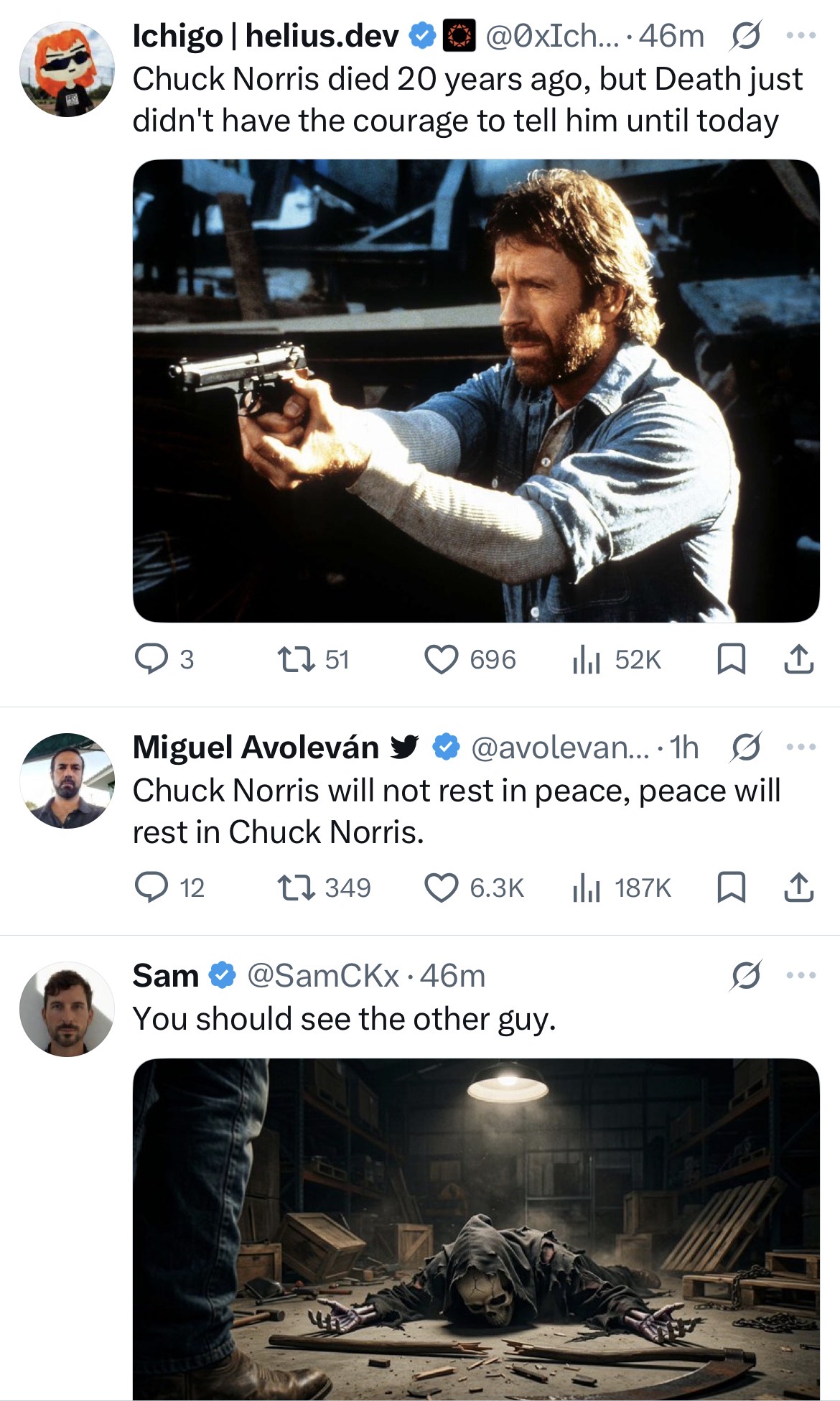
The "Chuck Norris died 20 years ago" meme is a digitally manufactured rumor that functions as a paradoxical extension of the original "Chuck Norris Facts" internet phenomenon. It is factually incorrect; the actor and martial artist Carlos Ray "Chuck" Norris is alive, having been born on March 10, 1940. This specific iteration serves as a testament to the enduring, hyperbolic nature of internet myth-making, where the subject’s legendary status is tested against the permanence of digital misinformation.
The Origins of the Chuck Norris Factosphere
To understand why someone would circulate a rumor about Chuck Norris dying two decades ago, one must first look at the cultural explosion of "Chuck Norris Facts" that began around 2005. These were satirical, hyperbolic statements attributing god-like powers to the actor. Examples included claims that "Chuck Norris can divide by zero" or that "Chuck Norris doesn’t do push-ups; he pushes the earth down."
This humor was built on the foundation of Norris’s image as a stoic, indestructible action hero, largely derived from his roles in Walker, Texas Ranger and various 1980s martial arts films. When the internet began to aggregate these "facts," it created a feedback loop where the more absurd the claim, the more "truthful" it felt to his fans. The "died 20 years ago" meme is a subversion of this loop. It plays with the cognitive dissonance of the audience: if Chuck Norris is truly invincible, the rumor of his death—especially one that predates the peak of the meme culture itself—becomes a logical impossibility that fans treat as a joke.
Deconstructing the 20-Year Death Timeline
The claim that Chuck Norris died 20 years ago—which, in the current year of 2026, would place his alleged passing in 2006—is a classic example of "death hoax" spam. Internet death hoaxes are a common phenomenon targeting celebrities, often used to drive traffic to clickbait websites, test the virality of misinformation, or simply troll online communities.
However, the "20 years ago" figure is specifically ironic. In 2006, Chuck Norris was at the absolute zenith of his online popularity. The Walker, Texas Ranger series had recently concluded (2001), and the Chuck Norris Facts book was released in 2005. By claiming he died in 2006, the meme suggests that the Chuck Norris we have seen in public appearances, television commercials, and internet media for the last two decades is either an imposter, a ghost, or a force so powerful that death itself was simply an inconvenience he chose to ignore. This aligns with the "Chuck Norris Fact" logic: Chuck Norris didn't die; he just got tired of living in the same dimension as everyone else.
The Role of Digital Permanence in Celebrity Hoaxes
Digital permanence is a double-edged sword. While it allows for the preservation of history, it also allows misinformation to linger indefinitely. The "Chuck Norris died" narrative persists because social media algorithms often prioritize engagement over veracity. When a user posts a "shocking" claim about a celebrity's death, the initial reaction from others—frequently defensive, mocking, or confused—drives the post higher in feeds.
This specific meme also highlights how audiences interact with "meme longevity." Unlike traditional celebrity gossip, which usually fades once a death is proven false, the Chuck Norris meme community treats any mention of his "death" as a prompt to generate more jokes. The rumor is not a genuine report, but rather a performance art piece in which the "fact" is secondary to the ironic commentary it invites from the user base.
Verifying Celebrity Status: How to Spot a Hoax
The internet is rife with misinformation, and determining the truth about a celebrity's health requires more than just checking social media trends. To distinguish between a genuine news event and an internet hoax, one should adhere to a standard verification process.
Verification Checklist
- Source Credibility: Are major, reputable news outlets (e.g., The Associated Press, Reuters, BBC) reporting the news? If the information is only appearing on clickbait blogs or social media platforms, it is almost certainly false.
- Date Context: Check the timestamps on the reports. Hoaxes often recycle old stories, merely changing the names or locations.
- Official Channels: Check the celebrity’s verified social media accounts or official representative websites. If a person of Chuck Norris's fame were to pass away, official statements would be released immediately.
- Contextual Analysis: Is the claim hyperbolic? Rumors that defy standard biology or physical reality are usually satirical in nature and should be treated as such.
Comparative Look at Similar Internet Myths
The "Chuck Norris died" narrative shares DNA with other famous celebrity death hoaxes. Table 1 below outlines how these rumors operate and how they differ from the Norris phenomenon.
| Hoax Type | Primary Motivation | Target Audience | Survival Mechanism |
|---|---|---|---|
| The "Death Hoax" | Traffic/Ad Revenue | General Public | Debunked by fact-checkers; fades over time. |
| The "Paul is Dead" | Paranoia/Conspiracy | Dedicated Fans | Becomes a piece of "lore" or historical curiosity. |
| The "Chuck Norris" | Satire/Humor | Meme Culture | Becomes a recurring joke; "immortal" status. |
As evidenced, the Chuck Norris meme is unique because it is rarely intended to deceive. Instead, it acts as a cultural touchstone that relies on the audience being "in on the joke." While a traditional death hoax aims to trick people, the Norris meme uses death as a punchline to reinforce the idea of his supernatural, meme-generated invincibility.
The Cultural Impact of Perpetuating Myths
Why does this meme persist in 2026? It serves as a form of social cohesion among internet users who grew up during the "Web 2.0" transition. Sharing a "Chuck Norris died 20 years ago" post is a way to signal participation in a shared history of internet humor. It reminds older users of the early days of message boards and viral emails, while introducing newer users to the "Chuck Norris Facts" lore.
Furthermore, these myths illustrate the evolution of how we view celebrities. In the past, the public might have been concerned by a rumor of a star's death. Today, the public treats the celebrity as a brand or a character. Because Chuck Norris has spent two decades leaning into his own meme status—even starring in commercials that play with his "tough guy" image—he has essentially granted the public permission to treat his life as a source of endless creative speculation.
Common Misconceptions and FAQ
1. Did Chuck Norris retire from public life in 2006?
No. While his high-profile television roles decreased after Walker, Texas Ranger, he has remained active in film, endorsements, and martial arts advocacy. His public presence has been consistent throughout the last two decades.
2. Why do people say he died 20 years ago specifically?
The "20 years ago" marker is a fluid time frame that changes as time passes. It is a rhetorical device used to make the claim feel like an "established historical fact" that people have simply forgotten, adding an extra layer of irony for those who know better.
3. Is it harmful to spread death hoaxes about celebrities?
While the Chuck Norris meme is clearly satirical, persistent death hoaxes can be harmful. They can cause genuine distress to a celebrity's family, clutter news cycles, and contribute to a general erosion of trust in digital information. Always check credible sources before sharing "breaking news" about anyone's health.
4. How does Chuck Norris feel about these memes?
Chuck Norris has generally expressed amusement at the "Chuck Norris Facts." He has acknowledged their role in keeping his name relevant to younger generations, provided the content remains in the realm of harmless, hyperbolic humor.
5. Where can I find accurate information about Chuck Norris?
For reliable information regarding his career, appearances, and life, refer to the Internet Movie Database (IMDb) for professional history, or follow his verified social media profiles for current, first-party updates.
Moving Forward: The Legacy of the Meme
In 2026, the internet looks very different than it did in 2006. We have moved from static, text-based forums to hyper-speed short-form video and algorithmic content feeds. Yet, the "Chuck Norris died 20 years ago" meme proves that some concepts are "internet-proof." They survive through platform migrations and cultural shifts because they are not based on data, but on a collective, agreed-upon mythology.
If you encounter this meme, understand that it is not a signal of a real event, but a reflection of how deeply the "Chuck Norris" figure has been integrated into the fabric of the web. It is a reminder that in the digital age, a person can be more than an actor—they can be a conceptual anchor, a character whose "life" or "death" is entirely controlled by the imagination of the public. The next time you see the claim, you can rest assured that the reality remains far more grounded: Chuck Norris is still here, and the meme is just getting started on its third decade.