Long-term care insurance provides the necessary financial resources to cover assistance with activities of daily living (ADLs) or supervision required due to cognitive impairment. In 2026, consumers navigate a landscape featuring traditional stand-alone policies, hybrid life-and-LTC products, and state-based partnership programs designed to protect personal assets while ensuring quality care in various settings.
Planning for long-term care is one of the most significant financial challenges facing aging adults. Unlike standard health insurance, which focuses on medical cures and acute treatments, long-term care insurance (LTCI) is designed to fund custodial care—the type of help needed when a person can no longer perform basic tasks independently. As of 2026, the cost of professional care continues to rise, making a structured insurance strategy essential for protecting retirement savings and ensuring autonomy in care choices.
Understanding the Need for Long-Term Care Insurance
The primary driver for seeking long-term care insurance is the high cost of formal care services, which are largely excluded from traditional health insurance and Medicare. Medicare is designed for short-term rehabilitative care, typically covering up to 100 days in a skilled nursing facility following a qualifying hospital stay, with significant co-payments after the first 20 days. It does not pay for long-term "custodial care," which represents the majority of care needs for seniors.
Medicaid does cover long-term care, but it is a means-tested program. To qualify, individuals must generally spend down their countable assets to very low levels (often $2,000 or less, depending on the state). LTCI acts as a bridge, allowing individuals to access high-quality care in their preferred environment—whether at home, in assisted living, or in a nursing home—without depleting their entire estate or relying on government assistance.
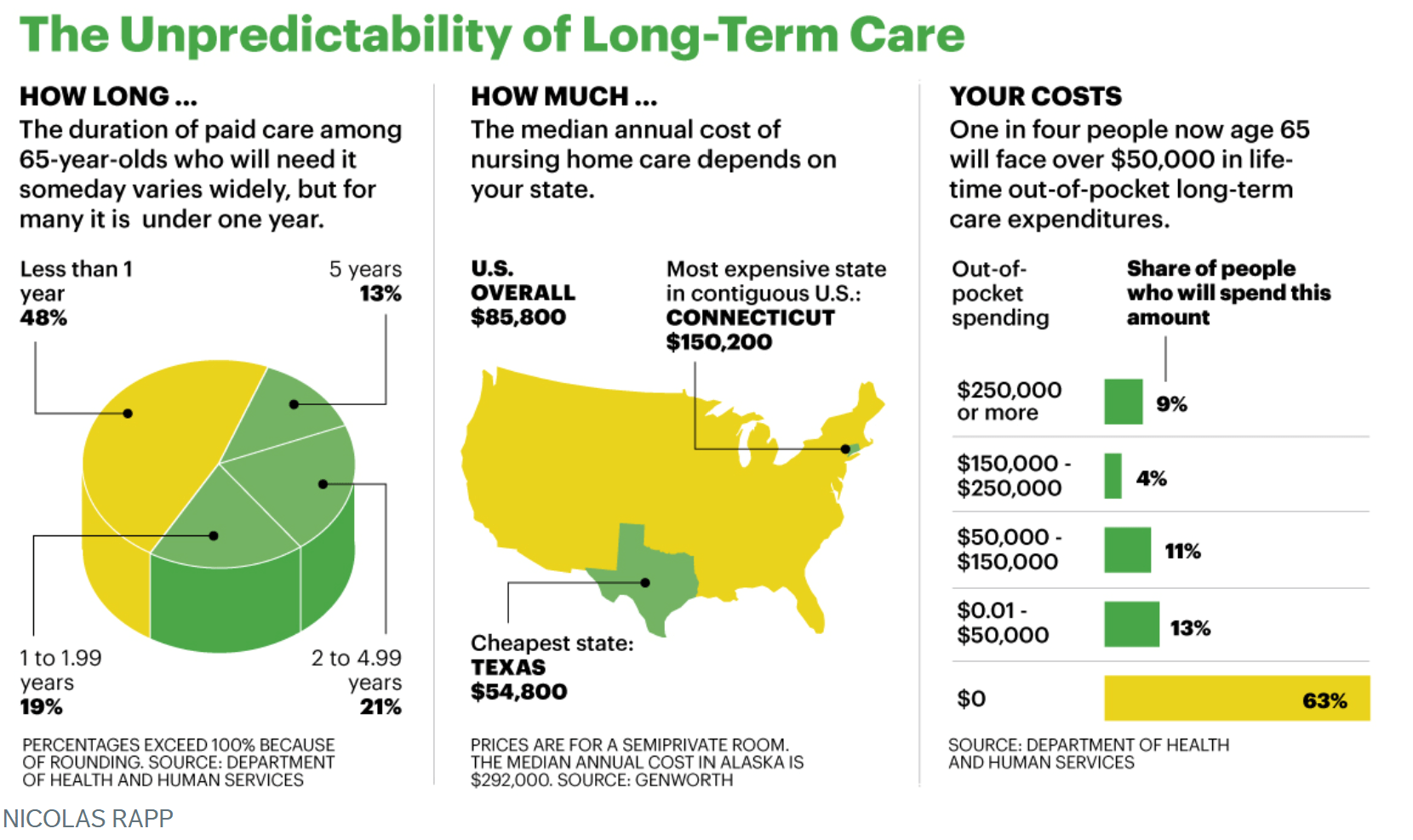
Statistics from the U.S. Department of Health and Human Services consistently show that approximately 70% of people turning age 65 will need some type of long-term care services during their remaining years. While some may only need help for a few months, others, particularly those with Alzheimer’s or other forms of dementia, may require intensive care for a decade or longer.
Traditional Long-Term Care Insurance
Traditional long-term care insurance, often referred to as "stand-alone" LTCI, was the original model for this coverage. It functions similarly to auto or home insurance: you pay a premium, and if you need care that meets the policy's triggers, the insurance company pays a benefit.
How Traditional Policies Work
These policies are generally "tax-qualified" under Section 7702B of the Internal Revenue Code. This means the benefits paid out for qualified long-term care services are generally tax-free, and a portion of the premiums may be tax-deductible depending on the policyholder's age and income.
Traditional policies allow for high levels of customization. Consumers can select:
- The Daily or Monthly Benefit: The maximum amount the policy will pay for care each day or month.
- The Benefit Period: The length of time the policy will pay (e.g., three years, five years, or occasionally "lifetime").
- Elimination Period: The "deductible" measured in days (commonly 90 days) that the policyholder must pay for care out of pocket before insurance payments begin.
Pros and Cons of Traditional LTCI
The primary advantage of traditional LTCI is that it typically offers the most "bang for your buck" in terms of pure long-term care leverage. For a relatively lower annual premium compared to hybrid products, you can secure a large pool of money for care.
The downside is the "use it or lose it" nature of the product. If you never require long-term care, the insurance company keeps the premiums, and there is no benefit paid to your heirs. Furthermore, while most modern policies are "guaranteed renewable," the premiums are not guaranteed to stay level. Insurance companies can (and often do) request rate increases from state regulators if the claims experience for a specific "block" of business is worse than originally projected.
Hybrid Life Insurance and LTC Options
In 2026, hybrid policies (also known as linked-benefit policies) have become the most popular choice for many consumers. These products combine a life insurance policy or an annuity with a long-term care rider.
The Linked-Benefit Mechanism
Hybrid policies solve the "use it or lose it" dilemma. If you need long-term care, you can access the policy's death benefit while you are still alive to pay for those costs. If you die without needing much or any care, your beneficiaries receive a death benefit. If you change your mind later, many of these policies offer a "return of premium" feature, allowing you to get most or all of your money back.
These policies are often funded with a single lump sum or a fixed series of payments (e.g., over 10 years). This provides the benefit of guaranteed premiums—once the policy is funded, the insurance company cannot ask for more money, and the benefits are locked in.
Asset-Based Annuity Hybrids
For those who may be uninsurable for traditional life insurance due to health issues, LTC-annuity hybrids can be an alternative. These involve depositing a sum into an annuity that provides a simplified underwriting process. If LTC is needed, the annuity pays out at a multiple of its value (e.g., three times the account value) for care. Under the Pension Protection Act, the growth within these specific annuities used for LTC is often tax-free.
Key Policy Components and Definitions
Navigating the options requires a firm grasp of the technical terms that dictate how and when a policy pays out.
Benefit Triggers
To start receiving benefits, a policyholder must meet "benefit triggers." In 2026, standard tax-qualified policies require a healthcare professional to certify that the individual:
- Is unable to perform at least two of the six Activities of Daily Living (ADLs) for a period expected to last at least 90 days. The ADLs are bathing, continence, dressing, eating, toileting, and transferring.
- Requires substantial supervision due to severe cognitive impairment (such as Alzheimer's or dementia) to protect their health and safety.
Inflation Protection
Because the cost of care in 2026 is higher than it was a decade ago, and will likely be higher a decade from now, inflation protection is a vital component.
- Compound Inflation (3% or 5%): The daily benefit increases automatically every year by a set percentage. This is the most robust option but also the most expensive.
- Simple Inflation: The benefit increases by a percentage of the original benefit amount each year.
- GPO (Guaranteed Purchase Option): Allows you to buy more coverage at specific intervals without new medical underwriting, though the premium for the added coverage will be based on your attained age.
Reimbursement vs. Indemnity
Most policies operate on a reimbursement basis, meaning they pay back the actual costs incurred for care, up to the daily limit. Indemnity policies (sometimes called "cash-benefit" policies) pay the full daily benefit amount regardless of the actual cost of care, once the trigger is met. Indemnity policies provide more flexibility—for example, to pay a family member for care—but are generally more expensive.
Comparing Long-Term Care Insurance Options
The following table summarizes the primary differences between the three most common LTC insurance structures available to consumers in 2026.
| Feature | Traditional LTCI | Hybrid (Life + LTC) | LTC-Annuity Hybrid |
|---|---|---|---|
| Primary Benefit | Long-term care only | Death benefit + LTC | Income + LTC |
| Premium Stability | Premiums can increase | Generally guaranteed/fixed | Single premium or fixed |
| "Use it or Lose it" | Yes (No benefit if unused) | No (Death benefit if unused) | No (Account value remains) |
| Underwriting | Most stringent | Stringent to Moderate | Simplified/Moderate |
| Funding Method | Ongoing annual premiums | Lump sum or 10-pay | Lump sum transfer |
| Tax Treatment | Premiums may be deductible | LTC benefits tax-free | LTC benefits tax-free |
State Partnership Programs
A critical consideration for many middle-class consumers is the Long-Term Care Partnership Program. This is a collaboration between state governments and private insurance companies.
If you purchase a "Partnership-qualified" policy and eventually exhaust its benefits, you may be able to qualify for Medicaid while keeping more assets than normally allowed. For every dollar the private insurance policy pays out in benefits, you get "asset neglect" or "dollar-for-dollar" credit.
For example, if a Partnership policy pays out $250,000 for your care, you can apply for Medicaid and keep $250,000 in assets above the standard Medicaid limit (usually $2,000). This protects your legacy for heirs while ensuring you still have access to the safety net if your care needs are catastrophic. Most states require a specific level of inflation protection for a policy to be Partnership-qualified, particularly for younger applicants.
Cost Factors and Underwriting
The cost of long-term care insurance is determined by several factors, with age and health being the most significant.
- Age at Purchase: The younger you are when you apply, the lower the premium. Most experts suggest looking at options between ages 50 and 65.
- Health Status: Insurance companies conduct medical underwriting, which includes a review of medical records, a cognitive screening, and sometimes a physical exam. Conditions like advanced diabetes, Parkinson's, or recent strokes can lead to a denial of coverage.
- Gender: Because women statistically live longer and are more likely to require long-term care, they typically pay higher premiums for traditional LTCI than men of the same age.
- Marital Status: Many insurers offer a "spousal discount" (often 15% to 30%) if both partners apply for coverage together, as the risk of one partner caring for the other reduces the immediate likelihood of a claim.
Common Pitfalls to Avoid
When selecting a guide to long-term care options, consumers should be wary of these frequent mistakes:
- Waiting Too Long: Health can change in an instant. If you wait until a diagnosis occurs, you will likely be uninsurable.
- Over-Insuring: You do not necessarily need to cover 100% of the cost of care. You can "co-insure" by using your Social Security or pension income to cover a portion of the daily rate and using the insurance to cover the gap.
- Ignoring Home Care Coverage: Ensure the policy has a "comprehensive" trigger that covers home-based care, not just nursing home stays. Most people prefer to age in place, and modern policies are designed to support this.
- Neglecting the Elimination Period: A 90-day elimination period is standard, but you must have the liquid savings to pay for those first three months of care out of pocket.
Frequently Asked Questions
What is the best age to buy long-term care insurance?
Generally, the "sweet spot" is between ages 52 and 64. At this stage, premiums are relatively affordable, and you are more likely to pass medical underwriting. Waiting until age 70 significantly increases the premium and the risk of being declined for health reasons.
Does long-term care insurance cover care provided by family members?
It depends on the policy. Traditional reimbursement policies usually require care to be provided by a licensed agency or professional. Indemnity or "cash-benefit" policies provide a monthly check that you can use to pay anyone, including a family member, though these policies are less common and more expensive.
Are long-term care insurance premiums tax-deductible in 2026?
For individuals, premiums for tax-qualified LTCI policies are considered a medical expense. If your total unreimbursed medical expenses exceed 7.5% of your adjusted gross income (AGI), you may be able to deduct the premium up to certain age-based limits set annually by the IRS. Business owners (especially C-corps) may be able to deduct the entire premium as a business expense.
What happens if the insurance company goes out of business?
Insurance companies are regulated by state departments of insurance. If an insurer becomes insolvent, the State Guaranty Association provides a level of protection to policyholders. Limits vary by state but typically cover at least $300,000 in long-term care benefits.
Can I use my Health Savings Account (HSA) to pay for LTCI?
Yes. You can use tax-free distributions from an HSA to pay for the premiums of a "tax-qualified" long-term care insurance policy, up to the age-based limits defined by the IRS each year.
Practical Next Steps
To choose the right long-term care insurance option, start by calculating your potential "gap." Determine the current daily cost of a private room in a nursing home or 40 hours a week of home health care in your specific geographic area using resources like the Genworth Cost of Care Survey. Compare this against your projected retirement income.
Consult with an independent specialist who represents multiple insurance carriers rather than a "captive" agent who only sells one brand. Request quotes for both a traditional policy and a hybrid policy to see which aligns better with your cash flow and estate planning goals. Finally, verify if your state offers a Partnership Program and ensure any policy you consider meets the requirements for asset protection.