The Army risk management process is a systematic, five-step cyclical framework designed to identify hazards, assess their impact, and implement controls to mitigate danger while maximizing mission accomplishment. Guided by Army Techniques Publication (ATP) 5-19, this process applies to all tactical and non-tactical activities to ensure informed decision-making across all levels of command.
Understanding the Foundation of Army Risk Management
As we operate in the year 2026, the complexity of military environments—ranging from large-scale combat operations to humanitarian assistance—demands a rigorous approach to safety and efficiency. Risk Management (RM) is not a secondary safety program; it is an inherent part of the Military Decision-Making Process (MDMP) and Troop Leading Procedures (TLP). The primary goal of RM is to preserve combat power and resources while enabling leaders to take necessary, calculated risks to achieve objectives.
The process is grounded in four fundamental principles that dictate how soldiers and leaders approach any task:
- Integrate RM into all phases of missions and operations: Risk assessment begins during the initial planning phase and continues through preparation, execution, and recovery.
- Make risk decisions at the appropriate level: A risk decision is the formal acceptance of a specific level of risk by the leader who has the authority to do so (usually the commander).
- Accept no unnecessary risk: Every operation carries inherent danger, but any risk that does not contribute to mission success or safe training should be eliminated or controlled.
- Apply RM cyclically and continuously: The environment is dynamic. As conditions change, hazards must be re-evaluated and controls adjusted.
The Five Steps of the Army Risk Management Process
The Army utilizes a standardized five-step process to ensure consistency across the force. Whether a unit is planning a live-fire exercise or a long-haul convoy, these steps remain the same.
Step 1: Identify the Hazards
A hazard is any condition with the potential to cause injury, illness, or death of personnel; damage to or loss of equipment or property; or mission degradation. During this step, leaders look at the entire operational environment through the lens of METT-TC (Mission, Enemy, Terrain and weather, Troops and support available, Time available, and Civil considerations).
- Mission: Complexity, duration, and psychological stress.
- Enemy: Capabilities, intent, and likelihood of engagement.
- Terrain and Weather: Visibility, temperature extremes, steepness, and soil stability.
- Troops: Training level, fatigue, and equipment status.
- Time: Rushed planning or inadequate rest cycles.
- Civil Considerations: Proximity to non-combatants and cultural sites.
Identification involves looking beyond the obvious. For example, in a vehicle maintenance shop, the hazard isn't just "working on trucks"; it is the specific potential for hydraulic fluid spills, heavy lifting injuries, or eye damage from grinding metal.
Step 2: Assess the Hazards
Once hazards are identified, they must be analyzed to determine their impact. This is done by looking at two factors: Probability and Severity.
- Probability is the likelihood that a hazard will result in an adverse event. It is categorized into five levels: Frequent, Likely, Occasional, Seldom, and Unlikely.
- Severity is the expected consequence of an event, measured by the degree of injury, property damage, or mission impact. It is categorized into four levels: Catastrophic, Critical, Moderate, and Negligible.
By plotting probability and severity on the standard Army Risk Assessment Matrix, leaders determine the initial risk level: Low, Moderate, High, or Extremely High.
Step 3: Develop Controls and Make Risk Decisions
After assessing the risk, leaders must develop controls to mitigate or eliminate the hazards. Controls generally fall into three categories:
- Educational Controls: Based on knowledge and skills. Examples include safety briefings, specialized training, and rehearsals.
- Physical Controls: Tangible barriers or equipment. Examples include safety goggles, guardrails, speed limiters, or high-visibility vests.
- Hazard Elimination: Removing the hazard entirely, such as choosing a different route to avoid a known landslide area.
Once controls are developed, the leader determines the Residual Risk—the level of risk remaining after controls are applied. If the residual risk is still "High" or "Extremely High," the decision to proceed must be elevated to a higher-ranking commander (typically a General Officer for Extremely High risks).
Step 4: Implement Controls
A control is only effective if it is integrated into the operation. This step ensures that the controls identified in Step 3 are communicated to the lowest level and resourced. Implementation can involve:
- Writing controls into the Operation Order (OPORD) or Fragmentary Order (FRAGO).
- Updating Standard Operating Procedures (SOPs).
- Ensuring specific equipment (like fire extinguishers or PPE) is on-site and functional.
- Clearly briefing every soldier on the specific hazards and the measures taken to mitigate them.
Step 5: Supervise and Evaluate
This is often the most overlooked step but is arguably the most critical. Supervision involves ensuring that soldiers are actually following the implemented controls. Evaluation occurs both during and after the operation.
During the mission, leaders monitor for "complacency" or "risk drift," where soldiers might stop following safety protocols as they become tired or overconfident. After the mission, the unit conducts an After Action Review (AAR) to determine if the controls worked and how the process can be improved for future operations.
The Risk Assessment Matrix
The following table illustrates the standard Army methodology for determining risk levels based on ATP 5-19 standards.
| Severity \ Probability | Frequent | Likely | Occasional | Seldom | Unlikely |
|---|---|---|---|---|---|
| Catastrophic | Extremely High | Extremely High | High | High | Moderate |
| Critical | Extremely High | High | High | Moderate | Low |
| Moderate | High | Moderate | Moderate | Low | Low |
| Negligible | Moderate | Low | Low | Low | Low |
Definition of Severity Levels
- Catastrophic: Death, permanent total disability, complete mission failure, or major property loss.
- Critical: Permanent partial disability, major illness, significant mission degradation, or significant property damage.
- Moderate: Minor injury or illness, compensable injury/illness, or some mission degradation.
- Negligible: First aid treatment only, or very slight mission impact/property damage.
Documentation: The DD Form 2977
In the 2026 operational environment, documentation remains a cornerstone of accountability. The primary tool for documenting the Army risk management process is the DD Form 2977, Deliberate Risk Assessment Worksheet (DRAW). This form replaces many older, unit-specific risk assessment sheets and provides a standardized format across the Department of Defense.
The DRAW requires leaders to list each hazard, the initial risk, the specific controls to be implemented, how those controls will be supervised, and the resulting residual risk. Most importantly, it includes a signature block for the "Risk Decision Authority," ensuring that the leader responsible for the mission is the one who officially accepts the risk.
Deliberate vs. Real-Time Risk Management
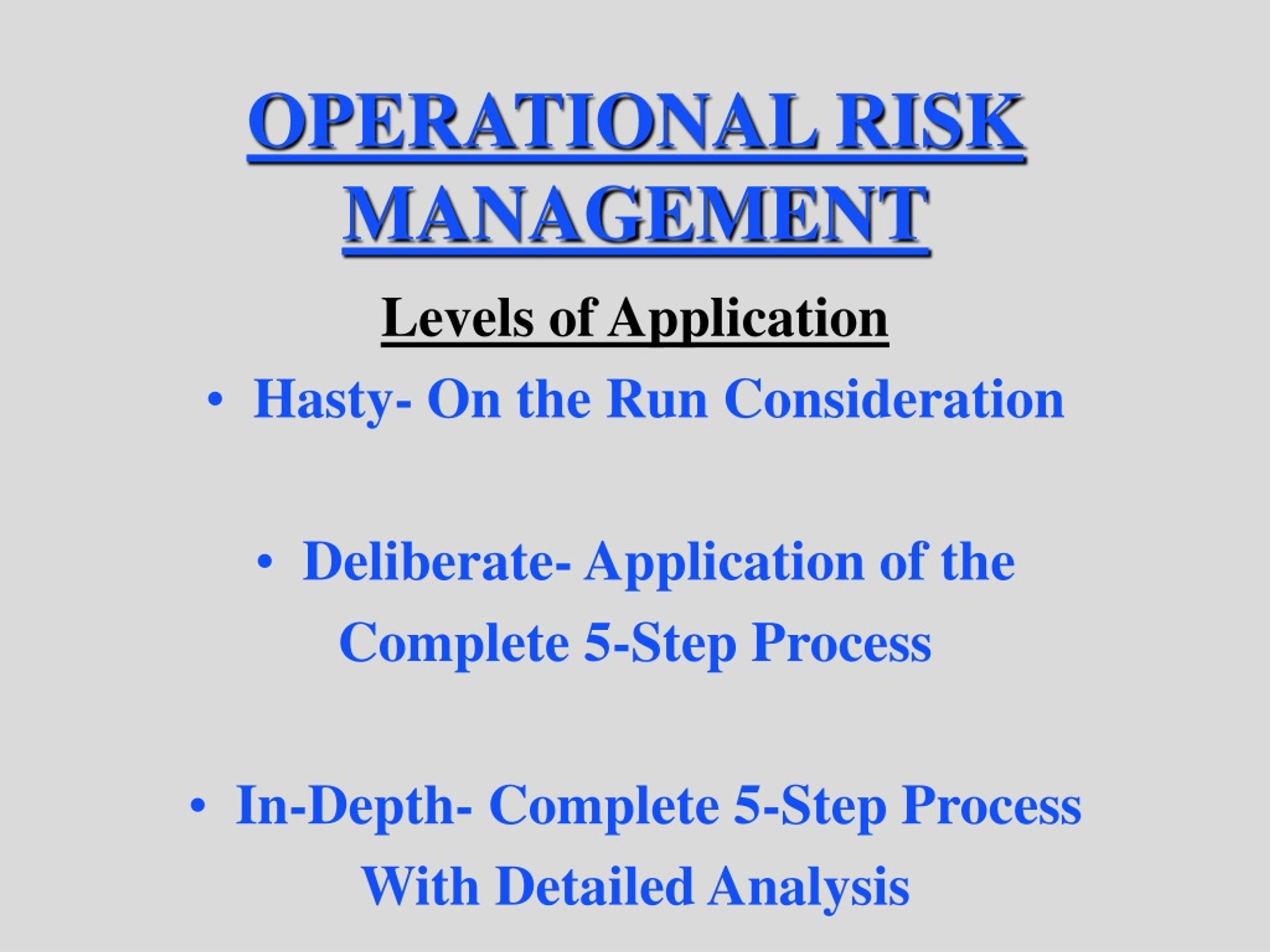
While the five-step process is the same, it is applied differently depending on the situation.
Deliberate Risk Management
Deliberate RM is used when there is ample time for planning. This typically occurs during the planning of training exercises, major deployments, or complex maintenance tasks. It involves formal documentation (DD Form 2977), detailed analysis, and often several levels of review.
Real-Time Risk Management
Real-time RM is the application of the five steps "on the fly" during mission execution. When an unexpected event occurs—such as a sudden change in weather, a vehicle breakdown in a hostile area, or an unexpected civilian presence—leaders must rapidly run through the RM steps mentally or through quick verbal coordination. Real-time RM relies heavily on the experience and intuition of leaders and soldiers.
Common Pitfalls in Risk Management
Even with a robust system in place, errors occur. Understanding common mistakes can help units improve their safety posture:
- Pencil-Whipping: This refers to filling out the DD Form 2977 as a bureaucratic formality rather than a genuine planning tool. If the controls listed on the form are not actually briefed or resourced, the document is useless.
- Failure to Re-assess: Units often identify hazards at the start of a multi-day operation but fail to account for how fatigue or changing weather patterns increase the risk level on day three or four.
- Inappropriate Decision Levels: Lower-level leaders sometimes take on "High" risks without seeking the required commander’s approval, leading to a lack of oversight and potentially catastrophic results.
- Over-reliance on PPE: Personal Protective Equipment (PPE) is a control, but it should be the last line of defense. Leaders should first look to eliminate the hazard or use engineering controls before relying solely on gear.
The Role of Leadership and Culture
The Army risk management process is only as effective as the culture that supports it. Leaders at every level—from Team Leader to Commanding General—must demonstrate that they take RM seriously. This doesn't mean being "risk-averse." In fact, a unit that masters RM can often be more aggressive because they have a clearer understanding of the battlefield and have mitigated the "dumb" risks that cause unnecessary casualties.
Training in RM is continuous. Army personnel are encouraged to use the resources provided by the U.S. Army Combat Readiness Center (USACRC), which provides updated tools, accident reports, and training modules to keep the force informed of emerging hazards.
Frequently Asked Questions
What is the primary regulation for Army Risk Management?
The primary doctrinal publication is ATP 5-19, Risk Management. This document provides the logic and fundamental procedures for managing risk across all Army activities. Additionally, DA PAM 385-30 provides detailed instructions on the technical aspects of the RM process.
Who is responsible for signing a high-risk assessment?
The "Risk Decision Authority" varies by unit and specific hazard, but generally, a company commander can approve Low and Moderate risks, a Battalion or Brigade commander approves High risks, and a General Officer is often required to sign off on Extremely High risks for training events.
Is the Army Risk Management process used in garrison?
Yes. The RM process is mandatory for both tactical operations (combat/field training) and garrison operations (office work, maintenance, motor pool activities, and even unit social events). It is also highly encouraged for individual soldiers to use during off-duty activities, such as long-distance travel or high-risk recreational sports.
How does RM differ from the older "Safety" programs?
In the past, safety was often seen as a separate "checklist" or an inspection. Risk Management integrated safety into the mission planning itself. Instead of saying "don't do that because it's dangerous," RM asks, "how can we do this dangerous task as safely as possible to ensure we win?"
What is "Residual Risk"?
Residual risk is the level of risk that remains after all identified controls have been implemented. It is the actual risk that the commander is agreeing to "accept" when they sign the assessment. If the residual risk is still too high for the mission's value, the mission should be modified or canceled.
Final Practical Recommendation
To effectively utilize the Army risk management process, leaders should integrate the DD Form 2977 into the very beginning of their planning cycle, rather than treating it as a final task before execution. By identifying hazards during the initial "Mission Analysis" phase of TLP or MDMP, controls can be baked into the scheme of maneuver, making them more natural and easier to supervise. For the most current templates and hazard alerts, always refer to the official U.S. Army Combat Readiness Center website.