A Jumbo Adjustable-Rate Mortgage (ARM) is a non-conforming loan designed for high-value real estate that exceeds federal conforming loan limits. These loans offer a lower initial interest rate for a set period—typically 5, 7, or 10 years—before adjusting based on market indices like the Secured Overnight Financing Rate (SOFR). For borrowers in 2026 looking to finance luxury homes or properties in high-cost markets, Jumbo ARMs provide a strategic tool to minimize monthly payments during the initial phase of homeownership.
The Intersection of Jumbo Loans and High-Balance Markets in 2026
In 2026, the distinction between a conforming loan and a jumbo loan remains a critical boundary for home buyers. Conforming loans are those that adhere to the funding criteria set by Fannie Mae and Freddie Mac. Every year, the Federal Housing Finance Agency (FHFA) adjusts these limits based on average home price changes. For many parts of the country, "high-balance" conforming loans act as a bridge, but for luxury properties in major metropolitan hubs, the Jumbo ARM remains the primary vehicle for significant financing.
A Jumbo loan is required whenever the loan amount exceeds the local conforming limit. Because these loans cannot be sold to Fannie Mae or Freddie Mac, they are held on a bank’s own balance sheet or sold into the private secondary market. This lack of government backing means lenders take on more risk, leading to stricter underwriting requirements. However, in the 2026 interest rate environment, the Adjustable-Rate Mortgage (ARM) structure has regained popularity among high-net-worth individuals as a way to circumvent the higher premiums often associated with 30-year fixed-rate jumbo products.
The "high-balance" designation typically refers to properties in federally designated "high-cost areas" where the ceiling for conforming loans is higher than the national baseline. Yet, for many buyers in markets like San Francisco, New York, or Miami, even these elevated limits are insufficient, necessitating a true Jumbo loan. Using an ARM for these properties allows borrowers to leverage a "teaser" or initial fixed rate that is often significantly lower than a standard fixed mortgage, providing substantial cash flow benefits in the early years of the loan.
How the Mechanics of a Jumbo ARM Function
The technical structure of a Jumbo ARM is defined by three main components: the initial fixed-rate period, the adjustment frequency, and the interest rate caps. Unlike the ARMs of decades past, modern ARMs are highly regulated and transparent, providing borrowers with a clear "worst-case scenario" regarding their future payments.
The Initial Fixed-Rate Period
Jumbo ARMs are usually expressed as a pair of numbers, such as 5/6, 7/6, or 10/6. The first number represents the number of years the interest rate remains fixed. For example, a 7/6 ARM stays at the initial agreed-upon rate for seven years. In 2026, the 7/6 and 10/6 structures are the most common for high-balance properties, as they provide a long enough runway for the borrower to either sell the property, refinance, or see a significant increase in liquid assets before the first adjustment.
The Adjustment Index and Margin
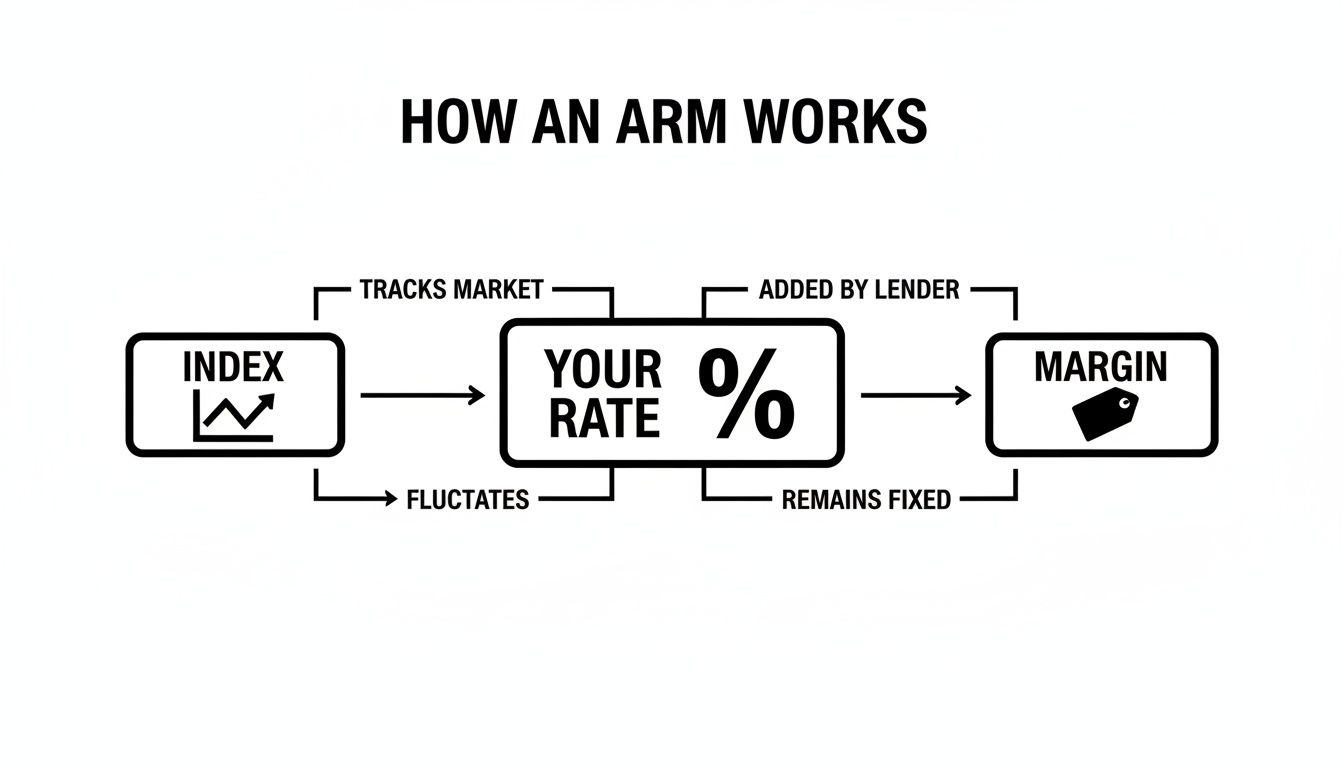
Once the fixed period ends, the rate adjusts based on a specific financial index. Most Jumbo ARMs in 2026 utilize the Secured Overnight Financing Rate (SOFR). The lender adds a predetermined "margin" (often between 2% and 3%) to the index value to determine the new interest rate. If the SOFR index is at 3.5% and your margin is 2.5%, your fully indexed rate would be 6.0%.
Interest Rate Caps
To protect borrowers from extreme market volatility, Jumbo ARMs include "caps." These limits dictate how much the rate can increase at specific intervals:
- Initial Cap: Limits the first adjustment after the fixed period ends.
- Periodic Cap: Limits how much the rate can change during each subsequent adjustment period (usually every six months).
- Lifetime Cap: The absolute maximum interest rate the loan can ever reach, regardless of how high market indices climb.
Underwriting Requirements for High-Balance Jumbo ARMs
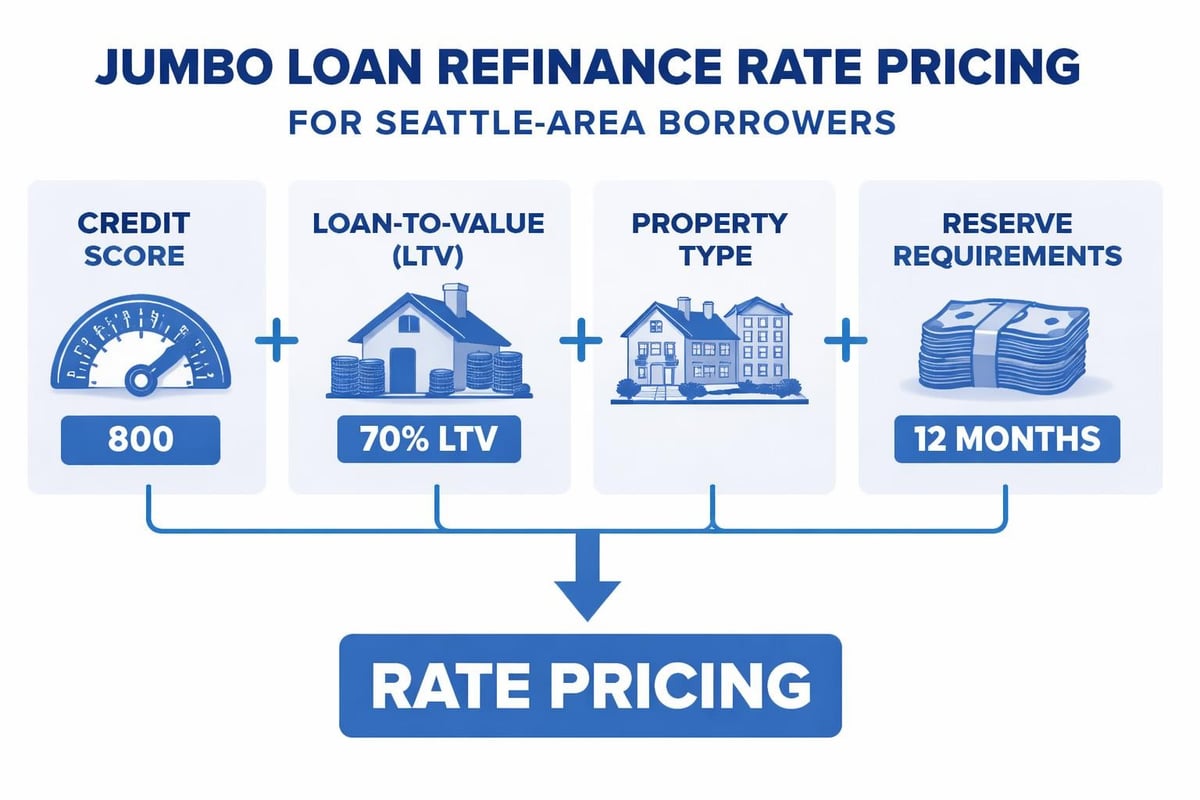
Securing a Jumbo ARM for a high-balance property requires a significantly more robust financial profile than a standard mortgage. Lenders view these loans as higher risk due to the large dollar amounts and the lack of a government guarantee. In 2026, the following "Four Pillars" of jumbo underwriting are standard across the industry.
1. Credit Score Thresholds
While a borrower might qualify for a conforming loan with a score in the mid-600s, Jumbo ARM lenders typically demand a minimum FICO score of 720, with the best rates reserved for those above 760. Lenders are looking for a history of managing large debts responsibly, so a deep credit file is often just as important as the score itself.
2. Debt-to-Income (DTI) Ratios
Lenders are strict about the percentage of your gross monthly income that goes toward debt payments. For Jumbo ARMs, the maximum DTI is often capped at 43%, though some portfolio lenders may go higher if the borrower has significant compensating factors. Crucially, lenders often calculate the DTI based on the "fully indexed rate" or a higher potential payment to ensure the borrower can afford the loan even if the rate increases.
3. Asset Reserves and Liquidity
This is the most significant hurdle for many jumbo borrowers. Lenders want to see that the borrower has "skin in the game" and the ability to cover payments during a financial hardship. It is common for lenders to require 6 to 12 months (and sometimes up to 24 months) of principal, interest, taxes, and insurance (PITI) in liquid or semi-liquid reserves. For a multi-million dollar property, this can mean keeping several hundred thousand dollars in accessible accounts.
4. Property Appraisals and Documentation
For high-balance properties, a single appraisal is often insufficient. Many lenders require two independent appraisals for loans exceeding $1.5 million or $2 million to ensure the collateral's value is accurately represented. Furthermore, income documentation for jumbo borrowers—who are often self-employed or have complex compensation structures involving RSUs and bonuses—is exhaustive, requiring multiple years of tax returns and K-1s.
Comparative Analysis: Jumbo ARM vs. Fixed Rate vs. High-Balance Conforming
Choosing the right financing vehicle depends on the loan amount, the intended duration of homeownership, and the current interest rate environment.
| Feature | Jumbo ARM (5/6 or 7/6) | 30-Year Fixed Jumbo | High-Balance Conforming |
|---|---|---|---|
| Typical Loan Amount | $1M - $10M+ | $1M - $10M+ | Up to FHFA High-Cost Limit |
| Initial Interest Rate | Lowest (Variable later) | Higher (Fixed for life) | Moderate (Fixed or ARM) |
| Down Payment | 10% - 25% | 15% - 30% | 3% - 5% (with PMI) |
| Reserve Requirement | 6 - 12 Months PITI | 6 - 12 Months PITI | Minimal to 6 Months |
| Best For | Short-term owners (5-10 yrs) | Long-term stability seekers | Buyers in expensive counties |
| Risk Factor | Interest rate risk after fixed period | Higher upfront monthly cost | Limited to specific price caps |
Strategic Advantages of Using a Jumbo ARM
Why would a sophisticated borrower choose a loan where the rate can change? In 2026, the strategy is often driven by the "spread" between fixed and adjustable rates and the borrower's anticipated life path.
Maximizing Cash Flow for Reinvestment
For high-net-worth individuals, money has a high opportunity cost. By choosing a Jumbo ARM with an initial rate that is 0.5% to 1.0% lower than a fixed-rate loan, a borrower can save thousands of dollars per month. These savings can be redirected into high-yield investments, business ventures, or other assets that potentially outperform the savings on interest.
Short-to-Medium Term Residency
Statistics show that the average homeowner moves or refinances every 7 to 10 years. If a borrower knows they will relocate or upgrade within the next decade, paying a premium for a 30-year fixed rate is mathematically inefficient. A 10/6 ARM provides a decade of stability at a lower price point, covering the entire expected duration of the borrower's stay in the home.
Hedging Against Falling Rates
In a 2026 market where rates may be higher than historical averages, many borrowers anticipate that interest rates will eventually trend downward. A Jumbo ARM allows the borrower to take the lower rate now without being "locked in" to a high fixed rate for the long term. If rates drop significantly, the borrower can refinance; if rates stay flat or drop slightly, the ARM might even adjust downward on its own, depending on the index.
Common Risks and How to Mitigate Them
The primary risk of a Jumbo ARM is "payment shock"—a situation where the interest rate increases significantly at the first adjustment, leading to a monthly payment that exceeds the borrower's comfort level.
To mitigate this risk, borrowers should:
- Analyze the Lifetime Cap: Know exactly what the maximum payment could be and ensure it is affordable under a "worst-case" scenario.
- Monitor the SOFR Index: Stay informed about the underlying index that drives the loan’s adjustments.
- Plan a Liquidity Event: Many jumbo borrowers time their ARMs to coincide with a future liquidity event, such as a business sale or the vesting of stock options, which can be used to pay down the principal before the first adjustment.
- Refinance Proactively: Do not wait until the month before the adjustment to look for a new loan. Start the refinance process 12 to 18 months before the fixed period ends to account for market fluctuations and appraisal timelines.
Frequently Asked Questions
What is the maximum loan amount for a Jumbo ARM in 2026?
There is no universal maximum for jumbo loans, as they are determined by individual bank "portfolios." While many retail banks cap their jumbo programs at $3 million to $5 million, specialized private banks and wealth management firms can facilitate Jumbo ARMs for $20 million or more for qualified clients.
Can I get a Jumbo ARM with only 10% down?
Yes, in 2026, some lenders offer 90% Loan-to-Value (LTV) jumbo options, meaning a 10% down payment. However, these programs usually require the borrower to have exceptionally high credit scores and may require private mortgage insurance (PMI) or a higher interest rate to offset the risk.
Is SOFR better than the old LIBOR index?
The Secured Overnight Financing Rate (SOFR) is generally considered more stable and transparent than the discontinued LIBOR. SOFR is based on actual transactions in the U.S. Treasury repurchase market, making it less susceptible to manipulation and more reflective of true market conditions.
Can I pay off a Jumbo ARM early?
Most modern Jumbo ARMs do not have prepayment penalties, allowing you to pay down the principal or pay off the loan entirely at any time. However, it is vital to verify this in the "Prepayment Penalty" section of your Loan Estimate and Closing Disclosure, as some niche products may still carry these fees for the first few years.
How does a "High-Balance Conforming" loan differ from a Jumbo ARM?
A High-Balance Conforming loan is a hybrid. It exceeds the national baseline limit but stays within the higher limit allowed for expensive counties. These loans follow Fannie Mae and Freddie Mac rules. A Jumbo ARM exceeds even those high-balance limits and follows the specific rules set by the private lender.
Expert Recommendation for High-Balance Borrowers
When evaluating a Jumbo ARM for a high-balance property in 2026, the decision should not be based on the initial monthly payment alone. Borrowers must consider their "exit strategy." If you plan to stay in the home for more than 10 years and are risk-averse, a fixed-rate mortgage may be worth the higher cost. However, for those with high liquidity, sophisticated investment strategies, or a clear timeline for moving, the Jumbo ARM offers a mathematically superior way to finance luxury real estate. Always work with a lender who specializes in high-net-worth clients, as they often have access to "portfolio" products that are not advertised to the general public.