An actual cash value life insurance policy, commonly known as permanent life insurance, is a contract that provides a death benefit alongside a tax-deferred savings component. As you pay premiums, a portion of the funds accumulates in a cash account, which can be accessed through loans, withdrawals, or policy surrenders during your lifetime.
The Fundamentals of Cash Value in Life Insurance
To understand an actual cash value life insurance policy, one must first distinguish between the two primary categories of life insurance: term and permanent. Term life insurance provides coverage for a specific period (e.g., 10, 20, or 30 years) and does not accumulate any value other than the potential death benefit. If the policyholder survives the term, the policy expires without value.
Permanent life insurance, conversely, is designed to last for the insured’s entire life, provided premiums are paid. The "actual cash value" refers to the equity that builds up within the policy. In the early years of the policy, a significant portion of your premium goes toward the cost of insurance (mortality charges) and administrative fees. However, a designated portion is funneled into a cash value account. Over time, this account grows through interest credits, dividends (in the case of mutual companies), or investment gains.
By 2026, the landscape of these policies has evolved to offer more transparency regarding fee structures, but the core mechanic remains the same: the cash value belongs to the policyholder while they are alive, whereas the death benefit is intended for the beneficiaries. It is crucial to note that, in most standard policies, the cash value is not paid out in addition to the death benefit; rather, the cash value forms part of the death benefit payout, or is kept by the insurer if the policy is strictly a "level death benefit" contract.
How Cash Value Accumulates and Grows
The growth of cash value is not instantaneous. Most policies have a "front-loaded" expense structure, meaning that for the first several years, very little cash value may be available as the company recoups the costs of underwriting and agent commissions.
Premium Allocation
When you pay a premium for a permanent policy, the insurance company divides that money into three "buckets":
- The Cost of Insurance (COI): This is the literal cost of providing the death benefit based on your age, health, and risk profile. As you age, this cost naturally increases.
- Administrative Fees and Expenses: These cover the insurer’s overhead, commissions, and state taxes.
- The Cash Value Account: The remainder is invested by the insurer. The way this money grows depends entirely on the specific type of permanent policy you own.
The Role of Interest and Dividends
In 2026, interest rate environments continue to dictate the attractiveness of different cash value products. In a Whole Life policy, the growth is typically based on a guaranteed minimum interest rate. If the policy is "participating" and issued by a mutual insurance company, you may also receive dividends. While not guaranteed, dividends can significantly accelerate the growth of the actual cash value over decades.
Categorizing Cash Value Policy Types
Not all cash value policies are created equal. The "best" version depends on your risk tolerance and how much control you want over the underlying investments.
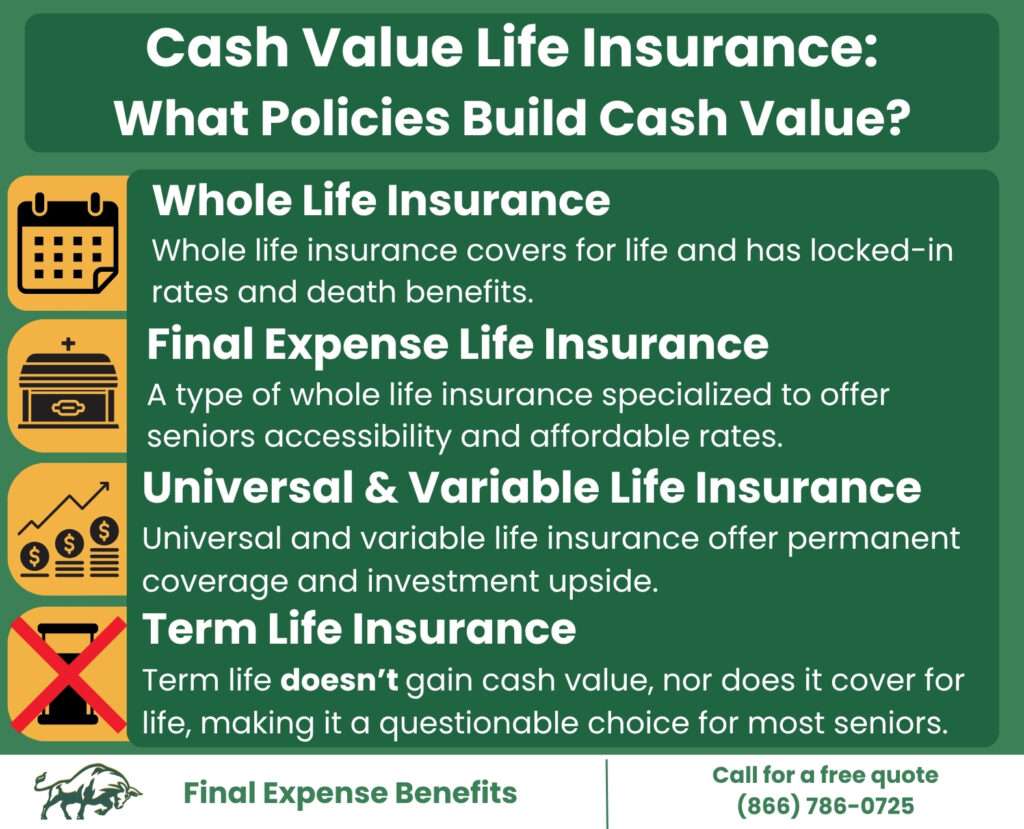
Whole Life Insurance
Whole life is the most traditional form of permanent insurance. It offers a guaranteed death benefit, fixed premiums that never change, and a guaranteed rate of return on the cash value. This is the most "set-it-and-forget-it" option, providing the highest level of predictability.
Universal Life (UL)
Universal life insurance offers more flexibility than whole life. Policyholders can often adjust their premium payments and even the death benefit amount. The cash value grows based on current market interest rates. If interest rates are high, the cash value builds quickly; if they drop, the policyholder might need to pay higher premiums to keep the policy from lapsing.
Indexed Universal Life (IUL)
IUL policies tie the cash value growth to the performance of a specific market index, such as the S&P 500. These policies usually have a "floor" (protecting against market losses) and a "cap" (limiting the maximum gain). This allows for higher potential growth than whole life without the direct downside risk of the stock market.
Variable Life Insurance
Variable policies allow the policyholder to invest the cash value in "sub-accounts," which function similarly to mutual funds. These offer the highest growth potential but also carry the risk of losing value if the markets perform poorly. In 2026, these remain popular for high-net-worth individuals who use the policy as a sophisticated tax-planning vehicle.
Distinguishing "Actual Cash Value" from Property Insurance Terms
A common point of confusion for consumers is the term "Actual Cash Value" (ACV) as it relates to property and casualty insurance versus life insurance. In homeowners or auto insurance, ACV refers to the replacement cost of an item minus depreciation. It is a measure of what an item is worth "used" at the time of a loss.
In life insurance, the term is often used colloquially by consumers to mean "the amount of money I can get out of my policy right now." Technically, the insurance industry refers to this as the Cash Surrender Value. It is vital to understand this distinction: the cash value is the total amount accumulated, while the surrender value is that amount minus any surrender charges or outstanding loans. If you are researching a life insurance policy, ensure you are looking at the "Living Benefits" or "Accumulated Value" section of your illustration.
Methods for Accessing Your Policy's Cash Value
One of the primary reasons individuals choose permanent life insurance over term is the ability to use the funds while they are still alive. This provides a "private bank" of sorts that can be tapped for emergencies, education, or retirement income.
Policy Loans
Most insurers allow you to borrow against the cash value of your policy. Unlike a bank loan, there is no credit check, and you are not legally required to pay it back. However, the insurer will charge interest on the loan. If you die with an outstanding loan, the balance plus interest is deducted from the death benefit paid to your heirs.
Partial Withdrawals
You can often withdraw a portion of the cash value. Unlike a loan, you do not have to pay this back. However, withdrawals will permanently reduce the death benefit. From a tax perspective, withdrawals are usually treated on a "first-in, first-out" (FIFO) basis. This means you can withdraw up to the amount you have paid in premiums (your "basis") without owing taxes. Anything beyond that is considered earnings and is taxed as ordinary income.
Full Surrender
If you no longer need the life insurance coverage, you can cancel the policy entirely and take the cash surrender value. Be cautious: if the policy is in its first 10 to 15 years, the insurance company may apply significant surrender charges, which can eat into your savings. Additionally, a full surrender may trigger a "tax bomb" if the cash value exceeds the total premiums paid.
| Feature | Whole Life | Universal Life | Variable Life | Indexed Universal Life |
|---|---|---|---|---|
| Premium Flexibility | Fixed/None | Highly Flexible | Limited/Flexible | Flexible |
| Cash Value Growth | Guaranteed Minimum | Market Interest Rates | Market Sub-accounts | Index Performance (Caps/Floors) |
| Risk Level | Low | Moderate | High | Moderate |
| Death Benefit | Guaranteed | Adjustable | Variable | Adjustable |
| Best For | Conservative planning | Flexibility-seekers | Aggressive investors | Balanced growth/protection |
Tax Advantages and Internal Revenue Code 7702
The tax treatment of cash value life insurance is one of its most potent features. Under current IRS rules—which remain a cornerstone of financial planning in 2026—the growth within the cash value account is tax-deferred. This means you do not pay annual taxes on interest, dividends, or capital gains earned inside the policy.
Furthermore, if managed correctly, the death benefit is generally received by beneficiaries free of federal income tax. However, policyholders must be aware of the Modified Endowment Contract (MEC) rules. If you fund a policy too quickly (exceeding certain premium limits set by the IRS), the policy loses its favorable FIFO tax status. Instead, withdrawals are taxed on a "last-in, first-out" (LIFO) basis, meaning gains are taxed first, similar to an annuity. Always consult with a tax professional before making large "dump-in" payments to a permanent policy.
Common Mistakes to Avoid
Understanding the basics also means recognizing where others have failed. Many policyholders experience frustration because they did not fully grasp the long-term commitment required.
- Surrendering Early: If you cancel a policy within the first few years, you will likely receive nothing back due to surrender charges and high initial expenses.
- Ignoring Loan Interest: While you don't have to pay back a policy loan, the interest compounds. If the loan balance grows to exceed the cash value, the policy will lapse, potentially creating a massive taxable event.
- Underfunding Universal Policies: In a Universal Life policy, if you pay only the minimum premium and interest rates remain low, the cash value may eventually be exhausted by the rising cost of insurance as you age. This can lead to a "death spiral" where the policy requires massive capital infusions to stay active in later years.
- Misunderstanding the Death Benefit: Remember that in most basic permanent policies, your beneficiary receives the face amount (e.g., $500,000), not the face amount plus the cash value. The cash value is essentially a portion of that $500,000 that you can access while alive.
The Role of Cash Value in a 2026 Financial Strategy
As we navigate 2026, cash value life insurance is often viewed as a "non-correlated asset." Because it does not necessarily move in tandem with the stock market (especially Whole Life and IUL), it can serve as a volatility buffer in a diversified portfolio. It provides a source of liquidity that can be used during market downturns, allowing your other investments time to recover.
However, these policies are generally more expensive than term insurance. For every dollar of premium, a significant portion goes toward the "permanent" nature of the death benefit. Therefore, these policies are most appropriate for individuals who have a lifelong need for insurance (such as for estate taxes or providing for a special-needs dependent) or those who have already maximized other tax-advantaged accounts like 401(k)s and IRAs.
Frequently Asked Questions
Can I lose money in an actual cash value life insurance policy?
It depends on the type of policy. In Whole Life and most IUL policies (due to the "floor"), your principal is generally protected from market losses. However, in Variable Life insurance, the cash value is tied directly to market performance, and it is possible for the account value to decrease if the underlying sub-accounts perform poorly.
What happens to the cash value when I die?
In a standard "Level Death Benefit" (Option A) policy, the insurance company keeps the cash value and pays the face amount of the death benefit to your beneficiaries. The cash value is essentially used by the insurer to offset their "net amount at risk." If you have an "Increasing Death Benefit" (Option B) rider, the beneficiaries may receive both the face amount and the accumulated cash value, though this rider typically requires higher premiums.
How long does it take to build significant cash value?
Generally, it takes 10 to 15 years for a permanent life insurance policy to reach a "break-even" point where the cash value equals or exceeds the total premiums paid. These are long-term financial instruments and are rarely suitable for short-term savings goals.
Is the cash value of my life insurance policy protected from creditors?
In many jurisdictions, the cash value and death benefit of a life insurance policy are protected from creditors’ claims. However, these laws vary significantly by state and by the specific circumstances of the debt. You should check the statutes in your specific location for confirmed protections.
Can I change my policy from Term to a Cash Value policy?
Many term life insurance policies include a "conversion rider." This allows the policyholder to convert their term coverage into a permanent cash value policy without undergoing a new medical exam. This is a valuable feature if your health declines during the term period.
Next Steps for Prospective Policyholders
If you are considering an actual cash value life insurance policy, your first step should be to request a "comprehensive illustration" from a licensed insurance professional. This document provides a year-by-year projection of how the cash value and death benefit are expected to grow based on both guaranteed and non-guaranteed assumptions. Review the "Surrender Value" column specifically to understand your liquidity in the early years. Finally, compare the costs of a permanent policy against the strategy of "buying term and investing the difference" to ensure that the tax advantages and lifelong coverage of a cash value policy align with your specific financial objectives for 2026 and beyond.