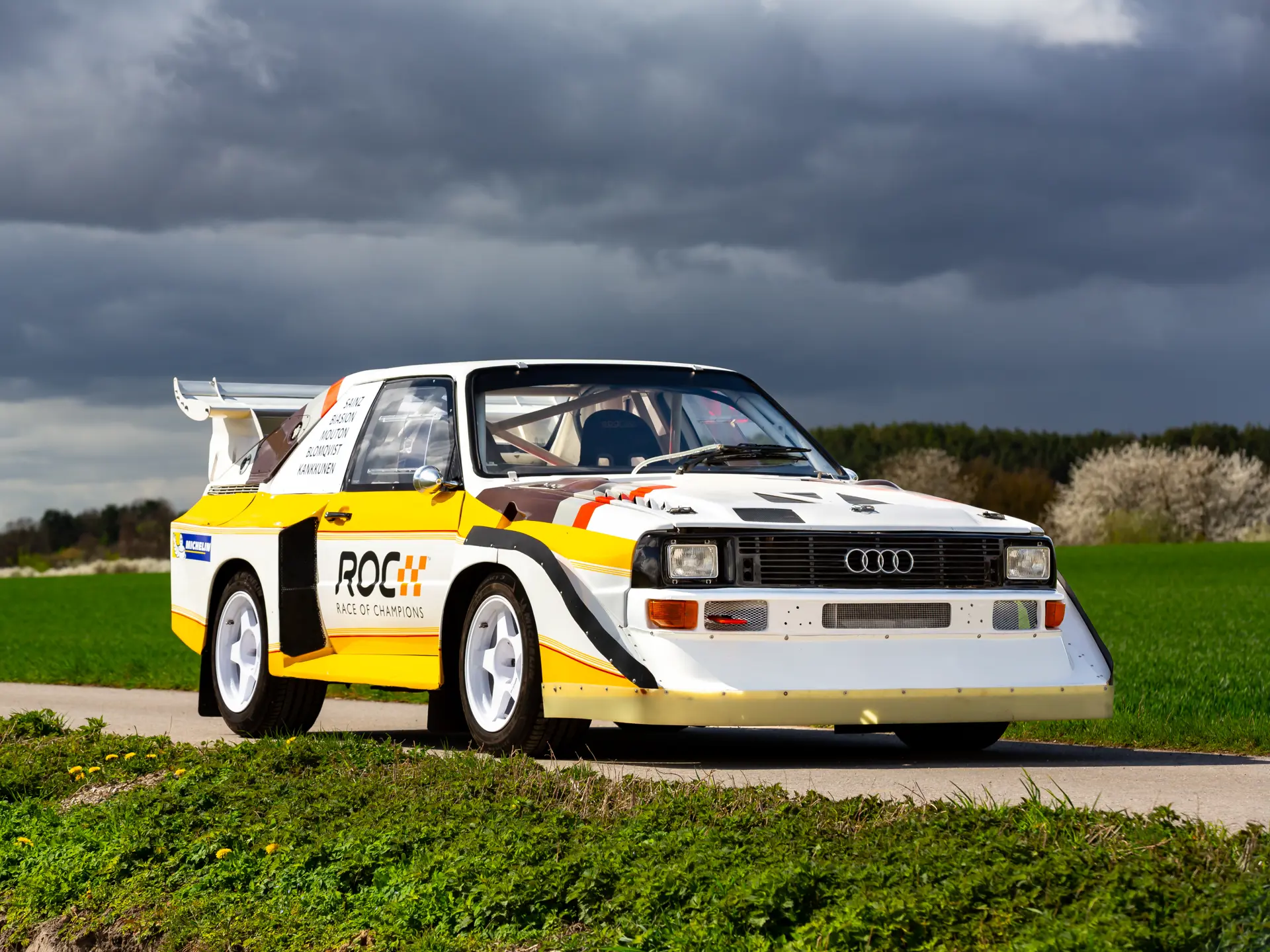
The Audi S1 rally car represents a watershed moment in motorsport history, defined by the introduction of permanent all-wheel drive and turbocharged five-cylinder power into top-tier international rallying. Its five major evolutionary milestones span from the initial conceptualization of quattro technology to the record-breaking exploits at Pikes Peak, completely rewriting the technical rules of the World Rally Championship during the Group B era.
Introduction to the Audi Sport Quattro S1 Legacy
Motorsport engineering underwent a permanent paradigm shift at the start of the 1980s. Before the arrival of Audi's revolutionary all-wheel-drive platform, rally cars relied almost exclusively on rear-wheel-drive layouts. These traditional setups struggled on loose, slippery surfaces such as gravel, mud, snow, and ice. Audi changed this dynamic by adapting all-wheel-drive systems—previously thought too heavy and complex for agile competition cars—into a compact, lightweight package.
When the ultimate evolution of this lineage, the Audi Sport Quattro S1, emerged, it combined brutal turbocharged horsepower with radical aerodynamic appendages and an extraordinarily short wheelbase. Understanding the machine requires looking past its mythos to examine the five defining milestones that shaped its development, competition career, and ultimate enduring legacy in automotive history.
Milestone 1: The Genesis of Permanent All-Wheel Drive in World Rallying
The foundational milestone for the S1 lineage occurred well before the S1 badge itself was officially adopted. It began with the development and homologation of the original Audi Quattro coupe that debuted in competition at the 1980 Jänner Rallye as a test entry, and its subsequent World Rally Championship debut later that year.
Overcoming Weight and Complexity Challenges
Traditionally, four-wheel-drive systems were confined to heavy-duty off-road utility vehicles like the Land Rover or Jeep. They required heavy transfer cases and complex mechanical linkages that penalized acceleration, top speed, and fuel efficiency. Audi engineers, led by Ferdinand Piëch and Jörg Bensinger, solved this by designing a hollow secondary output shaft within the manual transmission. This ingenious hollow shaft allowed power to flow simultaneously to the front and rear differentials without adding excessive weight or bulk.
Breaking the Rules of Homologation
When the Fédération Internationale de l'Automobile (FIA) permitted four-wheel-drive systems in international rally regulations starting for the 1979 season, rival manufacturers dismissed the concept as a heavy, over-engineered novelty. Audi proved them wrong almost immediately. By combining the quattro system with a turbocharged 2.1-liter inline-five cylinder engine, Audi created a vehicle with unprecedented traction on low-grip surfaces. This fundamental mechanical layout became the blueprint for modern rally cross, WRC dominance, and performance road cars for decades to follow.
Milestone 2: The Evolution to the Short Wheelbase Sport Quattro (E2)
As rival manufacturers caught up with Audi's four-wheel-drive advantage—most notably Lancia with the rear-wheel-drive 037 and later the all-wheel-drive Delta S4, alongside Peugeot with the mid-engined 205 T16—the original Audi Quattro coupe began to show its age. Its primary handicap was understeer, caused by the heavy front-mounted engine sitting far ahead of the front axle.
Shortening the Chassis
To combat this inherent balance issue, Audi introduced the Sport Quattro at the Frankfurt Motor Show in 1983, which directly paved the way for the ultimate S1 evolution. Engineers hacked 320 millimeters (12.6 inches) directly out of the center of the wheelbase. This drastic geometric modification significantly reduced polar moment of inertia, making the car much more agile in tight, twisting alpine hairpins, though it initially made the handling notoriously twitchy and demanding for drivers like Hannu Mikkola and Walter Röhrl.
Weight Savings and Kevlar Construction
Beyond the shortened chassis, the Sport Quattro and its subsequent S1 iterations incorporated extensive lightweight materials. Steel body panels were replaced with fiberglass, carbon-composite, and Kevlar elements. The windshield was sharply raked to improve aerodynamics and reduce interior cabin turbulence. These physical revisions set the stage for the definitive, highly aggressive aerodynamic package that would define the S1 in its final factory-backed WRC specification.
Milestone 3: The 1985 Sanremo Rally and the Power Peak of the S1 E2
The definitive iteration of the platform, officially designated the Audi Sport Quattro S1 E2 (Evolution 2), debuted in 1985. It featured massive, unmistakable aerodynamic wings, splitters, and air channels designed to force the lightweight car down onto the road surface at high speeds. This machine represents the absolute performance peak of internal combustion engine development during the untamed Group B era.
The Power of the Turbocharged Five-Cylinder
At the heart of the S1 E2 was a heavily revised, aluminum-block 2.1-liter (2,110 cc) turbocharged five-cylinder engine equipped with a KKK turbocharger running immense boost pressures. While official output figures varied depending on the specific event and stage layout, factory works cars routinely produced upwards of 500 horsepower, with some reports indicating over 550 horsepower in qualifying trims.
The Circulating Exhaust and Anti-Lag Innovation
To combat turbo lag—the frustrating delay between pressing the accelerator and the turbocharger spooling up to generate boost—Audi pioneered early iterations of anti-lag systems. By igniting fuel inside the exhaust manifold while the throttle was closed, the turbocharger continued to spin at high RPMs even during cornering deceleration. This generated the signature, violent machine-gun-like pops, bangs, and flames shooting from the exhaust pipes, ensuring instant throttle response when the driver got back on the power.
| Technical Specification | Audi Sport Quattro S1 E2 (Works Spec) |
|---|---|
| Engine Type | Inline-5, turbocharged, 20-valve DOHC |
| Displacement | 2,110 cc |
| Horsepower | 500+ hp (estimated up to 550+ hp) |
| Torque | ~590 Nm (435 lb-ft) |
| Transmission | 6-speed manual / dual-clutch sport transmission |
| Dry Weight | Approx. 1,090 kg (2,403 lbs) |
| Drivetrain | Permanent four-wheel drive with locking differentials |
Milestone 4: Walter Röhrl’s Victory at the 1987 Pikes Peak International Hill Climb
Following the tragic accidents that led to the abrupt banning of Group B rallying at the end of the 1986 season, Audi shifted its competitive focus away from European forest stages and toward the treacherous gravel slopes of the United States. The Pikes Peak International Hill Climb in Colorado became the ultimate proving ground for the S1 platform.
Conquering the Clouds
In 1987, legendary German rally driver Walter Röhrl piloted a heavily modified Audi Sport Quattro S1 (often referred to as the Pikes Peak version) up the 12.42-mile course, which featured 156 turns and transitioned from paved sections to loose gravel as it climbed to an altitude of over 14,000 feet. At high altitudes, internal combustion engines lose significant power due to thin air; however, Audi's massive turbocharger compensated for the atmospheric pressure drop.
Setting a Historic Record
Röhrl shattered previous course records, crossing the finish line in an astonishing time of 10 minutes and 47.858 seconds. This victory not only cemented Audi's dominance in American hillclimb racing—following Bobby Unser's win in 1986 and preceding Michèle Mouton's victory in 1985—but also served as a triumphant, high-altitude swansong for the factory-backed competition career of the legendary S1 platform.
Milestone 5: Legacy, Cultural Impact, and Modern Homages
The final milestone of the Audi S1 rally car is its enduring cultural resonance and its profound influence on automotive engineering. The safety concerns that brought an end to Group B also closed a chapter on an era of unbridled engineering freedom, yet the technical DNA of the S1 lives on in every modern performance vehicle bearing all-wheel-drive badges.
The Birth of S-Line and Quattro Road Cars
Audi capitalized directly on its motorsport success by transforming "quattro" from a mechanical feature into a standalone sub-brand and a badge of prestige. The victories on the rally stages directly translated into showroom sales, proving that "Win on Sunday, sell on Monday" applied just as effectively to all-wheel-drive technology as it did to rear-wheel-drive sports cars. The high-performance "S" model range launched by Audi in subsequent decades traces its spiritual lineage directly back to the brute force and engineering ambition of the S1.
Modern Reinterpretations and Electronic Collectibility
Original factory-built Audi Sport Quattro S1 rally cars are among the rarest and most valuable collector vehicles on earth, commanding multi-million-dollar valuations whenever they occasionally change hands. This extreme scarcity has inspired modern coachbuilders and high-end restomod specialists to recreate carbon-bodied, modern-powered interpretations of the classic icon, ensuring that the visual silhouette and the sonic howl of the five-cylinder turbo engine continue to captivate new generations of automotive enthusiasts.
Frequently Asked Questions
What engine was used in the Audi S1 rally car?
The S1 utilized a longitudinally mounted, turbocharged 2.1-liter inline-five-cylinder engine equipped with a multi-valve cylinder head. This engine layout became legendary for its distinct exhaust note, robust durability under extreme boost, and exceptional power delivery across a broad rev range.
How much horsepower did the Audi Sport Quattro S1 E2 produce?
In its ultimate competition specification during the peak of Group B rallying in 1985 and later hillclimb events, the engine officially produced over 500 horsepower, with unconfirmed period reports suggesting specialized setup variants could exceed 550 horsepower depending on turbo boost levels and fuel mixtures.
Why was the Audi Sport Quattro wheelbase shortened?
Engineers shortened the wheelbase of the Sport Quattro by 320 millimeters compared to the standard Audi Quattro coupe to reduce front-end understeer. This modification dramatically improved agility and turn-in response on tight, twisting rally stages, though it required exceptional driver skill to manage the car's sudden weight shifts.
Did the Audi S1 compete in the World Rally Championship?
Yes, the Audi Sport Quattro S1 and its E2 evolution competed in the World Rally Championship during the mid-1980s. However, due to escalating speeds, severe accidents across the championship, and regulatory changes, the FIA ultimately banned the dominant Group B class at the end of the 1986 season, prompting Audi to redirect the car toward hillclimbs like Pikes Peak.
How does the Audi S1 relate to modern Audi road cars?
The success of the S1 popularized permanent all-wheel-drive passenger vehicles globally. The technological lessons learned regarding weight distribution, turbocharging efficiency, and differential management directly influenced the development of Audi's consumer quattro models and the high-performance S-line vehicle lineup.
Practical Next Steps for Enthusiasts
For those looking to explore the history of the Audi S1 rally car beyond text, several immersive avenues exist:
- Museum Visits: Visit institutions such as the Audi Museum Mobile in Ingolstadt, Germany, or select international motorsport museums where surviving works cars are occasionally displayed.
- Historical Archives: Review period motorsport documentaries and onboard camera footage from events like the Rallye Sanremo and the Pikes Peak Hill Climb to observe the driving techniques required to master turbo lag and manual shifting under extreme pressure.
- Automotive Literature: Read definitive motorsport histories detailing the Group B era, which provide granular engineering breakdowns of the mechanical hurdles faced by Audi Sport engineers.