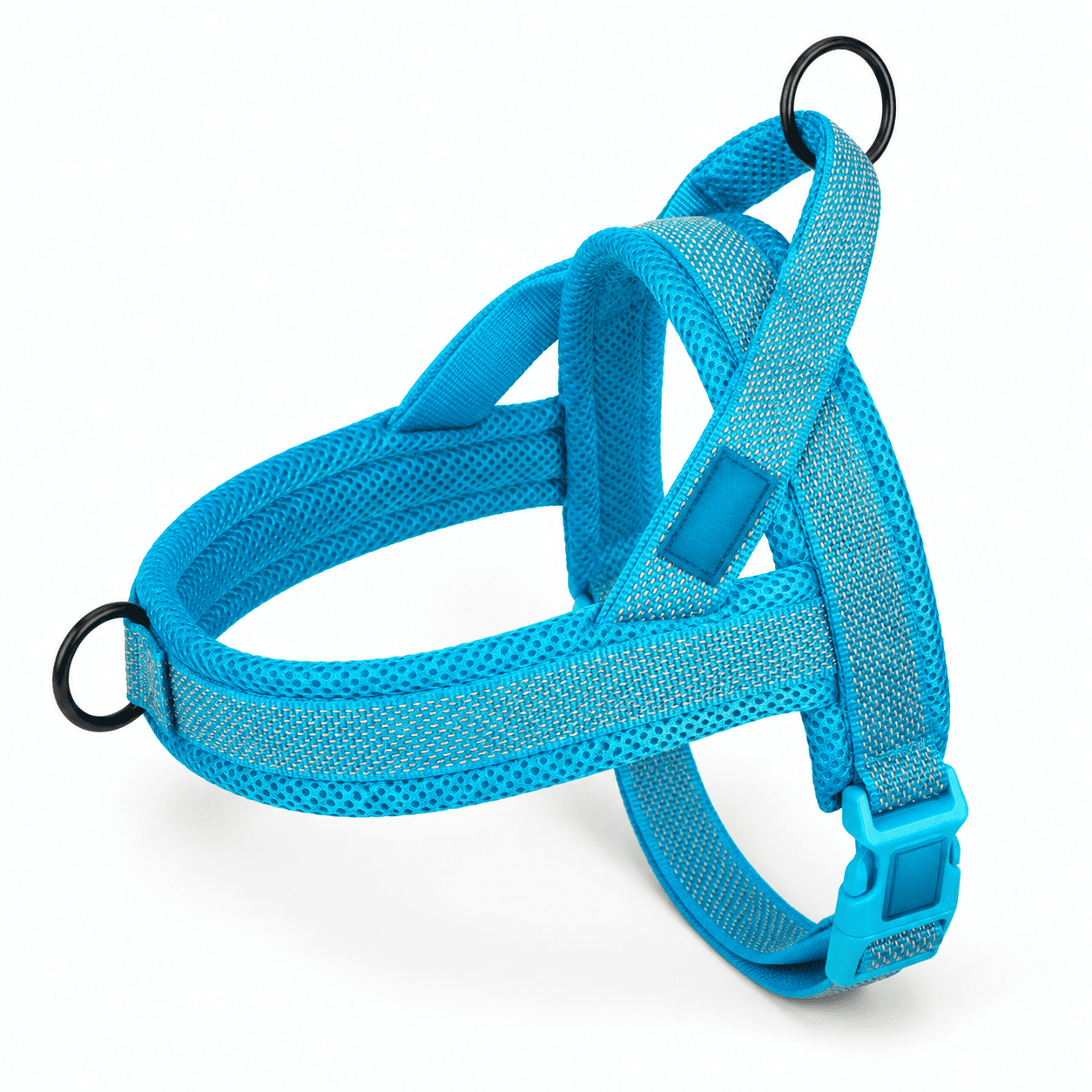
Choosing the right harness for a small puppy involves prioritizing neck protection, adjustable sizing for growth, and lightweight materials that won't overwhelm a small frame. As of 2026, the Ruffwear Hi & Light, Puppia Soft Harness, and Voyager Step-In Air remain the industry standards for balancing security with a puppy’s delicate anatomy.
Why Small Puppies Require a Harness Over a Traditional Collar
For many years, the standard for walking a dog was a simple flat collar. However, as veterinary medicine and canine biomechanics have advanced into 2026, the consensus among professionals is that a harness is almost always the superior choice for small and toy-breed puppies.
Small puppies, particularly those in the toy group (such as Chihuahuas, Pomeranians, and Yorkshire Terriers), have incredibly fragile tracheas. A "tracheal collapse" is a chronic, progressive disease where the cartilage rings of the windpipe weaken. When a small puppy wearing a collar pulls against a leash, the concentrated pressure on the throat can cause immediate respiratory distress or long-term structural damage.
A harness solves this by redistributing the force of the leash across the puppy's chest and shoulders—areas much more capable of handling pressure. Furthermore, puppies are often "flight risks." Because of their narrow heads and slender necks, many small puppies can easily back out of a collar. A properly fitted harness provides much better security, ensuring the puppy cannot slip away in high-traffic or high-stress environments.
Essential Criteria for Evaluating Puppy Harnesses
Before selecting a specific model, it is vital to understand the technical specifications that make a harness "high quality" for a developing dog.
1. Material and Weight
Small puppies can be easily fatigued by heavy gear. In 2026, the focus is on high-strength, low-weight textiles. Materials like 3D air mesh provide breathability and cushioning, while ripstop nylon offers durability without the bulk. A harness for a 5-pound puppy should ideally weigh only a few ounces.
2. Point of Adjustment
Puppies grow at an exponential rate. A harness with a single point of adjustment will likely be outgrown within weeks. Look for harnesses with multiple adjustment sliders (preferably four) to ensure the fit remains snug yet comfortable as the puppy’s chest deepens and their neck thickens.
3. Ease of Entry
Puppies are notoriously wiggly. There are two primary designs:
- Over-the-Head: These offer great security but can be frightening for some puppies who dislike things being pulled over their ears.
- Step-In: These are often preferred for sensitive puppies. You simply place their front paws in the loops and clip the harness over their back.
1. Ruffwear Hi & Light™ Lightweight Dog Harness
The Ruffwear Hi & Light is frequently cited by professional trainers and veterinarians as the premier choice for active small puppies. It is a minimalist, low-profile harness that provides the technical features of a heavy-duty hiking harness in a scaled-down version suitable for tiny frames.
Technical Performance and Design
The Hi & Light utilizes a 75D polyester ripstop shell, which is exceptionally resistant to the inevitable scratching and rolling that puppies do. One of its most significant advantages for small dogs is the "debris-resistant" liner. Small dogs are closer to the ground, meaning they pick up more dirt, pine needles, and sand. This liner prevents these irritants from getting trapped against the puppy’s skin.
The harness features four points of adjustment, allowing for a near-custom fit. For a small puppy, the size XXXS is a rare and valuable offering, fitting dogs with a chest girth as small as 9 inches (23 cm).
Pros and Cons
- Pros: Includes a hidden "ID pocket" for dog tags (reducing noise and jingle), highly reflective trim for visibility, and an anatomical design that allows for full range of motion in the shoulders.
- Cons: It is an over-the-head style, which may require some positive reinforcement training for puppies who are head-shy. It is also at a higher price point than basic mesh vests.
2. Puppia Soft Dog Harness (Authentic RiteFit)
The Puppia Soft Harness is a classic design that has remained a bestseller through 2026 because of its "choke-free" vest construction. Unlike the more technical Ruffwear model, the Puppia focuses on soft, padded comfort.
The Standard for Toy Breeds
This harness is primarily constructed from a soft, polyester air mesh. The primary benefit here is the distribution of weight. The "chest plate" of the harness is wide, meaning that even if a puppy lunges toward a squirrel, the force is spread across the widest possible surface area of the sternum.
The RiteFit version of the Puppia harness is particularly recommended for puppies because it adds adjustable neck straps. The original Puppia model had a fixed neck opening, which was often too small for puppies with larger heads (like French Bulldog puppies) or too loose for slender breeds. The RiteFit version uses both hook-and-loop fasteners and quick-release buckles for a secondary layer of security.
Pros and Cons
- Pros: Extremely affordable, widely available, and incredibly soft on the puppy’s fur, which helps prevent matting in long-haired breeds.
- Cons: The mesh material is less durable than nylon webbing and can be damaged if the puppy is a heavy chewer. It also takes longer to dry if it gets wet during a walk.
3. Voyager Step-In Air Dog Harness
For owners who find the struggle of putting on a harness to be the biggest hurdle, the Voyager Step-In Air is the definitive solution. It is designed for simplicity and speed, utilizing a "step-in" geometry that eliminates the need to pull anything over the puppy’s head.
Security and Airflow
The Voyager is made from an all-weather mesh that is highly breathable, making it an excellent choice for puppies in warmer climates. Despite its simple appearance, it features a triple-security closure system: a "hook-and-loop" (Velcro-style) fastener, a heavy-duty plastic buckle, and double D-rings for the leash attachment.
This redundancy is crucial for small puppies who might be prone to sudden "zoomies" or spooking. Even if the Velcro pulls apart, the buckle and the D-rings keep the harness securely attached to the puppy.
Pros and Cons
- Pros: The easiest harness to put on a squirming puppy; very lightweight; available in a wide array of colors for high visibility.
- Cons: Limited adjustability. Because it relies heavily on the Velcro closure for sizing, there is less room for growth compared to the Ruffwear Hi & Light. You may need to purchase multiple sizes as the puppy matures.
Comparative Overview of Top Puppy Harnesses
The following table compares the key specifications of these three leading models to help you determine which fits your puppy's lifestyle and physical requirements.
| Feature | Ruffwear Hi & Light | Puppia Soft (RiteFit) | Voyager Step-In Air |
|---|---|---|---|
| Primary Material | 75D Ripstop Polyester | Polyester Air Mesh | All-Weather Mesh |
| Entry Style | Over-the-Head | Over-the-Head / Side Clip | Step-In |
| Adjustment Points | 4 Points | 2-3 Points | Minimal (Velcro-based) |
| Smallest Size Girth | 9 inches (XXXS) | 11 inches (XS) | 10 inches (XXXS) |
| Best For | Hiking & Active Growth | Daily Walks & Comfort | Head-Shy Puppies |
| Security Level | High (Internal Webbing) | Moderate | High (Triple Closure) |
| Reflectivity | Integrated Trim | Optional / Select Models | Integrated Bands |
How to Properly Measure Your Small Puppy
A harness is only safe if it fits correctly. Many owners make the mistake of buying a size too large, thinking the puppy will "grow into it," but this creates a significant safety risk where the puppy can slip out.
The Measurement Process
- Chest Girth: This is the most important measurement. Use a soft measuring tape and wrap it around the widest part of the puppy’s ribcage, usually right behind the front legs.
- Neck Circumference: Measure the base of the neck where a collar would naturally sit.
- The Two-Finger Rule: Once the harness is on and adjusted, you should be able to fit exactly two fingers between the harness and the puppy’s body. If you can fit three fingers, it is too loose; if you can only fit one, it is too tight and may cause chafing.
According to the American Kennel Club (AKC), regular re-measuring is essential. A puppy can change sizes in as little as two weeks during peak growth spurts.
Practical Guidance for Harness Training
Introducing a harness should be a positive experience. In 2026, "force-free" training is the standard. Start by letting the puppy sniff the harness on the floor, placing treats on and around it.
When you first put the harness on, do not immediately go for a walk. Let the puppy wear it around the house for 10-15 minutes during mealtime or play. This creates a positive association with the feeling of the straps. If the puppy freezes or refuses to move (a common reaction), use high-value treats to encourage a few steps.
Common Mistake to Avoid: Never leave a harness on a puppy unsupervised. Puppies explore with their mouths, and a bored puppy can chew through a mesh or nylon harness in minutes, creating a choking hazard or destroying the gear.
Frequently Asked Questions
Can a puppy sleep in their harness?
It is not recommended. Harnesses can cause skin irritation or fur matting if worn 24/7. Additionally, the buckles and straps can be uncomfortable when the puppy tries to curl up. For safety, only use the harness for walks, training sessions, or supervised outings.
What should I do if my puppy is between two sizes?
If your puppy’s measurements fall exactly between two sizes, the best course of action depends on the harness type. For a highly adjustable harness like the Ruffwear Hi & Light, choose the larger size and tighten the straps. For a "Step-In" style like the Voyager, it is often safer to choose the smaller size to ensure the puppy cannot slip out, provided the "two-finger rule" still applies.
Are these harnesses suitable for use in a car?
While these harnesses are excellent for walking, they are generally not crash-tested for automotive safety. For car travel, it is safer to use a dedicated vehicle restraint system or a crate. If you must use a harness in the car, look for models specifically labeled as "crash-tested" by organizations like the Center for Pet Safety.
How often should I wash a puppy harness?
Small puppies are low to the ground and frequently get their harnesses dirty. Most mesh harnesses (like Puppia and Voyager) can be machine-washed on a gentle cycle in a mesh laundry bag. The Ruffwear Hi & Light should be hand-washed with mild detergent to preserve the integrity of the technical fabrics and reflective coatings.
Final Recommendation
For the majority of small puppy owners in 2026, the Ruffwear Hi & Light offers the best long-term value due to its extreme adjustability and durability during the growth phase. However, if your puppy is particularly sensitive to things touching their ears or head, the Voyager Step-In Air provides a stress-free alternative that maintains a high level of security. Regardless of your choice, always prioritize a snug fit over the desire to buy a larger size for "room to grow" to ensure your puppy stays safe and secure during their first adventures.