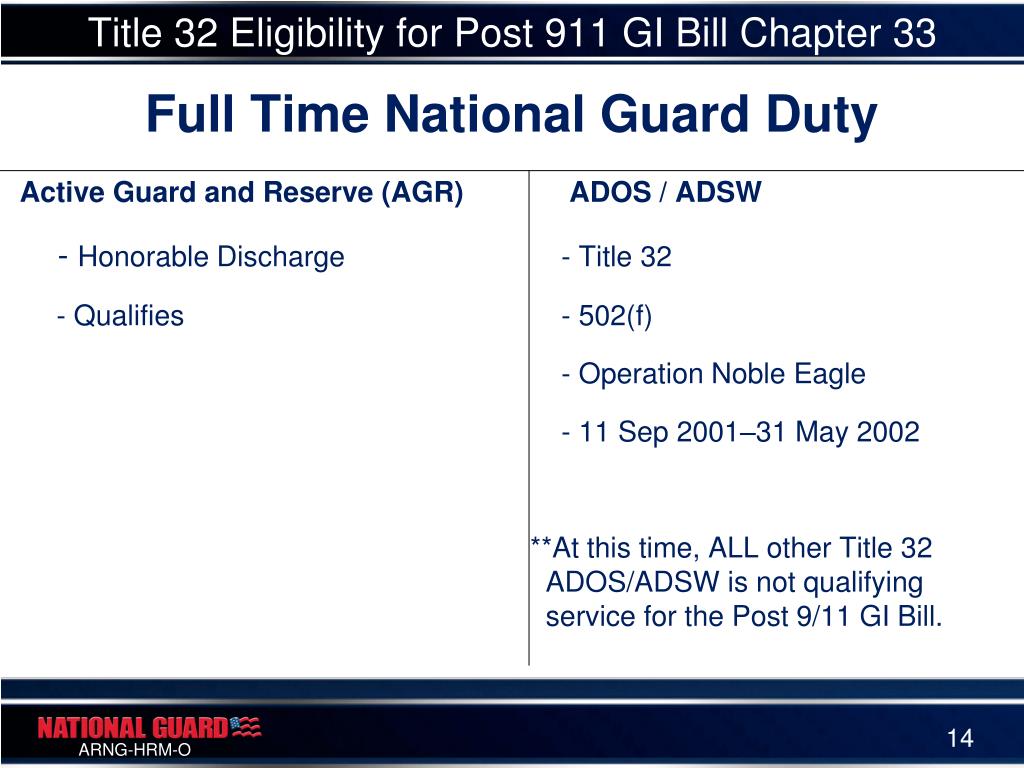
The Post-9/11 GI Bill provides comprehensive education benefits for National Guard members who have served on active duty after September 10, 2001. Eligibility depends on specific qualifying active-duty service, such as deployments under certain Title 10 or Title 32 orders, allowing service members to cover tuition, housing, and books.
Navigating military education benefits can often feel like moving through a maze of acronyms, service requirements, and regulatory updates. For members of the Army National Guard and Air National Guard, understanding how federal education benefits intersect with state-level tuition assistance and traditional service obligations is essential for maximizing financial support. While the Post-9/11 GI Bill (Chapter 33) is widely recognized as a premier educational assistance program administered by the U.S. Department of Veterans Affairs (VA), its application to National Guard members involves unique qualifying criteria that distinguish it from active-duty service.
This guide provides a comprehensive overview of the Post-9/11 GI Bill tailored specifically to National Guard members. It examines qualifying service requirements, tier-based benefit structures, payment mechanics, and practical strategies for combining these federal entitlements with other military and civilian resources.
Understanding the Foundation of Chapter 33 Benefits
The Post-9/11 GI Bill, codified under Title 38 of the United States Code, Chapter 33, was enacted to help veterans and service members transition to civilian life through higher education. Unlike older programs like the Montgomery GI Bill-Selected Reserve (Chapter 1606), Chapter 33 ties its benefit tier directly to the cumulative length of qualifying active-duty service rendered after September 10, 2001.
For National Guard members, this distinction is crucial. Guard service is primarily performed under state control (Title 32 or state active duty), which generally does not count toward Post-9/11 GI Bill eligibility unless specific federal activation criteria are met. However, when a National Guard member is mobilized for federal deployments, contingency operations, or certain types of training, that active-duty time accumulates toward federal education benefits.
Core Components of the Benefit Package
Eligible National Guard members who qualify at the maximum 100% tier receive a robust package designed to cover the true cost of attendance at public institutions or provide a substantial subsidy for private and foreign institutions. The primary components include:
- Tuition and Fees: Paid directly to the school. For public institutions, this covers all in-state tuition and mandatory fees. For private or foreign schools, payments are capped annually by the VA.
- Housing Allowance: A Monthly Housing Allowance (MHA) equivalent to the Basic Allowance for Housing (BAH) paid to an E-5 with dependents residing in the same ZIP code as the campus. This requires attending more than half-time and taking at least one in-person class.
- Book and Supply Stipend: An annual stipend of up to $1,000 paid out per-credit-hour or per-term, calculated proportionately based on enrollment intensity.
- Yellow Ribbon Program: An agreement between the VA and participating schools to cover tuition and fee charges that exceed the annual private school cap or out-of-state public school limits.
Qualifying Active-Duty Service for National Guard Members
The primary hurdle for National Guard members seeking Post-9/11 GI Bill benefits is meeting the active-duty service requirements. Standard weekend drills (one weekend a month) and annual training (two weeks a year) under Title 32 status do not qualify a member for Chapter 33 benefits.
To accrue qualifying active-duty service, a National Guard member must serve on active duty under specific statutory authorities. Recognizing these authorities helps members audit their DD Form 214 documentation to verify eligibility.
Qualifying Service Authorities
Federal law outlines several active-duty statuses that count toward the Post-9/11 GI Bill:
- Title 10, U.S.C.: Most federal mobilizations of the National Guard—such as deployments to Iraq, Afghanistan, the Horn of Africa, or domestic border missions authorized under federal control—fall under Title 10. These active-duty days count directly toward Chapter 33 eligibility.
- Title 32, Section 502(f): Certain full-time National Guard duty authorized by the President or the Secretary of Defense for the purpose of responding to a national emergency can qualify. A prominent example is service rendered under specific emergency declarations, provided the activation met statutory duration and authorization requirements.
- Active Guard Reserve (AGR): National Guard members serving in full-time AGR status accumulate qualifying active-duty service over time.
Non-Qualifying Service Periods
It is equally important to understand what service does not count. State active duty (SAD)—where the governor mobilizes the Guard for natural disasters or civil unrest under state authority—does not accrue federal Post-9/11 GI Bill time. Furthermore, initial active duty for training (basic training and advanced individual training) does not count unless the member has completed another qualifying period of active-duty service of at least 24 continuous months, or was discharged due to a service-connected disability.
| Service Status | Counts Toward Post-9/11 GI Bill? | Key Statutory Authority / Condition |
|---|---|---|
| Traditional Drill & Annual Training | No | Title 32 (Standard weekend/annual training) |
| State Active Duty (SAD) | No | State governor mobilization (disasters/emergencies) |
| Federal Deployments | Yes | Title 10 (Overseas contingency operations, federal missions) |
| Active Guard Reserve (AGR) | Yes | Title 32 or Title 10 full-time support roles |
| Title 32 Emergency Response | Yes | Specific federalized emergency activations under 32 U.S.C. 502(f) |
Tiered Benefit Structure and Percentage Levels
The Department of Veterans Affairs calculates Post-9/11 GI Bill benefits on a tiered scale ranging from 40% to 100%. The tier is determined by the total amount of aggregate qualifying active-duty service a member has completed.
When calculating active-duty time, the VA counts cumulative days. Any period of service under a qualifying active-duty order is added together. For instance, a National Guard member who deployed for 12 months in 2018 and another 12 months in 2022 has accumulated 24 months of active-duty service, placing them at the 80% benefit tier.
The Tier Breakdown Matrix
Understanding where your service places you on the tier spectrum helps in financial planning for college expenses:
- 100% Tier: Requires at least 36 months of aggregate active-duty service, or service connected to a service-connected disability resulting in a discharge after 30 continuous days.
- 90% Tier: Requires 30 months of aggregate active-duty service.
- 80% Tier: Requires 24 months of aggregate active-duty service.
- 70% Tier: Requires 18 months of aggregate active-duty service.
- 60% Tier: Requires 12 months of aggregate active-duty service.
- 50% Tier: Requires 6 months of aggregate active-duty service.
- 40% Tier: Requires at least 90 days of aggregate active-duty service.
At a 60% tier, for example, the VA covers 60% of eligible tuition and fees, 60% of the prorated housing allowance, and 60% of the book stipend.
Interaction with Other Military Education Benefits
National Guard members often have access to multiple education streams, including state-specific tuition assistance (STAR), Federal Tuition Assistance (FTA), and the Montgomery GI Bill-Selected Reserve (MGIB-SR, Chapter 1606). Navigating how these programs interact requires careful strategic planning.
Choosing Between Chapter 33 and Chapter 1606
Members eligible for both the Post-9/11 GI Bill (Chapter 33) and the Montgomery GI Bill-Selected Reserve (Chapter 1606) must make an irrevocable choice when surrendering one benefit to use another if their service overlaps. Generally, Chapter 33 offers a significantly higher payout because of the Monthly Housing Allowance and direct tuition payments, making it the preferred choice for most members with substantial active-duty time.
However, members cannot use two different GI Bill programs concurrently for the same term of education. Total combined usage under multiple VA education benefit programs is capped at 48 months.
Combining Federal Tuition Assistance and State Programs
National Guard members can frequently utilize Federal Tuition Assistance (up to federal caps per fiscal year) and state tuition assistance waivers or grants alongside VA benefits, depending on state regulations and the specific type of VA benefit utilized. However, rules govern how financial aid packages calculate awards.
- Federal Tuition Assistance (FTA): Can be used while utilizing Chapter 33, but FTA generally pays tuition directly. Schools must ensure that combined third-party payments do not exceed total institutional charges.
- State Tuition Assistance (STA): Each state National Guard bureau manages its own tuition assistance program. Some states allow STA to cover remaining balances after Chapter 33 applies, while others have specific coordination rules. Members should consult their state's Education Services Officer (ESO) to map out the exact sequence of billing.
Application Process and Required Documentation
Applying for the Post-9/11 GI Bill is managed through the U.S. Department of Veterans Affairs. Guard members should initiate the process several months before their intended semester start date to avoid administrative delays in payment processing.
Step-by-Step Application Workflow
- Verify Eligibility and Review DD Form 214s: Collect all DD Form 214 (Certificate of Release or Discharge from Active Duty) documents for every period of qualifying active-duty service. Ensure that character of service is marked as honorable.
- Submit VA Form 22-1990: Apply online through the official VA Education Benefits Portal. You will need your Social Security number, banking direct deposit information, military history details, and the name and address of the school you plan to attend.
- Receive the Certificate of Eligibility (COE): Once processed, the VA will mail or email a COE letter stating your exact benefit tier percentage, months of remaining entitlement, and expiration date.
- Submit COE to the School Certifying Official (SCO): Provide your COE to the veterans affairs office or registrar's office at your educational institution. The SCO submits enrollment certifications (VA Form 22-1999) to the VA each term.
- Manage Enrollment Verification: If receiving the Monthly Housing Allowance under Chapter 33, you must verify your enrollment status with the VA monthly via text message or email to ensure continuous disbursement.
Frequently Asked Questions
Does routine weekend drill count toward the Post-9/11 GI Bill?
No. Standard weekend drills and annual training performed under Title 32 do not count as active-duty service for Chapter 33 eligibility. Only active-duty service under qualifying federal mobilization authorities (such as Title 10 deployments or specific Title 32 emergency orders) accrues time toward the benefit.
Can National Guard members transfer their Post-9/11 GI Bill to dependents?
Yes, but with strict military service prerequisites. To transfer Post-9/11 GI Bill benefits to a spouse or dependent children, a National Guard member must have completed at least six years of qualifying service in the armed forces and agree to serve an additional four-year service obligation in the Guard. The transfer must be completed while actively serving.
How long do National Guard members have to use their Post-9/11 GI Bill benefits?
For individuals whose last qualifying active-duty discharge or release occurred before January 1, 2013, the delimiting date is 15 years from that release date. However, the Forever GI Bill (Harry W. Colmery Veterans Educational Assistance Act) eliminated the expiration date for individuals whose last discharge date was on or after January 1, 2013. Their benefits do not expire.
What happens if I deploy again while already using my GI Bill?
Deploying again while utilizing benefits is common for National Guard members. Any new qualifying active-duty service will increase your cumulative active-duty days, potentially pushing you to a higher benefit tier (e.g., from 80% to 100%) and adding additional months of entitlement up to the 48-month statutory maximum across all VA programs.
Can I use the Post-9/11 GI Bill for trade schools, certifications, or apprenticeships?
Yes. Chapter 33 benefits can be applied to non-college degree programs, vocational and technical training, flight training, apprenticeships, and on-the-job training programs, provided the specific training program is approved by the State Approving Agency (SAA) and registered with the VA.
Practical Next Actions and Strategic Planning
Maximizing the Post-9/11 GI Bill as a National Guard member requires proactive planning and coordination between military channels and academic institutions. Begin by auditing your service record to ensure every qualifying mobilization is properly documented on a DD Form 214. Next, schedule an appointment with your state National Guard Education Services Officer (ESO) to review state-specific tuition waivers that can stretch your federal VA entitlement further. Finally, connect with the certifying official at your chosen institution well before registration deadlines to streamline enrollment certification and avoid out-of-pocket tuition liabilities.