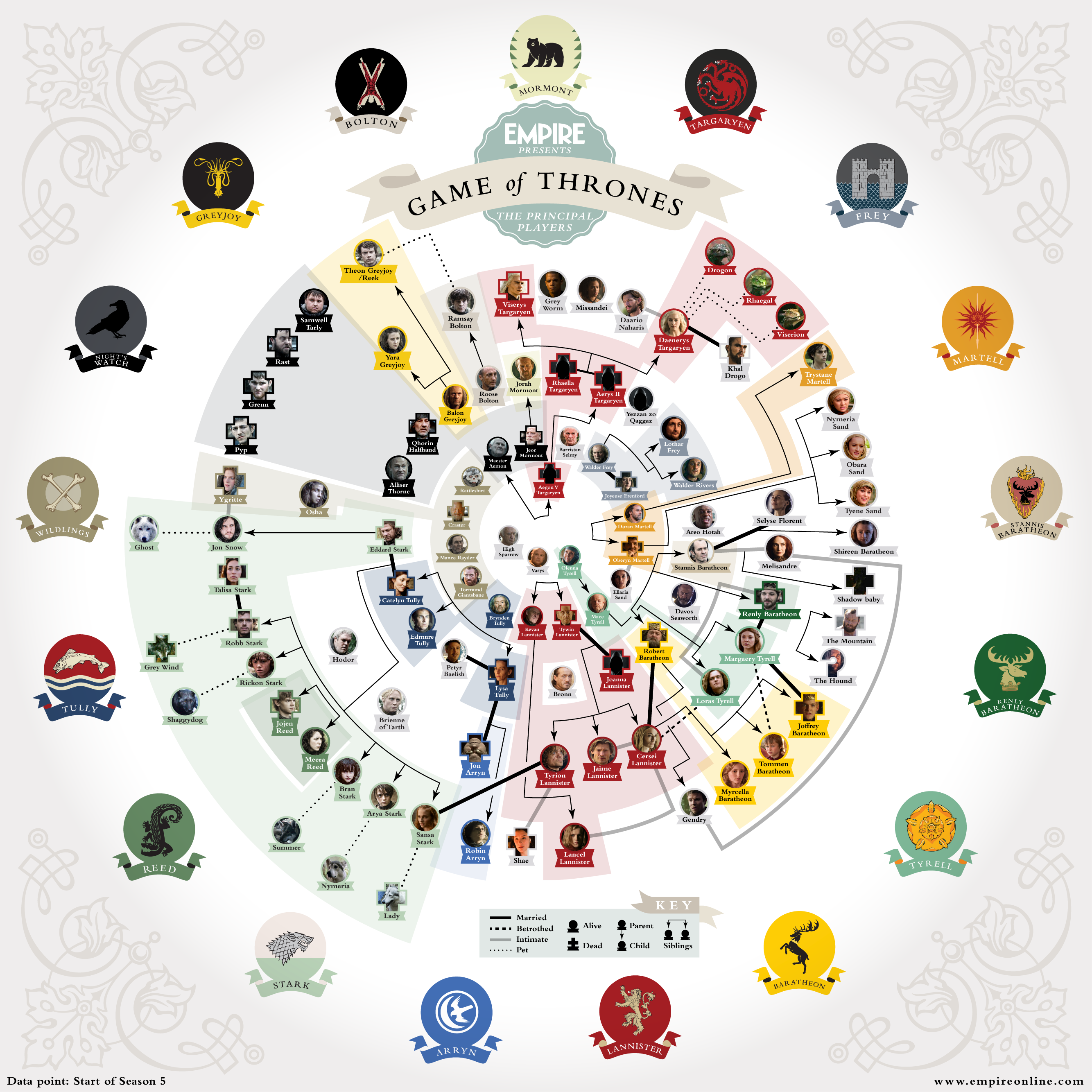
In the final season of Game of Thrones, the narrative converges on the existential threat of the White Walkers and the political struggle for the Iron Throne. This season features the culmination of arcs for the primary Great Houses of Westeros, including the Starks of Winterfell, the Targaryens, and the Lannisters, as they navigate shifting alliances, betrayal, and the climactic Battle of Winterfell.
The Stark Family: Resilience and Rebirth
The Starks serve as the emotional and moral anchor for the final season. Having been scattered across the world for years, the surviving siblings—Jon Snow, Sansa, Arya, and Bran—are reunited at Winterfell, the ancestral seat of House Stark.
Jon Snow (Aegon Targaryen)
Jon Snow enters the eighth season in a position of complex dual identity. Having pledged his support to Daenerys Targaryen, he struggles to reconcile his Northern heritage with his newfound status as the true heir to the Targaryen line. His arc is defined by his commitment to the living against the dead, prioritizing survival over political ambition. As a character, Jon serves as the bridge between the warring factions of Westeros, though his reluctance to claim power creates significant friction within the Targaryen alliance.
Sansa Stark
As the Lady of Winterfell, Sansa Stark represents the political pragmatism of the North. Throughout season eight, she remains deeply skeptical of Daenerys Targaryen, prioritizing the autonomy of the North and the security of her people over the abstract ideal of a unified Seven Kingdoms. Her development from a victim of court politics to a shrewd strategist is central to the season’s resolution, showcasing her growth into a leader who understands the mechanics of governance.
Arya Stark
Arya returns to Winterfell as a highly skilled assassin, fundamentally changed by her time with the Faceless Men. In the final season, she plays a pivotal role in the defense of the realm, specifically during the Long Night. Unlike her siblings, Arya remains largely detached from the throne’s political machinations, focused instead on the preservation of her family and the final execution of her personal "list."
Bran Stark
Bran’s transition into the Three-Eyed Raven shifts his role from a participant in the war to the repository of human history. His presence provides the supernatural context necessary to understand the threat posed by the Night King. His character serves as a narrative device that forces other characters to confront their pasts and future trajectories, ultimately positioning him as the philosophical center of the season’s conclusion.
House Targaryen and the Quest for the Iron Throne
The Targaryen influence in Season 8 is represented primarily by Daenerys Targaryen. Her narrative arc focuses on the high-stakes transition from a conqueror motivated by liberation to a monarch struggling with the isolation of power.
Daenerys Targaryen
Daenerys arrives in the North with her Unsullied army and Dothraki hoard, bringing her dragons to aid in the war against the White Walkers. The eighth season chronicles the erosion of her support base and the mounting pressure of her claim to the Iron Throne. Her transformation is driven by the loss of her closest advisors and the realization that her lineage—and her dragons—are viewed with fear rather than gratitude by the people of Westeros.
Jorah Mormont and Grey Worm
These characters serve as the primary conduits for Daenerys’s political and military reach. Jorah Mormont remains the steadfast protector, representing the theme of unconditional loyalty. His death during the Battle of Winterfell marks a significant turning point for Daenerys, stripping away one of her last anchors to humanity and sound judgment. Grey Worm, conversely, represents the military efficiency of the Unsullied and the tragedy of a life defined entirely by servitude.
House Lannister: The End of an Era
House Lannister’s trajectory in the final season is one of decline and internal reckoning, specifically focusing on the deteriorating bond between Jaime and Cersei Lannister.
Cersei Lannister
As the reigning Queen on the Iron Throne, Cersei remains the primary antagonist for the southern campaign. Her strategy in Season 8 is one of isolationist fortification; she remains in King’s Landing, relying on the Golden Company and her control of the city’s defenses. Cersei’s refusal to assist in the war against the White Walkers highlights her character’s commitment to self-preservation above all else, even at the cost of the entire continent.
Jaime Lannister
Jaime’s journey to the North represents one of the most significant character shifts in the series. By abandoning Cersei to fight for the living, he attempts to reconcile his past as the Kingslayer with his desire for redemption. His decision to return to King’s Landing in the final episodes serves as a tragic acknowledgment of his inextricable bond with his sister, illustrating the destructive nature of their relationship.
Tyrion Lannister
Serving as Daenerys’s Hand of the Queen, Tyrion faces the difficult task of managing her descent into paranoia. He represents the voice of diplomacy in a season defined by military escalation. His failures in the eighth season are not a lack of intelligence, but a failure to foresee the extreme shifts in political stability and the volatile nature of his Queen.
Comparison of Key Political Factions
The following table summarizes the primary objectives and ultimate status of the major houses as they enter the final conflict.
| House | Primary Goal | Leadership Status (End of S8) | Strategic Focus |
|---|---|---|---|
| Stark | Survival & Independence | Bran Stark (King) | Defense of the North |
| Targaryen | Claim the Iron Throne | Daenerys (Deceased) | Conquest & Justice |
| Lannister | Maintain Royal Control | House effectively extinct | Defensive Isolation |
| Greyjoy | Regain Salt Throne | Yara Greyjoy (Lady) | Maritime Sovereignty |
The Impact of Supporting Characters
While the Great Houses dominate the political narrative, supporting characters provide the necessary friction to propel the plot forward. Characters like Theon Greyjoy and Brienne of Tarth serve as extensions of the main houses, embodying themes of honor and redemption.
Theon’s arc concludes with a sacrifice that bridges his identity as both a Greyjoy and a Stark, providing one of the few moments of genuine closure for his fractured character. Brienne, through her knighthood and her relationship with Jaime Lannister, highlights the transition of feudal values into a new era where merit—rather than just lineage—begins to hold weight.
Frequently Asked Questions
What was the primary motivation for Cersei Lannister in Season 8?
Cersei’s goal was to maintain her hold on the Iron Throne by waiting for her enemies to destroy one another. By refusing to send her armies to the North, she aimed to conserve her strength for the final confrontation against whichever force survived the White Walkers.
Why did Jon Snow struggle with his Targaryen identity?
His struggle was both personal and political. Personally, he saw himself as a Stark, raised in the tradition of the North. Politically, his identity as a Targaryen threatened the stability of his alliance with Daenerys, creating a power vacuum that inevitably led to distrust and conflict between their respective supporters.
How did the threat of the White Walkers change the political dynamics?
The existential threat of the Army of the Dead forced a temporary unification of competing houses. This "Long Night" acted as a catalyst that exposed the true characters of the leaders: those who sought to protect the realm versus those who prioritized their own power.
What was the ultimate significance of the Battle of Winterfell?
It was the definitive conclusion to the supernatural threat that had been looming since the first episode of the series. The defeat of the Night King fundamentally changed the stakes of the series, moving the narrative from a struggle for survival back to a struggle for political control.
How does the final state of Westeros differ from the start of the season?
By the end of Season 8, the traditional power structure of the Great Houses has been dismantled. The Iron Throne is destroyed, and the political system moves toward a more elective form of monarchy, signaling the end of the absolute dynastic rule that defined the continent for centuries.
Recommendation for Viewers
To fully appreciate the narrative arc of the final season, revisit the character developments of the Stark siblings in the early seasons. The payoffs in the eighth season are rooted heavily in the foundational trauma and growth established in the series' inception. When observing the final battles, pay close attention to the tactical decisions of characters like Jon Snow and Tyrion Lannister, as these reflect their internal conflicts between duty and morality.