A private label brand is a product manufactured by a third-party producer but sold under a retailer’s or wholesaler's exclusive brand name. While the producer manages the physical manufacturing, the retailer owns the brand, specifies the product’s traits, and manages the marketing, positioning it as a unique alternative to national manufacturer brands.
The Relationship Between Producers and Private Labels
To understand why a brand produced by one company but owned by another is called a private label, one must look at the structural hierarchy of modern retail. In the traditional manufacturing model, a company like Nestlé or Procter & Gamble designs, produces, and markets its own brands (manufacturer brands). However, the private label model bifurcates these responsibilities. The producer acts as a silent partner, focusing on operational efficiency, raw material sourcing, and assembly, while the retailer (the owner) focuses on consumer data, shelf placement, and brand identity.
In 2026, this relationship has evolved beyond simple "store brands." Many producers now specialize entirely in private label manufacturing, maintaining state-of-the-art facilities that serve multiple competing retailers. The producer provides the "what" (the physical goods), while the owner provides the "who" and "where" (the brand persona and the sales channel). This distinction is vital for legal and financial reasons: the owner of the private label typically holds the trademark and bears the primary liability for marketing claims, while the producer is responsible for manufacturing quality and safety standards.
Defining the Difference: Private Label vs. Manufacturer Brands
The primary confusion regarding the statement "a brand that is owned by a producer is called a private label" often stems from a misunderstanding of market terminology. Technically, if a producer owns the brand and sells it across various retailers, it is a manufacturer brand (or national brand). A private label, by definition, is characterized by the retailer's ownership.
Manufacturer Brands
These are developed and owned by the company that produces them. They are heavily advertised to create "pull" demand, meaning consumers go to a store specifically looking for that brand. The producer controls the entire lifecycle, from the laboratory to the television commercial. Examples include Nike in apparel or Coca-Cola in beverages.
Private Label Brands
These are exclusive to a specific retailer. In 2026, major retailers have moved away from the "generic" look of the past, instead building "premium private labels" that rival national brands in quality. The retailer identifies a gap in the market, defines the product specifications, and then contracts a producer to build it. The producer does not own the intellectual property of the brand name, even if they developed the recipe or the chemical formula used in the product.
Why Producers Choose the Private Label Path
It might seem counterintuitive for a producer to manufacture goods that will eventually compete with their own branded products or carry someone else’s name. However, the private label sector offers significant industrial advantages that make it a cornerstone of the 2026 manufacturing economy.
1. Utilization of Manufacturing Capacity
Factories are most profitable when they are running at 100% capacity. Many producers use private label contracts to fill the gaps in their production schedules. If a producer’s own brand only requires 60% of the factory's output, they can sell the remaining 40% of their "line time" to a private label client. This allows the producer to amortize their fixed costs—such as machinery, rent, and base labor—across a larger volume of units, lowering the per-unit cost for everything they make.
2. Reduced Marketing and Distribution Overhead
When a producer creates a private label product, they do not have to worry about consumer advertising, shelf-space negotiations, or retail returns. The retailer handles the "last mile" of the business. The producer’s only "customer" is the retail buyer. This significantly reduces the need for a massive sales force and a multimillion-dollar marketing budget, allowing the producer to focus purely on engineering and logistics.
3. Stability through Long-Term Contracts
Retailers often sign multi-year agreements with private label producers to ensure consistency for their store brands. These contracts provide the producer with a predictable revenue stream, which is often more stable than the volatile consumer market where manufacturer brands must constantly fight for "share of mind."
The Strategic Advantage for the Brand Owner (The Retailer)
For the retailer, owning the brand while outsourcing the production is a high-margin strategy. By 2026, data-driven inventory management has made private labels more profitable than ever.
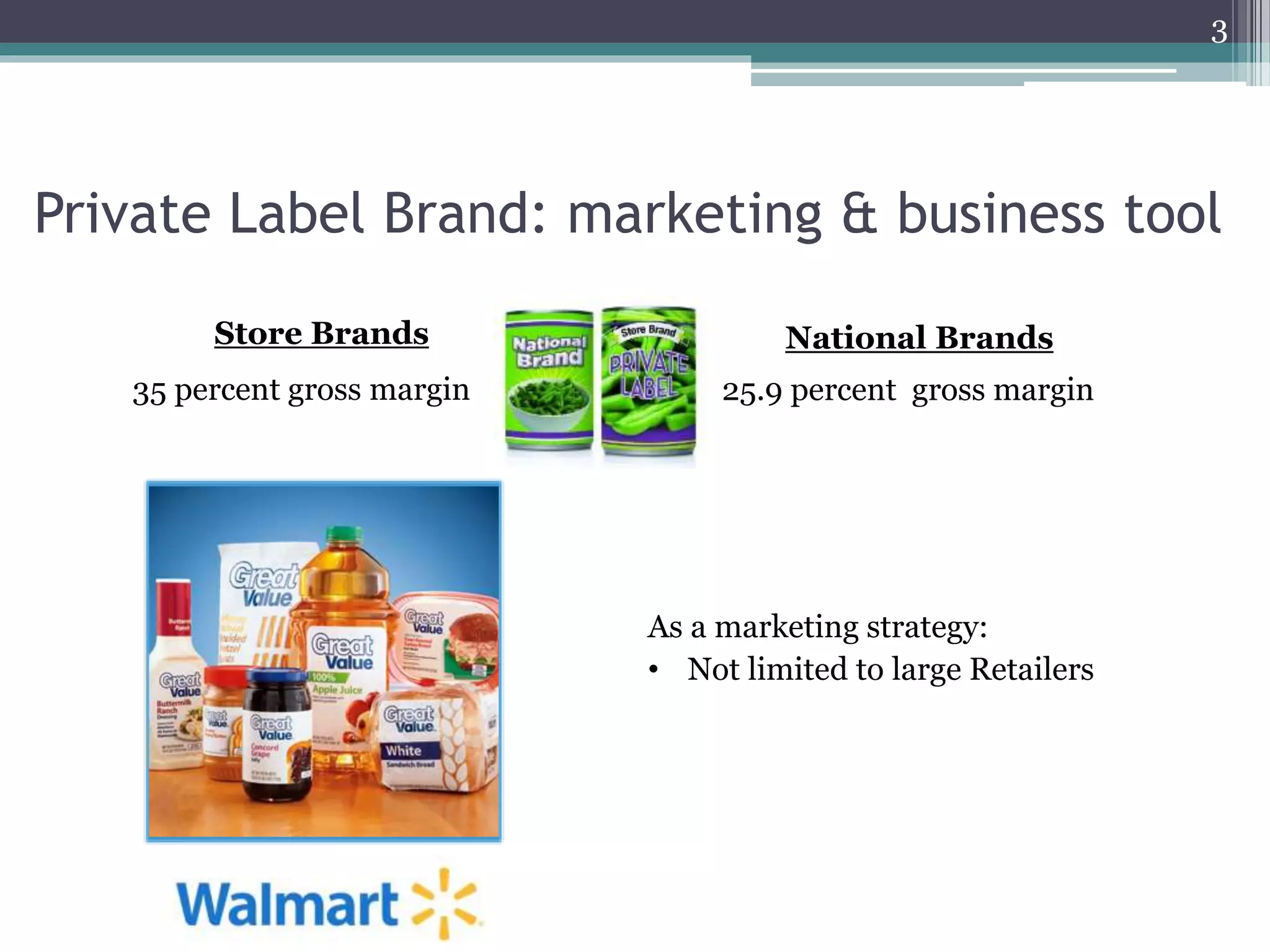
- Higher Profit Margins: Because there is no "middleman" brand owner taking a cut, and because marketing costs are lower, retailers often see margins on private labels that are 25% to 30% higher than on national brands.
- Pricing Control: Retailers can use their private labels as a "price floor" to attract budget-conscious shoppers, or as a premium "exclusive" to build loyalty.
- Negotiation Leverage: Having a strong private label gives a retailer leverage when negotiating with national brand manufacturers. If a national brand refuses to offer a discount, the retailer can simply give more shelf space to its own private label.
Comparative Overview: Branding and Production Models
The following table outlines the key differences between the major branding models as they exist in the current 2026 market.
| Feature | Manufacturer Brand | Private Label Brand | White Label Brand |
|---|---|---|---|
| Ownership | The Producer | The Retailer/Wholesaler | The Retailer/Wholesaler |
| Customization | Controlled by Producer | High (Exclusive Specs) | Low (Generic Specs) |
| Exclusivity | Sold at many retailers | Exclusive to one retailer | Sold by many retailers |
| Profit Margin | Moderate (High Ad Spend) | High (Low Ad Spend) | High (Lowest R&D) |
| Brand Equity | Built by Producer | Built by Retailer | Shared/Minimal |
| Example | Sony, Kellogg’s | Costco’s Kirkland, Amazon Basics | Generic "Store" Aspirin |
Operational Logistics: From Factory to Shelf
The transition of a product from a producer’s facility to a private label brand involves several critical phases. It is not as simple as putting a different sticker on a box; in 2026, the integration between producer and owner is deeply technical.
Technical Specifications and R&D
The brand owner (retailer) provides a Product Requirements Document (PRD). This includes everything from the chemical composition of a shampoo to the thread count of a bedsheet. The producer’s R&D team then works to match these specs while maintaining a cost-effective production flow. In many cases, the producer may offer a "base formula" that the retailer then "tweaks" to make it unique—such as adding a specific fragrance or organic certification.
Quality Assurance (QA) and Compliance
Since the brand owner’s reputation is on the line, QA standards for private labels are often more stringent than for national brands. Producers must allow regular audits and provide transparency into their supply chains. In 2026, this often involves blockchain tracking to prove that the raw materials meet the "green" or "ethical" claims made on the retailer’s packaging.
Packaging and Logistics
Packaging is usually designed by the retailer but applied at the producer's factory. This requires the producer to manage multiple sets of packaging inventory for different clients. Advanced "Just-In-Time" (JIT) manufacturing allows producers to switch between different private label runs with minimal downtime, ensuring that the retailer receives fresh stock without needing massive warehouses.
Challenges and Risks in the Private Label Model
While the model is highly efficient, it is not without risks for both the producer and the brand owner.
- Dependency Risk: For a producer, becoming too reliant on a single large retail client for private label manufacturing is dangerous. If that retailer decides to switch producers or move production in-house, the original producer could lose a majority of their business overnight.
- Brand Dilution: For the owner, if the producer cuts corners on quality to save costs, the retailer’s entire brand reputation is at risk. A consumer who buys a bad "store brand" milk may stop trusting the "store brand" electronics as well.
- Intellectual Property (IP) Conflicts: Tensions often arise regarding who owns an innovation developed during the private label partnership. If a producer creates a new, more efficient way to seal a package, can they use that for other clients, or does the original retailer own that process?
The Future of Private Labeling in 2026
The landscape of 2026 shows a massive shift toward "Producer-to-Consumer" (P2C) and "Retailer-as-Manufacturer" hybrid models. Artificial Intelligence now allows retailers to predict demand so accurately that they can commission private label runs with zero waste. Furthermore, small-scale "micro-producers" are increasingly entering the private label space, allowing boutique retailers to offer highly specialized, artisanal private labels that were once only possible for global giants.
The definition of a brand owned by a producer versus one owned by a retailer remains a fundamental pillar of commerce. As long as retailers seek exclusivity and producers seek volume, the private label model will continue to dominate the global supply chain, blurring the lines between who "makes" a product and who "is" the brand.
Frequently Asked Questions
Is a private label the same as a white label? Not exactly. While both involve a producer making goods for another company, a white label product is usually a generic item sold to many different retailers who all put their own labels on it without changing the product. A private label is typically a custom-made product created specifically for one retailer, with unique formulations or designs that the retailer defines.
Can a producer have its own brand and still make private labels for others? Yes, this is very common. Many "dual-track" manufacturers produce a high-end national brand under their own name while simultaneously producing a "value" private label for a major grocery chain. This allows them to capture two different market segments (the premium buyer and the budget buyer) using the same factory infrastructure.
Who is legally responsible if a private label product is defective? In most jurisdictions, both the producer and the brand owner can be held liable. However, the retailer (the brand owner) is usually the first point of contact for the consumer and the regulatory bodies. Contracts between the retailer and producer typically include "indemnification clauses" that specify who pays for legal costs or recalls based on whether the defect was a design flaw (retailer’s fault) or a manufacturing error (producer’s fault).
Why are private label products usually cheaper? The lower price isn't necessarily due to lower quality. Private labels save money on several fronts: they spend almost nothing on national television or digital advertising, they have zero costs for a national sales and distribution force, and they don't have to pay the "brand premium" that established manufacturers charge to cover their corporate overhead.
Do private labels ever become more popular than national brands? Yes. In 2026, several private labels have achieved such high levels of consumer trust that they are preferred over national alternatives. This is particularly true in categories like organic foods, household cleaning supplies, and basic consumer electronics, where the retailer's "guarantee" is seen as being as valuable as a manufacturer's legacy.
Practical Recommendation for Businesses
If you are a producer, your goal should be to diversify your client base so that no single private label contract accounts for more than 30% of your revenue. Focus on "flexible manufacturing" technology that allows you to switch between different brand specifications quickly. If you are a retailer looking to launch a private label, prioritize the "Premium-Private" tier. Consumer data in 2026 shows that shoppers are moving away from "cheapest possible" options and toward "high-value exclusives" that offer national-brand quality at a 10-15% discount, rather than a 50% discount.