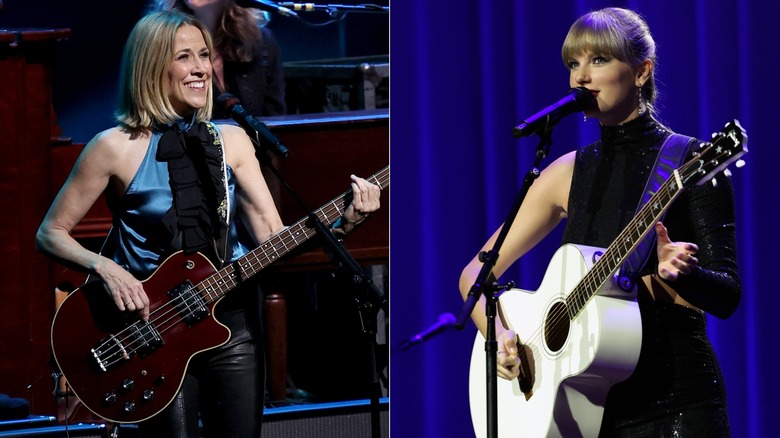
If you enjoy Sheryl Crow’s blend of 90s alt-rock, rootsy Americana, and polished pop-rock, you should explore artists like Alanis Morissette, Melissa Etheridge, and Bonnie Raitt. For contemporary sounds with a similar spirit, look toward Brandi Carlile, Kacey Musgraves, and Maren Morris, who carry her legacy of singer-songwriter excellence into 2026.
Sheryl Crow has occupied a unique space in the musical landscape since the early 1990s. As a multi-instrumentalist, producer, and songwriter, she bridged the gap between the grit of classic rock and the accessibility of mainstream pop. Whether it is the loose, "jam-band" feel of her debut Tuesday Night Music Club or the darker, experimental production of The Globe Sessions, her work is defined by organic instrumentation and high-level storytelling.
Finding artists who capture that same "lightning in a bottle" requires looking at three distinct categories: her 1990s contemporaries, her classic rock influences, and the modern artists who have inherited her "crossover" blueprint.
The Architecture of Sheryl Crow’s Sound
To understand which artists are truly "similar," one must first deconstruct what makes Sheryl Crow’s music distinctive. Her sound is built on three primary pillars:
- The Roots-Rock Foundation: Crow’s music heavily features the Fender Telecaster, Wurlitzer electric pianos, and Hammond B3 organs. This gives her songs a timeless, "live-in-the-room" quality reminiscent of the Rolling Stones or Creedence Clearwater Revival.
- Lyrical Narrative: Much like her mentor Don Henley, Crow writes songs that function as short stories. From the observational wit of "All I Wanna Do" to the political commentary of "Redemption Day," she avoids the vague clichés of bubblegum pop.
- Vocal Texture: Her voice possesses a natural rasp and a "cool girl" nonchalance. She rarely over-sings, preferring to stay in a comfortable mid-range that emphasizes the melody and the lyrics.
As of 2026, Crow’s influence remains visible across genres, particularly as younger artists move away from purely synthesized sounds back toward organic, guitar-driven arrangements.
The 90s Alternative Rock Contemporaries
During the mid-to-late 90s, a wave of female singer-songwriters reclaimed the airwaves. While their sounds varied, they shared a common thread of self-reliance and musical autonomy.
Alanis Morissette
While Crow leaned more toward classic rock, Alanis Morissette was the face of the 90s post-grunge movement. If you appreciate the defiant attitude in Crow’s "If It Makes You Happy," you will find a similar (though more aggressive) catharsis in Morissette’s Jagged Little Pill. By 2026, both artists are viewed as the "mothers" of the modern alt-rock female vocal style. Morissette’s music features complex, wordy lyrics and a willingness to be unpolished, making her a perfect companion for fans of Crow’s more experimental 90s work.
Melissa Etheridge
If the aspect of Sheryl Crow you love most is her raspy, blues-influenced rock, Melissa Etheridge is the closest sonic match. Etheridge’s breakthrough albums, such as Yes I Am, rely on powerful, guitar-heavy arrangements and a vocal delivery that sits somewhere between Janis Joplin and Bruce Springsteen. Like Crow, Etheridge is a formidable guitarist who understands the power of a simple, driving rock hook.
Liz Phair
For those who enjoy the "indie" sensibility of Crow’s early work, Liz Phair is essential listening. Her landmark album Exile in Guyville offers a raw, lo-fi counterpart to Crow’s more polished productions. Phair’s deadpan vocal delivery and clever, often subversive lyrics mirror the "cool" factor that Crow brought to the mainstream.
The Roots and Blues Influence (The Pioneers)
Sheryl Crow did not invent her sound in a vacuum; she was heavily influenced by the women who came before her in the 70s and 80s.
Bonnie Raitt
It is impossible to discuss Sheryl Crow without mentioning Bonnie Raitt. Raitt’s mastery of the slide guitar and her ability to blend blues, rock, and country provided the blueprint for Crow’s career. Songs like "Something to Talk About" have the same effortless, mid-tempo groove that Crow perfected on her self-titled 1996 album. Raitt’s longevity—highlighted by her continued Grammy success into the mid-2020s—proves the enduring power of the "roots-rock" lane.
Stevie Nicks
Crow has famously collaborated with Stevie Nicks, and the two share a similar vocal register and a love for "California Rock." Nicks’ solo work, particularly albums like Bella Donna, features the same atmospheric, guitar-and-piano textures that appear on Crow’s The Globe Sessions. If you gravitate toward Crow’s more mystical or ballad-heavy tracks, Nicks is the primary source of that inspiration.
Modern Heirs to the Roots-Rock Throne
In 2026, the spirit of Sheryl Crow lives on in a new generation of artists who refuse to be pigeonholed into a single genre. These artists often blend Americana, pop, and rock in a way that feels inherently "Crow-esque."
Brandi Carlile
Brandi Carlile is perhaps the most direct successor to the Sheryl Crow mantle. Like Crow, Carlile is a multi-instrumentalist who produces her own work and possesses a voice that can transition from a delicate folk whisper to a full-throttle rock belt. Her album In These Silent Days (2021) and her continued dominance in the Americana scene through 2025 demonstrate a similar commitment to organic storytelling and classic arrangement. Carlile also shares Crow’s habit of collaborating with legends, further cementing her status as a bridge between musical eras.
Kacey Musgraves
While Musgraves started in traditional country, her evolution into "Galactic Country" and pop-rock mirrors Crow’s own crossover journey. Musgraves’ 2024 album Deeper Well and her previous work on Golden Hour feature the same clean, acoustic-driven production and conversational songwriting that defined Tuesday Night Music Club. Fans of Crow’s lighter, sunnier pop-rock tracks will find a kindred spirit in Musgraves.
Maren Morris
Maren Morris represents the "rock" side of modern country-pop. Her hit "The Bones" has the rhythmic complexity and soulful vocal delivery that characterized Crow’s late-90s hits. Morris has often cited Crow as a major influence, and her move toward more independent, genre-fluid music in recent years aligns with Crow’s own career trajectory of prioritizing artistic freedom over radio trends.
Comparing the Greats: A Quick Reference
The following table compares key artists to Sheryl Crow based on the specific "era" or "style" of her music they most closely resemble.
| Artist | Primary Genre | Primary Similarity to Crow | Recommended Starting Album |
|---|---|---|---|
| Alanis Morissette | Alt-Rock | Lyrical honesty; 90s cultural impact | Jagged Little Pill |
| Brandi Carlile | Americana | Vocal power; genre-blending; production | By the Way, I Forgive You |
| Bonnie Raitt | Blues-Rock | Slide guitar; rootsy, organic arrangements | Nick of Time |
| Melissa Etheridge | Heartland Rock | Raspy vocals; guitar-driven energy | Yes I Am |
| Kacey Musgraves | Country-Pop | Conversational lyrics; crossover appeal | Golden Hour |
| Grace Potter | Rock/Soul | High-energy performance; blues influence | Grace Potter & The Nocturnals |
| Shawn Colvin | Folk-Pop | Acoustic focus; intricate songwriting | A Few Small Repairs |
The "Nashville" Connection: Why It Matters
In the latter half of her career, Sheryl Crow moved to Nashville and leaned more heavily into her country roots, culminating in projects like Feels Like Home and her 2019 duets album Threads. This transition is a key reason why many modern country and Americana artists are now compared to her.
Artists like The Highwomen (a supergroup consisting of Brandi Carlile, Maren Morris, Natalie Hemby, and Amanda Shires) embody the collective, musician-first spirit that Crow has always championed. Their emphasis on three-part harmonies and social commentary mirrors Crow’s collaborative work with the "Tuesday Night Music Club"—the group of musicians who helped craft her first record.
Furthermore, Maggie Rogers deserves a mention for her ability to fuse folk-style songwriting with modern production. While Rogers uses more electronic elements than Crow typically does, her core identity as a "girl with a guitar" who writes her own narrative is very much in line with Crow’s 1994-1998 peak.
Frequently Asked Questions
Is Sheryl Crow considered Country or Rock?
Sheryl Crow is primarily considered a Rock and Alternative Rock artist, but she has significant roots in Country, Folk, and Blues. Throughout her career, she has successfully charted on both Pop and Country radio. Her 2023 induction into the Rock and Roll Hall of Fame solidified her status as a rock icon, though she remains a staple in the Nashville music community.
Who are the "Tuesday Night Music Club" members?
The Tuesday Night Music Club was both an album title and a collective of musicians including Kevin Gilbert, David Baerwald, Bill Bottrell, and others. They were instrumental in creating Crow’s debut sound. Artists who work in similar "collective" environments today include Haim and Boygenius, where the interplay between multiple musicians defines the final product.
Which modern artist has a voice most like Sheryl Crow?
In terms of texture and range, Maren Morris and Elle King are often cited as having that same "raspy but melodic" quality. Brandi Carlile also shares Crow’s ability to use her vocal "break" (the transition between chest and head voice) for emotional effect.
What are some essential Sheryl Crow albums for new fans?
To understand her range, start with Tuesday Night Music Club (1993) for the hits, Sheryl Crow (1996) for the rock edge, and The Globe Sessions (1998) for her most critically acclaimed songwriting and production. Her 2024 album, Evolution, is also a great entry point for seeing how her sound has adapted to the mid-2020s.
Are there any indie artists similar to her?
Yes, Courtney Barnett captures Crow’s deadpan, observational lyrical style, while Sharon Van Etten echoes the darker, moody production found on Crow’s late-90s tracks. Waxahatchee (Katie Crutchfield) is another excellent choice for fans of Crow’s Americana-leaning work, especially her 2020 album Saint Cloud and its 2024 successor Tigers Blood.
Practical Recommendation for Listeners
If you are looking to build a playlist of artists similar to Sheryl Crow, start by creating a "bridge" between the 90s and the present.
- Start with the Source: Add Bonnie Raitt’s "Love Sneakin' Up On You" and Stevie Nicks’ "Edge of Seventeen."
- Add the 90s Peers: Include Alanis Morissette’s "Hand in My Pocket" and Melissa Etheridge’s "Come to My Window."
- Integrate the Modern Heirs: Add Brandi Carlile’s "The Joke," Kacey Musgraves’ "Butterflies," and Maren Morris’ "My Church."
- Explore the 2026 Landscape: Look for newer releases from Grace Potter or Elle King, who continue to fly the flag for guitar-driven, female-led rock.
By following this lineage, you will see that Sheryl Crow isn't just an artist with a few hits; she is a foundational figure in a genre that continues to thrive by valuing authentic instruments and honest voices.