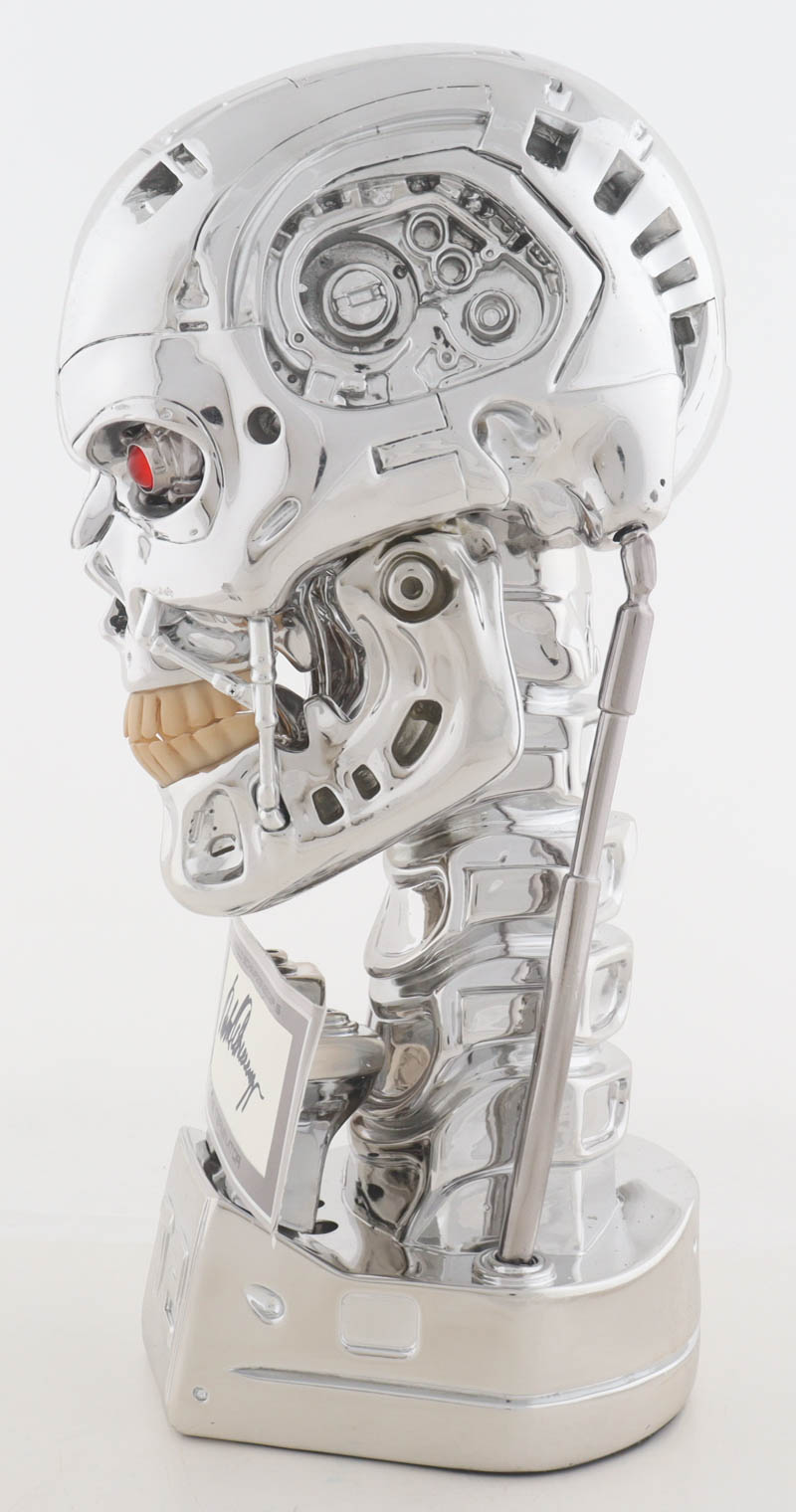
Arnold Schwarzenegger’s portrayal of the Cyberdyne Systems Model 101 Series 800 Terminator is a cornerstone of science fiction history. Spanning four decades of cinema, his performance transitioned from a cold-blooded assassin to a heroic protector, fundamentally changing the "unstoppable machine" archetype and cementing Schwarzenegger’s status as a global cultural icon.
The relationship between the actor and the machine began in 1984 under the direction of James Cameron. While the role required minimal dialogue, it demanded a physical presence and a precise, mechanical performance that few actors could achieve. Schwarzenegger did not just play a character; he defined a visual and behavioral language for artificial intelligence in popular media. As of 2026, the T-800 remains the benchmark against which all cinematic cyborgs are measured.
The Genesis of the T-800: Casting and Concept
In the early 1980s, the concept of the "Terminator" was a nightmare vision held by director James Cameron. Originally, the studio suggested Arnold Schwarzenegger for the role of the human resistance fighter, Kyle Reese. However, during a lunch meeting, Cameron became fascinated by Schwarzenegger’s intensity and his specific ideas on how the machine should move—without blinking, with total economy of motion, and a complete lack of human emotion.
Cameron realized that the Terminator shouldn't be a lean, infiltrator-type character as originally envisioned (which would have been played by someone like Lance Henriksen), but rather a "human tank." Schwarzenegger was cast as the Cyberdyne Systems Model 101, the specific living tissue sheath that covers the T-800 endoskeleton.
The Distinction Between T-800 and Model 101
To understand Schwarzenegger’s role, one must distinguish between the chassis and the skin. The T-800 refers to the hyper-alloy combat chassis—the metal skeleton underneath. The Model 101 refers to the physical appearance of the organic tissue (the Arnold Schwarzenegger look). In the lore of the franchise, there are other models with different faces, but the 101 remains the most prolific and recognizable version deployed by Skynet.
Technical Specifications of the T-800 Chassis
The T-800 is described in the films as a "cybernetic organism: living tissue over a metal endoskeleton." This design was a breakthrough for Skynet because it allowed the machine to bleed, sweat, and even have bad breath, making it the perfect infiltrator.
- Chassis Construction: The skeleton is composed of a frictionless hyper-alloy, making it nearly impervious to small-arms fire. It is designed to withstand extreme temperatures and high-impact collisions.
- Power Source: The machine is powered by two nuclear energy cells (hydrogen fuel cells). In Terminator 3: Rise of the Machines, it is revealed that these cells are volatile; if damaged, they can result in a massive explosion.
- The Neural Net Processor: The T-800 features a "learning computer" located in the skull. This CPU allows the machine to adapt to human behavior, learn tactical combat on the fly, and even mimic human voices with 100% accuracy.
- Sensory Array: The iconic red glowing eyes are actually infrared sensors, allowing the machine to track heat signatures and see through smoke, mirrors, and total darkness.
The Evolution of the Character Across Five Decades
Schwarzenegger’s T-800 has undergone one of the most complex character arcs in cinema history, despite technically being a machine that follows programming.
The Terminator (1984): The Ultimate Villain
In the original film, the T-800 is a slasher-movie monster. Schwarzenegger’s performance was terrifying because of its relentless nature. He performed his own stunts and trained for weeks with firearms until he could strip and reassemble weapons blindly. This version of the T-800 had only 18 lines of dialogue, proving that physical presence was more important than script length for this role.
Terminator 2: Judgment Day (1991): The Protector
The sequel flipped the script, featuring a reprogrammed T-800 sent back by the future John Connor to protect his younger self. This film explored the machine's ability to learn. The relationship between the T-800 and young John (Edward Furlong) humanized the character, culminating in the famous "thumbs up" finale. This performance won Schwarzenegger worldwide acclaim for showing "emotion" through a character that physically could not feel it.
Later Iterations and the Aging Machine
As the franchise progressed into Terminator 3: Rise of the Machines (2003), Terminator Genisys (2015), and Terminator: Dark Fate (2019), the films began to address Schwarzenegger’s real-world aging. The writers introduced the concept that while the endoskeleton remains intact, the organic skin tissue ages like a human’s. This allowed for the "Pops" and "Carl" iterations of the character—versions of the T-800 that had spent decades living among humans, developing a sense of mimicry that bordered on genuine consciousness.
Production and Special Effects: The Stan Winston Legacy
No discussion of Schwarzenegger as the T-800 is complete without mentioning Stan Winston, the legendary special effects artist. The "look" of the T-800 was a combination of Schwarzenegger’s physical performance and Winston’s animatronics.
For scenes where the T-800 was damaged, Schwarzenegger spent upwards of five to six hours in the makeup chair. Artists applied layers of silicone, metal plates, and light-up eye components to his face. In 1984, this was revolutionary. By 1991’s Terminator 2, the team integrated these practical effects with burgeoning CGI from Industrial Light & Magic (ILM), creating a seamless transition between the "Arnold" face and the "Metal" skeleton.
Comparing the T-800 Across the Franchise
The following table outlines the different T-800 (and T-850) units played by Schwarzenegger throughout the main film entries.
| Film | Character Designation | Primary Objective | Final Status | Key Weaponry |
|---|---|---|---|---|
| The Terminator (1984) | T-800 Model 101 | Terminate Sarah Connor | Destroyed in hydraulic press | AMT Hardballer .45 Long Slide |
| T2: Judgment Day (1991) | T-800 Model 101 | Protect John Connor | Self-terminated in molten steel | M134 Minigun / Win. 1887 |
| T3: Rise of the Machines | T-850 Model 101 | Protect John & Kate | Destroyed via fuel cell explosion | Sage Control SL-6 Grenade Launcher |
| Terminator Genisys (2015) | T-800 "Pops" | Protect Sarah Connor | Upgraded via Mimetic Poly-alloy | Remington 870 / Barrett M82 |
| Terminator: Dark Fate (2019) | T-800 "Carl" | Aid Sarah & Dani | Destroyed in EMP blast | Various high-caliber firearms |
Physical Training and Stunt Work
To portray a 400-pound machine, Schwarzenegger had to adjust his natural bodybuilding movements. He worked on moving his head independently of his shoulders to simulate a camera gimbal. This "robotic" movement became a hallmark of the character.
He also famously practiced firing weapons without blinking. Humans have a natural reflex to blink when a firearm discharges; Schwarzenegger spent hours at the range to override this reflex, ensuring that the Terminator looked truly inhuman during gunfights. According to historical records from the Internet Movie Database (IMDb), Schwarzenegger's commitment to the physicality of the role is what saved the production when early makeup tests didn't look quite right—his acting sold the illusion.
Cultural Impact and Iconic Catchphrases
Schwarzenegger’s T-800 is responsible for some of the most famous lines in cinema history. "I'll be back," first uttered in the 1984 film when the Terminator is denied entry to a police station, has been voted one of the top movie quotes of all time by the American Film Institute (AFI).
The character's impact extends beyond the screen. The T-800 has appeared in:
- Video Games: Including the Mortal Kombat series and various standalone Terminator titles.
- Theme Parks: The "T2-3D: Battle Across Time" attraction at Universal Studios.
- Academic Discourse: The character is frequently cited in discussions regarding the "Uncanny Valley" and the ethics of autonomous weapons systems.
Frequently Asked Questions
Did Arnold Schwarzenegger play the Terminator in every movie?
Schwarzenegger has appeared in five of the six live-action Terminator films. He had starring roles in The Terminator, Terminator 2, Terminator 3, Terminator Genisys, and Terminator: Dark Fate. In Terminator Salvation (2009), a digital likeness of his 1984 self was used, but he did not physically film scenes for the movie as he was serving as the Governor of California at the time.
What is the difference between a T-800 and a T-850?
The T-850, featured in Terminator 3: Rise of the Machines, is an incremental upgrade of the T-800. It features a slightly more durable endoskeleton, dual hydrogen fuel cells (instead of one), and a more advanced psychological profile to better manipulate and understand human emotions. Physically, they appear identical because they both use the Model 101 skin.
Is the T-800 a robot or a cyborg?
The T-800 is technically a cybernetic organism (cyborg). A robot is entirely mechanical. Because the T-800 consists of a mechanical endoskeleton covered by living, biological tissue (skin, hair, blood), it meets the definition of a cyborg. This distinction is vital to the plot, as the biological component is what allows the Terminator to travel through time, as the time-displacement equipment only accepts living tissue.
How much did Arnold Schwarzenegger get paid for the Terminator roles?
His salary increased exponentially with the franchise's success. For the 1984 original, he was paid roughly $750,000. By Terminator 2, his salary jumped to $15 million. For Terminator 3: Rise of the Machines, he set a record at the time with a $30 million salary plus 20% of the profits.
Can a T-800 be killed by normal guns?
In the films, standard handguns and rifles generally do not stop a T-800; they only damage the organic skin or momentarily stagger the chassis. To "kill" or disable a T-800, one typically needs high explosives, anti-materiel rifles, extreme heat (molten metal), or massive electrical discharges.
Summary of Next Actions for Fans
If you are looking to explore the legacy of the T-800 further, the best course of action is to view the first two films in their remastered 4K formats. These versions highlight the intricate practical makeup effects by Stan Winston that are often lost in lower resolutions. For those interested in the technical "blueprints" of the machine, various licensed technical manuals and "making-of" books provide deep dives into the fictional engineering of the Cyberdyne systems.
Finally, for a modern perspective on the AI fears presented in the films, researching current developments in robotics and large language models (LLMs) provides a fascinating real-world parallel to the "Skynet" anxieties of the 1980s.