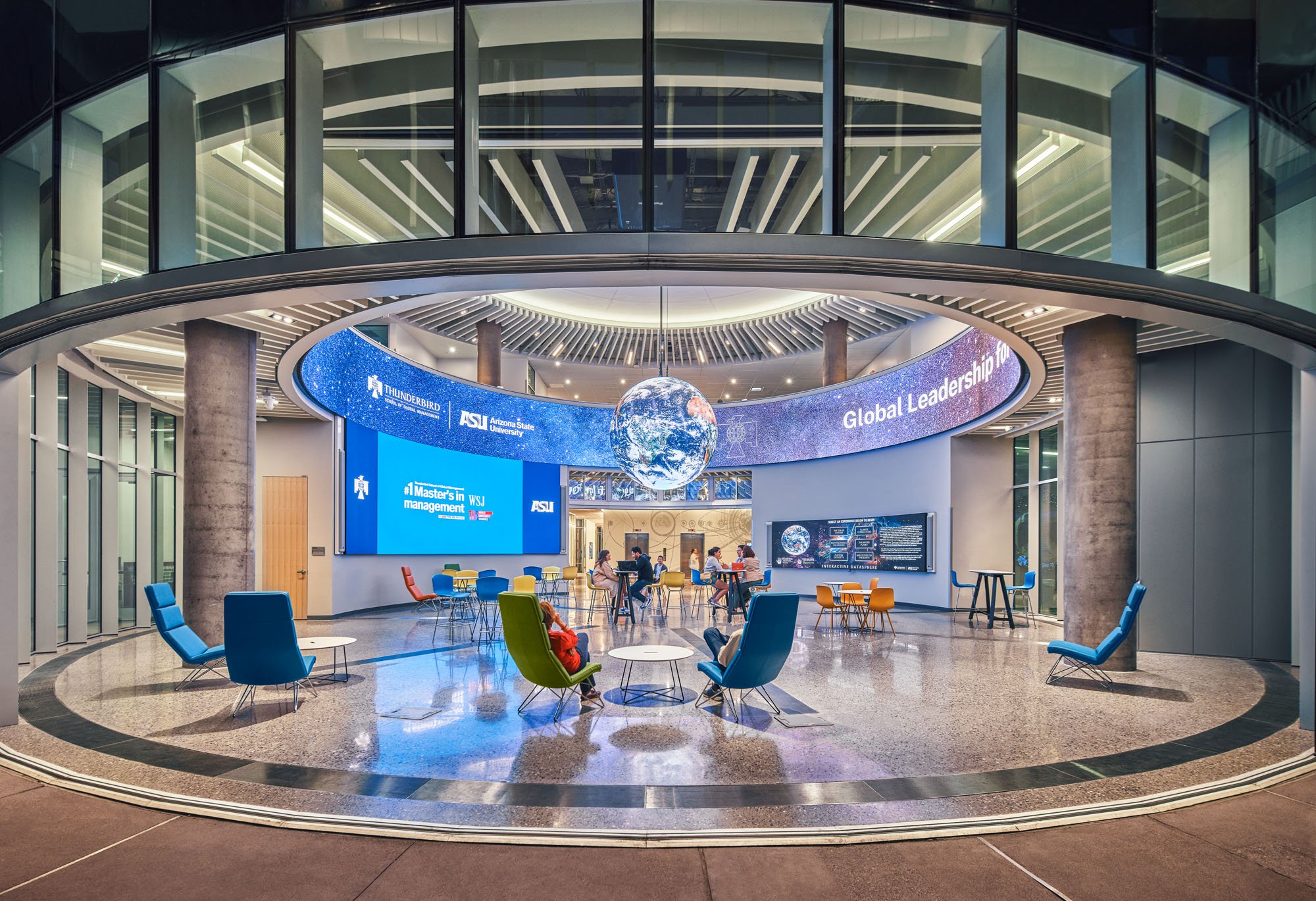
Arizona State University’s Thunderbird School of Global Management is the world’s premier institution for international leadership and management education. Headquartered in downtown Phoenix, it specializes in preparing professionals for the Fourth Industrial Revolution through a curriculum focused on global trade, cross-cultural leadership, and emerging technologies like AI, blockchain, and sustainable development.
The Evolution of Global Leadership Education
Founded in 1946 as the American Institute for Foreign Trade, Thunderbird School of Global Management has undergone a significant transformation since its inception. Originally established on the site of Thunderbird Field No. 1—a deactivated World War II airbase in Glendale, Arizona—the school was created to train American professionals for international commerce and diplomacy. This "Thunderbird" heritage remains central to its identity, even as the institution has modernized and expanded its reach.
In 2014, Thunderbird officially integrated with Arizona State University (ASU), a move that provided the school with the immense resources of one of the largest public research universities in the United States. In 2026, Thunderbird continues to operate as a specialized, high-tech unit within ASU, bridging the gap between traditional business management and global political economy.
The school’s current headquarters, the F. Francis and Dionne Najafi Global Headquarters in downtown Phoenix, represents the physical embodiment of this evolution. Opened in late 2021, the facility is a "smart building" designed to facilitate global connectivity. It features a digital global forum, an innovation lab for extended reality (XR), and advanced teleconferencing suites that allow students in Phoenix to collaborate in real-time with peers and professors across Thunderbird’s global hubs in cities like Seoul, Nairobi, and Dubai.
The Master of Global Management (MGM) Program
The flagship program at Thunderbird is the Master of Global Management (MGM). Unlike a traditional MBA, which often focuses heavily on domestic business practices and financial accounting, the MGM is designed from the ground up to address the complexities of operating across borders.
Specialized Concentrations
One of the defining features of the MGM in 2026 is its modularity. Students can choose from over 15 concentrations, allowing them to tailor their degree to specific industry needs. Popular concentrations include:
- Global Business: Focuses on traditional multinational corporate management and strategy.
- Data Science for Global Management: Equips leaders with the ability to interpret big data trends across different geographic markets.
- Global Digital Transformation: Addresses how legacy organizations can adopt AI and cloud computing on a global scale.
- Sustainable Development: Aligned with the UN Sustainable Development Goals, this track prepares leaders for the burgeoning green economy.
- Global Healthcare Delivery: Focuses on the management of health systems in both developed and emerging economies.
The Global Challenge Lab (GCL)
A cornerstone of the MGM experience is the Global Challenge Lab. This capstone project requires students to spend three to five weeks on-site at a company or NGO somewhere in the world. Working in consulting teams, students solve real-world problems—such as market entry strategies in Southeast Asia or supply chain optimization in Latin America. In 2026, these labs are increasingly focused on digital infrastructure and climate adaptation strategies, reflecting the pressing needs of the global market.
The Francis and Dionne Najafi 100 Million Learners Global Initiative
A defining mission of Thunderbird in 2026 is the Francis and Dionne Najafi 100 Million Learners Global Initiative. Launched with the ambitious goal of providing world-class management and entrepreneurship education to 100 million learners worldwide by 2030, this initiative offers online courses at no cost to the learner.
The curriculum is divided into three levels:
- Foundational: Aimed at learners with a primary school education level, focusing on basic entrepreneurship.
- Intermediate: Designed for those with high school or some college education.
- Advanced: Targeted at graduate-level learners.
The initiative is powered by AI-driven translation, allowing the content to be consumed in dozens of languages, including Arabic, Hindi, Spanish, and Swahili. This project underscores Thunderbird's shift from an elite, exclusive institution to a global engine for educational equity.
Undergraduate and Executive Education
While the MGM is the most recognized degree, Thunderbird has expanded its offerings to capture a broader range of the professional lifecycle.
Bachelor of International Trade (BIT)
The BIT is a specialized undergraduate degree designed for students who know early on that they want to work in the global arena. It combines rigorous business training with foreign language requirements and cultural studies. In 2026, the BIT is frequently paired with ASU’s accelerated "4+1" programs, allowing students to earn both their bachelor’s and their MGM in five years.
Executive Master of Global Management (EMGM)
For mid-career professionals with at least 10 years of experience, the EMGM offers a format that accommodates full-time work. This program focuses on high-level strategy, diplomatic negotiation, and managing large-scale organizational change. The cohort-based model fosters deep networking among senior leaders from government, military, and private sectors.
Comparison: Thunderbird MGM vs. Traditional MBA
Prospective students often weigh the benefits of a Thunderbird degree against a standard Master of Business Administration. The following table highlights the key differences as of 2026.
| Feature | Thunderbird Master of Global Management (MGM) | Traditional MBA |
|---|---|---|
| Core Focus | Global leadership, cross-cultural management, and Fourth Industrial Revolution tech. | Functional business areas (Finance, Marketing, Ops) usually in a domestic context. |
| Curriculum | Integrated global political economy and regional studies. | Standardized business administration and corporate management. |
| Language Req. | Often required or highly encouraged (second language proficiency). | Rarely required. |
| Experience | Requires an international capstone (Global Challenge Lab). | Usually involves a local or domestic internship. |
| Alumni Network | "T-Birds" – Highly tight-knit, global network of 50,000+ members. | Large, often regionally concentrated alumni bases. |
| Ideal Candidate | Aspiring global executives, diplomats, and international entrepreneurs. | Career switchers or those seeking roles in finance, consulting, or US corporate HQ. |
Admissions Requirements and Procedures
Admission to Thunderbird is competitive and holistic. The school looks for "Global Mindset"—a specific psychological construct defined by intellectual, psychological, and social capital.
Application Checklist for 2026
- Standardized Tests: While many graduate programs have moved away from testing, Thunderbird typically requires the GMAT or GRE, though waivers are available for candidates with significant professional experience or high undergraduate GPAs.
- English Proficiency: For international students, TOEFL, IELTS, or Duolingo English Test scores are mandatory.
- Work Experience: For the MGM, 0-3 years of experience is common, while the EMGM requires 10+ years.
- Essays and Interviews: Candidates must demonstrate their passion for global affairs and their ability to thrive in multicultural environments.
Tuition and Financial Aid
For the 2026-2027 academic year, tuition for the MGM program is approximately $70,000 to $80,000 for the full program, depending on residency and specialization. However, Thunderbird is known for offering robust scholarship packages. The Thunderbird Alumni Scholarship and the Global Leadership Scholarship are the two primary vehicles for funding, often covering 25% to 100% of tuition for top-tier candidates.
Career Outcomes and the "T-Bird" Network
The true value of a Thunderbird education is often found in its alumni network. Known as "T-Birds," the 50,000+ alumni are famous for their loyalty. The "First Tuesday" tradition—where alumni meet in cities worldwide on the first Tuesday of every month—continues in 2026, both in person and in the metaverse.
Career outcomes for graduates are diverse. While many go into traditional management consulting (McKinsey, BCG, Bain) or multinational tech firms (Google, Amazon), a significant percentage enter the public sector or international NGOs. In 2026, there is a marked increase in graduates joining "Climate Tech" firms and international regulatory bodies focused on AI governance.
The Thunderbird Career Services department provides lifelong support, including global executive coaching and access to a proprietary job board that caters specifically to international roles.
Frequently Asked Questions
Is Thunderbird School of Global Management accredited?
Yes, Thunderbird is accredited by the Association to Advance Collegiate Schools of Business (AACSB). This is the gold standard of business school accreditation globally, ensuring the highest level of faculty quality and curriculum standards. Because it is part of ASU, it also falls under the Higher Learning Commission (HLC) accreditation.
What is the ranking of Thunderbird in 2026?
Thunderbird consistently ranks #1 globally for its Master’s in Management by the Times Higher Education/Wall Street Journal. It is also frequently ranked in the top three for international trade and global leadership by various publications including U.S. News & World Report.
Can I complete a Thunderbird degree entirely online?
Yes, Thunderbird offers several online options, including the Master of Applied Leadership and Management (MALM). These programs utilize the same faculty as the on-campus degrees but are delivered through ASU’s award-winning online platform, making them accessible to working professionals worldwide.
What is the "Global Mindset" assessment?
Unique to Thunderbird, the Global Mindset Inventory (GMI) is a psychometric assessment tool used to measure a student’s ability to influence individuals, groups, and organizations that are unlike them. Students take this assessment at the beginning and end of their program to measure their growth in cross-cultural competency.
Are there dual-degree options?
Thunderbird offers several dual-degree programs in partnership with other ASU colleges. For example, students can pursue an MGM alongside a Juris Doctor (JD) from the Sandra Day O'Connor College of Law or a Master of Public Administration (MPA) from the Watts College of Public Service and Community Solutions.
Practical Recommendation for Prospective Students
If you are considering applying to Thunderbird in 2026, the most effective first step is to engage with the alumni network. Unlike many other schools where alumni may be distant, T-Birds are generally eager to mentor prospective students. Attending a "First Tuesday" event in your local city or joining a virtual information session can provide insights into the "Global Mindset" that admissions officers are looking for.
Furthermore, ensure your application emphasizes your "international curiosity." You do not necessarily need to have lived abroad, but you must demonstrate a clear commitment to understanding global systems and a desire to lead in a world defined by rapid technological change and cultural interconnectedness.