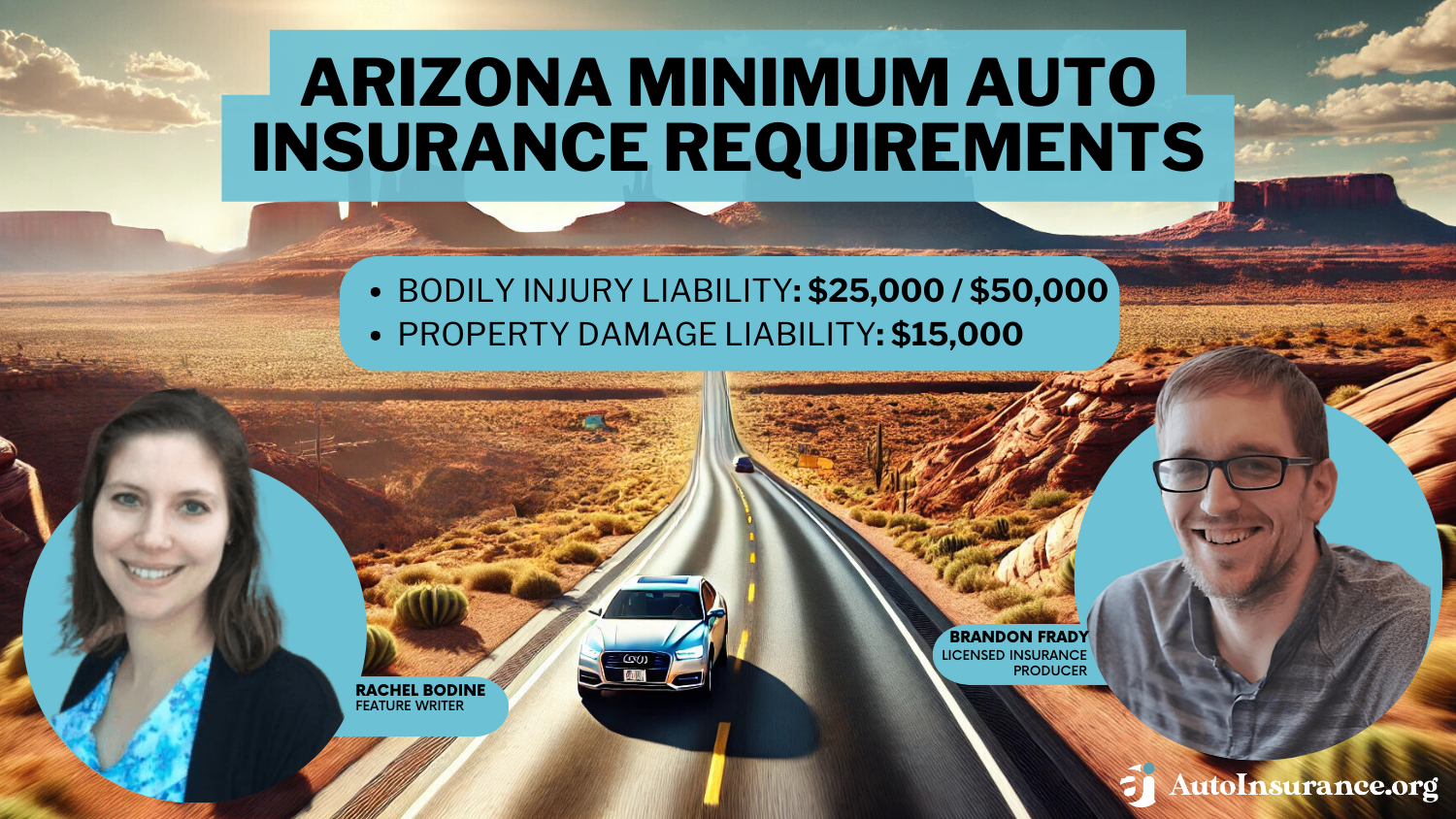
In Arizona, statutes require every motor vehicle operated on public highways to be covered by a motor vehicle liability insurance policy. As of 2026, the mandatory minimum coverage limits remain $25,000 for bodily injury per person, $50,000 for total bodily injury per accident, and $15,000 for property damage liability.
Understanding the Legal Framework: ARS § 28-4009
Arizona’s requirements for automobile insurance are primarily governed by the Arizona Revised Statutes (ARS) Title 28, Chapter 9. Specifically, ARS § 28-4009 outlines the specific contents and limits required for a motor vehicle liability policy to be considered valid under state law.
Arizona operates under a "tort" or "at-fault" system. This means the person found legally responsible for causing a traffic collision is also responsible for the resulting financial damages, including medical bills, lost wages, and property repairs. Because the financial burden falls on the at-fault driver, the state mandates a baseline of insurance to ensure that victims can receive at least a minimum level of compensation without relying solely on the personal assets of the liable party.
The statute serves as a consumer protection mechanism, but it also functions as a prerequisite for vehicle registration. In 2026, the Arizona Department of Transportation (ADOT) and the Motor Vehicle Division (MVD) utilize real-time electronic verification systems to ensure that every registered vehicle maintains the coverage levels dictated by these statutes.
Breaking Down the 25/50/15 Minimum Limits
When discussing Arizona minimum auto insurance coverage statutes, you will often see the shorthand 25/50/15. These figures represent the maximum amount an insurance company will pay out for specific types of claims resulting from a single accident where the policyholder is at fault.
Bodily Injury Liability: $25,000 Per Person
This portion of the policy covers medical expenses, rehabilitation, and sometimes funeral costs for a single individual injured in an accident you caused. In 2026, with the rising costs of emergency room visits and specialized medical care, $25,000 is often exhausted quickly in cases of moderate to severe injuries.
Bodily Injury Liability: $50,000 Per Accident
This is the "aggregate" limit for bodily injury. If multiple people are injured in the same accident, the policy will pay no more than $50,000 total across all victims. Furthermore, no single person can receive more than the $25,000 individual limit mentioned above. For example, if three people are injured and each has $20,000 in medical bills, the policy would only cover $50,000 of the $60,000 total, leaving the driver personally liable for the remaining $10,000.
Property Damage Liability: $15,000 Per Accident
This coverage pays for damage to another person's property. While this usually refers to the other driver's vehicle, it also covers damage to buildings, fences, or utility poles. Given that the average price of a new vehicle in 2026 often exceeds $50,000, a $15,000 limit is frequently insufficient to cover a total loss of a modern car.
Mandatory vs. Optional Coverages under Arizona Law
While the statutes strictly mandate liability coverage, they also address other types of insurance that insurers are required to offer, even if the consumer has the right to reject them in writing.
Uninsured and Underinsured Motorist (UM/UIM)
Per ARS § 20-259.01, every insurer writing automobile liability policies in Arizona must offer Uninsured Motorist (UM) and Underinsured Motorist (UIM) coverage in amounts at least equal to the bodily injury limits of the policy.
- Uninsured Motorist (UM): Protects you if you are hit by a driver who has no insurance at all or a hit-and-run driver.
- Underinsured Motorist (UIM): Protects you if the at-fault driver has insurance, but their limits (such as the 25/50 minimums) are not enough to cover your total medical expenses.
In Arizona, you must reject these coverages in a specific, signed writing if you do not want them. Legal experts and the Arizona Department of Insurance and Financial Institutions (DIFI) strongly recommend maintaining UM/UIM coverage due to the high volume of motorists who drive in violation of the financial responsibility statutes.
Comprehensive and Collision Coverage
It is important to note that Arizona statutes do not require comprehensive or collision insurance. These coverages protect your own vehicle. However, if you are financing or leasing a vehicle in 2026, your lender will almost certainly require these coverages as a condition of the loan agreement to protect their collateral.
| Coverage Type | Arizona Statutory Requirement | Purpose |
|---|---|---|
| Bodily Injury Liability | $25,000 / $50,000 | Pays for others' medical injuries when you are at fault. |
| Property Damage Liability | $15,000 | Pays for others' property damage when you are at fault. |
| UM/UIM Coverage | Must be offered in writing | Protects you if the other driver lacks sufficient insurance. |
| Collision Coverage | Not required by law | Repairs your car after an accident regardless of fault. |
| Comprehensive Coverage | Not required by law | Covers non-collision events (theft, fire, vandalism). |
Methods of Proving Financial Responsibility
Arizona law allows for a few alternatives to traditional commercial insurance policies to satisfy the financial responsibility requirements, though these are less common for the average driver.
- Certificate of Deposit: Under ARS § 28-4084, a person may file a certificate of deposit in the amount of $40,000 with the State Treasurer. This serves as a bond to cover potential liabilities.
- Surety Bond: A driver can obtain a surety bond from a company authorized to do business in Arizona, conditioned for payments in the amounts required by the 25/50/15 limits.
- Self-Insurance: Businesses or individuals who own more than 25 vehicles may apply for a certificate of self-insurance from the MVD by demonstrating the financial ability to pay judgments.
For the vast majority of residents, a standard insurance policy from a provider licensed by the Arizona DIFI is the only practical way to comply with the statutes.
Evidence of Insurance and Digital Verification
Arizona was one of the first states to modernize its insurance verification processes. Under current 2026 regulations, drivers must carry "evidence of financial responsibility" in their vehicle at all times.
Valid forms of evidence include:
- A physical insurance identification card issued by the insurer.
- An electronic insurance card displayed on a smartphone or mobile device.
- A printed image of the insurance card.
The Arizona MVD maintains a computer database that communicates directly with insurance companies. If a policy is cancelled or lapses, the insurer is required by law to notify the MVD. If the MVD does not receive a notification of a new policy, they will send an inquiry to the vehicle owner. Failure to respond or provide proof of new coverage can lead to immediate registration suspension.
Penalties for Non-Compliance in 2026
The consequences for violating Arizona's minimum insurance statutes are severe and cumulative. Arizona law enforcement officers can verify insurance status during any routine traffic stop or at the scene of an accident.
First Offense
If convicted of driving without insurance for the first time within a 36-month period, the court may impose a civil penalty (fine) of at least $500. Additionally, the driver's license and vehicle registration/plates are typically suspended for three months. To reinstate these, the driver must pay a reinstatement fee and file an SR-22 certificate of financial responsibility for three years.
Second Offense
A second conviction within 36 months results in a minimum fine of $750. The license and registration suspension increases to six months. The SR-22 requirement remains mandatory for three years.
Third and Subsequent Offenses
Third-time offenders face a minimum fine of $1,000. The suspension period for both the license and registration increases to one full year.
The SR-22 mentioned above is a form issued by an insurance company that "guarantees" to the state that the driver has the minimum 25/50/15 coverage. If the policy is cancelled for any reason, the insurer is legally obligated to notify the MVD immediately, which triggers an automatic suspension of the driver’s license.
The Gap Between Statutory Minimums and Real-World Costs
While the 25/50/15 limits satisfy the legal requirements of ARS § 28-4009, they are widely considered insufficient by financial advisors in 2026. The economic reality of a car accident often exceeds these figures.
Consider a multi-car pileup on I-10 in Phoenix. If you are found at fault and three late-model vehicles are damaged, the $15,000 property damage limit might only cover 20-30% of the total repair costs. Once the insurance company pays out that $15,000, they are generally "off the hook" for the rest, but you are not. The other drivers (or their insurance companies via subrogation) can sue you personally for the remaining balance.
Similarly, a single night in an Arizona trauma center can easily exceed $25,000. If an injured party has a claim worth $100,000 and your policy only pays $25,000, your personal assets—including savings, future wages, and property—could be targeted to satisfy the judgment.
FAQ: Frequently Asked Questions
Does Arizona's minimum insurance cover my own car?
No. The Arizona minimum auto insurance statutes only mandate liability insurance. Liability insurance pays for damage and injuries you cause to others. To cover your own vehicle's repairs, you would need to purchase optional collision or comprehensive coverage.
Can I get a ticket if I have insurance but don't have the card with me?
Yes. Under Arizona law, you are required to provide "evidence" of insurance upon request by a peace officer. However, many courts will dismiss or significantly reduce the fine if you can later prove that a valid policy was in effect at the precise time of the citation.
Does the minimum insurance requirement apply to motorcycles?
Yes. Motorcycles are also subject to the financial responsibility laws in Arizona. Owners must maintain the same 25/50/15 liability limits as passenger vehicles.
What is an SR-22, and why does Arizona require it?
An SR-22 is not insurance; it is a certificate filed by your insurance company with the MVD. It proves that you are carrying at least the statutory minimum liability coverage. Arizona requires it for drivers who have had their licenses suspended due to insurance lapses, DUIs, or other serious traffic violations.
Does Arizona require "No-Fault" insurance?
No. Arizona is an "at-fault" state. Unlike states like Florida or New York, Arizona does not require Personal Injury Protection (PIP) insurance, which pays your own medical bills regardless of who caused the accident. In Arizona, the person who caused the crash is responsible for the damages.
Professional Advice Limitation
This article provides a general overview of Arizona minimum auto insurance coverage statutes and is intended for informational purposes only. It does not constitute legal or financial advice. Because laws can change and individual circumstances vary significantly, readers should consult with a licensed Arizona insurance agent or a qualified attorney to ensure compliance with current regulations and adequate financial protection.
Final Recommendation for Arizona Drivers
While satisfying the Arizona minimum auto insurance coverage statutes keeps you legal on the road, it does not necessarily keep you safe financially. For most drivers in 2026, the recommended course of action is to purchase "umbrella" coverage or higher liability limits (such as 100/300/50) whenever possible. The difference in monthly premiums between the bare minimum and significantly higher coverage is often much lower than the potential cost of a single uncovered lawsuit. At a minimum, always ensure your insurance provider has a current record of your vehicle and that you never allow your policy to lapse, even for a single day, to avoid the high costs of reinstatement and SR-22 filings.