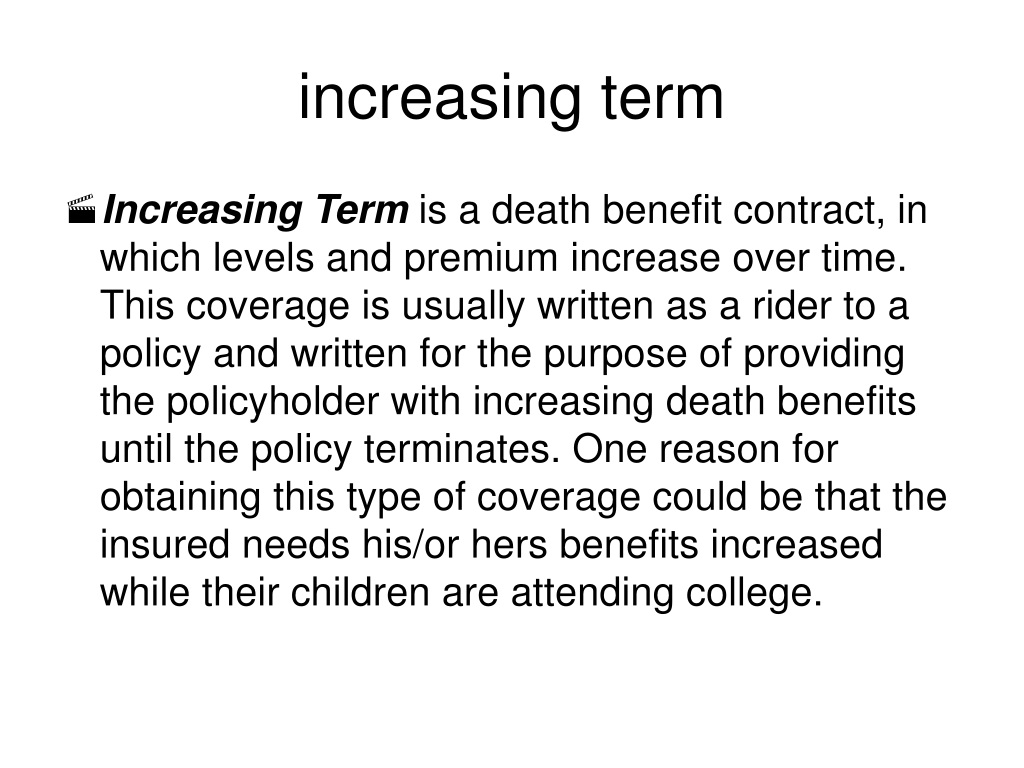
Annual increasing term life insurance is a life insurance policy where the death benefit grows each year by a predetermined percentage or an inflationary index. This ensures the payout maintains its real-world value over time, providing a critical hedge against rising living costs and increasing financial responsibilities as you age.
Understanding life insurance in 2026 requires a focus on long-term value preservation. While standard level term insurance is the most common product on the market, it suffers from a silent erosion of value: inflation. If you purchase a policy today with a fixed payout, that amount may buy significantly less in twenty years. Increasing term life insurance was designed specifically to combat this issue by scaling the protection alongside your likely cost-of-living increases.
What is Increasing Term Life Insurance?
At its core, increasing term life insurance is a variant of traditional term life insurance. Unlike "Level Term," where the death benefit remains the same from the first day to the last, or "Decreasing Term," where the benefit drops (often to align with a mortgage balance), an increasing policy expands its coverage over the life of the contract.
The primary objective is to ensure that the "real value" of the payout remains constant or grows. For example, a $500,000 policy purchased a decade ago would not carry the same purchasing power today. By selecting an increasing structure, the policyholder ensures their beneficiaries receive a sum that reflects the economic reality at the time of the claim, rather than the economic reality at the time of purchase.
This type of insurance is particularly relevant for those with young families. As children grow, the costs associated with their education, extracurricular activities, and general maintenance tend to rise. Simultaneously, the general cost of goods and services—tracked by the Consumer Price Index (CPI)—inevitably climbs. An increasing term policy acts as an automated adjustment mechanism to keep your safety net robust.
How the Increasing Mechanism Works
The "increase" in these policies is not random; it is governed by specific contractual triggers established at the time of the application. Generally, there are three ways the death benefit grows:
1. Fixed Percentage Increases
This is the most straightforward method. The policyholder agrees to a set annual increase, such as 3%, 5%, or even 10%. If you start with a $250,000 death benefit and a 5% simple annual increase, the benefit grows by $12,500 every year. In some cases, this increase is compounded, meaning the 5% is calculated based on the previous year’s total, leading to faster growth over a 20 or 30-year term.
2. Index-Linked Increases
In many modern policies as of 2026, the increase is tied to a specific economic indicator. The most common indices used are the Consumer Price Index (CPI) or the Retail Price Index (RPI). If the cost of living increases by 4.2% in a given year, your death benefit increases by the same margin. This provides the most accurate protection against inflation because the coverage tracks the actual purchasing power of the currency.
3. Fixed Dollar Increments
Less common but still available, some policies increase by a flat dollar amount each year (e.g., an additional $10,000 of coverage annually). This is often used when a policyholder anticipates specific, predictable increases in their liabilities, such as the birth of additional children or the expansion of a business.
The Cost Structure: Premiums in Increasing Term Policies
One of the most important technical aspects to understand is how you pay for this growing coverage. There are generally two ways insurers structure the premiums for increasing term insurance:
Increasing Premiums
In the majority of increasing term policies, the premium rises alongside the death benefit. Because the insurance company is taking on more risk each year (both because the payout is higher and the insured individual is older), they adjust the cost annually. It is vital to review the "renewal schedule" or "premium table" before signing. In the early years, these policies are often very affordable, but the cost can escalate significantly in the final decade of a long term.
Level Premiums
Some specialized policies offer "level premiums" for increasing coverage. In this scenario, you pay the same amount every month for the duration of the term, but the death benefit still grows. To account for this, the initial premiums are much higher than they would be for a standard level-term policy. You are essentially "pre-paying" for the future increases in coverage. This is often preferred by individuals who want absolute budget certainty and do not want to worry about rising bills in their later years.
Comparing Term Insurance Structures
To determine if increasing term is the right choice, it is helpful to see how it stacks up against other common term products.
| Feature | Level Term | Decreasing Term | Increasing Term |
|---|---|---|---|
| Death Benefit | Remains constant | Decreases over time | Increases annually |
| Primary Use | General family protection | Mortgage/Debt repayment | Inflation protection/Rising costs |
| Initial Cost | Moderate | Lowest | Highest (for level premium) |
| Premium Trend | Usually stays the same | Usually stays the same | Often increases annually |
| Complexity | Low | Low | Moderate |
| Long-term Value | Eroded by inflation | Linked to specific debt | Maintains purchasing power |
Benefits of Choosing an Increasing Policy
Inflation Hedging
Inflation is the greatest threat to long-term financial planning. A policy that seemed generous in 2026 might be insufficient by 2046. Increasing term insurance removes the need for the policyholder to manually review and "top up" their coverage every few years, which often requires new medical underwriting and higher costs due to increased age.
No Additional Medical Exams
One of the most significant advantages of an increasing term policy is that the growth in coverage is usually guaranteed without the need for further medical evidence. If you were to buy a level term policy and later decided you needed more coverage because of inflation, you would typically have to apply for a new policy and undergo a medical exam. If your health has declined in the interim, that new coverage could be prohibitively expensive or denied altogether. With an increasing policy, the "future insurability" is baked into the original contract.
Alignment with Life Stages
For young professionals or families, financial responsibilities rarely stay static. Salaries tend to rise, but so do mortgage payments, property taxes, and the costs of raising children. An increasing policy mirrors this upward trajectory of financial need. It provides a "hands-off" approach to life insurance management.
Potential Drawbacks and Considerations
Escalating Costs
The most significant risk with an increasing term policy is the potential for premiums to become unaffordable in the later years. If the premium is linked to the increase in coverage, a 5% increase in the death benefit might result in a 7% or 8% increase in the premium (because the risk of mortality also increases with age). Policyholders must ensure that their projected income can sustain these higher costs in the future.
Complexity of Indexing
If a policy is linked to an index like the CPI, the annual increase is unpredictable. While this protects against high inflation, it also makes it difficult to budget for premium changes. Some insurers put a "cap" on the increase (e.g., the benefit will not increase by more than 10% in a single year), but they may also have a "floor" (the benefit will increase by at least 2% even if inflation is zero).
Over-Insurance
There is a slight risk of becoming "over-insured." If your children leave home, your mortgage is paid off, and your savings grow significantly, you might find yourself paying for an ever-increasing death benefit that your beneficiaries no longer strictly need. However, most policies allow you to "opt-out" of an annual increase, though doing so might permanently stop the increasing feature for the remainder of the term.
Who Should Consider Increasing Term Insurance?
Increasing term insurance is not a one-size-fits-all solution. It is a strategic tool for specific financial profiles:
- Young Parents: Those who want to ensure that their children's future standard of living is protected regardless of how much the price of milk, housing, or tuition rises over the next 20 years.
- High-Net-Worth Individuals: For those concerned about future estate taxes (which may grow as asset values increase), an increasing death benefit can provide the necessary liquidity to cover those future tax liabilities.
- Long-Term Term Buyers: If you are purchasing a 30-year or 40-year term, inflation is a massive factor. If you are only buying a 5-year or 10-year term, the impact of inflation is much smaller, and a level term policy may be more cost-effective.
- Individuals with Health Concerns: Since increases are guaranteed without medical re-entry, this is a powerful way for someone currently in good health to "lock in" their ability to get more coverage in the future, even if their health fails later.
How to Evaluate a Policy
When shopping for an annual increasing term policy in 2026, pay close attention to the following contractual details:
- The Increase Formula: Is it simple or compound interest? Is it linked to a specific index?
- The Premium Structure: Will your payments stay level, or will they increase? If they increase, is there a maximum limit?
- Opt-Out Clauses: Can you stop the increases if you no longer need them? What are the consequences of doing so?
- Conversion Options: Does the policy allow you to convert the term coverage into a permanent (Whole Life) policy later without a medical exam? This can be a valuable "exit ramp" for the policy.
For more information on how inflation affects financial planning, you can consult resources from the Bureau of Labor Statistics regarding the Consumer Price Index or the Internal Revenue Service (IRS) regarding cost-of-living adjustments.
FAQs
Can I choose how much the policy increases each year?
Yes, typically at the time of purchase. You can choose a fixed percentage (often 3% to 5%) or choose to have it linked to an inflation index like the CPI. Once the policy is active, you usually cannot change the formula, though many insurers allow you to decline a specific year's increase if you choose.
Does the premium always go up with the coverage?
In most cases, yes. Most increasing term policies feature "attained age" premiums, meaning the cost goes up because you are getting more coverage and because you are one year older. However, some insurers offer "Level Premium Increasing Term," where you pay a higher, steady amount from the start.
Is increasing term insurance better than level term?
"Better" depends on your goals. Level term is simpler and cheaper initially. Increasing term is more robust and protects your purchasing power. If you are worried about inflation over a long period (20+ years), increasing term is often the superior strategic choice.
What happens if I decline an annual increase?
Most insurance companies have a "two-strikes" rule. If you decline the annual increase once, nothing happens. If you decline it two or three years in a row, the insurer may permanently remove the increasing feature, and your policy will remain at its current level for the rest of the term.
Are the increases in the death benefit taxable?
In the United States and many other jurisdictions, life insurance death benefits are generally received income tax-free by the beneficiaries. This remains true regardless of whether the benefit was the original amount or the increased amount resulting from an increasing term policy.
Practical Recommendation
If you are under the age of 45 and looking for a 20-year or 30-year life insurance policy, request a quote for both level term and increasing term. Carefully examine the "premium projection" for the increasing policy to see what you will be paying in the final five years of the term. If the projected premiums fit within your long-term financial plan, the inflation protection provided by an increasing policy offers a level of security that a static level-term policy simply cannot match. For those on a strict fixed budget, a level term policy remains the more predictable option, but it requires the policyholder to manually update their coverage as their life evolves.