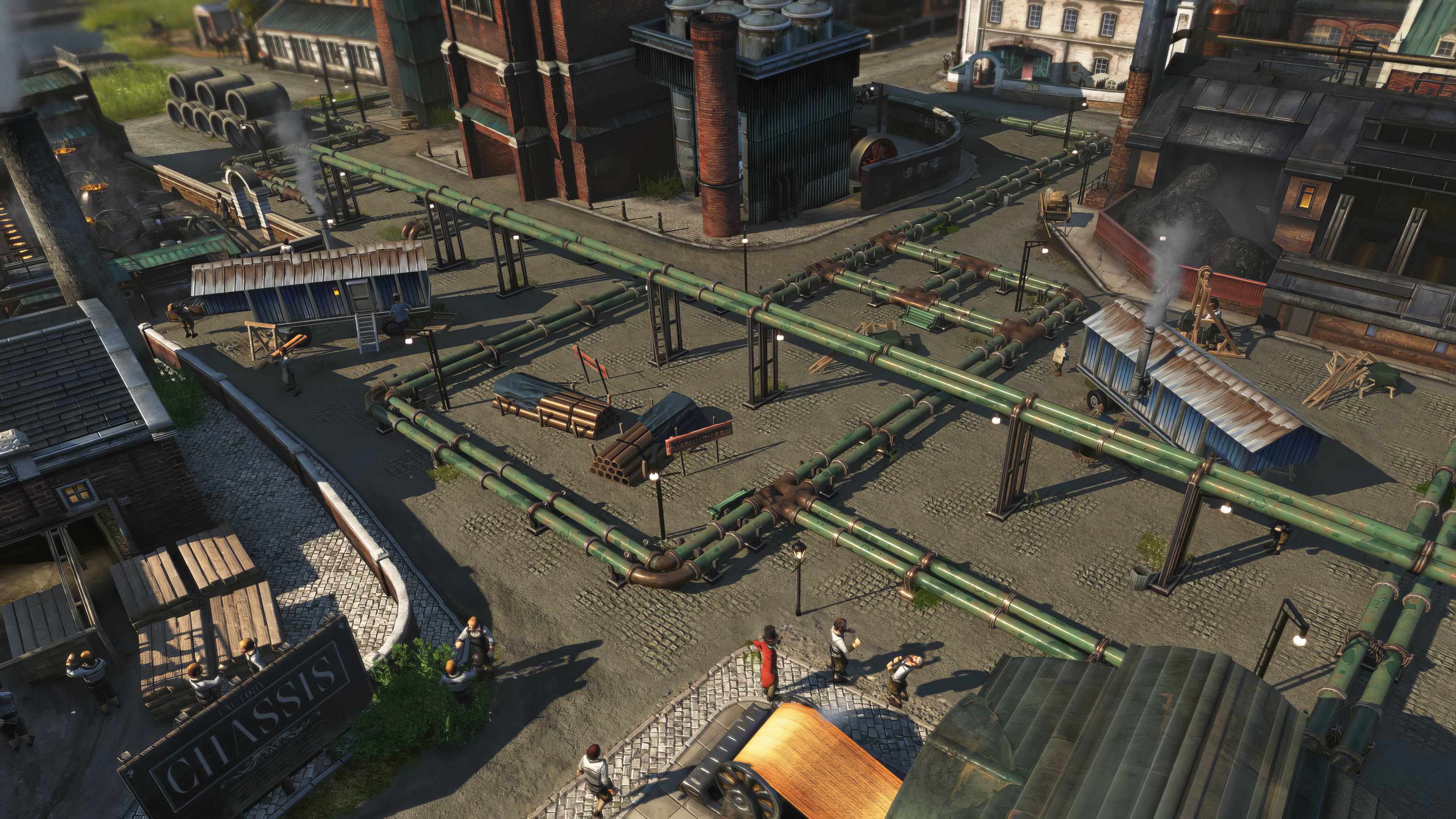
Mastering Anno 1800 supply chains requires balancing production ratios, logistical throughput, and workforce demands across multiple global sessions. By aligning raw material output with processing speeds and utilizing the "Production Statistics" menu (Ctrl+Q), players can maintain a stable economy, satisfy high-tier population needs, and maximize tax revenue without overproducing costly surplus.
The Architecture of Anno 1800 Supply Chains
In the world of Anno 1800, a supply chain is the sequential process of converting raw materials into finished consumer goods or construction materials. Unlike simpler city builders, this game demands a granular understanding of time-based production. Every building has a specific cycle time—the duration it takes to produce one unit of a resource.
The complexity of these chains scales with your population's social strata. While Farmers are content with basic goods like Fish and Knitwear, Investors require intricate networks involving multiple islands, specialized machinery, and rare ores. In 2026, with the full suite of DLCs available, the scope of these chains has expanded to include "Multifactory" systems and lifestyle needs that add layers of optimization beyond the base game’s original design.
Understanding a chain involves three primary components:
- Raw Material Producers: These are buildings like Grain Farms, Iron Mines, or Lumberjack Huts that extract or grow basic resources.
- Processing Facilities: These buildings, such as Flour Mills or Malt Houses, transform raw materials into intermediate goods.
- Final Production: The end-of-the-line buildings, like Bakeries or Breweries, create the product that citizens consume or that engineers use for construction.
The Golden Rule: Mastering Production Ratios
The most common mistake in Anno 1800 is building on a whim rather than according to math. Each building operates on a specific timer. To prevent bottlenecks or wasted maintenance costs, you must match the output of the "upstream" building to the intake of the "downstream" building.
For example, a Sausage supply chain in the early game works on a 1:1 ratio. A Pig Farm produces one unit of pigs every minute, and a Slaughterhouse processes one unit of pigs into sausages every minute. If you build two Slaughterhouses but only one Pig Farm, the second Slaughterhouse will sit idle half the time, draining your treasury.
As you progress to more complex chains, the ratios become less intuitive. The Canned Food chain is a classic example of logistical difficulty. In the base game, this requires:
- 2 Cattle Farms (Produce beef)
- 1 Goulash Kitchen (Combines beef and peppers)
- 1 Pepper Farm (Produces peppers)
- 1 Iron Mine (Produces iron)
- 1 Charcoal Kiln (Produces coal)
- 1 Artisan Workshop (Produces cans from iron and coal)
- 1 Cannery (Combines goulash and cans)
If any single link in this chain fails—perhaps an Iron Mine is too far from a warehouse—the entire Cannery shuts down, causing a cascade of unhappiness among your Artisans.
Using the Production Statistics Menu
The most critical tool for any governor is the Production Statistics screen (accessible via Ctrl+Q or by clicking the economy bar). This menu provides a real-time bar graph comparing your current production capacity against the actual consumption of your population.
- Green Bar > Blue Bar: You are overproducing. This is safe but reduces profit margins.
- Blue Bar > Green Bar: You are underproducing. Your warehouse stocks will eventually hit zero, leading to a sudden drop in population and tax income.
Logistics: The Invisible Backbone of Industry
A perfect production ratio is useless if the goods cannot reach their destination. Logistics in Anno 1800 involve the physical movement of goods via carts, trucks, and ships.
Warehouse Management and Loading Ramps
Every production building must deliver its finished product to a Warehouse or directly to the next building in the chain. Buildings have a "delivery range" indicated by the green highlight on roads. If a building is too far from a Warehouse, production will stall as the internal storage fills up.
Warehouses are limited by their loading ramps. A basic Warehouse has two ramps, meaning only two carts can unload simultaneously. In high-density industrial zones, you will often see "Waiting for Loading" icons. This indicates a logistical bottleneck. To solve this, you must either upgrade the Warehouse or build additional ones nearby to distribute the traffic.
The Impact of Electricity
Upon reaching the Engineer tier, you gain access to Electricity. When a production building is powered by an Oil Power Plant, its productivity typically increases by 100% (doubling its output). This fundamentally alters your supply chain ratios. A single Pig Farm under the influence of electricity can now support two Slaughterhouses (assuming the Slaughterhouses are also powered).
Electricity also enables the use of Items and Specialists that can further boost productivity to 300% or more, allowing you to compress your industrial footprint significantly.
Inter-Regional Supply Chains and Trade Routes
As your empire expands to the New World, Enbesa, or the Arctic, you will find that many high-tier goods cannot be produced on a single island. This necessitates the creation of Trade Routes.
Managing Cargo and Transit Time
The "hidden" factor in inter-regional chains is transit time. If your Investors in the Old World consume 10 tons of Coffee per minute, and it takes a cargo ship 20 minutes to make a round trip from the New World, that ship must carry at least 200 tons of Coffee per trip to keep the supply stable.
Using faster ships, such as the Great Eastern or Extravagant Steamers, reduces transit time and lowers the amount of inventory "stuck" at sea. In 2026, the use of specialized items like the "Turbo-Propeller" or "Jet Engine" (for airships) is essential for maintaining the massive consumption rates of high-tier Skyscrapers.
Charter Routes vs. Trade Routes
- Charter Routes: These are automated services you pay for with gold. They are useful for small, early-game transfers but lack the capacity for major supply chains.
- Trade Routes: These use your own fleet. They offer total control over cargo slots, waiting times, and route safety. For any vital supply chain (like Rum, Coffee, or Cigars), always use your own ships.
Optimizing via the Trade Union and Research Institute
Experienced players do not just build more farms; they optimize the ones they have. The Trade Union is a building that exerts an area of influence over nearby production facilities. By socketing Items or Specialists into the Trade Union, you can modify how a supply chain functions.
Resource Substitution
Some of the most powerful items in the game allow you to substitute one raw material for another. For example, the specialist "Chef Michel" allows Canneries to use Pigs instead of Goulash. This effectively deletes the Goulash Kitchen and Cattle Farm links from the Canned Food chain, simplifying the logistics and saving massive amounts of island space.
Extra Goods Generation
Certain items, like the "Printing Press" or various agricultural experts, provide "1 extra unit of [Resource] every X cycles." This "bonus" production does not require input materials, making it 100% profit. When applied to high-value chains like Heavy Weapons or Steam Carriages, these extras can fund your entire military.
Essential Production Ratios for Early and Mid-Game
The following table outlines the standard ratios for core supply chains. Note that these assume 100% productivity for all buildings and do not account for electricity or items.
| Product | Required Buildings (Ratio) | Population Tier | Primary Input |
|---|---|---|---|
| Fish | 1 Fishery | Farmers | None (Coastal) |
| Knitwear | 1 Sheep Farm : 1 Framework Knitters | Farmers | Wool |
| Sausages | 1 Pig Farm : 1 Slaughterhouse | Workers | Pigs |
| Bread | 2 Grain Farms : 1 Flour Mill : 2 Bakeries | Workers | Grain |
| Soap | 2 Pig Farms : 2 Rendering Works : 1 Soap Factory | Workers | Pigs / Tallow |
| Beer | 2 Hop Farms : 2 Grain Farms : 1 Malthouse : 3 Breweries | Workers | Hops / Grain |
| Canned Food | 2 Cattle Farms : 1 Pepper Farm : 1 Goulash Kitchen : 1 Cannery | Artisans | Beef / Peppers |
| Sewing Machines | 2 Iron Mines : 2 Coal Kilns : 2 Furnaces : 1 Steelworks : 2 Workshops | Artisans | Iron / Wood / Steel |
| Rum | 2 Sugar Cane Plantations : 1 Rum Distillery | Artisans (Import) | Sugar Cane |
| Coffee | 2 Coffee Plantations : 1 Coffee Roaster | Engineers (Import) | Coffee Beans |
Advanced Strategies: Handling the Skyscraper Era
In the late-game "High Life" content, supply chains evolve into "Department Store" goods. These products, such as Fountain Pens or Department Store Jewelry, do not just satisfy a need; they provide "buffs" to nearby Skyscrapers, reducing the consumption of other goods.
This creates a circular optimization problem. By providing luxury goods via complex chains, you reduce the demand for basic goods (like Bread), allowing you to demolish lower-tier production and replace it with high-value industry. This "Density Management" is the hallmark of a master player in 2026.
Troubleshooting Common Supply Chain Failures
If your economy is fluctuating wildly, check the following in order:
- Workforce Shortage: If you don't have enough Workers, your factories will run at reduced productivity, breaking your ratios.
- Internal Storage Full: If a factory cannot unload its product because the local Warehouse is full, the entire chain stops. Ensure you have enough global island storage.
- Pier Congestion: On trade islands, ships may be queuing to unload. Build specialized Advanced Piers or Docklands modules to increase unloading speed.
- Raw Material Depletion: Ensure your Mines haven't been paused or that your Charcoal Kilns haven't been crowded out by buildings (which reduces their productivity).
Frequently Asked Questions
Why is my production at 0% even though I have the building?
This usually occurs for one of three reasons: the building is not connected to a road, there is no workforce available of the required tier, or the building lacks its required input materials. Check the "Missing Input" icon above the building. If it shows a resource, trace that resource back to its source to find the break in the chain.
How do I stop my ships from being sunk on supply routes?
In 2026, the most effective way to protect supply chains is through Escort Ships or by using White Flag items (like the "Epic Velox") which make your trade vessels non-attackable by AI or pirates. Alternatively, reroute your trade lines away from enemy-controlled islands using the waypoint system in the Trade Route menu.
Is it better to produce everything on one island?
Generally, no. Due to limited fertility (the ability to grow certain crops) and space constraints, you should specialize islands. Have one "Agricultural Island" for grains and livestock, and one "Industrial Island" for smelting and heavy manufacturing. Use your main city island primarily for residences and clean public buildings to maximize "Attractiveness."
Does "Overtime" (Work Intensity) help supply chains?
Increasing work intensity (up to +50%) can fix a temporary shortage without building new factories. However, it significantly lowers happiness and increases the chance of riots and explosions. It is a useful stopgap measure but should not be a permanent solution for a core supply chain.
How does the Docklands DLC affect supply chains?
The Docklands allows you to "Export" surplus goods in exchange for other resources. This can effectively replace entire supply chains. For example, you can produce a massive surplus of Steam Carriages and trade them for all the Raw Coffee you need, completely bypassing the need for complex New World logistics.
Recommendation for Next Actions
To refine your Anno 1800 economy, begin by opening the Production Statistics (Ctrl+Q) and identifying your top three goods where the "Blue Bar" (demand) is closest to the "Green Bar" (supply). Focus on stabilizing these three chains before expanding your population further. If you have reached the Engineer tier, prioritize the construction of an Oil Power Plant in your industrial district; the 100% productivity boost is the most cost-effective way to scale your supply chains without consuming more island space. Finally, investigate the Research Institute to identify specialists that can substitute difficult-to-attain materials, as this remains the most powerful late-game strategy for sustaining a massive Investor population.