The 36,610-pound figure refers to the peak gooseneck towing capacity introduced with the 2021 RAM 3500 High-Output models. The ongoing debate centers on the hyper-specific vehicle configuration required to achieve this rating, its practical utility for average owners, and the significant legal and licensing requirements triggered when operating at such extreme weight limits.
As we look at the heavy-duty truck landscape in 2026, the "36,610 debate" remains a foundational case study in how automotive manufacturers balance marketing-driven specifications with real-world engineering. While RAM and its competitors have since pushed these numbers even higher, the 36,610-pound milestone marked a turning point where Class 3 trucks began rivaling the capacities of medium-duty commercial vehicles.
The Origin of the 36,610-Pound Rating
The 36,610-pound rating was first touted during the 2021 model year update for the RAM 3500. At the time, RAM was locked in a fierce "torque war" with Ford and General Motors. To claim the title of "Best-in-Class Towing," RAM engineers optimized the 6.7L Cummins High-Output (HO) Turbo Diesel engine to produce a then-record 1,075 lb-ft of torque.
This specific number was not an arbitrary choice; it was the result of rigorous testing under the SAE J2807 standards. These standards dictate how manufacturers must measure towing capacity, including performance on grades, braking distances, and structural integrity. However, the debate began almost immediately because this headline-grabbing figure was only applicable to a very narrow slice of the RAM 3500 lineup.
The "Asterisk" Configuration
To reach 36,610 pounds of towing capacity, a buyer cannot simply walk onto a lot and pick any RAM 3500. The rating is exclusive to a specific "weight-optimized" build:
- Cab Style: Regular Cab (to minimize vehicle curb weight).
- Drivetrain: 4x2 (Two-wheel drive is lighter than 4x4 systems).
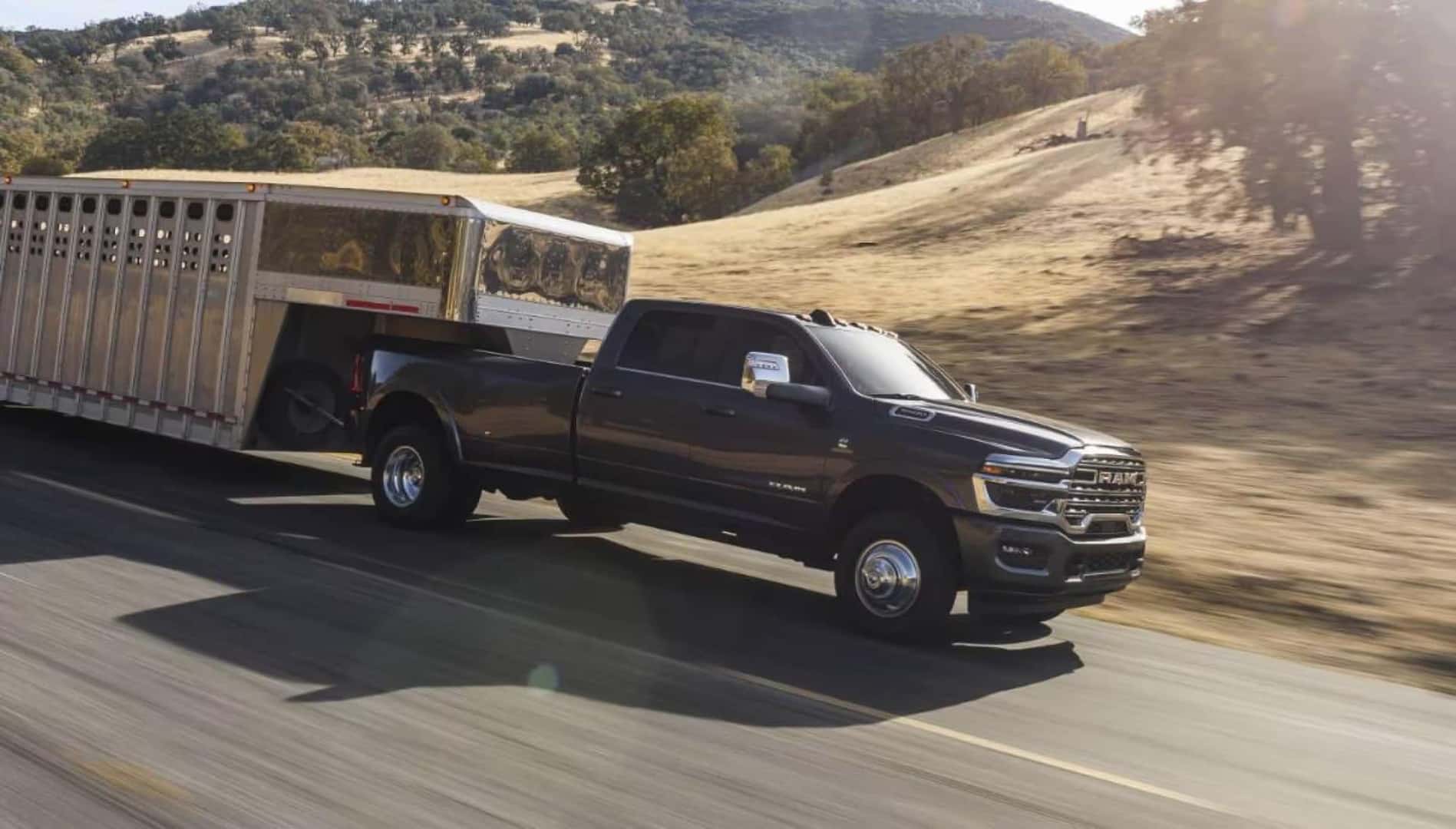
- Rear Wheels: Dual Rear Wheel (DRW/Dually) for stability.
- Engine: 6.7L Cummins HO Diesel.
- Axle Ratio: 4.10 Rear Axle Ratio (optimized for low-end pulling power rather than fuel economy).
- Package: Max Tow Package, which includes heavy-duty cooling and structural reinforcements.
Most consumers purchase Crew Cab 4x4 models, which offer significantly lower towing capacities due to the increased weight of the truck itself. This discrepancy is the heart of the debate: is a "best-in-class" rating valid if it applies to a configuration that only a tiny fraction of customers actually buy?
Technical Deep Dive: The Cummins and Aisin Synergy
The 36,610-pound capacity would be impossible without the specific pairing of the High-Output Cummins engine and the Aisin AS69RC six-speed automatic transmission. Understanding this mechanical duo is essential to understanding why the debate persists regarding the truck's longevity and performance.
The 6.7L High-Output Cummins
Unlike the standard 6.7L Cummins found in the RAM 2500, the High-Output version used in the 3500 features a different block material (compacted graphite iron), higher boost levels from a variable-geometry turbocharger, and a more robust fuel delivery system. In 2026, while newer iterations have exceeded these figures, the 1,075 lb-ft threshold remains the benchmark for the "36,610 era."
The Aisin AS69RC Transmission
While the standard RAM 2500 and lower-output 3500s often utilized the 68RFE transmission, the 36,610-pound towing spec necessitated the Aisin AS69RC. This is a commercial-grade transmission designed to handle the heat and shear forces generated by a 15-ton trailer. Critics in the debate often point out that while the engine can pull the weight, the maintenance intervals for the Aisin transmission become much more aggressive when operating near the Gross Combined Weight Rating (GCWR).
The CDL and Legal Compliance Debate
Perhaps the most contentious part of the 36,610-pound debate isn't about mechanical capability, but rather legal legality. In the United States, the Federal Motor Carrier Safety Administration (FMCSA) and state Department of Transportation (DOT) agencies have strict rules regarding Gross Combined Weight Ratings (GCWR).
The 26,001-Pound Threshold
For most states, if a vehicle and trailer combination has a GCWR of 26,001 pounds or more, and the trailer being towed has a Gross Vehicle Weight Rating (GVWR) of more than 10,000 pounds, the driver is legally required to hold a Commercial Driver's License (CDL).
A RAM 3500 configured for 36,610 pounds of towing has a GCWR of approximately 43,000 pounds. This means that any driver utilizing the truck’s full capacity for a business purpose—and in many jurisdictions, even for "heavy" private use—is operating a commercial-grade load.
The Debate Point: Many buyers are unaware that by purchasing the highest-capacity RAM 3500, they are entering a realm of regulation that includes:
- Logbooks and Electronic Logging Devices (ELDs).
- Medical examiner certificates.
- Strict drug and alcohol testing pools.
- Higher insurance premiums for commercial-rated vehicles.
For the "hot-shot" trucking industry (independent haulers using heavy-duty pickups), the 36,610-pound rating is a double-edged sword. It allows for heavier freight, but it virtually guarantees the need for full CDL compliance, which some operators try to avoid by staying under the 26,000-pound limit.
Comparative Landscape: Class 3 vs. Class 4
Another layer of the debate involves how the RAM 3500 (a Class 3 truck) compares to Class 4 and 5 trucks like the Ford F-450 or RAM 4500.
| Feature | RAM 3500 (Max Config) | Ford F-350 (Max Config) | RAM 4500 (Chassis Cab) |
|---|---|---|---|
| Max Towing (Gooseneck) | ~36,610–37,000 lbs | ~35,000–38,000 lbs | ~34,000–35,220 lbs* |
| Engine Choice | 6.7L Cummins HO | 6.7L PowerStroke HO | 6.7L Cummins (Derated) |
| Primary Use | Consumer/Hot-Shot | Consumer/Heavy Duty | Commercial/Vocational |
| License Requirement | Often CDL (over 26k GCWR) | Often CDL (over 26k GCWR) | CDL Required (usually) |
*Note: Chassis Cab models often have lower "towing" ratings on paper than their 3500 counterparts because they are designed for high-payload "upfit" bodies rather than empty-bed gooseneck racing.
The debate often surfaces when enthusiasts realize that a RAM 3500 technically has a higher towing capacity on paper than a RAM 4500. This is because the 4500/5500 series are "derated" for commercial longevity and are heavier vehicles themselves, which reduces their maximum trailer weight relative to their GCWR. The 3500’s 36,610-pound rating is a "peak performance" metric, whereas the 4500 is a "sustained performance" metric.
Practical Limitations: Payload and Pin Weight
A major point of confusion in the weight capacity debate is the difference between pulling weight and carrying weight. The 36,610-pound rating is for a gooseneck trailer. Gooseneck and fifth-wheel trailers typically place 15% to 25% of their total weight directly onto the bed of the truck (known as pin weight).
At 36,610 pounds, a trailer could exert a vertical load of over 7,000 pounds on the truck's rear axle. While the RAM 3500 Dually has an impressive payload capacity, it is often the GVWR (Gross Vehicle Weight Rating)—the maximum the truck itself can weigh—that is exceeded long before the maximum towing capacity is reached.
For example, if the truck has a payload capacity of 6,500 pounds, but you have a driver, a full tank of fuel, and some tools in the back, your remaining "available" payload for the trailer pin might only be 5,800 pounds. In this scenario, you could not legally or safely tow a 36,610-pound trailer because the resulting pin weight would exceed the truck's structural limits.
Real-World Performance and Safety
When discussing the 36,610-pound capacity, safety and wear-and-tear cannot be ignored. Critics of these ultra-high ratings argue that just because a truck can tow 18 tons doesn't mean it should do so regularly.
Braking and Stability
Even with advanced exhaust braking (the "Jake Brake" feature of the Cummins) and heavy-duty trailer brakes, stopping 43,000 pounds of combined weight is a massive undertaking. The debate often focuses on whether the RAM 3500’s braking system—though robust—is being pushed to its absolute thermal limit at these weights. In 2026, newer models have implemented larger rotors and more advanced electronic brake distribution, but the 36,610-pound era trucks are often viewed as the limit for traditional hydraulic braking systems in Class 3 pickups.
Frame Stress
The RAM 3500 uses a fully boxed frame with high-strength steel. However, the constant stress of 36,610 pounds can lead to accelerated wear on suspension components, bushings, and universal joints. Owners who frequently tow at these limits often report the need for more frequent maintenance of the rear differential and cooling system.
Troubleshooting the "Low Tow" Misconception
Many owners are frustrated when they find their specific RAM 3500 is only rated for 18,000 or 22,000 pounds. This is usually due to three factors:
- The Rear Axle Ratio: A 3.73 ratio is better for highway cruising but significantly lowers the towing capacity compared to the 4.10.
- The Transmission: The standard 68RFE transmission cannot handle the torque required for the 36,610-pound rating.
- The Engine: The standard output Cummins (non-HO) has lower thermal and structural limits.
To verify your specific truck's capacity, you must look at the door jamb sticker for the GVWR and GAWR (Gross Axle Weight Rating). RAM also provides a VIN-specific towing lookup tool which is the final word in resolving any "debate" about a specific vehicle's capability.
Frequently Asked Questions
Can I tow 36,610 pounds with a RAM 3500 Single Rear Wheel (SRW)?
No. The 36,610-pound rating is strictly for Dual Rear Wheel (DRW) models. Single Rear Wheel trucks lack the lateral stability and the tire load capacity to handle the extreme pin weights associated with a 15-ton+ trailer. SRW models typically max out between 18,000 and 25,000 pounds depending on the year and configuration.
Do I need a special hitch for 36,610 pounds?
Yes. Standard 2-inch or even 2.5-inch receiver hitches for "bumper pulling" are not rated for this weight. To tow 36,610 pounds, you must use a gooseneck hitch rated for at least 37,000 or 40,000 pounds. Most factory-installed puck systems in RAM 3500s are designed to accommodate these high-capacity hitches.
Does the 36,610-pound rating apply to fifth-wheel trailers?
Generally, fifth-wheel ratings are slightly lower than gooseneck ratings due to the weight of the fifth-wheel hitch assembly itself and the different dynamics of the connection. While very close, the "headline" 36,610 figure is almost always a gooseneck-specific measurement.
How does the 2026 RAM 3500 compare to the 36,610-pound models?
By 2026, RAM has refined its engineering to push these limits even further, often exceeding 38,000 pounds in specific configurations. However, the core requirements—High Output engine, 4.10 gears, and DRW—remain the same. The 36,610-pound model is now considered the "classic" high-water mark for the early 2020s.
Is the RAM 3500 fuel-efficient when towing 36,610 pounds?
Efficiency drops significantly. While an empty Cummins HO might get 15-18 MPG on the highway, towing 36,610 pounds will likely result in 6-9 MPG depending on terrain and wind resistance. The 4.10 axle ratio, which is required for this tow rating, also reduces unloaded fuel economy compared to a 3.73 ratio.
Practical Recommendation for Buyers
If you are looking to purchase a RAM 3500 specifically for its high weight capacity, you must first define your use case. If you are a commercial "hot-shot" hauler, the 36,610-pound capacity (and the required High-Output engine/Aisin transmission) is an essential tool, but you must factor in the cost of CDL compliance and commercial insurance.
For recreational users—such as those pulling large luxury fifth-wheel campers—the 36,610-pound rating is often "overkill." Most luxury campers max out at 20,000 to 24,000 pounds. In these cases, a Crew Cab 4x4 RAM 3500 (which has a lower rating than the 36,610-pound max) is actually the better choice because it offers more interior room and better off-road capability while still providing a significant safety margin for the trailer. Always prioritize Payload (GVWR) over the headline Towing Capacity, as payload is almost always the first limit you will encounter in the real world.