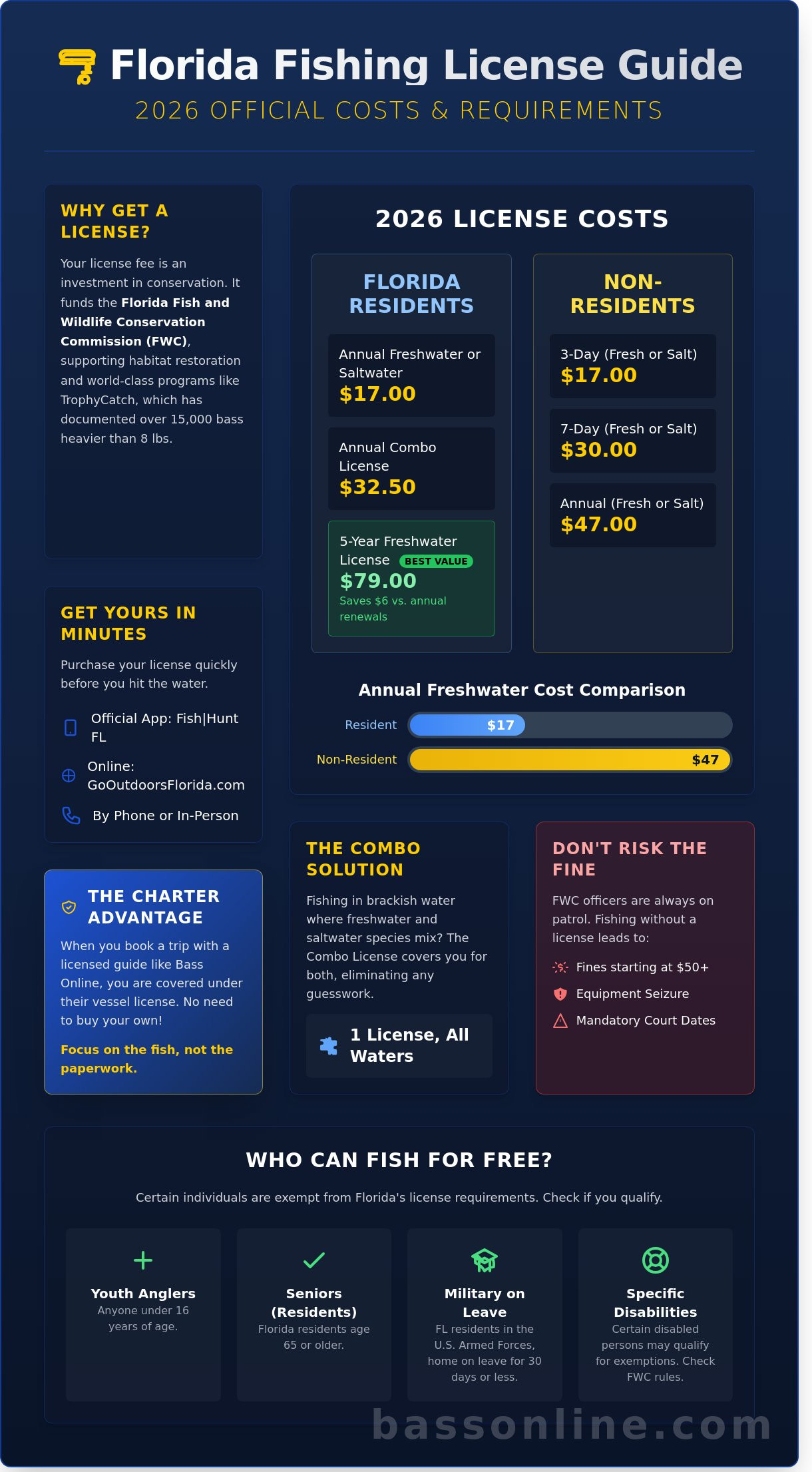
As of 2026, the base price for a non-resident 3-day saltwater fishing license in Florida is $17.00. This permit allows visitors to legally fish in Florida’s coastal waters and saline environments for a 72-hour window. While the base fee is set by the Florida Fish and Wildlife Conservation Commission (FWC), total costs may vary slightly due to administrative processing fees depending on the point of purchase.
The $17 price point is a cornerstone of Florida's accessible tourism model, allowing short-term visitors to enjoy the state’s world-class angling without committing to an annual fee. However, the term "17 dollars" also applies to the annual saltwater license for Florida residents, creating a common point of confusion for those planning a trip. Navigating the nuances of these permits is essential to avoid significant fines and to contribute correctly to Florida’s extensive marine conservation efforts.
The Distinction Between Resident and Non-Resident Licenses
When discussing why a Florida saltwater fishing license costs $17, it is vital to distinguish between who is buying it and for how long. The Florida Fish and Wildlife Conservation Commission (FWC) uses the $17 figure for two primary, yet distinct, license types.
For non-residents, the $17 fee covers a 3-day saltwater license. This is the most popular choice for vacationers, spring breakers, and weekend travelers. It grants the holder the right to take, or attempt to take, saltwater fish, crabs, clams, and other marine organisms. The clock starts at the specific date and time selected by the user at the time of purchase, providing a full 72 hours of legal access.
For Florida residents, the $17 fee provides an annual saltwater license. This is a significant benefit for locals, offering a full 365 days of access for the same price that a visitor pays for three days. This pricing structure is designed to encourage local participation in conservation while generating necessary revenue from the high volume of out-of-state tourism.
Defining Residency for License Purposes
To qualify for the resident rate (which allows you to get an annual license for the same $17), you must meet specific FWC criteria. You are considered a resident if you have a valid Florida Driver’s License or ID card with a Florida address. For those without these documents, residency can be proven through an alternate method, such as a voter registration card or a homestead exemption. Military personnel stationed in Florida are also eligible for resident pricing. If you do not meet these criteria, you must purchase the non-resident 3-day license to remain compliant.
Total Costs: Processing Fees and Point of Purchase
While the statutory cost of the 3-day non-resident license is $17, the final amount charged to your credit card or paid at the counter is often higher. These "convenience fees" or "administrative fees" are standard across most state licensing systems in 2026.
- Online Purchases: When buying through the official Go Outdoors Florida portal or the mobile app, a convenience fee is typically applied. This usually amounts to $2.25 or a percentage of the total sale (often around 2.5% to 5%). Therefore, your $17 license may actually cost closer to $19.50.
- Retail Locations: Purchasing your license at a "big box" retailer like Walmart, Bass Pro Shops, or a local bait and tackle shop also incurs a sub-agent fee. This is a small surcharge (usually around $0.50 to $1.50) paid to the vendor for processing the transaction through the state’s system.
- Tax Collector’s Offices: This is often the only way to pay the flat $17 fee without an additional convenience surcharge, though it requires a physical visit during business hours, which is often inconvenient for tourists arriving on weekends.
- Telephone Sales: Buying via the FWC’s toll-free number usually carries the highest convenience fee, sometimes exceeding $5.00, to cover the cost of the live operator and system processing.
Saltwater vs. Freshwater: Where the 3-Day License Applies
A common mistake made by visitors is assuming that the $17 saltwater license covers all fishing in Florida. This is not the case. Florida manages saltwater and freshwater species under separate licensing frameworks.
The Saltwater Boundary
The 3-day saltwater license is required for any attempt to take marine fish, which includes everything from the surf at the beach to the offshore reefs. It also covers "brackish" water areas where salt and fresh water mix. However, the FWC establishes specific lines of demarcation on many coastal rivers. Upstream of these lines, you are legally in freshwater territory, and the $17 saltwater license is no longer valid. If you plan to fish in an estuary where you might catch both Largemouth Bass (freshwater) and Redfish (saltwater), you legally need both licenses or a "combo" license.
What is Covered?
The 3-day saltwater license covers the "taking" of fish. This includes not just keeping the fish, but the act of fishing itself. Even if you practice 100% catch-and-release, you are still required to hold a valid license. The permit also covers the harvesting of shellfish, such as blue crabs and stone crabs (though specific gear rules apply), and the gathering of clams or oysters.
Additional Permits and Add-ons
The base $17 license is a "general" permit. For certain high-demand or highly regulated species, the FWC requires additional "permits" or "tags." These are added to your $17 base cost and are essential for legal harvest.
Snook Permit
If you intend to harvest a Snook (within the designated seasons and size limits), you must purchase a Snook Permit. As of 2026, this is an additional $10.00. Without this specific add-on, you may catch and release Snook, but you cannot legally possess one.
Spiny Lobster Permit
For those visiting during the regular lobster season or the two-day "mini-season," a Spiny Lobster permit is required. This costs approximately $5.00. This is mandatory for anyone diving or "bully netting" for lobsters in the Florida Keys or other coastal regions.
Tarpon Tags
Tarpon are strictly catch-and-release in Florida. The only exception is if you are pursuing a world record and need to harvest the fish for official weighing. In this rare instance, a Tarpon Tag costs $51.50 and is limited to one per person per year.
Reef Fish Survey (State Reef Fish Angler)
If you are fishing from a private boat for "reef fish" (such as Snapper, Grouper, or Amberjack), you must sign up for the State Reef Fish Angler designation. While this is typically free, it is a mandatory requirement that must be attached to your license. This allows the FWC to better track the health of reef fish populations through targeted surveys.
License Exemptions: Who Doesn't Need to Pay?
Not everyone in the water needs to spend $17 on a 3-day license. Florida provides several exemptions, particularly for youth, seniors, and those fishing under certain commercial umbrellas.
- Children Under 16: Any child (resident or non-resident) under the age of 16 does not need a fishing license. This is a significant cost saver for families.
- Florida Residents Over 65: Florida residents aged 65 or older do not need to purchase a license, provided they carry proof of age and residency (like a Florida ID). This exemption does not apply to non-residents; an out-of-state senior must still purchase the $17 3-day license.
- Licensed Fishing Charters: This is the most common "exemption" for tourists. If you hire a professional fishing guide or go out on a "party boat" (head boat), the vessel’s commercial license covers all passengers. You do not need to buy your own $17 license if you are fishing on a boat that holds a valid vessel license.
- Shore-based Resident Exemption: Florida residents can obtain a "Shore-Based Saltwater Fishing License" for free. This allows them to fish from land or structures attached to land (like a pier or bridge). However, this free version is not available to non-residents. Visitors must pay the $17 fee even if they are only fishing from the beach.
- Licensed Fishing Piers: Some piers in Florida pay a significant annual fee to the state so that their patrons can fish without individual licenses. Always ask the pier attendant if your entry fee includes the fishing license.
Comparing License Options for Non-Residents
If you are staying in Florida for more than three days, the $17 3-day license might not be the most economical choice. The FWC offers longer durations that provide better value for extended vacations.
| License Type | Duration | Base Cost (USD) | Best For |
|---|---|---|---|
| 3-Day Saltwater | 72 Hours | $17.00 | Weekend trips or single-day outings. |
| 7-Day Saltwater | 7 Days | $30.00 | Week-long vacations. |
| Annual Saltwater | 365 Days | $47.00 | Frequent visitors or snowbirds. |
| 3-Day Freshwater | 72 Hours | $17.00 | Short-term lake or river fishing. |
| Resident Annual | 365 Days | $17.00 | Permanent Florida residents only. |
As shown in the table, if you plan to fish for four or five days, the 7-day license at $30 is more cost-effective than buying two 3-day licenses (which would total $34).
How to Purchase the License
In 2026, the process of obtaining your license is streamlined and largely digital. You can secure your permit in minutes using one of the following methods:
The "Go Outdoors Florida" App
The official FWC mobile app is the most convenient way to manage your licenses. Once purchased, the license is stored digitally on your phone. This satisfies the legal requirement to "carry" your license. If a law enforcement officer (FWC Officer) asks for your permit, you simply show them the screen. The app also provides real-time information on bag limits and seasons based on your GPS location.
Online Portal
Visiting the official Go Outdoors Florida website allows you to print a hard copy of your license. Many anglers prefer this as a backup in case their phone battery dies while on the water. You can also purchase your Snook or Lobster permits through the same checkout process.
In-Person Retailers
Most sporting goods stores and many large supermarkets in coastal Florida have a licensing terminal. You will need to provide your Social Security Number (required by federal law for child support enforcement purposes) and a valid photo ID. The retailer will print a thermal paper receipt that serves as your license.
Compliance and Enforcement
Florida’s saltwater fishing regulations are strictly enforced by the FWC and local sheriff's offices. The $17 license is not just a "suggestion"; it is a legal requirement backed by significant penalties.
Penalties for Fishing Without a License
If caught fishing without a valid license, you will typically be issued a citation. As of 2026, the fine for a first-time offense is usually the cost of the license plus an additional $50 penalty. However, if you are also in possession of out-of-season fish or undersized catch, the fines can escalate into the hundreds or thousands of dollars, and your fishing gear (and even your boat) can be seized.
The Role of Conservation
It is helpful to view the $17 fee as a contribution rather than a tax. The revenue generated from license sales is "ring-fenced" by law. This means it can only be used for specific purposes, including:
- Fish Stocking: Supplementing natural populations of popular species.
- Artificial Reef Construction: Creating new habitats for reef fish off the Florida coast.
- Habitat Restoration: Replanting seagrasses and restoring mangroves that act as nurseries for young fish.
- Law Enforcement: Funding the officers who protect the waters from overfishing and poaching.
Common Mistakes to Avoid
Even with the best intentions, many anglers run into trouble with the licensing system. Here are the most frequent errors associated with the 3-day license:
- Wrong Start Date: When buying online, the system often defaults to the current date and time. If you are buying your license on a Wednesday for a trip that starts on Saturday, ensure you manually change the effective date.
- Assuming "Land-Based" is Free for Everyone: As mentioned, the free shore-based license is for residents only. Visitors fishing from a jetty or the beach must have the paid $17 license.
- Forgetting the Federal HMS Permit: if you are fishing from a private boat in federal waters (generally beyond 3 miles on the Atlantic or 9 miles on the Gulf) for "Highly Migratory Species" like Tuna, Swordfish, or Sailfish, your $17 Florida license is not enough. You also need a federal HMS permit.
- License "Sharing": A license is non-transferable. You cannot buy one license for a family of four. Every person 16 and older who is actively fishing (holding a rod or helping to land a fish) must have their own individual license.
Final Practical Recommendations
If you are heading to Florida for a short fishing excursion, the 3-day saltwater license is your most efficient legal entry point. To ensure a smooth experience:
- Check the Weather and Season First: Before spending $17, ensure the species you want to target are actually in season. For example, if you are specifically looking for Grouper or Snook, check the FWC "Saltwater Seasons" chart, as these are often closed during specific months to protect spawning.
- Use the App: Download the "Go Outdoors Florida" app before you leave home. It simplifies the purchase and keeps your license accessible even if you lose your wallet.
- Buy for the Whole Group: If you are traveling with a group, have one person collect everyone's ID information and purchase all licenses at once online to minimize multiple convenience fees.
- Keep Your ID Handy: A fishing license is only valid when accompanied by a government-issued photo ID. Keep your driver's license in a waterproof bag or case alongside your digital or physical fishing permit.
By understanding that the $17 cost is a standard non-resident fee for a 3-day window (or an annual resident fee), you can plan your Florida angling adventure with confidence, knowing you are compliant with state law and contributing to the sustainability of the "Fishing Capital of the World."
FAQ
Does the $17 3-day license cover me if I fish from a pier? It depends on the pier. Some licensed fishing piers pay a blanket fee to the state, allowing guests to fish without an individual license. However, if the pier is not specifically licensed for this, you must have your own $17 permit. Always ask at the pier's bait shop or entrance gate before casting your line.
Is there a difference between the 3-day license cost online versus in a store? The base price is always $17.00. However, online purchases usually include a $2.25 convenience fee, while physical retail stores like Walmart charge a $0.50 or $1.00 sub-agent fee. The cheapest way to buy is usually at a county Tax Collector’s office, though their limited hours often make this difficult for travelers.
I am a veteran; do I still have to pay $17 for a 3-day license? If you are a non-resident veteran, yes, the $17 fee applies. However, Florida residents who are 100% disabled veterans are eligible for a free "Military Gold Sportsman’s License," which covers saltwater, freshwater, and hunting. This benefit is unfortunately not extended to non-resident veterans.
If I catch a fish in saltwater but I'm standing on a freshwater bank, which license do I need? License requirements are generally determined by the species you are targeting and the "line of demarcation" set by the FWC for that specific body of water. If you are in an area designated as "saltwater," you need the saltwater license regardless of what you catch. If you are in a "transitional" area, it is highly recommended to hold both or a combo license to avoid any ambiguity during an inspection.
Does my 3-day license include the "State Reef Fish Angler" designation? The designation is not automatically included, but you can add it for free during the checkout process. It is mandatory if you intend to fish for Snapper, Grouper, or other reef species from a private boat. If you are fishing from shore, you do not need it.