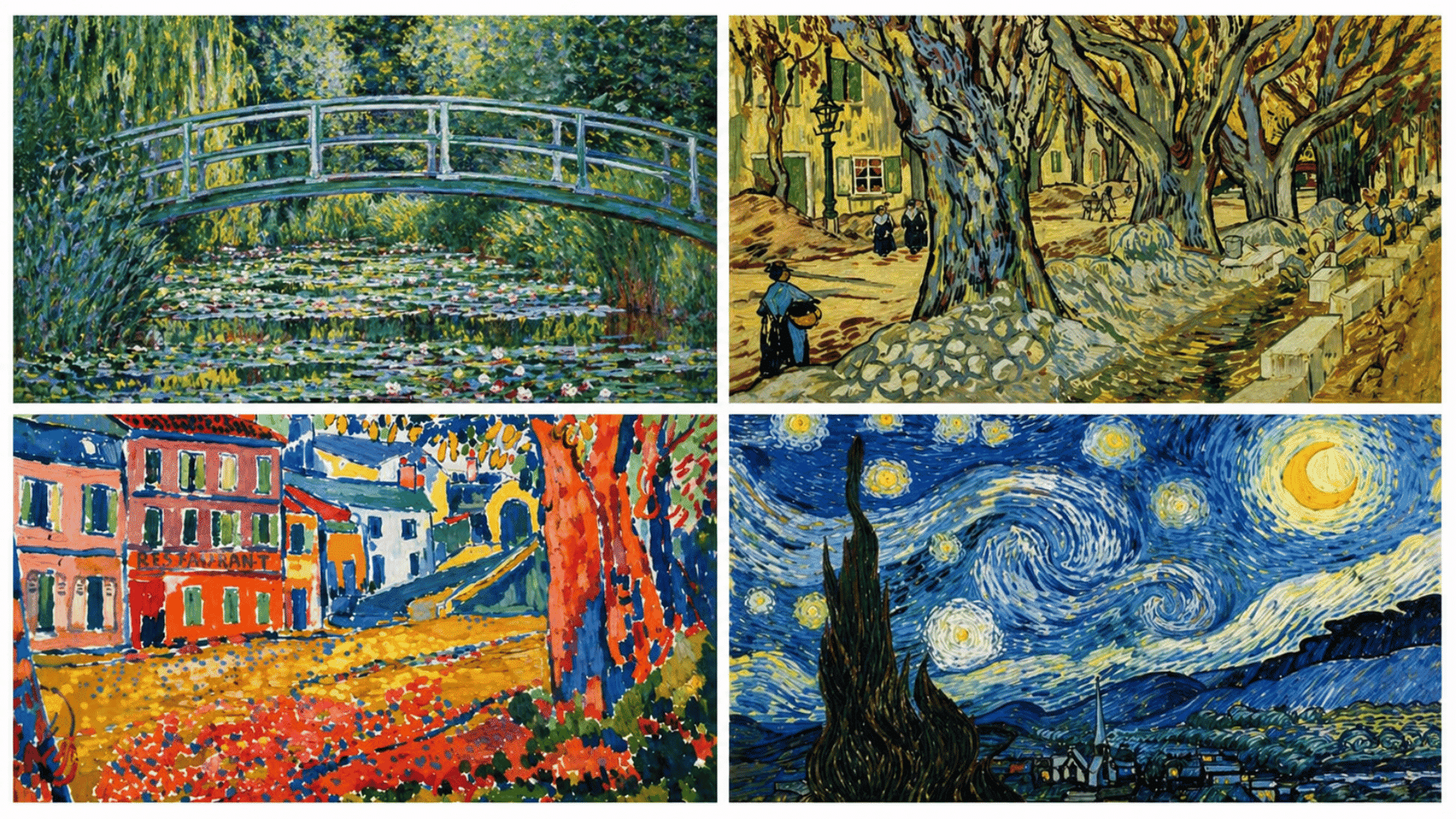
Art movements are collective trends in style, philosophy, or technique adopted by groups of artists during a specific period. These movements often emerge as a reaction against established traditions, socio-political shifts, or evolving technologies. By examining examples of these movements, one can better understand the trajectory of human expression and how cultural contexts shape the way we perceive visual reality.
The study of art history through movements allows observers to categorize complex visual narratives into digestible chapters. While the term "art movement" implies a unified, formal group, many movements were loose associations of artists sharing a localized philosophy or aesthetic goal. Understanding these examples requires looking beyond the canvas to the broader historical, economic, and philosophical triggers that forced artists to redefine their craft.
Defining the Art Movement Framework
An art movement is characterized by a group of artists who hold a similar aesthetic philosophy or goal, often—though not always—active during the same period and location. While some movements, such as the Surrealists, had rigid membership criteria and written manifestos, others, such as Impressionism, were loosely organized labels applied by critics or the public.
To identify an art movement, historians look for three core components:
- Shared Philosophy: A common belief about what art should represent or achieve.
- Distinctive Technique: A recognizable set of visual markers (e.g., specific brushwork, color palettes, or subject matter).
- Institutional Reaction: A response to, or departure from, the dominant academic or social status quo of the time.
Key Art Movements: A Chronological Comparison
The evolution of Western art is frequently categorized by shifts in focus—from the mimetic (mimicking reality) to the conceptual (representing ideas). The following table provides a snapshot of influential movements that define this progression.
| Movement | Approximate Period | Primary Objective | Key Visual Characteristics |
|---|---|---|---|
| Renaissance | 1400–1600 | Humanism and realism | Linear perspective, balanced composition |
| Baroque | 1600–1750 | Emotional drama and awe | Chiaroscuro (light/dark contrast), movement |
| Impressionism | 1860s–1880s | Capturing light and transient moments | Visible, short brushstrokes, outdoor lighting |
| Cubism | 1907–1914 | Multiple perspectives | Geometric shapes, fragmented forms |
| Surrealism | 1924–1966 | Exploring the unconscious mind | Dreamlike logic, juxtaposition of objects |
| Pop Art | 1950s–1970s | Challenging high-culture elitism | Bold colors, commercial iconography |
Deep Dive: Influential Art Movements and Examples
The Renaissance: Rebirth of Realism
The Renaissance represents a monumental shift toward the study of the natural world. Artists moved away from the flat, symbolic representations of the Middle Ages, adopting mathematical linear perspective to create the illusion of depth.
- Core Philosophy: Humanism—the idea that humans are the center of the universe and capable of understanding it through reason.
- Essential Example: Leonardo da Vinci’s The Last Supper (1495–1498). By utilizing vanishing-point perspective, Da Vinci created an architectural space that pulls the viewer into the scene, emphasizing both structural perfection and human emotion.
Impressionism: The Science of Light
Impressionism was a radical break from the polished surfaces of the French Academy. By moving their studios outdoors (en plein air), artists like Claude Monet sought to record the objective reality of light as it hit a surface at a specific time of day.
- Core Philosophy: The fleeting nature of perception over the permanence of the subject.
- Essential Example: Claude Monet’s Impression, Sunrise (1872). The painting is defined by "broken color," where colors are applied side-by-side rather than blended, allowing the eye to mix them optically, simulating the vibration of light.
Cubism: Deconstructing the Visual Plane
Cubism, pioneered by Pablo Picasso and Georges Braque, rejected the single-viewpoint perspective that had dominated art since the Renaissance. Instead, it presented the object from multiple viewpoints simultaneously, reflecting the fragmented pace of the industrializing 20th century.
- Core Philosophy: Acknowledging the flatness of the canvas while representing the complexity of 3D objects.
- Essential Example: Pablo Picasso’s Les Demoiselles d'Avignon (1907). This work shattered traditional beauty standards, using sharp, jagged forms to represent the human figure in a state of total geometric deconstruction.
Surrealism: The Logic of the Dream
Emerging from the trauma and disillusionment of the post-World War I era, Surrealism sought to liberate the human experience from the constraints of rationalism. Influenced heavily by Freudian psychoanalysis, Surrealists used art to unlock the imagery of dreams and the subconscious.
- Core Philosophy: Juxtaposition of unrelated objects to create "uncanny" effects.
- Essential Example: Salvador Dalí’s The Persistence of Memory (1931). By rendering dream-logic imagery (the melting clocks) with high-detail, academic precision, Dalí made the impossible feel physically tangible.
The Role of Technology in Art Movements
Historically, the evolution of art movements is inextricably linked to technological advancement. For example, the invention of the portable metal paint tube in the mid-19th century allowed Impressionist painters to leave their studios and paint in nature—a prerequisite for the movement’s success.
Similarly, the camera's emergence shifted the burden of "realistic representation" away from painting. Because photography could capture reality with perfect mechanical accuracy, painters felt liberated to pursue abstraction, leading directly to the birth of Expressionism and Cubism. In 2026, we see a parallel shift as AI-assisted generation tools force contemporary artists to reconsider the role of "authorship" and "intent," potentially signaling the dawn of a new, tech-centric movement.
Common Misconceptions
One common error when analyzing art movements is assuming that these groups were always exclusive or mutually exclusive. Many artists transitioned between styles as their personal philosophies evolved. For instance, Picasso moved through several distinct periods, including the Blue Period and Analytic Cubism, despite having a recognizable "Picasso" style.
Another misconception is that art movements "end." While a period like the Renaissance is defined by dates in textbooks, the underlying techniques—such as perspective and chiaroscuro—remained foundational training for artists for centuries afterward. Art movements are best viewed as cumulative knowledge rather than replacement systems.
Practical Steps to Studying Art Movements
For those interested in building a deeper understanding of these examples, consider the following approach:
- Start with the Context: Do not just look at a painting. Research what was happening in politics, religion, and science during the year it was painted.
- Analyze the "Why": Ask yourself what the artist was reacting against. Was the style meant to shock the public, or to capture a scientific truth?
- Visit Physical Archives: While digital galleries are useful, viewing a piece in its physical form allows for an appreciation of texture, scale, and color density that digital reproductions cannot replicate.
- Identify the Pivot Points: Look for works that served as "bridges" between two movements—such as Paul Cézanne’s late works, which served as the essential link between Impressionism and Cubism.
Frequently Asked Questions
Are art movements officially defined by a set of rules? Some are, some are not. Movements like Futurism had very strict, published manifestos. Others, such as Impressionism, were labels bestowed by critics or the public that the artists eventually adopted for convenience. There is no official governing body that dictates when a movement begins or ends.
How does an art movement differ from a style? A style is a consistent set of visual characteristics associated with an artist or a region (e.g., Gothic style). An art movement is a collective endeavor involving multiple artists who share a manifesto, a geographic location, or a specific goal to change the direction of art history.
Why did art movements become so short-lived in the 20th century? The 20th century saw rapid acceleration in social and technological change. As mass communication and global travel expanded, ideas moved faster, and the appetite for novelty increased. This shortened the "incubation period" for movements, leading to a faster turnover of styles like Dada, Pop Art, and Minimalism.
Can an artist belong to more than one art movement? Absolutely. Many prominent artists were early pioneers of one movement before pivoting to another. Artists often moved between movements as they discovered new techniques or encountered different social pressures. The labels are primarily tools for historians to categorize work after the fact.
Are there new art movements happening in 2026? Yes. In the current landscape, movements are increasingly defined by the intersection of digital media and physical reality. We are currently observing a trend toward "Post-Digital" art, where artists intentionally incorporate the aesthetics of glitch, algorithmic error, and digital scarcity into physical mediums.
Recommendation for Further Exploration
To truly understand these examples, you must engage with the primary sources. Begin by selecting one movement that interests you and visiting a major institution’s digital archive, such as the Metropolitan Museum of Art or the Tate. Look for "manifestos" from that period; reading the original text written by the artists themselves will reveal their motivations more clearly than any secondary textbook analysis. If possible, seek out local exhibitions to observe how contemporary curators are framing these historical movements for 2026 audiences.