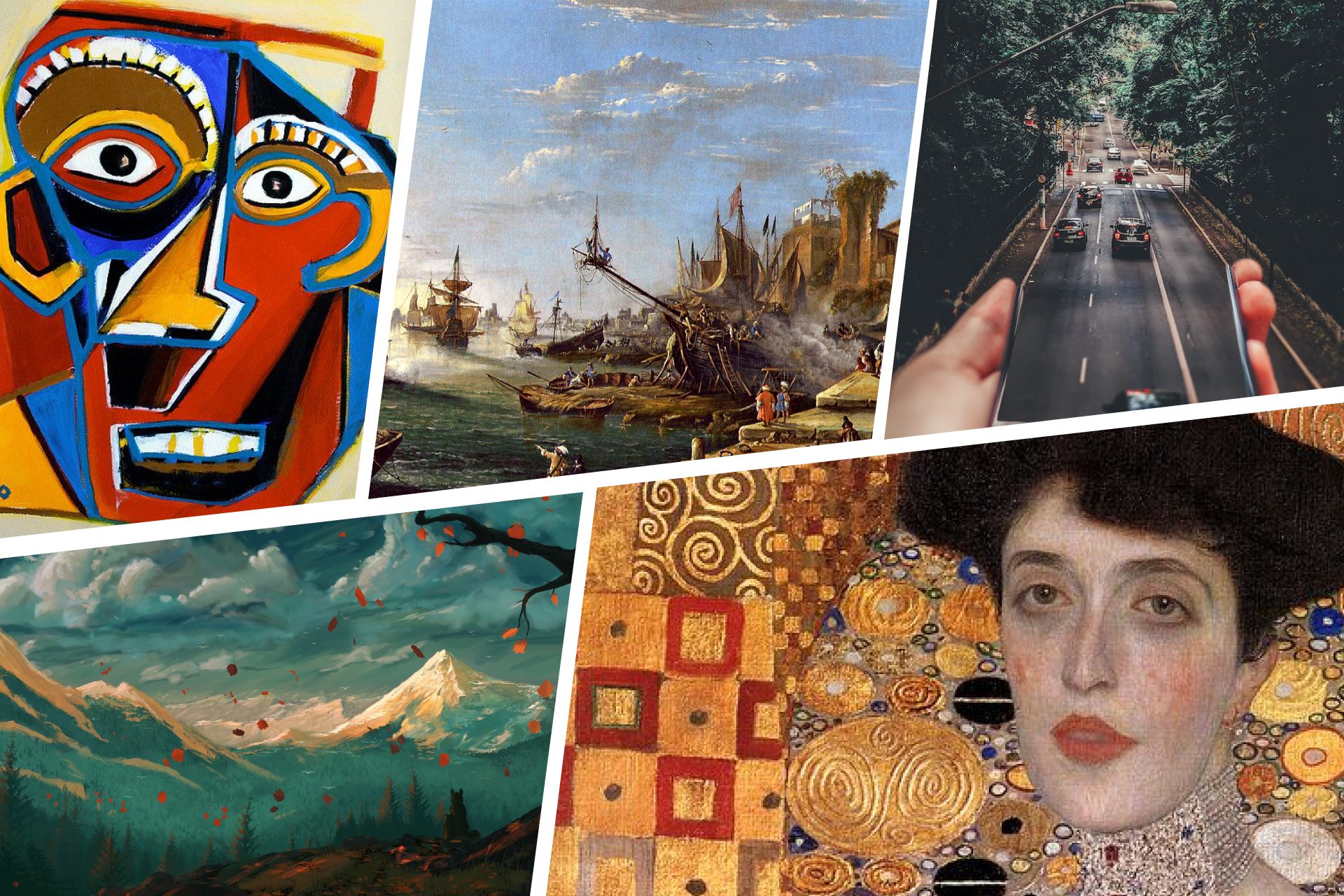
Understanding art styles is the foundation for appreciating, collecting, and creating visual culture, as it allows observers to categorize works based on shared characteristics, historical contexts, and technical executions. Whether you are browsing a digital gallery, researching auction lots, or identifying inspiration for a design project, a structured approach to recognizing these movements clarifies the evolution of human expression from classical techniques to modern digital interpretations.
Defining Artistic Movements and Styles
An art style is a cohesive set of techniques, visual motifs, and aesthetic philosophies that define a body of work created by an individual, a group of artists, or during a specific historical period. While "movement" often implies a conscious group effort—such as the Impressionists gathering in 19th-century Paris—a "style" is a broader classification used to describe how a piece looks.
Recognizing these styles requires looking at key technical markers:
- Brushwork: Visible, thick, or blended strokes.
- Color Palette: Naturalistic, hyper-saturated, or limited monochromatic schemes.
- Subject Matter: Religious, political, mundane, or abstract.
- Perspective: Linear, flattened, or distorted to evoke emotion.
By examining these elements, you can place a work of art into its appropriate category, providing context that deepens your understanding of the artist's intent and the cultural pressures of their time.
A Chronological and Categorical List of Major Art Styles
The following list covers some of the most influential styles throughout history. While this is not an exhaustive history of human art, these categories represent the primary pillars encountered in museums and scholarly discussions.
Classical and Traditional Styles
- Renaissance (1400–1600): Marked by the revival of classical philosophy, literature, and art. It prioritized linear perspective, anatomical precision, and the transition from egg tempera to oil paint. Figures like Leonardo da Vinci and Michelangelo championed light and shadow (chiaroscuro) to create three-dimensional realism.
- Baroque (1600–1750): A reaction against the balance of the Renaissance, Baroque art focused on drama, movement, and extreme tension. It is characterized by intense light sources and deep, dark shadows. The works of Caravaggio and Rembrandt are definitive examples.
- Neoclassicism (1750–1850): Emerging as a reaction to the perceived decadence of the Rococo style, Neoclassicism drew direct inspiration from ancient Greek and Roman art. It emphasized order, restraint, and moral virtue, often depicting heroic scenes with a clean, highly polished finish.
The Rise of Modernism
- Impressionism (1860s–1880s): This movement rejected the rigid rules of the Paris Salon. Impressionists sought to capture the "impression" of a moment, specifically focusing on how light changes the appearance of an object. The brushwork is loose and rapid, and colors are often applied side-by-side with minimal mixing, meant to blend in the viewer's eye.
- Expressionism (1905–1920): Here, the priority shifted from capturing reality to expressing personal, subjective emotions. Artists like Edvard Munch used distorted shapes, exaggerated brushstrokes, and non-naturalistic, jarring colors to reflect anxiety or intense joy.
- Cubism (1907–1914): Pioneered by Pablo Picasso and Georges Braque, Cubism deconstructs the subject, viewing it from multiple perspectives simultaneously on a two-dimensional surface. This style essentially shattered the Renaissance tradition of a single, fixed viewpoint.
- Surrealism (1924–1966): Influenced by the psychological theories of Sigmund Freud, Surrealism aimed to unlock the unconscious mind. The imagery is dreamlike, often pairing disparate objects in bizarre, impossible, or uncanny juxtapositions, as seen in the works of Salvador Dalí.
Contemporary and Digital Styles
- Pop Art (1950s–1970s): A challenge to fine art traditions by incorporating imagery from popular and mass culture—advertising, comic books, and mundane objects. It often utilizes bold colors and mechanical reproduction techniques like silkscreening.
- Minimalism (1960s–1970s): Characterized by extreme simplicity and the absence of decorative elements. Minimalism focuses on the medium itself and the physical presence of the object, often using geometric shapes and industrial materials.
- Digital Art (1990s–Present): While technically a medium, digital art has developed distinct "styles" based on software and screen-based aesthetics. These include Pixel Art, Vector Illustration, and Generative AI-assisted styles, which leverage computational power to create imagery that mimics traditional paint or entirely synthetic forms.
Comparative Overview of Notable Art Styles
| Style | Primary Focus | Key Visual Identifier | Famous Artist |
|---|---|---|---|
| Renaissance | Realism & Geometry | Linear perspective | Leonardo da Vinci |
| Baroque | Drama & Emotion | High contrast (Chiaroscuro) | Rembrandt |
| Impressionism | Light & Atmosphere | Visible, short brushstrokes | Claude Monet |
| Cubism | Multi-perspective | Fragmented, geometric forms | Pablo Picasso |
| Surrealism | Subconscious Mind | Dreamlike, bizarre imagery | Salvador Dalí |
| Pop Art | Mass Culture | Vibrant, graphic repetition | Andy Warhol |
Practical Tips for Identifying Art Styles
To accurately identify a style when viewing an unfamiliar work, follow a structured process of elimination. First, determine if the work is Representational (depicting real-world objects) or Abstract (non-representational).
If the work is representational, look at the handling of light and space. If it features a perfect "vanishing point" and logical shadows, it is likely rooted in the traditions established during or after the Renaissance. If the work feels "flat" or emphasizes bold outlines rather than deep space, you may be looking at Post-Impressionist or modern works.
Next, observe the palette. Intense, unnatural colors usually indicate a movement from the 20th century, such as Fauvism or Expressionism. Muted, earth-toned palettes are frequently found in earlier periods, though this is not a hard-and-fast rule, as the availability of pigments varied significantly before the invention of synthetic paints in the 19th century.
Common Mistakes in Categorization
A frequent error is conflating a movement with an individual technique. For example, "oil painting" is not an art style; it is a medium. An oil painting can be Impressionist, Baroque, or Abstract. Ensure you are identifying the conceptual framework (the style) rather than the physical materials (the medium).
Another common pitfall is the assumption that art moves in a linear, progressive fashion where each style "improves" upon the last. Art history is better understood as a series of reactions. Modernism was not an improvement on the Renaissance; it was a response to the changing social and technological realities of the industrial age.
Frequently Asked Questions
How do I tell the difference between Modern Art and Contemporary Art? Modern Art generally refers to the period between the 1860s and the 1970s, characterized by a break from tradition. Contemporary Art refers to art created from the mid-20th century to the present day, which often engages with social, political, and global themes.
Does "Abstract" mean "without meaning"? No. Abstract art refers to art that does not attempt to accurately depict physical reality. The "meaning" in abstract art is often found in the formal elements—color, balance, texture, and composition—rather than a narrative subject matter.
Why are pictures important when learning about art styles? Art is a visual language. While verbal descriptions provide historical context, pictures are essential because they allow you to recognize the "texture" and "rhythm" of a movement, which are difficult to convey through text alone.
Can an artwork belong to two different styles? Yes. Art history is rarely black and white. Many artists acted as bridges between movements, and some works incorporate elements from multiple periods. Such works are often classified as "transitional."
Where can I find verified images of these art styles? For academic research, prioritize databases like the Google Arts & Culture platform, the archives of major museums such as the Metropolitan Museum of Art, and peer-reviewed art history journals. These sources provide high-resolution documentation and curatorial metadata.
Next Actions for Further Learning
To refine your ability to identify styles, start by visiting a local gallery or an online museum archive. Select three pieces from different centuries. Write down three characteristics of the brushwork and the color palette for each. By comparing these notes against this list, you will begin to see patterns that are invisible to a casual observer. Consistently practicing this observational method is the fastest way to develop a sophisticated eye for historical and contemporary art.