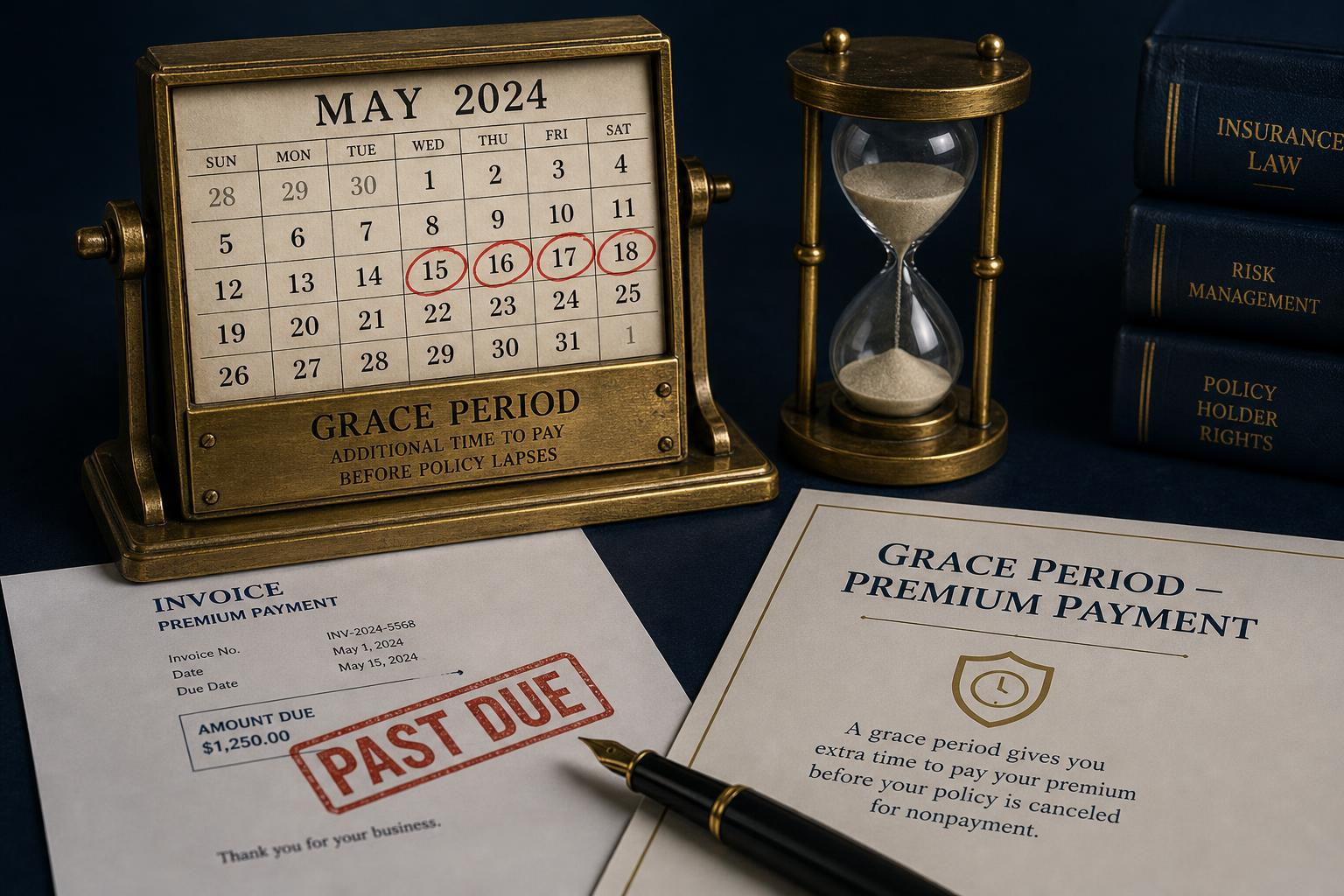
In Arizona, an auto insurance grace period refers either to the brief period an insurer allows for late premium payments before cancelling a policy or the automatic window (typically 14 to 30 days) granted to register a newly acquired vehicle under existing coverage. State law requires insurers to provide a 10-day written cancellation notice for nonpayment.
Understanding the Auto Insurance Grace Period in Arizona
The term "grace period" creates widespread confusion among drivers because it applies to two entirely different scenarios: paying a monthly premium late and adding a new car to an existing policy. In Arizona, neither scenario operates as a unrestricted free pass, and assuming your policy remains fully active without understanding the underlying contractual and statutory rules can lead to severe legal and financial consequences.
Disclaimer: This guide provides general informational coverage regarding insurance practices and Arizona statutory requirements. It does not constitute legal advice or formal insurance counseling. Policy terms vary by carrier, and drivers should consult their specific policy contract or a licensed Arizona insurance producer for authoritative details regarding their coverage.
When discussing auto insurance in Arizona, a grace period represents either:
- The Payment Grace Period: The extra time an insurance company voluntarily or contractually extends past a bill's due date before officially terminating coverage or assessing late fees.
- The Newly Acquired Vehicle Grace Period: The automatic, temporary extension of your existing coverage to a newly purchased or leased replacement or additional vehicle while you arrange to formally add it to your policy.
Understanding how both mechanisms work requires analyzing both individual private policy contracts and the Arizona Revised Statutes (A.R.S.) governed by the Arizona Department of Insurance and Financial Institutions (DIFI) and enforced by the Arizona Department of Transportation (ADOT) Motor Vehicle Division (MVD).
Payment Grace Periods vs. Statutory Cancellation Rules
Many policyholders mistakenly believe that Arizona state law mandates a automatic 30-day grace period for late monthly premium payments. Arizona state law does not mandate a minimum payment grace period. Instead, payment terms are primarily dictated by the insurance contract agreed upon between the vehicle owner and the insurance company.
However, Arizona law heavily regulates how and when an insurer can terminate a policy due to nonpayment.
Policy Timeline for Nonpayment:
- Due Date: Payment missed.
- Optional Courtesy Window: Insurers may offer 0-10 days before issuing formal notice.
- Notice Sent: Written 10-day A.R.S. § 20-1632 notice.
- Policy Terminated: Coverage ends; ADOT MVD notified electronically.
The 10-Day Statutory Cancellation Notice (A.R.S. § 20-1632)
While state law does not force insurers to grant extra payment time, A.R.S. § 20-1632 establishes strict rules for how insurance companies must cancel a policy for nonpayment of premium.
Under Arizona law:
- Written Notice Required: An insurer cannot cancel a motor vehicle insurance policy for nonpayment without mailing or delivering a written notice of cancellation to the named insured.
- 10-Day Advance Notice: For nonpayment of premium, the statutory notice of cancellation must be mailed or delivered at least 10 days prior to the effective date of cancellation.
- Proof of Mailing: The insurer must retain proof of mailing or electronic delivery. The cancellation clock begins running based on the mailing date specified in the notice.
If you miss your premium due date, your insurer might not cancel your policy instantly. Instead, they will generate and send a formal Notice of Cancellation. The effective date of cancellation listed on that document represents the absolute boundary of your insurance coverage. If you make the full required payment before that effective date, the cancellation notice is rescinded, and coverage continues uninterrupted.
What Happens to Claims During an Overdue Payment Window?
A critical distinction exists between an insurer allowing a late payment and an insurer covering claims made while a payment is past due.
If you carry a policy with an insurer that grants a 7-day payment grace period, and you cause an accident on day 4 of that window, coverage eligibility depends entirely on your carrier's underwriting guidelines:
- Conditional Coverage: Some insurers will cover claims incurred during the grace period provided you pay the outstanding premium balance (plus any applicable late fee) before the grace period or cancellation notice expires.
- Lapse and Denial: Other carriers place policies in a "pending cancellation" status upon a missed due date. If payment is not received, the policy is cancelled retroactively to the original due date or the effective cancellation date, meaning any claim occurring during the unpaid period will be denied outright.
Never assume an accident will be covered simply because you are within a carrier's informal late payment window.
Grace Periods for Adding a Newly Acquired Vehicle
The second—and often more generous—type of grace period in Arizona involves purchasing or leasing a new vehicle. When you buy a car from a dealership or private seller, standard Personal Auto Policies (PAP) in Arizona include provisions that extend temporary coverage to the new vehicle automatically.
The exact length and terms of this grace period depend on whether the vehicle is classified as a replacement vehicle or an additional vehicle.
New Vehicle Grace Periods:
- Replacement Vehicle: Replaces an existing car
- Same coverage as old car
- Typically 14 to 30 days to report
- Additional Vehicle: Added alongside existing cars
- Broadest coverage on policy
- Typically 14 days to report
Replacement Vehicle vs. Additional Vehicle
Replacement Vehicle: A car bought to replace a vehicle currently listed on your policy.
- Liability Coverage: Automatically extends to the replacement vehicle until the end of the policy term or for a set contractual window (commonly 14 to 30 days), even if you have not yet notified the insurer.
- Physical Damage Coverage (Comprehensive & Collision): Automatically applies at the same level as the vehicle being replaced for a specified period (typically 14 days).
Additional Vehicle: A car purchased in addition to the vehicles already insured on your policy (you are adding to your fleet rather than replacing one).
- Liability Coverage: Automatically extends to the new car for a shorter period—usually 14 days from the date you take possession. Coverage level usually matches the vehicle with the broadest coverage currently listed on your policy.
- Notification Mandate: You must notify the insurer within the specified contractual window (e.g., 14 days). If you fail to report the additional vehicle within that timeframe, automatic coverage ceases entirely on day 15.
Physical Damage Coverage Rules for Cars Without Prior Collision/Comprehensiveness
What if your existing policy only includes basic liability coverage, but you buy a brand-new car that requires comprehensive and collision coverage?
Standard personal auto policy contracts usually grant a very brief window—typically 4 days—of physical damage coverage for a newly acquired vehicle if your existing policy does not already carry comprehensive and collision coverage.
- Deductible Application: If a loss occurs within those 4 days, a standard deductible (often $500) applies automatically.
- Strict Reporting Deadline: If you do not notify your carrier within those 4 days to explicitly add comprehensive and collision insurance, physical damage coverage expires completely, leaving your new asset uninsured against theft, vandalism, weather, or collisions.
Arizona MVD Enforcement and Financial Responsibility Laws
In Arizona, car insurance is not merely a contract between you and an insurance carrier; it is a legal prerequisite for driving under A.R.S. § 28-4135. When a payment grace period expires and a policy is officially cancelled, the Arizona Department of Transportation (ADOT) Motor Vehicle Division (MVD) is alerted almost instantaneously.
Mandatory Minimum Liability Limits
Arizona law dictates that all motor vehicles operated or parked on public roadways must maintain continuous motor vehicle financial responsibility. The minimum statutory liability limits in Arizona (A.R.S. § 28-4009) are:
- $25,000 for bodily injury or death of one person in an accident.
- $50,000 for bodily injury or death of two or more persons in an accident.
- $15,000 for damage to or destruction of property of others in an accident.
These limits are commonly summarized as 25/50/15 coverage.
Electronic MVD Tracking and "De-Insuring"
Arizona utilizes an automated electronic reporting system. Insurance companies licensed to operate in Arizona are required by law to electronically transmit policy status updates to the MVD.
When your auto policy is cancelled due to nonpayment or expiration of a grace period:
- The insurer sends an electronic notice of cancellation to the MVD.
- The MVD system matches the Vehicle Identification Number (VIN) to state vehicle registration records.
- The MVD issues an Inquiry Notice or Notice of Intended Suspension to the registered owner.
- If you cannot provide proof of continuous insurance or proof of an active replacement policy within the response window, the MVD will suspend your vehicle registration and potentially your driver's license.
Legal Penalties for Driving During a Coverage Gap
Driving in Arizona after your insurance policy has lapsed or been cancelled carries stiff civil penalties under A.R.S. § 28-4135:
- First Offense: Minimum $500 civil penalty, plus a 3-month suspension of driver's license, vehicle registration, and license plates.
- Second Offense (within 36 months): Minimum $750 civil penalty, plus a 6-month suspension of license and registration.
- Third Offense (within 36 months): Minimum $1,000 civil penalty, plus a 12-month suspension of license and registration.
To reinstate suspended driving privileges after a lapse, Arizona drivers are frequently required to pay MVD reinstatement fees ($10 to $50 per item) and maintain an SR-22 Certificate of Financial Responsibility filed through an insurance company for 3 consecutive years.
Comparative Breakdown: Grace Period Scenarios in Arizona
The following reference table outlines how different grace period situations are handled under standard insurance practices and Arizona legal statutes.
| Scenario | Typical Duration | Statutory Basis / Rule | Primary Operational Risk |
|---|---|---|---|
| Late Monthly Payment | 0 to 10 days (Insurers vary) | A.R.S. § 20-1632 requires 10-day notice prior to final cancellation. | Retroactive claim denial if cancellation takes effect before payment is received. |
| Adding Replacement Car | 14 to 30 days | Personal Auto Policy Contract terms. | Overstaying the reporting window drops physical damage coverage down to basic limits or zero. |
| Adding Additional Car | 14 days | Personal Auto Policy Contract terms. | Total loss of coverage on day 15 if vehicle is not formally registered on the policy. |
| New Car without Existing Full Coverage | 4 days | Standard PAP Physical Damage Clause. | High deductible ($500 standard) applies automatically; all physical damage coverage lapses after day 4. |
| MVD Verification Response Window | 15 to 30 days from notice | A.R.S. § 28-4143 / ADOT Enforcement. | Automatic suspension of vehicle registration and license plate privileges. |
Step-by-Step Guide: How to Handle Overdue Payments and Policy Lapses
If you realize your payment is overdue or you have received a Notice of Cancellation in Arizona, act quickly to avoid driver's license suspension and costly long-term rate increases.
Action Plan for Policy Reinstatement:
- STEP 1: Contact Carrier Immediately: Determine exact policy status and cancellation date
- STEP 2: Cure Balance & Request Reinstatement: Pay past-due amount; sign "Statement of No Loss" if required
- STEP 3: Verify Arizona MVD Electronic Record: Ensure carrier updates state database; clear any pending suspensions
- STEP 4: Address License/Registration Penalties: Pay reinstatement fees and submit SR-22 if suspension occurred
Step 1: Contact Your Insurance Carrier Immediately
Do not rely on online payment portals if your policy is near or past its cancellation date. Call your insurer or local Arizona agent directly. Ask the representative:
- Is my policy still within the late payment window, or has a Notice of Cancellation been issued?
- What is the exact effective date and time of cancellation?
- Can the policy be reinstated without a gap in coverage?
Step 2: Pay the Balance and Sign a Statement of No Loss
If your policy has formally lapsed but is within the insurer's allowed reinstatement window (often 14 to 30 days after cancellation):
- The carrier may require you to pay the past-due balance plus a reinstatement fee.
- You will likely be required to sign a Statement of No Loss, certifying under penalty of fraud that no accidents, injuries, or property damage occurred during the period when the coverage was lapsed.
Step 3: Verify MVD Filing
Confirm that your insurer electronically submits proof of coverage (Form E or direct MVD transmission) to ADOT. You can verify your vehicle registration status online via the official AZ MVD portal (AZMVDNow.gov).
Step 4: Resolve Any Active MVD Suspensions
If the coverage gap caused the MVD to suspend your registration:
- Pay the required MVD reinstatement fees online or at an MVD office.
- If mandated by court or state order, have your insurer file an SR-22 certificate electronically with the MVD before operating the vehicle.
Long-Term Financial Impact of Coverage Lapses
Beyond legal fines and registration suspensions, allowing an auto insurance policy to lapse past its grace period carries severe financial repercussions that can last for years:
Financial Impact of Coverage Lapses:
- Premium Rate Hikes:
- Gap < 30 days: 10% - 20% increase
- Gap > 30 days: 30% - 80% increase
- Loss of Continuous Coverage discount
- Risk Reclassification:
- Reclassified as "High-Risk"
- Loss of preferred rate tiers
- Required SR-22 filing fees
High-Risk Driver Reclassification
Insurance carriers track continuous coverage history. A lapse of even a single day breaks your "continuous coverage" status. When applying for new insurance or renewing an existing policy, carriers will view you as a higher-risk customer, causing your premiums to spike by 15% to over 50% for up to three to five years.
Loss of Premium Discounts
Most major insurers offer substantial discounts for maintaining uninterrupted insurance coverage. Experiencing a cancellation for nonpayment eliminates continuous coverage discounts and may forfeit paperless or auto-pay savings.
Out-of-Pocket Liability
If you cause an accident during an unpaid lapse period, your insurer will deny the claim. Under Arizona law, you become personally liable for all medical bills, lost wages, and property damage incurred by other parties, which can result in wage garnishment, asset liens, and severe financial distress.
Frequently Asked Questions
Does Arizona state law mandate a 30-day grace period for late premium payments?
No. Arizona state law does not require auto insurance companies to give a 30-day payment grace period. Payment due dates and late payment windows are determined by individual insurance policy contracts. However, under A.R.S. § 20-1632, insurers must mail a written notice at least 10 days before cancelling a policy for nonpayment.
Can an auto insurance company cancel my policy immediately if I miss a payment by one day?
An insurer cannot instantly terminate your coverage on day one without notice. Arizona law requires the insurer to issue a formal cancellation notice giving you at least 10 days advance notice before the cancellation takes effect. However, if you fail to pay before that designated cancellation date, coverage ends, and claims occurring during the unpaid period can be denied.
How long do I have to add a newly purchased car to my auto insurance policy in Arizona?
For additional vehicles, standard personal auto policies generally give you 14 days from the date of purchase to notify your insurer. For replacement vehicles, you typically have between 14 and 30 days depending on your specific policy terms. If you require physical damage coverage (comprehensive and collision) on a car when your policy only carries liability, you usually have only 4 days to notify your carrier.
What happens if I get into an accident during my payment grace period?
If you have an accident during a payment grace period or before the cancellation date listed on a nonpayment notice, coverage depends on whether you cure the unpaid balance. If you pay the full required amount before the notice expires, coverage remains intact. If you do not pay and the policy is cancelled, the insurer will deny coverage for any accident occurring after the policy effective cancellation date.
How does the Arizona MVD know if my auto insurance policy has lapsed?
Insurance companies operating in Arizona are legally mandated to transmit policy creation, renewal, non-renewal, and cancellation data electronically to the ADOT MVD. When a policy lapses, the MVD system automatically flags the vehicle's VIN and generates an inquiry letter to the owner.
What is an SR-22 requirement in Arizona after an insurance lapse?
An SR-22 is a certificate of financial responsibility issued by an insurance company that proves to the Arizona MVD that you hold at least the minimum mandatory liability coverage (25/50/15). If your driving privileges or registration are suspended due to an uninsured lapse under A.R.S. § 28-4135, the MVD may require you to maintain an active SR-22 filing for up to three years.
Practical Recommendation for Arizona Drivers
To protect your driving record, vehicle registration, and personal finances:
- Set Up Automated Payments: Avoid accidental payment lapses by enrolling in automatic electronic payments linked to a credit card or bank account.
- Contact Insurers Before Buying a Car: Always notify your insurance producer or carrier before or on the day you take possession of a new vehicle to ensure physical damage coverage is bound immediately.
- Act on Notices Swiftly: If you receive an A.R.S. § 20-1632 Notice of Cancellation, pay the outstanding balance immediately or secure a replacement policy prior to the effective cancellation date to prevent MVD penalties and rate spikes.