API security on Google Cloud's Apigee API platform safeguards enterprise application programming interfaces using a multi-layered, defense-in-depth strategy. Apigee protects APIs by integrating Google Cloud network perimeter defenses, enforcing fine-grained identity and access policies at the runtime proxy layer, utilizing machine learning for automated anomaly and bot detection, and providing end-to-end data encryption and audit tracking.
The Apigee Defense-in-Depth Security Framework
Securing enterprise APIs requires protecting both the perimeter infrastructure and the individual data payloads passing through API proxies. Google Cloud's Apigee platform addresses API security not as an isolated runtime check, but as a continuous defense-in-depth architecture. This design spans network infrastructure, identity management, request validation, threat detection, and data governance.
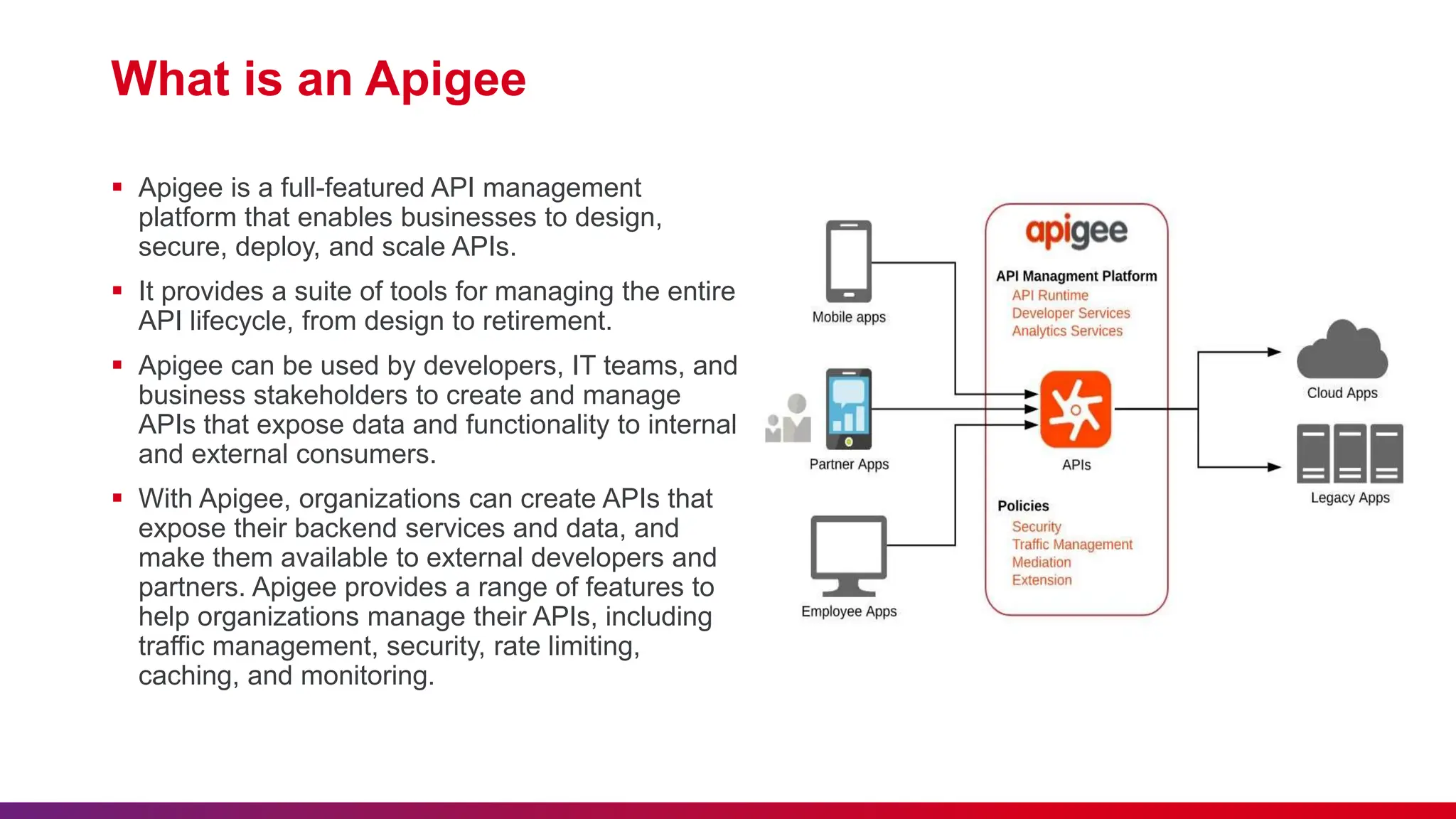
In modern enterprise architectures, microservices and legacy backends are frequently exposed across public clouds, hybrid environments, and on-premises data centers. Apigee sits between API consumers (such as web applications, mobile apps, and third-party partner systems) and target backend services. By decoupling API security from backend service code, developers can standardize security controls across thousands of endpoints without refactoring underlying business logic.
The foundation of Apigee's security model relies on four distinct architectural layers:
- Perimeter and Network Edge: Mitigating Distributed Denial of Service (DDoS) attacks, enforcing Web Application Firewall (WAF) rules, and controlling network ingress before traffic reaches the API proxy.
- Access Control and Identity: Authenticating clients, validating cryptographic tokens, enforcing scope-based authorizations, and terminating Mutual TLS (mTLS) connections.
- Runtime Policy Enforcement: Inspecting request and response payloads, filtering malicious content, and shaping traffic spikes to prevent resource exhaustion.
- Security Analytics and Posture Management: Using machine learning to identify anomalous behavior, detect bot attacks, continuously score security risks, and log audit trails for compliance auditing.
Network and Perimeter Security
Before an API request reaches an Apigee API proxy policy, it must pass through Google Cloud's globally distributed network perimeter. In Apigee X (the cloud-native iteration of Apigee), the enterprise runtime environment resides within a Google-managed Virtual Private Cloud (VPC). Integrating this architecture with Google Cloud Armor and Cloud Load Balancing provides multi-layered perimeter security.
Google Cloud Armor acts as the first line of defense at the edge of Google's network, defending against Layer 3 and Layer 4 volumetric DDoS attacks, as well as Layer 7 application-level exploits. By attaching Google Cloud Armor security policies to the external HTTP(S) Load Balancers that route traffic into Apigee, organizations can block malicious IP addresses using geo-location filtering, enforce custom IP allowlists/denylists, and apply pre-configured WAF rules aligned with the OWASP Top 10 vulnerabilities (such as SQL Injection and Cross-Site Scripting).
Network isolation is further strengthened using Google Cloud Private Service Connect (PSC) and VPC Service Controls. Private Service Connect creates secure, private endpoints within an organization's internal VPC, allowing API consumers to reach Apigee runtimes without traversing the public internet. Conversely, VPC Service Controls define security perimeters around Google Cloud resources, preventing data exfiltration by blocking unauthorized service calls between Apigee runtimes, Google Cloud Storage, BigQuery, and internal backend databases.
Transport Layer Security and Mutual TLS (mTLS)
Data in transit across the Apigee platform is encrypted using Transport Layer Security (TLS 1.2 and TLS 1.3). For high-security environments—such as open banking, healthcare exchange networks, and B2B partner integrations—standard server-side TLS is insufficient because it only authenticates the server to the client. Apigee supports bidirectional authentication through Mutual TLS (mTLS).
Mutual TLS requires both the client and the Apigee ingress proxy to present valid X.509 digital certificates before establishing a secure communication session. Apigee manages certificates using Keystores (storing private keys and certificates) and Truststores (storing trusted Certificate Authority certificates). During the mTLS handshake, Apigee verifies the client's certificate chain against configured trust anchors, checks for revocation via Certificate Revocation Lists (CRLs) or OCSP stapling, and extracts client identity attributes directly from X.509 distinguished names to make downstream authorization decisions.
Identity, Authentication, and Authorization Mechanisms
Establishing the caller's identity and determining their exact operational permissions is a core function of the Apigee API platform. Apigee provides native runtime policies that enforce identity standards across various security profiles.
| Security Layer | Capabilities & Components |
|---|---|
| 1. PERIMETER | Google Cloud Armor (DDoS, WAF) | Cloud Load Balancing |
| 2. NETWORK | VPC Service Controls | Private Service Connect | mTLS |
| 3. ACCESS CONTROL | API Keys | OAuth 2.0 / OIDC | JWT Validation | Cloud IAM |
| 4. RUNTIME THREAT | SpikeArrest | Quotas | JSON/XML Threat Protection | Regex Filter |
| 5. INTELLIGENCE | Advanced API Security | ML Anomaly & Bot Detection | SIEM Logging |
API Keys vs. OAuth 2.0 and OpenID Connect (OIDC)
Apigee supports multiple identity patterns, allowing organizations to match authentication strength to the sensitivity of the underlying resource:
- API Key Verification: API keys serve primarily as client identification markers rather than robust authentication credentials. In Apigee, the VerifyAPIKey policy checks an incoming request key against Apigee's developer app metadata. This process verifies that the key is active, valid, and associated with an API Product that grants access to the requested path. API keys are suitable for low-risk, public read-only APIs, operational dashboards, or developer portals where tracking usage and applying developer rate limits are the primary requirements.
- OAuth 2.0 Framework: For protected resources involving user data, Apigee implements full OAuth 2.0 standards (RFC 6749). Apigee can act as a complete OAuth 2.0 Authorization Server or as an OAuth Resource Server that validates access tokens issued by external identity providers (such as Google Cloud Identity, Okta, Ping Identity, or Microsoft Entra ID). Native policies like OAuthV2 handle token generation, token refresh, token validation, and token revocation across supported grant types, including Authorization Code, Client Credentials, and Password credentials.
- OpenID Connect (OIDC): Built on top of OAuth 2.0, OIDC adds an identity layer that enables clients to verify the end-user's identity via ID Tokens formatted as JSON Web Tokens. Apigee policies validate these identity tokens, allowing APIs to retrieve standardized user attributes (claims) while delegating user consent and multi-factor authentication (MFA) management to enterprise Identity Providers (IdPs).
JSON Web Token (JWT) Validation Policies
Modern distributed architectures rely heavily on cryptographically signed JSON Web Tokens (JWTs) to pass authorization context between services without requiring stateful database lookups. Apigee includes out-of-the-box policies designed for JWT lifecycle management:
- VerifyJWT: Validates the cryptographic signature of an incoming JWT using public keys (via raw X.509 certificates or dynamic JSON Web Key Sets [JWKS] fetched from an identity provider URL). The policy automatically verifies token expiration times, standard claims (such as issuer, audience, and subject), and custom application claims before routing the request to backend services.
- GenerateJWT: Construct and cryptographically sign new JWTs at the API proxy layer using RSA or HMAC algorithms. This capability allows Apigee to accept external credentials from clients, convert them into trusted internal claims, and forward a newly signed token to backend microservices.
- DecodeJWT: Parses a JWT's header and payload without validating its signature, useful for extracting non-sensitive metadata for logging or dynamic routing decisions prior to formal signature verification steps.
Fine-Grained Role-Based Access Control (RBAC) via Google Cloud IAM
In addition to securing runtime client-to-API traffic, Apigee enforces rigorous administrative security through Google Cloud Identity and Access Management (IAM). IAM governs which administrators, DevOps engineers, and CI/CD pipelines can modify API proxy configurations, deploy code, view analytics, or inspect encryption keys.
Apigee defines granular predefined IAM roles, such as Apigee Admin, Apigee Organization Admin, Apigee Environment Admin, Apigee Developer Admin, and Apigee Analytics Viewer. Organizations can create custom IAM roles adhering to the principle of least privilege. For example, a continuous integration service account can be granted exclusive permissions to deploy API proxies to a staging environment without being granted access to production encryption keys or user audit logs.
Runtime Threat Mitigation and Traffic Shaping Policies
Once client identity is authenticated, Apigee inspects and shapes incoming traffic to mitigate application-layer denial of service, resource exhaustion, and malicious injection attempts.
Rate Limiting and Volumetric Control
Traffic spikes—whether driven by legitiate flash sales or distributed botnets—can easily overwhelm backend database connections and application servers. Apigee provides complementary rate-limiting policies to ensure platform stability:
- SpikeArrest Policy: Designed to smooth out short-term traffic spikes and protect backend services from sudden surges. Unlike traditional quota policies calculated over hours or days, SpikeArrest operates on fractional time intervals (such as requests per second or requests per minute). If a service is configured for 60 requests per minute, SpikeArrest throttles traffic if more than 1 request arrives within a single second window, preventing micro-bursts from crashing downstream services.
- Quota Policy: Enforces business-level usage limits calculated over longer time horizons (such as requests per hour, day, week, or month). Quotas are typically attached to specific API Products or developer applications, allowing API providers to monetize API access or enforce tier-based consumption models (for example, limiting free-tier developers to 1,000 calls per day while allowing enterprise tiers 1,000,000 calls).
Payload Inspection and Injection Defense
Malicious actors frequently embed malicious code within request bodies, HTTP headers, or query parameters to exploit vulnerabilities in backend application code. Apigee offers automated payload validation policies that block these attacks at the API gateway layer:
- JSONThreatProtection Policy: Inspects JSON payloads to prevent structural denial of service attacks. It allows administrators to define strict boundaries on JSON formatting, including maximum container depth, maximum array length, maximum object entry key length, and maximum string length. Requests violating these structural boundaries are rejected immediately before reaching application servers.
- XMLThreatProtection Policy: Safeguards APIs parsing XML content against malicious XML payloads, such as XML External Entity (XXE) attacks, recursive entity expansion (Billion Laughs attacks), and deeply nested element structures.
- RegularExpressionProtection Policy: Evaluates request query parameters, HTTP headers, URI paths, and payload strings against regular expressions defined by security teams. This policy intercepts common code-injection signatures, including SQL Injection (SQLi), Cross-Site Scripting (XSS), Command Injection, and Path Traversal patterns.
Apigee Advanced API Security: Machine Learning and Posture Management
Traditional rate-limiting and signature-matching policies protect against known, predictable security threats. However, modern API threats often involve legitimate credentials executing abnormal sequences of API calls to extract sensitive enterprise data. To address complex business-logic abuse and automated credential stuffing, Google Cloud offers Apigee Advanced API Security.
Advanced API Security is an integrated cloud module that extends Apigee's security capabilities through continuous posture assessment and automated machine learning analytics.
| POSTURE MANAGEMENT | BOT & ANOMALY DETECTION |
|---|---|
| Continuous Misconfig Checks | Credential Stuffing Detection |
| Compliance Assessment | Scraping & Data Exfiltration Alerts |
| Real-time Risk Scoring | Machine Learning Abuse Profiles |
Security Risk Scoring and Misconfiguration Detection
Security misconfigurations—such as deploying an API proxy without an authentication policy, leaving debug endpoints exposed in production, or permitting weak TLS ciphers—are primary vectors for enterprise data breaches. Advanced API Security continuously scans deployed API proxies and environment configurations against Google Cloud's security baseline standards.
The module provides security teams with an aggregated security score and a detailed posture dashboard highlighting specific vulnerabilities, including:
- Deployed API proxies missing authentication policies (VerifyAPIKey, OAuthV2, or VerifyJWT).
- API routes allowing unrestricted HTTP methods or wildcard resource paths.
- Weak perimeter transport security, such as exposed HTTP endpoints that fail to enforce HTTPS redirection.
- Proxies lacking traffic-shaping controls, making them vulnerable to resource exhaustion.
Each flagged misconfiguration includes severity metrics and step-by-step remediation guidance, enabling platform administrators to audit compliance across large, multi-cloud API ecosystems.
Machine Learning-Powered Bot Detection and Anomaly Analytics
Automated bots frequently bypass traditional WAFs by using valid credentials, rotating IP addresses, and mimicking human browser headers. Apigee Advanced API Security leverages machine learning models trained on vast operational telemetry to recognize anomalous behavior patterns in real time.
Key detection capabilities include:
- Credential Stuffing Identification: Detecting automated attempts to test stolen credential pairs across authentication endpoints by analyzing failed login ratios, client fingerprint variations, and traffic velocity.
- Data Scraping and Exfiltration: Identifying callers harvesting mass records by monitoring unexpected sequences of API calls, abnormal payload extraction volumes, or access patterns that deviate from established historical baselines.
- Rules-Based Security Actions: Security teams can configure automated responses when an anomaly or bot rule triggers. Apigee can automatically log the event for security auditing, flag the client identity, issue HTTP 429 (Too Many Requests) responses, or return custom HTTP error payloads to block malicious automated actors without disrupting legitimate traffic.
Data Privacy, Tokenization, and Compliance Controls
Organizations operating in regulated industries—such as healthcare, finance, and retail—must enforce data privacy controls to meet compliance frameworks, including PCI-DSS, HIPAA, and the General Data Protection Regulation (GDPR). Apigee provides built-in runtime data protection capabilities to ensure sensitive payloads are protected throughout their lifecycle.
Sensitive Data Masking and Payload Encryption
Log files and analytics stores are common sources of accidental data leakage when APIs process Personally Identifiable Information (PII), Payment Card Industry (PCI) data, or protected health information (PHI). Apigee includes a Data Masking framework that redacts or obfuscates sensitive fields before variables are stored in execution logs, trace sessions, or analytical dashboards.
Administrators configure data masking configurations specifying exact JSONPaths or XPaths corresponding to sensitive fields (such as credit card numbers, social security numbers, and passwords). Once masked, these values are replaced with static mask patterns across the Apigee Debugger UI, Cloud Audit Logs, and analytics databases.
For end-to-end data security, Apigee supports payload-level cryptographic policies. Using the JavaCallout policy or native cryptographic policy extensions, proxies can encrypt specific JSON body attributes using asymmetric or symmetric encryption algorithms before forwarding payloads to external storage or third-party partner systems.
CMEK and Regulatory Compliance
Apigee X supports Customer-Managed Encryption Keys (CMEK) integrated with Google Cloud Key Management Service (KMS). By default, Google Cloud encrypts all customer data at rest using Google-managed encryption keys. However, organizations bound by strict regulatory standards can use CMEK to generate, rotate, and control their own cryptographic encryption keys hosted in Cloud KMS.
With CMEK enabled, customer data stored within the Apigee runtime environment—including Key-Value Maps (KVMs), OAuth token stores, developer application metadata, and analytics datastores—is encrypted using keys under the client's direct control. If an organization revokes key access in Cloud KMS, Apigee loses the ability to decrypt stored data, providing an immediate cryptographic kill-switch for corporate compliance requirements.
Comparing Apigee Security Components Across Deployment Models
Apigee is available across multiple deployment models, including Apigee X (Google Cloud fully managed SaaS), Apigee Hybrid (Google-managed control plane with customer-managed runtime data plane deployed on Kubernetes), and legacy Apigee Edge (cloud/on-premises). The following table outlines how core security features map across these architectural models:
| Security Capability | Apigee X (Fully Managed Cloud) | Apigee Hybrid (Multi-Cloud / On-Prem) | Architectural Scope & Governance |
|---|---|---|---|
| Edge DDoS & WAF Defense | Native integration with Google Cloud Armor & Cloud Load Balancer | Customer integrates upstream ingress (e.g., F5, Cloudflare, AWS WAF) | Perimeter Layer 3/4/7 threat mitigation |
| Network Isolation | Private Service Connect & VPC Service Controls | Kubernetes Network Policies & Customer VPC Peering | Private microservice network boundary enforcement |
| Inbound mTLS Termination | Terminated at Cloud Load Balancer or Apigee Ingress Gateway | Terminated at customer-managed Kubernetes Ingress Gateway | Client authentication via X.509 digital certificates |
| Runtime Policy Enforcement | Native policies (OAuth, JWT, SpikeArrest, Threat Protection) | Native policies (OAuth, JWT, SpikeArrest, Threat Protection) | In-line request and response payload security |
| Key Management (Data at Rest) | Google Cloud KMS with CMEK support | Customer-managed Kubernetes Secrets & KMS providers | Storage encryption for KVMs, tokens, and metadata |
| Advanced API Security | Integrated cloud module (ML Bot & Anomaly Detection) | Integrated with Google Cloud control plane analytics | Automated threat scoring and behavioral analytics |
| Administrative Access Control | Google Cloud IAM (Fine-grained RBAC roles) | Google Cloud IAM (Control Plane) + K8s RBAC (Data Plane) | Governance over deployment and admin operations |
Security Logging, Auditing, and SIEM Integration
Continuous observability is essential for effective incident response and compliance verification. Apigee captures comprehensive operational logs, audit trails, and performance metrics, streaming them directly into enterprise Security Information and Event Management (SIEM) systems.
Apigee integrates natively with Google Cloud Observability tools, including:
- Cloud Audit Logs: Captures administrative actions performed within the Apigee platform, such as who deployed an API proxy, updated an OAuth policy, modified IAM permissions, or exported developer application keys. Audit logs are immutable and stored securely for compliance auditing.
- Message Logging Policy: Enables API proxies to capture and stream custom runtime security events directly to external logging endpoints, Syslog servers, Google Cloud Storage, or Pub/Sub topics. Developers can capture attributes such as client IP addresses, TLS protocol versions, failed authentication attempts, and response latencies.
- SIEM Integration (Google Chronicle, Splunk, Datadog): By exporting log streams via Google Cloud Pub/Sub, security operations teams can feed Apigee runtime logs into SIEM platforms like Google Chronicle, Splunk, or Elastic. Security Operations Center (SOC) analysts can correlate API access patterns with endpoint logs, corporate network logs, and identity provider logs to detect cross-platform Advanced Persistent Threats (APTs).
Frequently Asked Questions
What is the difference between Google Cloud Armor and Apigee runtime security policies?
Google Cloud Armor acts as a network-level perimeter guard operating at the edge of Google's network, stopping volumetric DDoS attacks, enforcing IP allowlists/denylists, and filtering common web application vulnerabilities (OWASP Top 10) before traffic enters your cloud infrastructure. Apigee runtime policies operate deeper at the API application layer, validating API keys, enforcing OAuth 2.0 tokens, evaluating JSON/XML structures, parsing business logic claims, and shaping API-specific rate limits. Together, they form a multi-layered security architecture.
How does Apigee protect APIs against the OWASP API Security Top 10 vulnerabilities?
Apigee addresses key OWASP API threats through native policy enforcement and automated posture analytics. For example, Broken Object Level Authorization (BOLA) and Broken Authentication are mitigated using strict OAuth 2.0 and VerifyJWT validation policies coupled with Cloud IAM rules. Unrestricted Resource Consumption is prevented using SpikeArrest and Quota policies. Ingestion and structure vulnerabilities (such as Injection attacks) are stopped by JSON/XML Threat Protection and RegularExpressionProtection policies.
Can Apigee enforce Mutual TLS (mTLS) for backend target services?
Yes. Apigee supports mTLS on both inbound connections (client-to-Apigee) and outbound connections (Apigee-to-backend target). For outbound target connections, Apigee acts as the TLS client, presenting an X.509 certificate stored in an Apigee Keystore to the backend service and validating the backend service's server certificate using an Apigee Truststore. This guarantees encrypted, mutually authenticated communication between Apigee and internal microservices.
Does Apigee store sensitive API payload data, and is it encrypted?
Apigee processes API payload data in memory during runtime request/response execution. Apigee does not store full request or response bodies long-term unless explicitly configured to write payload data using a Message Logging policy. Operational metadata, Key-Value Maps (KVMs), OAuth tokens, and developer app credentials stored within Apigee are encrypted at rest by default using AES-256 keys, with optional Customer-Managed Encryption Keys (CMEK) integration via Google Cloud KMS.
What is Apigee Advanced API Security, and is it included by default?
Apigee Advanced API Security is an advanced add-on module available for Apigee X and Apigee Hybrid enterprise platforms. While standard Apigee includes core runtime security policies (such as API Key verification, OAuth, and rate limiting), Advanced API Security adds machine-learning-driven analytics specifically designed to identify complex bot attacks, credential stuffing, data exfiltration patterns, and API misconfigurations across enterprise API ecosystems.
Implementation Roadmap for Enterprise API Security
To establish a resilient API security posture using Google Cloud's Apigee platform, enterprise architecture and platform engineering teams should adopt a phased deployment strategy:
- Establish Perimeter Defense: Deploy Google Cloud Load Balancing with Google Cloud Armor enabled. Configure baseline WAF rules to block OWASP Top 10 vulnerabilities and restrict public ingress routes so that all incoming traffic must pass through Google's edge infrastructure.
- Standardize Identity Patterns: Mandate central identity standards across all API proxies. Replace legacy API key mechanisms with OAuth 2.0 access tokens or signed JSON Web Tokens (JWTs) validated against an enterprise Identity Provider (IdP). Implement mTLS for high-security partner and B2B endpoints.
- Enforce Core Operational Guardrails: Apply baseline traffic-shaping policies (SpikeArrest) and payload inspection policies (JSON/XML Threat Protection, RegularExpressionProtection) into standard proxy templates or shared flows used across engineering teams.
- Implement Data Protection Controls: Configure Data Masking rules across all Apigee environments to prevent PII, PCI, or PHI data from appearing in execution traces and audit logs. Integrate Cloud KMS with Customer-Managed Encryption Keys (CMEK) to meet regulatory compliance standards for data at rest.
- Enable Continuous Posture and Threat Analytics: Activate Apigee Advanced API Security to scan deployed API proxies continuously for security misconfigurations. Configure security rules to alert Security Operations Center (SOC) teams upon detecting anomalous traffic velocity, automated bot patterns, or credential stuffing attempts.
- Stream Audit Logs to SIEM: Export Apigee Cloud Audit Logs and runtime event streams via Google Cloud Pub/Sub to an enterprise SIEM platform (such as Google Chronicle or Splunk) to maintain complete visibility and ensure rapid incident response capabilities.