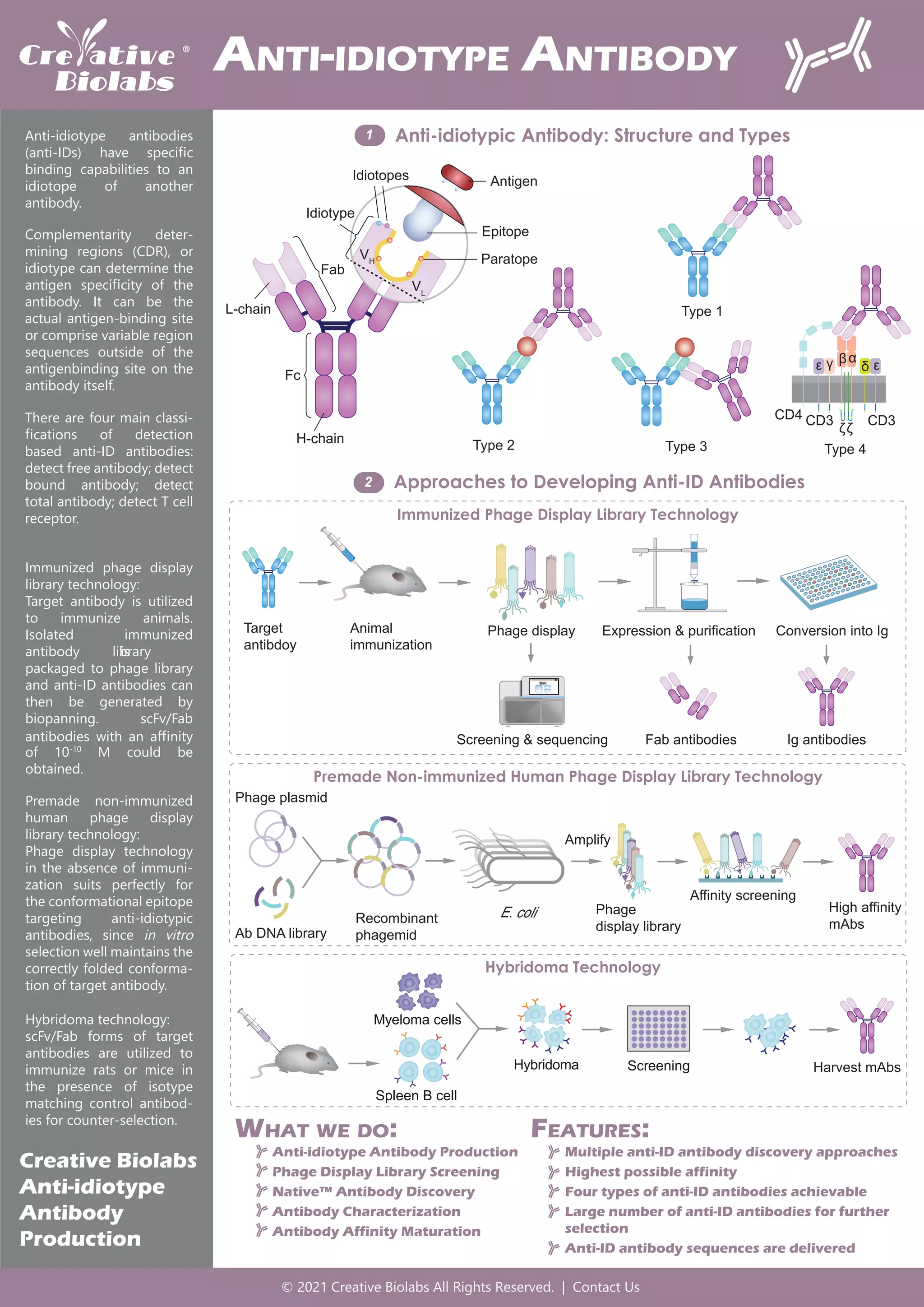
An antibody idiotype refers to the unique set of antigenic determinants (idiotopes) located within the variable region of an antibody molecule, specifically at or near the antigen-binding site. These determinants define the individual character of a specific antibody clone, effectively serving as a molecular fingerprint that distinguishes one antibody’s binding profile from every other antibody produced by the immune system.
The Structural Basis of Antibody Diversity
To understand the idiotype, one must first understand the architecture of an immunoglobulin (antibody) molecule. Antibodies are Y-shaped proteins composed of two heavy chains and two light chains. Each chain contains a constant region and a variable region. The variable regions of the heavy (VH) and light (VL) chains combine to form the Paratope—the specific site that physically interacts with a target antigen.
The idiotype is comprised of multiple idiotopes. An idiotope is an individual antigenic determinant or "epitope" found within the variable domain. Because the variable region is shaped by the unique amino acid sequences generated during V(D)J recombination and somatic hypermutation, the specific spatial configuration of these idiotopes is unique to each B-cell clone. When you speak of the "idiotype" of an antibody, you are referring to the sum total of these unique, clone-specific antigenic markers.
Distinguishing Idiotype from Isotype and Allotype
In immunological terminology, it is easy to confuse similar-sounding concepts. To clarify, immunoglobulins are classified based on three distinct levels of variation:
- Isotype: This represents the class of the antibody (e.g., IgG, IgM, IgA, IgD, IgE). Isotypes are determined by the constant region of the heavy chain and are shared by all members of a species.
- Allotype: This refers to subtle genetic variations in the constant regions that differ between individuals within the same species. Allotypes are inherited traits, similar to blood types.
- Idiotype: This is specific to the variable region. Unlike isotypes and allotypes, which are defined by genetic inheritance or conserved biological function, the idiotype is defined by the unique, somatically rearranged sequence that allows an antibody to recognize a specific target.
| Feature | Location | Biological Basis | Taxonomic Scope |
|---|---|---|---|
| Isotype | Constant Region | Genetic (Heavy chain gene) | All members of a species |
| Allotype | Constant Region | Allelic variation | Individuals within a species |
| Idiotype | Variable Region | V(D)J Recombination / Mutation | Individual B-cell clone |
The Idiotype Network Hypothesis
Proposed by Niels Jerne in 1974, the Idiotype Network Hypothesis revolutionized our understanding of immune regulation. Jerne suggested that the immune system is not merely a reactive force waiting for an infection, but a self-regulating, internal network of interactions.
The hypothesis posits that because an idiotype is itself an antigen (a "self-antigen"), the body produces "anti-idiotype" antibodies. These anti-idiotype antibodies recognize the binding site of the primary antibody. In this model, the immune system maintains a balance: the primary antibody binds the pathogen, while anti-idiotype antibodies bind the primary antibody to modulate its concentration and activity. This dynamic creates a "network" of suppressive and stimulatory signals that prevents runaway immune responses and maintains homeostasis. While the extent of this network's role in daily immune function is still a subject of ongoing research, the existence of anti-idiotypic antibodies is a well-documented biological reality.
Clinical Relevance and Therapeutic Applications
The specificity of the idiotype has significant implications for both diagnostics and immunotherapy. Because each B-cell lymphoma or leukemia clone expresses a unique idiotype, researchers have long explored this as a target for highly specific cancer treatments.
Anti-Idiotype Vaccines
In specific cancer therapies, researchers have developed "anti-idiotype vaccines." The strategy involves isolating the unique idiotype from a patient’s own tumor cells. By injecting this idiotype into the patient, the immune system is trained to recognize the tumor as a foreign invader. Essentially, the vaccine teaches the immune system to produce its own "anti-idiotype" antibodies, which then target the tumor cells for destruction while sparing healthy tissue.
Diagnostic Monitoring
In laboratory diagnostics, anti-idiotype reagents are used to track specific antibody responses. If a researcher or clinician needs to monitor the presence of a specific monoclonal antibody therapeutic in a patient’s blood, they may use a custom-generated anti-idiotype antibody that binds only to that therapeutic agent, ignoring all other antibodies in the serum.
Technical Challenges in Idiotype Characterization
Characterizing an antibody idiotype is a resource-intensive process. Because the idiotype is determined by the tertiary structure of the variable region, it can be extremely sensitive to environmental conditions.
- High Specificity Requirements: Generating an antibody that recognizes an idiotype (an anti-idiotype antibody) requires the production of monoclonal antibodies in a laboratory setting. This often involves immunizing mice with the specific antibody clone and screening thousands of resulting hybridomas to find one that binds solely to the variable region and not the constant regions.
- Structural Integrity: Since the idiotype relies on the exact folding of the antigen-binding site, any denaturation of the protein—such as high heat, incorrect pH, or degradation—will destroy the idiotype. Experiments must be conducted in strictly controlled buffers to maintain the biological relevance of the interaction.
- Cross-Reactivity: A common obstacle is the presence of "idiotype-like" structures on unrelated antibodies. Researchers must perform rigorous negative control experiments to ensure that the detected signal is truly specific to the target clone.
Practical Considerations for Research and Development
For those working in fields ranging from vaccine development to monoclonal antibody manufacturing, integrating idiotype testing is often a question of necessity. If you are developing a therapeutic antibody (e.g., a "mab" drug), you must define the idiotype to prove that the product remains consistent across different manufacturing batches.
- Standardization: Use standardized protein folding analysis to ensure the variable region configuration is identical in every batch.
- Verification: Utilize mass spectrometry alongside traditional binding assays to verify the sequence and structural integrity of the idiotype.
- Cost Management: Anti-idiotype production is specialized and expensive. It is typically only recommended when precise quantification of a specific clone is required, rather than general antibody levels.
Frequently Asked Questions
Is the idiotype of an antibody permanent for the life of an organism?
No. An idiotype is linked to the specific B-cell clone that produced the antibody. Since B-cells are constantly being generated and undergoing somatic hypermutation, the idiotypes present in your blood change as your immune system matures and encounters new antigens.
Can an idiotype change during the course of an infection?
Yes. During a process called "affinity maturation," B-cells undergo rapid mutations in their variable regions to increase their binding strength to a pathogen. These mutations alter the amino acid sequence and, consequently, the idiotype of the resulting antibodies produced by that B-cell lineage.
What is the difference between an idiotype and a paratope?
The paratope is the functional part of the antibody that binds the antigen. The idiotype is the set of all antigenic determinants (idiotopes) found in the variable region, which includes the paratope as well as surrounding loops.
Can anti-idiotype antibodies be harmful?
In some autoimmune conditions, the body may accidentally produce auto-antibodies against its own idiotypes, leading to a regulatory failure in the immune system. While they are a normal part of homeostatic regulation, their overproduction or misdirection can lead to clinical pathology.
How do researchers store idiotype-defined antibodies?
These antibodies require specialized storage, usually in ultra-low temperature freezers (-80°C) or lyophillized (freeze-dried) states. Because the idiotype is a structural feature, storage buffers often include stabilizers to prevent the variable region from unfolding over time.
Recommended Next Steps
If you are looking to investigate the idiotype of a specific antibody for research or therapeutic purposes, your next step should be to perform a structural alignment of the variable region genes. Utilizing high-resolution structural biology tools, such as X-ray crystallography or cryo-electron microscopy, will allow you to map the specific idiotopes within the variable domain.
For those in a clinical setting focusing on oncology, consider reviewing current protocols for monitoring "minimal residual disease" (MRD) through the identification of patient-specific idiotypic sequences via next-generation sequencing (NGS). This approach bypasses the need for traditional antibody-based detection and offers a more scalable method for tracking tumor-specific B-cell clones.