The International System of Units (SI) is the modern global standard for measurement, built upon seven base units: the second, metre, kilogram, ampere, kelvin, mole, and candela. It provides a coherent, universally recognized mathematical framework that eliminates regional discrepancies, ensuring precision, reproducibility, and clarity across science, commerce, and engineering.
Historical Evolution of Measurement Standards
Long before the standardization of measurements, human societies relied on arbitrary, localized units derived from the human body or everyday objects. Cubits, feet, inches, and pounds varied dramatically from town to town, creating significant friction in international trade, taxation, and scientific collaboration. The intellectual shifts of the Enlightenment and the Scientific Revolution demanded a universal, rational system based on immutable natural constants rather than the changing dimensions of human anatomy or royal artifacts.
The foundation of the modern SI system was laid during the French Revolution. In 1795, the French National Assembly formally established the metric system, defining the metre as one ten-millionth of the distance from the North Pole to the Equator along the meridian passing through Paris, and the kilogram as the mass of one cubic decimetre of pure water at its maximum density. Although initially adopted slowly, the practical advantages of a decimal-based system—where larger and smaller units are related by powers of ten—drove its gradual adoption across Europe and eventually worldwide.
As science progressed, mechanical artifacts proved susceptible to physical degradation, oxidation, and microscopic mass loss. This realization triggered a series of major revisions over the centuries. The International Bureau of Weights and Measures (BIPM), established by the Metre Convention of 1875, took charge of maintaining international standards. The twentieth century saw the formal creation of the Système International d'Unités (SI) in 1960 by the 11th General Conference on Weights and Measures (CGPM). This framework unified existing scientific units, expanded the scope of measurement, and set the stage for the historic 2019 redefinition, which severed all ties to physical artifacts in favor of unchanging fundamental physical constants of nature.
The Foundation: The Seven SI Base Units
At the heart of the SI system lie seven base quantities. Each base unit is dimensionally independent, meaning no base unit can be expressed as a mathematical combination of the others. Every other measurement in the universe of physics is derived from these fundamental building blocks.
The Metre ($m$) for Length
The metre measures spatial distance. Historically linked to physical meridians and later to a platinum-iridium bar kept in Sèvres, France, the modern metre is defined precisely as the length of the path travelled by light in a vacuum during a time interval of $1/299,792,458$ of a second. This definition anchors the measurement of length to the universal speed of light ($c$), which is an exact, defined constant.
The Kilogram ($kg$) for Mass
Mass measures the amount of matter in an object, distinct from weight, which depends on gravitational force. For over a century, the kilogram was defined by the International Prototype of the Kilogram (IPK), a physical cylinder of platinum-iridium alloy. In May 2019, this artifact was retired. The kilogram is now defined by fixing the exact numerical value of the Planck constant ($h$) to $6.62607015 \times 10^{-34}$ joule second ($J \cdot s$).
The Second ($s$) for Time
Time measures the duration of events and intervals between them. The second is defined by taking the fixed numerical value of the caesium frequency ($\Delta \nu_{Cs}$), the unperturbed ground-state hyperfine transition frequency of the caesium-133 atom, to be $9,192,631,770$ when expressed in the unit $Hz$, which is equal to $s^{-1}$. Atomic clocks utilizing this phenomenon achieve extraordinary precision, losing less than a second over millions of years.
The Ampere ($A$) for Electric Current
Electric current quantifies the rate of flow of electric charge past a specific point. The ampere is defined by taking the fixed numerical value of the elementary charge ($e$) to be $1.602176634 \times 10^{-19}$ coulomb ($C$). Since a coulomb is defined as one ampere multiplied by one second, fixing the elementary charge directly links electrical current to the quantum properties of fundamental particles.
The Kelvin ($K$) for Thermodynamic Temperature
Thermodynamic temperature measures the average kinetic energy of particles within a system. The kelvin is defined by fixing the exact numerical value of the Boltzmann constant ($k$) to $1.380649 \times 10^{-23}$ joule per kelvin ($J \cdot K^{-1}$). The zero point of the kelvin scale is absolute zero, the theoretical point at which molecular motion ceases entirely.
The Mole ($mol$) for Amount of Substance
The mole measures the number of elementary entities—such as atoms, molecules, ions, or electrons—in a given substance. One mole contains exactly $6.02214076 \times 10^{23}$ elementary entities. This specific number is the fixed numerical value of the Avogadro constant ($N_A$) when expressed in the unit $mol^{-1}$. This quantity bridges the macroscopic world of laboratory measurements with the microscopic world of atomic particles.
The Candela ($cd$) for Luminous Intensity
Luminous intensity measures the wavelength-weighted power emitted by a light source in a particular direction per unit solid angle. The candela is defined by taking the fixed numerical value of the luminous efficacy of monochromatic radiation of frequency $540 \times 10^{12}$ hertz ($K_{cd}$) to be $683$ lumens per watt ($lm \cdot W^{-1}$). This unit aligns physical radiometry with human visual perception, which varies across the electromagnetic spectrum.
| Base Quantity | Name of SI Unit | Symbol | Defining Physical Constant |
|---|---|---|---|
| Length | metre | m | Speed of light ($c$) |
| Mass | kilogram | kg | Planck constant ($h$) |
| Time | second | s | Caesium transition frequency ($\Delta \nu_{Cs}$) |
| Electric Current | ampere | A | Elementary charge ($e$) |
| Thermodynamic Temperature | kelvin | K | Boltzmann constant ($k$) |
| Amount of Substance | mole | mol | Avogadro constant ($N_A$) |
| Luminous Intensity | candela | cd | Luminous efficacy ($K_{cd}$) |
Derived Units and Coherence
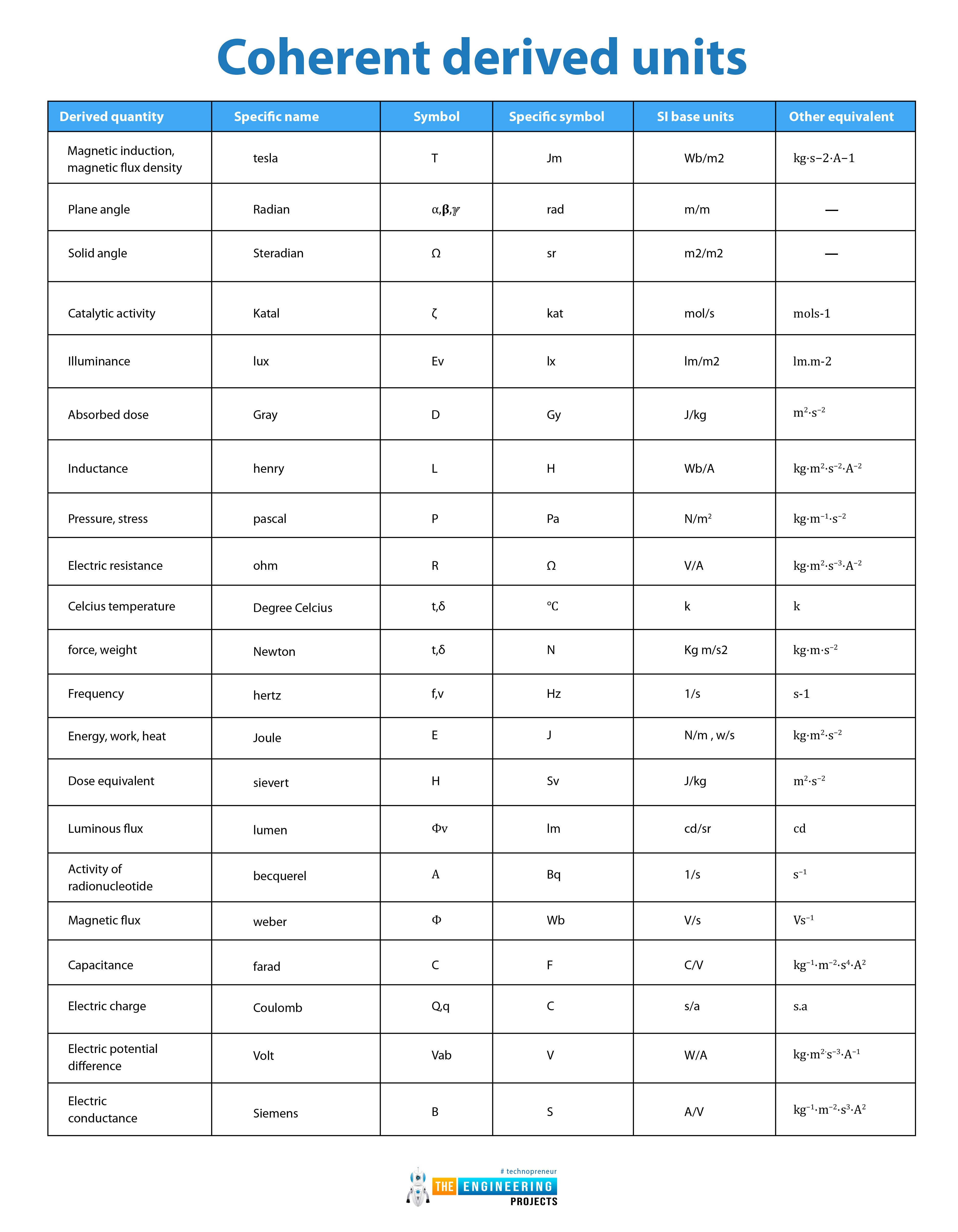
While base units provide foundational standards, most physical phenomena require complex measurements that combine these units. Derived units are formed by multiplying and dividing base units algebraically without introducing numerical conversion factors, making the SI system fully coherent.
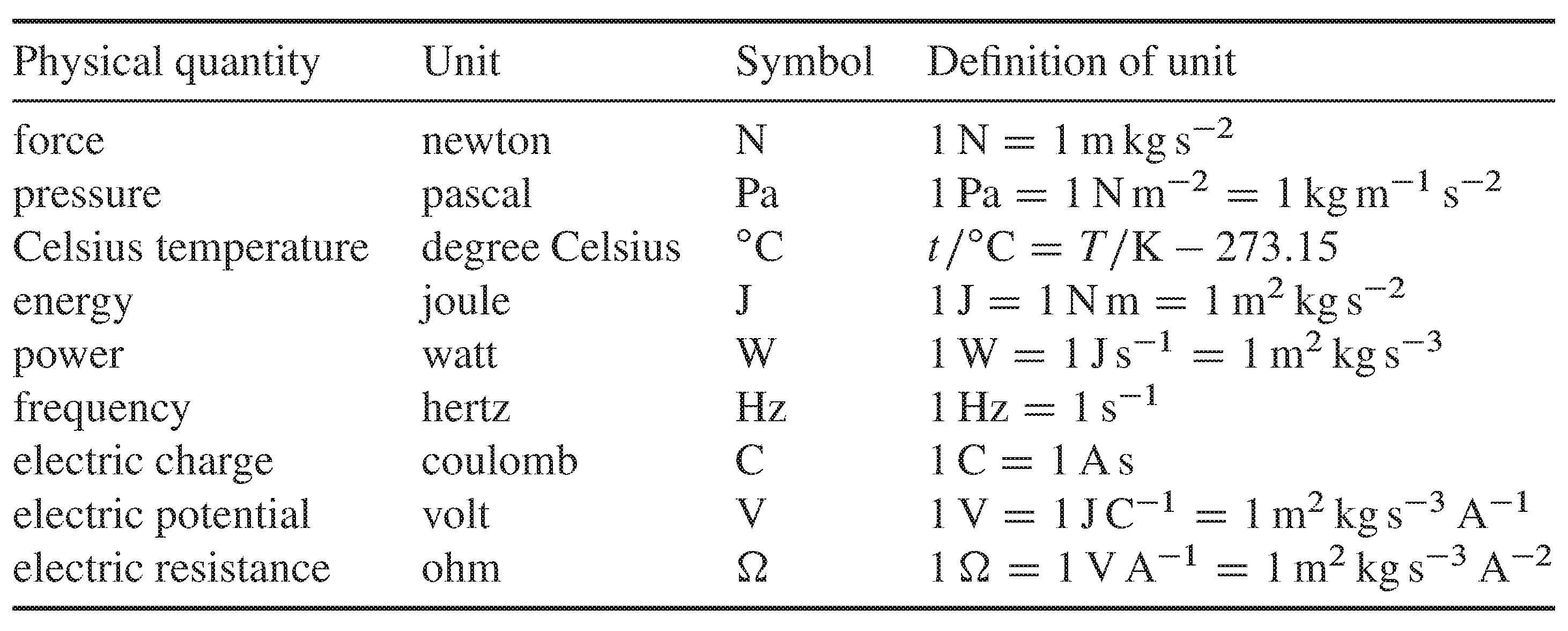
For example, velocity is calculated as distance divided by time, yielding the derived unit metres per second ($m/s$). Acceleration adds another division by time, resulting in metres per second squared ($m/s^2$). When mass is multiplied by acceleration, the resulting derived unit of force is the kilogram metre per second squared ($kg \cdot m/s^2$), which is given the special name newton ($N$) in honor of Sir Isaac Newton.
Similarly, pressure or stress is defined as force per unit area ($N/m^2$), designated as the pascal ($Pa$). Energy, work, and heat are expressed as force multiplied by distance ($N \cdot m$), known as the joule ($J$). Power is the rate of energy transfer over time ($J/s$), referred to as the watt ($W$).
These named derived units simplify complex equations across engineering and physics. Electrical engineering heavily relies on derived units such as the volt ($V$) for electric potential difference, the ohm ($\Omega$) for electrical resistance, and the farad ($F$) for capacitance. Magnetic fields are measured in tesla ($T$), while frequency is expressed in hertz ($Hz$). The coherence of these units ensures that when working within the SI framework, multiplying a current in amperes by a resistance in ohms automatically yields a potential difference in volts without any intermediary conversion multipliers.
Decimal Multiples and Submultiples: SI Prefixes
To accommodate measurements ranging from subatomic scales to astronomical distances, the SI system utilizes standard prefixes. These prefixes represent powers of ten, allowing scientists and engineers to scale base and derived units cleanly while maintaining decimal consistency.
Prefixes larger than one, such as kilo ($10^3$), mega ($10^6$), giga ($10^9$), tera ($10^{12}$), peta ($10^{15}$), exa ($10^{18}$), zetta ($10^{21}$), and yotta ($10^{24}$), scale units upward. Conversely, prefixes smaller than one, such as centi ($10^{-2}$), milli ($10^{-3}$), micro ($10^{-6}$), nano ($10^{-9}$), pico ($10^{-12}$), femto ($10^{-15}$), atto ($10^{-18}$), zepto ($10^{-21}$), and yocto ($10^{-24}$), scale units downward. In 2022, the CGPM expanded this range further by adding ronna ($R$, $10^{27}$), quetta ($Q$, $10^{30}$), ronto ($r$, $10^{-27}$), and quecto ($q$, $10^{-30}$) to handle massive data storage requirements and subatomic particle physics.
When applying prefixes, compounding is strictly prohibited. For instance, mass is measured using the base unit kilogram, which already contains a prefix (kilo). Multiples and submultiples of mass are formed by attaching prefixes to the word gram rather than the word kilogram (e.g., milligram [$mg$], not microkilogram).
Practical Application and Common Pitfalls
Adopting and maintaining precision within the SI unit system requires strict adherence to stylistic and mathematical conventions. Errors in unit conversion or notation can cause catastrophic engineering failures, as seen in historical aerospace accidents where mixed unit systems led to miscalculated orbital insertions and fuel pressures.
Rules for Writing SI Symbols
- Case Sensitivity: Symbol casing is critically important. Capital letters are used for symbols derived from proper names (e.g., $A$ for ampere, $K$ for kelvin, $Hz$ for hertz), while lowercase letters are used for all other units (e.g., $m$ for metre, $s$ for second, $mol$ for mole). The sole exception is the litre, which may be written as $L$ or $l$ to avoid confusion with the number one.
- Plurals: SI unit names take standard grammatical plurals (e.g., amperes, newtons), but SI unit symbols never take a plural marker or a trailing period (e.g., write $10\ kg$, never $10\ kgs$ or $10\ kg.$).
- Spacing and Multiplication: A space must always separate a numerical value from its unit symbol (e.g., $5.5\ m$, not $5.5m$). Multiplication of units is indicated by a centered dot or a space (e.g., $N \cdot m$ or $N\ m$), while division is indicated by a solidus ($/$) or negative exponents ($m \cdot s^{-1}$).
Common Mistakes to Avoid
- Confusing Mass and Weight: In everyday language, people often use kilograms to express weight. Scientifically, weight is a force measured in newtons ($W = mg$), while mass is an intrinsic property measured in kilograms.
- Mixing Systems Inconsistently: Introducing non-SI units—such as pounds, inches, or calories—into an SI equation without proper conversion factors breaks mathematical coherence and introduces significant error risks.
- Incorrect Temperature Scaling: When performing thermodynamic calculations, temperatures must always be expressed in kelvins, not degrees Celsius, because ratios of temperatures only hold true on an absolute scale.
Frequently Asked Questions
Why did the SI system redefine the kilogram and other units in 2019?
The 2019 redefinition eliminated humanity's last reliance on a physical artifact—the International Prototype of the Kilogram stored in France, which was found to be losing microscopic amounts of mass over time. By tying all seven base units to immutable fundamental physical constants of nature, measurements of mass, electrical current, and temperature became permanently stable, reproducible anywhere in the universe, and immune to physical degradation.
Is the kilogram a base unit despite having a prefix?
Yes, the kilogram is officially designated as the base unit of mass in the International System of Units, despite containing the prefix kilo. This is a historical anomaly maintained for practical reasons, as the gram is too small for many industrial and commercial applications. However, submultiples and multiples of mass are formed by attaching prefixes to the word gram.
What is the difference between a base unit and a derived unit?
Base units are dimensionally independent quantities that cannot be broken down into simpler measurements. Derived units are mathematical combinations of base units—such as multiplication or division—used to measure complex physical phenomena like force, energy, pressure, and electrical resistance.
How does the SI system maintain global synchronization?
Global synchronization is maintained through the Metre Convention, an international treaty signed in 1875. The International Bureau of Weights and Measures (BIPM), operating under the supervision of the International Committee for Weights and Measures (CIPM) and the General Conference on Weights and Measures (CGPM), coordinates national measurement standards and ensures international traceability.
Can non-SI units still be used legally?
Certain non-SI units are accepted for use alongside the SI because of their deep entrenchment in specialized fields or everyday life. Examples include time units like minutes, hours, and days, as well as angular measurements like degrees, arcminutes, and arcseconds. Units like the litre and tonne are also widely accepted alongside SI equivalents.
Next Actions and Further Verification
To ensure precision in scientific, technical, or educational work involving the SI unit system, consult the official guidelines published by the Bureau International des Poids et Mesures (BIPM) via their published SI Brochure. When performing complex calculations, verify that all input values are converted into consistent base or derived SI units before applying mathematical formulas to maintain absolute coherence and accuracy.