The three most influential wars of the late 1800s were the First Sino-Japanese War (1894–1895), the Spanish-American War (1898), and the Second Boer War (1899–1902). These conflicts signaled the decline of traditional empires, the emergence of the United States and Japan as global powers, and the introduction of modern industrial warfare tactics.
The Geopolitical Climate of the Late 1800s
To understand the three major wars that closed out the 19th century, one must first recognize the environment of "New Imperialism." By 1870, the Industrial Revolution had matured in Western Europe and North America, creating an insatiable demand for raw materials and new markets. This period was characterized by a frantic race among industrialized nations to claim "spheres of influence" across Africa, Asia, and the Pacific.
Technology acted as the primary catalyst for these conflicts. The development of the telegraph allowed for near-instantaneous communication between colonial capitals and distant front lines, while the expansion of steam-powered naval fleets meant that distant territories could be reached and conquered with unprecedented speed. Furthermore, the late 1800s saw a revolution in ballistics, including the transition from black powder to smokeless powder and the introduction of the first truly effective machine guns.
As of 2026, historians view this era not merely as a series of isolated colonial skirmishes, but as the direct architectural foundation for the global alliances and rivalries that would eventually ignite World War I. The three wars discussed below represent the turning points where old-world dominance began to crumble under the weight of modernized, industrialized military force.
1. The First Sino-Japanese War (1894–1895)
The First Sino-Japanese War was a watershed moment in Asian history, marking the shift of regional dominance from the Qing Dynasty of China to the burgeoning Empire of Japan. For centuries, China had been the "Middle Kingdom," the central cultural and political power of East Asia. However, while Japan embraced rapid modernization during the Meiji Restoration, China’s attempts at reform were fragmented and resisted by traditionalist factions within the imperial court.
Origins and Causes
The primary point of contention was the Korean Peninsula. Strategically located, Korea had long been a "tributary state" of China. Japan, seeking to secure its borders and expand its economic influence, viewed Korea as a "dagger pointed at the heart of Japan." When a pro-Japanese reformer was assassinated and a subsequent rebellion (the Donghak Peasant Rebellion) prompted both China and Japan to send troops into Korea, the tension escalated into full-scale war in July 1894.
Military Progression and Technological Disparity
Despite China possessing a larger army and a theoretically superior naval force—the Beiyang Fleet—the Japanese forces were significantly better trained, led, and equipped with modern Western-style logistics. The Battle of the Yalu River in September 1894 demonstrated the devastating effectiveness of rapid-fire guns and tactical discipline over the static, older naval strategies employed by the Chinese.
Japanese forces quickly pushed through the Korean Peninsula and into Manchuria, eventually capturing the strategic naval base of Port Arthur. The brutality of the conflict, particularly reports of the Port Arthur Massacre, shocked international observers and foreshadowed the total warfare of the coming century.
Impact and Legacy
The war concluded with the Treaty of Shimonoseki in April 1895. The terms were humiliating for China:
- China recognized the "total independence" of Korea (which effectively became a Japanese protectorate).
- Taiwan, the Pescadores Islands, and the Liaodong Peninsula were ceded to Japan.
- China was forced to pay a massive war indemnity of 200 million taels of silver.
As of 2026, this conflict is recognized as the beginning of the "Century of Humiliation" for China and the emergence of Japan as the first non-Western imperial power. It altered the balance of power in the Pacific permanently and spurred other Western powers to demand their own "concessions" from a weakened China.
2. The Spanish-American War (1898)
Often referred to by contemporary American politicians as a "Splendid Little War," the Spanish-American War lasted less than four months but had consequences that fundamentally altered the global standing of the United States. It signaled the final collapse of the Spanish Empire in the Western Hemisphere and the Pacific, and the birth of the United States as an overseas imperial power.
Causes: The Maine and Yellow Journalism
By the late 1890s, Spain’s control over its colonies, particularly Cuba, was failing. Cuban revolutionaries were engaged in a brutal struggle for independence, and reports of Spanish atrocities—frequently exaggerated or sensationalized by "Yellow Journalism" in the U.S. press—swayed American public opinion toward intervention.
The flashpoint occurred on February 15, 1898, when the USS Maine exploded in Havana Harbor. Although modern forensic analysis suggests an internal coal bunker fire was the likely cause, the media of the time blamed Spanish mines. The cry "Remember the Maine, to Hell with Spain!" became the catalyst for a formal declaration of war in April 1898.
Key Theaters of Conflict
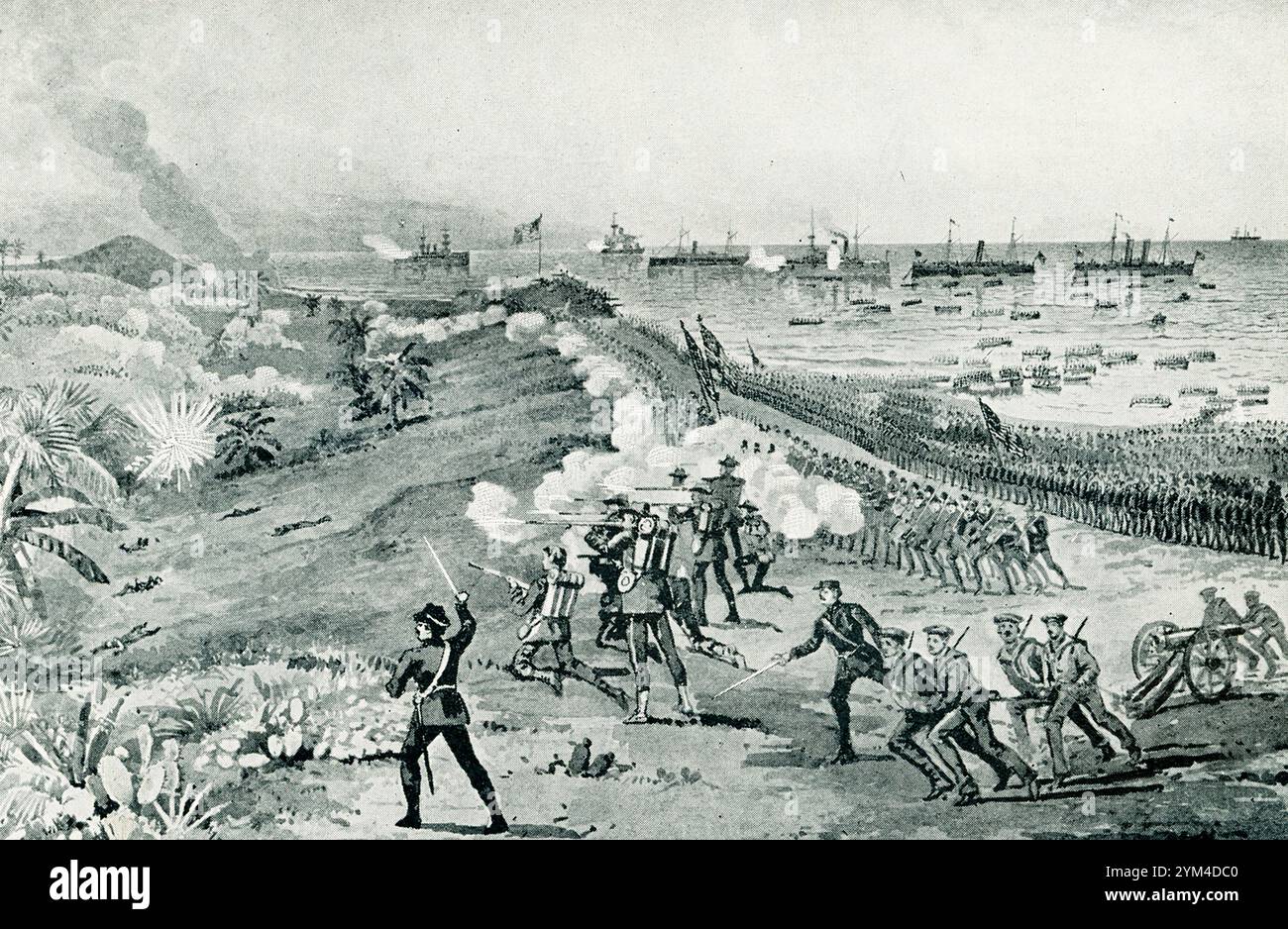
The war was fought on two main fronts: the Philippines (a Spanish colony in the Pacific) and the Caribbean (Cuba and Puerto Rico).
- The Pacific Theater: Commodore George Dewey led the U.S. Asiatic Squadron into Manila Bay on May 1, 1898. In a matter of hours, the outdated Spanish fleet was destroyed without a single American combat fatality.
- The Caribbean Theater: The land campaign in Cuba is famous for the Battle of San Juan Hill, where Theodore Roosevelt and his "Rough Riders" achieved a celebrated victory. Simultaneously, the U.S. Navy blockaded and eventually destroyed the Spanish Caribbean Squadron off the coast of Santiago de Cuba.
Consequences: The Treaty of Paris
The 1898 Treaty of Paris officially ended the war. Spain surrendered its claim to Cuba and ceded Puerto Rico, Guam, and the Philippine Islands to the United States for a payment of $200 million.
The war forced the United States to confront its new identity. For the first time, the U.S. governed foreign territories and populations without the immediate intent of granting them statehood. This led to a fierce domestic debate between imperialists and anti-imperialists, including figures like Mark Twain, who argued that overseas expansion contradicted the fundamental principles of American democracy. You can find more original documentation on these debates at the Library of Congress.
3. The Second Boer War (1899–1902)
The Second Boer War (commonly known simply as the Boer War) was a brutal struggle between the British Empire and the two independent Boer republics: the South African Republic (Transvaal) and the Orange Free State. It was the most costly, longest, and bloodiest war fought by the British between the Napoleonic Era and World War I.
The Conflict of Interests
The Boers were descendants of Dutch, German, and French settlers who had lived in Southern Africa for generations. They were fiercely independent, deeply religious farmers (Boer is the Dutch word for farmer). The conflict was driven by two factors: the British desire to unify South Africa under the Crown and the 1886 discovery of the world’s largest gold deposits in the Transvaal.
The British "Uitlanders" (foreigners) flooded into the gold fields, but the Boer government, led by Paul Kruger, refused to grant them voting rights, fearing they would lose control of their country. Diplomatic failures led the Boers to launch a preemptive strike against British forces in October 1899.
Phases of the War
The war is generally divided into three distinct phases:
- The Boer Offensive (1899): The Boers used modern Mauser rifles and superior mobility to besiege British garrisons at Ladysmith, Mafeking, and Kimberley. During "Black Week" in December 1899, the British suffered three major defeats in quick succession.
- The British Counter-Offensive (1900): Massive reinforcements arrived from across the British Empire. Under Lord Roberts, the British captured the Boer capitals of Bloemfontein and Pretoria, seemingly winning the war.
- Guerrilla Warfare and Scorched Earth (1900–1902): The Boers refused to surrender, forming "Commandos" that harassed British supply lines. In response, Lord Kitchener implemented a "Scorched Earth" policy, burning Boer farms and moving women and children into "concentration camps" to prevent them from aiding the guerrillas.
The Human Cost and Resolution
The conditions in the concentration camps were catastrophic; due to poor administration and disease, approximately 27,000 Boer women and children and at least 14,000 Black Africans died. The outcry over these conditions, led by activists like Emily Hobhouse, forced a change in British policy and left a legacy of bitterness that would influence South African politics for a century.
The Treaty of Vereeniging in May 1902 ended the war, with the Boer republics being absorbed into the British Empire, eventually becoming part of the Union of South Africa in 1910. The war exposed significant weaknesses in British military logistics and health, leading to major reforms in the decade preceding 1914. Detailed accounts of the military reforms following this war can be found at the National Army Museum.
Comparative Analysis of Late 19th-Century Wars
The following table compares the primary characteristics of these three conflicts to illustrate the shifts in global power and military technology during this era.
| Feature | First Sino-Japanese War | Spanish-American War | Second Boer War |
|---|---|---|---|
| Primary Dates | 1894–1895 | 1898 | 1899–1902 |
| Main Belligerents | Qing China vs. Japan | Spain vs. United States | British Empire vs. Boer Republics |
| Primary Cause | Control of the Korean Peninsula | Cuban Independence / USS Maine | Gold discovery / Imperial expansion |
| Military Innovation | Modern steam-powered navies | Steel-hulled battleships | Guerrilla tactics / Scorched earth |
| Major Outcome | Japan becomes a world power | U.S. gains overseas empire | British consolidation of S. Africa |
| Casualties (Approx.) | 35,000+ | 3,000 (mostly disease) | 75,000+ |
Technological and Tactical Shifts
The wars of the late 1800s served as a testing ground for technologies that would define the 20th century. In 1870, many soldiers still used muzzle-loading rifles; by 1899, the bolt-action magazine rifle (such as the Mauser and the Lee-Metford) was standard. These weapons allowed for a much higher rate of fire and greater accuracy at long ranges.
The introduction of smokeless powder (Poudre B and Cordite) was equally revolutionary. In earlier wars, the battlefield would quickly become obscured by thick clouds of white smoke. By the late 1800s, smokeless powder allowed snipers and machine gunners to remain hidden while firing, making the "frontal assault" tactics of the past suicidal. This transition was most brutally evidenced during the Boer War, where British soldiers in traditional red coats or formal formations were picked off by Boer marksmen from miles away.
Furthermore, these wars saw the first significant use of:
- The Maxim Gun: The first recoil-operated machine gun, which could fire 600 rounds per minute.
- Field Telegraphy: Enabling commanders to coordinate large-scale movements across vast distances.
- Medical Advancements: While disease still killed more soldiers than bullets (especially in the Spanish-American War), the understanding of germ theory began to influence field hospitals and sanitation.
Common Myths and Misconceptions
When researching wars in the late 1800s, several misconceptions often arise:
- "The wars were short and easy": While the Spanish-American War was brief, the Boer War lasted nearly three years and strained the world's largest empire to its limits.
- "Colonial wars didn't involve advanced technology": On the contrary, the late 19th-century colonial wars were the primary drivers for naval and ballistic innovation.
- "The U.S. only became a world power in WWI": The events of 1898 prove that the U.S. had already achieved "Great Power" status and was exerting influence across two oceans well before 1914.
Frequently Asked Questions
Which of these wars had the most casualties?
The Second Boer War resulted in the highest total casualties of the three, specifically when accounting for the deaths in concentration camps. While battle deaths were relatively low compared to later 20th-century conflicts, the combined death toll of soldiers and civilians exceeded 75,000. In contrast, the Spanish-American War had very few combat deaths, though over 2,000 American soldiers died from yellow fever and typhoid.
How did these wars lead to World War I?
These conflicts accelerated the arms race. Japan's victory over China (and later Russia in 1905) disturbed the European balance of power. The British struggle in South Africa led them to seek new alliances (such as the Anglo-Japanese Alliance of 1902 and the Entente Cordiale with France), moving away from "Splendid Isolation." These shifting alliances created the "tinderbox" of Europe that ignited in 1914.
Why was "Yellow Journalism" so important in 1898?
Yellow Journalism, led by publishers William Randolph Hearst and Joseph Pulitzer, used sensationalism to sell newspapers. By printing unverified accounts of Spanish cruelty and blaming Spain for the USS Maine explosion without evidence, they created a public frenzy that made it politically impossible for President McKinley to avoid war. This remains a classic study in the power of media to influence foreign policy.
What happened to the colonies after these wars?
The outcomes were varied. The Philippines fought a bloody war for independence against the U.S. (1899–1902) before eventually gaining independence in 1946. Taiwan remained under Japanese control until the end of World War II in 1945. South Africa became a self-governing dominion within the British Empire in 1910, though the racial tensions exacerbated by the Boer War eventually led to the era of Apartheid.
Recommended Next Actions
For those looking to deepen their understanding of this era, the following steps are recommended:
- Visit Digital Archives: Explore the National Archives for digitized records of the Spanish-American War, including original telegrams regarding the USS Maine.
- Study Military Evolution: Research the "Haldane Reforms" of the British Army following the Boer War to see how a major power learns from military failure.
- Comparative Reading: Read the Treaty of Shimonoseki and the Treaty of Paris side-by-side. Note how both treaties use "indemnities" and "territorial cessions" to redefine sovereignty, a hallmark of 19th-century diplomacy.