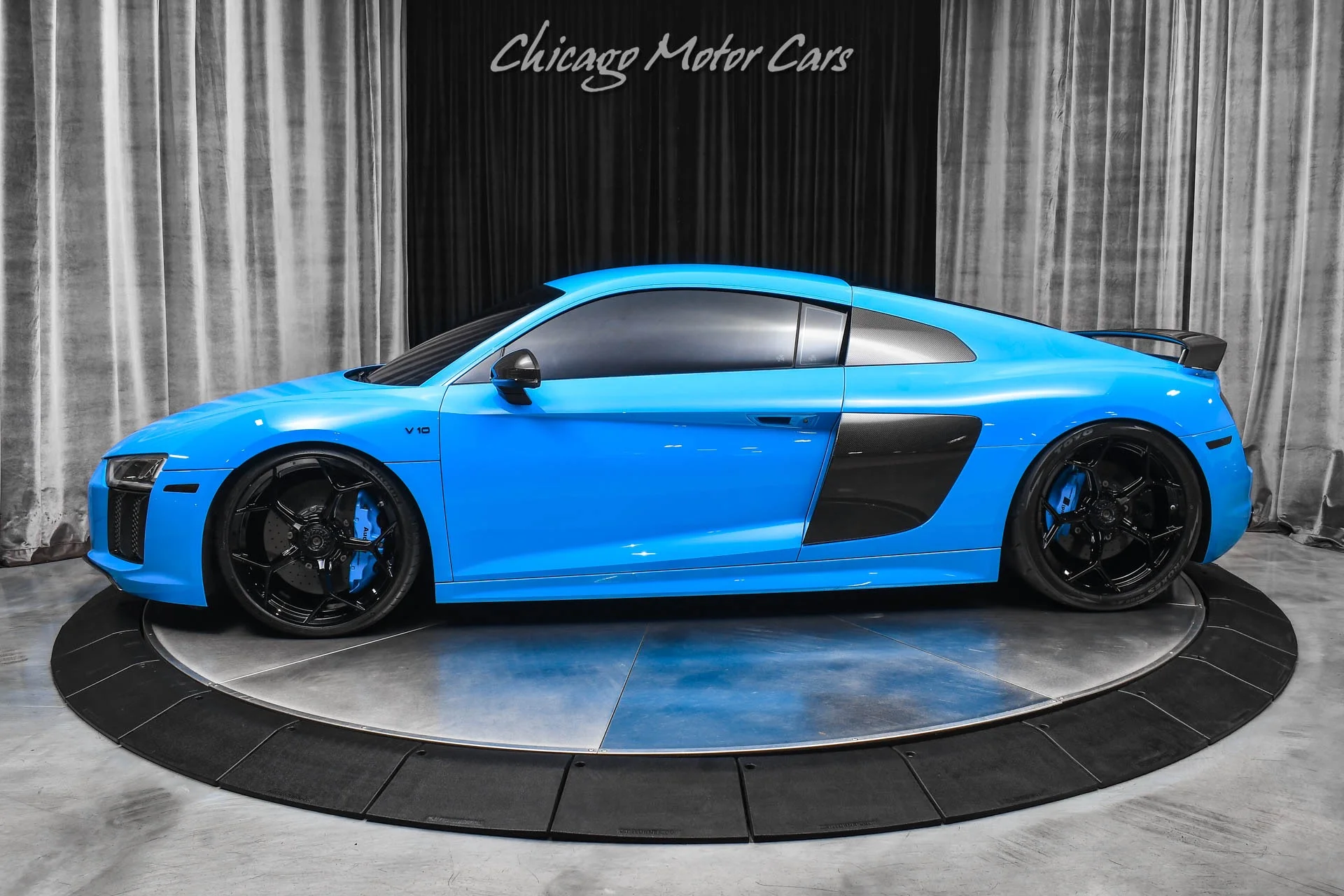
The 2017 Audi R8 marks the launch of the supercar’s second generation (internal designation Type 4S) in the North American market. Built on an advanced composite chassis featuring aluminum and carbon-fiber-reinforced polymer, the 2017 R8 features a mid-mounted, naturally aspirated 5.2-liter V10 engine paired with a 7-speed S tronic dual-clutch transmission and Quattro all-wheel drive.
Platform and Architecture: The Type 4S Chassis
The second-generation Audi R8 introduced significant structural engineering upgrades over its predecessor (the Type 42). Central to this evolution is the revised Audi Space Frame (ASF), a lightweight structural frame that integrates aluminum components with structural carbon-fiber-reinforced polymer (CFRP).
- 2017 Audi R8 Space Frame (ASF)
- Aluminum Structure + CFRP B-Pillars & Bulkhead
- = 40% Increase in Torsional Rigidity
- = Approx. 70 lb (32 kg) Frame Reduction
- Aluminum Structure + CFRP B-Pillars & Bulkhead
Material Composition and Rigidity
- Structural Blend: Approximately 79% aluminum and 13% CFRP by weight.
- Key CFRP Components: The rear bulkhead, central tunnel, and B-pillars are constructed entirely from high-strength CFRP modules.
- Torsional Stiffness: Static torsional rigidity increased by 40 percent compared to the first-generation model. This enhancement improves steering precision, suspension tuning, and high-speed directional stability.
- Weight Efficiency: The complete body-in-white frame weighs roughly 441 lbs (200 kg), representing a saving of approximately 70 lbs (32 kg) over the previous generation's frame despite the added stiffness.
Engine Specifications: The 5.2-Liter Naturally Aspirated V10
The heart of the 2017 Audi R8 is its high-revving, mid-mounted 5.2-liter (5,204 cc) 90-degree V10 engine. Available in two distinct tunes—the standard V10 and the elevated V10 Plus—this naturally aspirated power unit utilizes motorsport-derived technology to deliver linear power delivery up to an 8,700 RPM rev limit.
| Engine Parameter | Base V10 Coupe / Spyder | V10 Plus Coupe |
|---|---|---|
| Displacement | 5.2 Liters (5,204 cc) | 5.2 Liters (5,204 cc) |
| Aspiration | Naturally Aspirated | Naturally Aspirated |
| Valvetrain | DOHC, 4 valves/cylinder (40V) | DOHC, 4 valves/cylinder (40V) |
| Bore x Stroke | 84.5 mm x 92.8 mm | 84.5 mm x 92.8 mm |
| Compression Ratio | 12.7:1 | 12.7:1 |
| Horsepower (SAE net) | 540 hp @ 7,850 RPM | 610 hp @ 8,250 RPM |
| Torque | 398 lb-ft (540 Nm) @ 6,500 RPM | 413 lb-ft (560 Nm) @ 6,500 RPM |
| Specific Output | 103.8 hp/liter | 117.2 hp/liter |
| Redline | 8,700 RPM | 8,700 RPM |
Advanced Engine Engineering Highlights
- Dual Fuel Injection System: Combines direct fuel injection (FSI) into the combustion chamber with indirect port injection (MPI) into the intake manifold. FSI optimizes fuel atomization and cooling under high loads, while port injection lowers emissions and improves efficiency at partial throttle.
- Dry-Sump Lubrication: Replaces a traditional oil pan with a dedicated external oil tank and multi-stage scavenge pumps. This design permits a significantly lower engine mounting position (lowering the vehicle's center of gravity) and maintains consistent oil flow during extreme cornering forces exceeding 1.2 g.
- Cylinder on Demand (CoD) System: To improve fuel efficiency during light cruising, the engine management system can temporarily deactivate one cylinder bank (turning the engine into a 5-cylinder unit) by shutting off ignition and fuel supply to cylinders 1–5 or 6–10 alternately.
Transmission and Quattro Drivetrain Architecture
Unlike its predecessor, which offered a 6-speed open-gate manual gearbox, the 2017 Audi R8 exclusively features a 7-speed S tronic dual-clutch transmission (DCT). Manual transmission options were eliminated for the second generation to optimize shift speeds and dynamic acceleration.
Drivetrain Components
- 7-Speed S Tronic Transmission: Utilizes concentric electrohydraulically actuated multi-plate clutches. The transmission offers fully automatic shift profiles or manual paddle-shift control with gear changes occurring in under 120 milliseconds.
- Electrohydraulic Multi-Plate Clutch: Mounted on the front axle drive, replacing the previous viscous coupling. This electrohydraulically actuated multi-plate wet clutch actively distributes torque between the axles without slip limits. It can direct 100% of available torque to the rear wheels, or continuously vector up to 100% of engine power to the front axle depending on slip angle, steering input, and surface grip.
- Rear Mechanical Differential: A mechanical limited-slip differential (LSD) is standard on the rear axle, working alongside the electronic torque distribution to maintain traction during corner exit.
- 5.2L V10 Engine (Mid-Mounted)
- 7-Speed S tronic Dual-Clutch
- Rear LSD Differential / Primary Rear Drive
- Electrohydraulic Multi-Plate Clutch
- Front Axle Drive
2017 Audi R8 Specifications Comparison Matrix
The table below outlines key technical metrics, dimensional measurements, and factory performance claims for the 2017 Audi R8 Coupe, V10 Plus Coupe, and Spyder models.
| Metric / Feature | 2017 Audi R8 V10 Coupe | 2017 Audi R8 V10 Plus Coupe | 2017 Audi R8 V10 Spyder |
|---|---|---|---|
| Engine Configuration | 5.2L Naturally Aspirated V10 | 5.2L Naturally Aspirated V10 | 5.2L Naturally Aspirated V10 |
| Peak Horsepower | 540 hp @ 7,850 RPM | 610 hp @ 8,250 RPM | 540 hp @ 7,850 RPM |
| Peak Torque | 398 lb-ft @ 6,500 RPM | 413 lb-ft @ 6,500 RPM | 398 lb-ft @ 6,500 RPM |
| 0–60 mph Acceleration | 3.5 seconds | 3.2 seconds | 3.5 seconds |
| 0–100 km/h (0–62 mph) | 3.5 seconds | 3.2 seconds | 3.6 seconds |
| Top Speed | 199 mph (320 km/h) | 205 mph (330 km/h) | 198 mph (318 km/h) |
| Curb Weight (US EPA) | ~3,616 lbs (1,640 kg) | ~3,572 lbs (1,620 kg) | ~3,792 lbs (1,720 kg) |
| Brake System (Front) | 8-piston calipers / Wave steel rotors | 6-piston calipers / Ceramic rotors | 8-piston calipers / Wave steel rotors |
| Brake System (Rear) | 4-piston calipers / Wave steel rotors | 4-piston calipers / Ceramic rotors | 4-piston calipers / Wave steel rotors |
| Front Brake Rotor Diameter | 14.4 in (365 mm) | 15.0 in (380 mm) | 14.4 in (365 mm) |
| Rear Brake Rotor Diameter | 14.0 in (356 mm) | 14.0 in (356 mm) | 14.0 in (356 mm) |
| Suspension Type | Magnetic Ride Adaptive Dampers | Fixed Sport Suspension | Magnetic Ride Adaptive Dampers |
| EPA Fuel Economy (C/H/C) | 14 / 22 / 17 MPG | 14 / 22 / 17 MPG | 14 / 22 / 17 MPG |
| Fuel Tank Capacity | 19.3 gal (73 L) [Opt. 21.9 gal] | 19.3 gal (73 L) [Opt. 21.9 gal] | 19.3 gal (73 L) [Opt. 21.9 gal] |
Chassis Dynamics, Suspension, and Braking Systems
The overall handling profile of the 2017 Audi R8 relies on forged aluminum double-wishbone suspension systems at all four corners, complemented by model-specific damper tuning and high-performance braking hardware.
- 2017 Audi R8 Suspension & Braking
- Double-Wishbone Aluminum Arms (Front/Rear)
- Steering: Electromechanical EPS (15.7:1 Ratio)
- Base V10 Dampers: Audi Magnetic Ride (Fluid Viscosity Control)
- V10 Plus Dampers: Fixed Steel Springs & Passive Monotube Shocks
- Brakes:
- Base: Wave-Contoured Steel Discs (8-Piston Front / 4-Piston Rear)
- Plus: Carbon-Fiber Ceramic Discs (6-Piston Front / 4-Piston Rear)
Suspension Geometry and Damping Options
- Double-Wishbone Setup: Forged aluminum control arms front and rear maintain precise camber and caster geometry under severe lateral loads.
- Audi Magnetic Ride (Standard on Base V10 & Spyder): Utilizes synthetic damper fluid impregnated with microscopic magnetic particles. Applying an electromagnetic current alters fluid viscosity within milliseconds, enabling continuous adjustment between soft compliance for highway cruising and stiff control for track environments.
- Fixed Sport Suspension (Standard on V10 Plus): Eliminates electronic magnetorheological fluid in favor of traditional steel coil springs and passive monotube dampers tuned specifically for track stiffness and reduced roll angles. (Audi Magnetic Ride was available as a non-cost option on the V10 Plus for buyers preferring compliance).
- Dynamic Steering (Optional): Variable-ratio electromechanical power steering that dynamically alters the lock-to-lock steering ratio (from 10.0:1 to 17.5:1) based on road speed and drive mode selection. The standard fixed steering setup features a direct 15.7:1 ratio.
Braking Systems Breakdown
- Wave Steel Rotors (Standard V10): Floating steel friction rings featuring a wave-shaped outer edge to reduce unsprung mass by roughly 6.6 lbs (3 kg) across four corners. Clamped by 8-piston monobloc aluminum calipers up front and 4-piston calipers at the rear.
- Carbon-Ceramic Brakes (Standard V10 Plus): Specially formulated carbon-fiber-reinforced silicon carbide disc rotors. The front discs measure 380 mm with 6-piston calipers, while the rears measure 356 mm with 4-piston calipers. These components reduce unsprung rotational weight by 33 lbs (15 kg) compared to steel setups, while providing heat resistance up to 1,800°F (980°C).
Exterior Dimensions and Aerodynamic Data
The 2017 Audi R8 was redesigned to be wider and lower than the original model, presenting a wider footprint and optimized aerodynamic efficiency.
| Dimension | Measurement | Notes |
|---|---|---|
| Overall Length | 174.4 in (4,426 mm) | |
| Overall Width | 76.4 in (1,940 mm) | (Excluding side mirrors) |
| Mirror Width | 80.0 in (2,032 mm) | (Including side mirrors) |
| Overall Height | 48.8 in (1,240 mm) | (Coupe) |
| Wheelbase | 104.3 in (2,650 mm) | |
| Front Track | 64.5 in (1,638 mm) | |
| Rear Track | 62.8 in (1,596 mm) | |
| Ground Clearance | 4.1 in (105 mm) |
Aerodynamic Development
- Rear Spoiler Dynamics: Standard V10 models use an electronically deployed rear spoiler that raises automatically at 75 mph (120 km/h) and retracts below 50 mph (80 km/h). The V10 Plus features a fixed clear-coated carbon-fiber rear wing that provides constant downforce at elevated speeds.
- Underbody Diffuser: A fully enclosed smooth underbody terminates in a rear diffuser that channels airflow beneath the vehicle, creating negative pressure to suck the chassis to the tarmac without requiring massive upper surface wings.
- Downforce Generation: At its top speed of 205 mph, the V10 Plus produces approximately 220 lbs (100 kg) of total downforce, with roughly 145 lbs (66 kg) applied over the rear axle.
Interior Ergonomics, Technology, and Cabin Dimensions
The cabin of the 2017 Audi R8 shifts away from a traditional dashboard-mounted central display, adopting a driver-centric control layout centered around the Audi Virtual Cockpit.
- Driving Environment
- Digital Gauge Cluster: 12.3-inch TFT Display
- Hardware Engine: Nvidia Tegra 3 Chip
- Resolution: 1,440 x 540 Pixels
- Display Modes: Classic, Infotainment, Performance (V10 Plus)
Digital Instrument Cluster: Audi Virtual Cockpit
- Display Spec: A 12.3-inch high-resolution TFT display operating at 60 frames per second powered by an Nvidia Tegra 3 quad-core processor.
- Functionality: Replaces traditional analog gauges and central infotainment screens. Displays high-definition 3D Google Earth satellite navigation, media telemetry, vehicle diagnostics, and drivetrain temperatures directly in front of the driver.
- Performance Mode (V10 Plus): Includes a central tachometer with custom gear shift light indicators (turning green, yellow, then flashing red at the 8,700 RPM limit), tire pressure and temperature monitors, g-force metering, and lap timers.
Wheel and Control Interface
- Satellite Steering Wheel Switches: Features up to four integrated control buttons mounted directly to the steering wheel hub:
- Engine Start/Stop Button (Red)
- Audi Drive Select Selector
- Performance Mode Selector (V10 Plus exclusive - dry, wet, snow profiles)
- Dynamic Exhaust System Control Switch
Interior Space and Luggage Capacity
- Seating Capacity: 2 passengers.
- Headroom: 38.5 inches (978 mm).
- Legroom: 41.2 inches (1,046 mm).
- Front Cargo Luggage Compartment (Frunk): 3.7 cubic feet (104 liters) of cargo capacity—enough for a single carry-on bag or briefcase.
- Rear Parcel Shelf (Coupe only): 8.0 cubic feet of additional storage behind the front bucket seats, tailored to fit two golf bags or small duffel bags.
Standard vs. Optional Feature Matrix
Understanding how the 2017 Audi R8 models differ helps clarify equipment levels across pre-owned inventory.
| Feature / System | 2017 R8 Base V10 | 2017 R8 V10 Plus | Notes / Option Packages |
|---|---|---|---|
| Sideblade Finish | Mythos Black Metallic | Gloss Carbon Fiber | Customizable via Audi Exclusive program |
| Exterior Mirror Caps | Body Color | Gloss Carbon Fiber | Power-folding, heated, auto-dimming standard |
| Exhaust Tips | Chrome Trapezoidal | Gloss Black Quad-Style | Sport Exhaust Package available on Base V10 |
| Front Seats | 18-Way Power Sport Seats | Fixed-Back Carbon Shell Bucket | Sport Seats optional on V10 Plus for US market |
| Upholstery | Fine Nappa Leather | Fine Nappa Leather | Diamond-stitched leather package optional |
| Audio System | Bang & Olufsen (13-Speaker) | Bang & Olufsen (13-Speaker) | 550-watt system standard on US models |
| Headlight Tech | Full LED Headlights | Full LED w/ Laser High Beam | Laser High Beams optional in NA market |
| Wheel Sizing | 19" 5-V-Spoke Cast Aluminum | 19" 5-Double-Spoke Forged | 20" Forged 10-Spoke wheels optional on both |
Operational Considerations and Maintenance Parameters
For buyers and collectors analyzing the 2017 Audi R8 in the secondary market, operational overhead, service schedules, and baseline ownership requirements follow specific parameters.
- Maintenance Intervals & Technical Specifications
- Engine Oil: Castrol EDGE Professional / SAE 5W-40 (VW 502 00)
- Oil Capacity: 8.7 Quarts (8.3 Liters) dry refill
- Service Schedule: Every 10,000 miles (15,000 km) or 12 months
- Spark Plugs: Replacement at 40,000 miles (60,000 km)
- S tronic Fluid: Dual-clutch fluid flush every 40,000 miles
- Fuel Requirement: Minimum 91 Octane (AKI) / 98 RON Premium Unleaded
Key Reliability and Service Insights
- Atmospheric Engine Reliability: The 5.2L V10 is an evolution of a long-standing engine architecture shared with the Lamborghini Huracán. Lacking turbochargers, it operates under reduced heat stress within the engine bay, extending component longevity.
- S tronic Maintenance: The 7-speed dual-clutch transmission (DL800) is robust compared to older single-clutch R tronic gearboxes. Regular fluid flushes every 40,000 miles ensure smooth clutch actuation and heat dissipation.
- Magnetic Ride Damper Inspection: On Base V10 models equipped with Audi Magnetic Ride, inspect the magnetic dampers for fluid weeping or physical leaks during routine service. Leaking magnetic struts require complete assembly replacement.
- Carbon-Ceramic Brake Wear: On V10 Plus models, carbon-ceramic rotors offer an exceptionally long service life during normal street driving, often lasting beyond 100,000 miles. However, replacement rotors incur high parts costs compared to conventional steel units.
Frequently Asked Questions
What is the difference between the 2017 Audi R8 V10 and V10 Plus?
The 2017 Audi R8 V10 Plus delivers 610 hp and 413 lb-ft of torque, compared to 540 hp and 398 lb-ft in the base V10. Additionally, the V10 Plus comes standard with carbon-ceramic brakes, fixed sport suspension, a fixed carbon-fiber rear wing, carbon-fiber exterior trim, lighter bucket seats, and weighs approximately 44 lbs (20 kg) less than the base coupe.
Did the 2017 Audi R8 come with a manual transmission option?
No. The second-generation Audi R8 (Type 4S), introduced for the 2017 model year in North America, discontinued the 6-speed manual transmission found in first-generation models. All 2017 R8 models use a 7-speed S tronic dual-clutch transmission.
What are the 0–60 mph acceleration times for the 2017 Audi R8?
The 2017 Audi R8 V10 Plus Coupe accelerates from 0 to 60 mph in 3.2 seconds (with independent magazine tests reporting sub-3.0 second times using launch control). The base 540-hp R8 V10 Coupe and R8 V10 Spyder complete the 0–60 mph sprint in 3.5 seconds.
How does the Quattro system work on the 2017 Audi R8?
The 2017 R8 features an updated electrohydraulic multi-plate clutch system. Unlike early viscous-coupling setups, this system electronically monitors driving dynamics and can dynamically route up to 100% of engine torque to either the front or rear axle, working in tandem with a mechanical rear limited-slip differential.
What is the real-world fuel economy of the 2017 Audi R8?
According to EPA ratings, the 2017 Audi R8 achieves 14 MPG city, 22 MPG highway, and 17 MPG combined. Fuel-saving technologies like dual fuel injection, Cylinder on Demand (CoD), and an automatic engine stop-start system help maintain these figures during highway cruising.
Are laser headlights standard on the 2017 Audi R8?
No. LED headlights are standard across all trims. Audi's full LED headlights with Laser High Beam technology—identifiable by distinctive blue anodized strips in the headlight housing—were introduced as an optional extra for the 2017 model year (initially limited to high-spec models like the V10 Plus Select Edition).
Final Summary and Buyer Guidance
The 2017 Audi R8 represents the peak of naturally aspirated performance engineering, combining high-rpm V10 power with everyday usable technology.
- Select the Base V10 Coupe or Spyder if you plan to use the vehicle primarily for daily driving or long-distance touring. The standard Audi Magnetic Ride suspension provides compliant ride quality over broken pavement, and the 540-hp motor offers more than enough performance for public roads.
- Select the V10 Plus Coupe if your priorities include track days, maximal performance, and lightweight carbon-fiber styling. The extra 70 hp, standard carbon-ceramic brakes, fixed sport suspension, and aggressive gearing deliver a raw, track-focused driving experience.
When shopping the pre-owned market for a 2017 model year Audi R8, inspect damper seals on Magnetic Ride units, verify clutch life indicators via scanner diagnostics, check service history for 10,000-mile maintenance intervals, and confirm whether ceramic brake rotors have suffered physical chipping or track-induced wear.