Yes, women-owned business grants are available in Massachusetts through a combination of state-administered programs, corporate initiatives, and private philanthropic foundations. While free, non-repayable capital is strictly competitive and generally harder to secure than traditional loans, women entrepreneurs in the Commonwealth can access several targeted funding opportunities to start, stabilize, or scale their enterprises.
Navigating the landscape of entrepreneurial financing requires understanding that true "free money" grants are rare, highly scrutinized, and often bound by strict compliance metrics. For business owners operating within the Commonwealth of Massachusetts, the search for capital involves looking beyond federal SBA designations and tapping into localized economic development ecosystems. This comprehensive guide outlines the realities of women-owned business grants in Massachusetts, detailing where to find genuine funding, how to qualify, and which alternative structures can bridge the gap when grants are unavailable.
Navigating the Grant Landscape for Women Entrepreneurs in Massachusetts
The misconception that numerous no-strings-attached grants are readily available for women-owned businesses often leads founders down unproductive paths. In reality, government agencies at the state level rarely hand out direct "startup cash" to private-sector retail or service businesses simply based on gender. Instead, government-backed programs focus on economic development, job creation, innovation, and infrastructure enhancement.
When evaluating grants available in Massachusetts, entrepreneurs must distinguish between three primary sources: state and municipal government initiatives, corporate-sponsored philanthropic programs, and specialized nonprofit or community development financial institutions (CDFIs). Each source operates under a different set of rules, funding cycles, and eligibility prerequisites.
Furthermore, having a formal Women-Owned Business Enterprise (WBE) certification or a federal Economically Disadvantaged Women-Owned Small Business (EDWOSB) designation is often a prerequisite for state-level contracting grants, though it does not automatically qualify a business for general cash awards. Understanding this distinction saves applicants considerable time and prevents them from falling victim to fee-based grant-writing scams that promise guaranteed funding.
State-Level and Regional Programs in Massachusetts
Massachusetts features several active economic development agencies and quasi-public entities dedicated to supporting regional business growth. While direct cash grants for general operations are limited, state programs frequently provide funding tied to specific milestones, such as technological innovation, exporting, or commercial real estate improvements.
Massachusetts Growth Capital Corporation (MGCC)
The MGCC is a pivotal resource for small businesses in the Commonwealth. While primarily known for administering loan programs and capital access funds, the MGCC periodically manages targeted grant programs funded through state budgets or federal recovery allocations. These grants are typically directed toward businesses in specific sectors, such as childcare, tourism, or manufacturing, or those recovering from economic hardships.
MassVentures and Innovation Grants
For women entrepreneurs operating high-tech, life sciences, or scalable product-based startups, MassVentures offers programs that can inject non-dilutive capital into early-stage companies. Programs like the SBIR/STTR Targeted Technologies (STT2) program provide matching grants to companies that have secured federal small business innovation research funding. While not exclusively restricted by gender, these programs actively encourage diverse founder participation.
Local Municipal and Community Development Grants
Many individual cities and towns in Massachusetts—including Boston, Worcester, Springfield, and Lowell—utilize Community Development Block Grants (CDBG) to fund localized small business grant programs. These municipal grants often target storefront improvements, façade renovations, or technical assistance for businesses located within designated commercial districts. Women business owners should consult their local municipal economic development office or Main Streets organization to track active localized cycles.
| Grant Source | Primary Focus | Typical Funding Range | Key Eligibility Requirement |
|---|---|---|---|
| Municipal CDBG Programs | Storefront improvements, local business stabilization | $2,500 – $15,000 | Business must be physically located within the specific municipality or target district. |
| MassVentures (STT2) | High-tech R&D and commercialization matching | Variable ($25,000 – $100,000+) | Prior federal SBIR/STTR award winner; Massachusetts-based operations. |
| Corporate Philanthropy (e.g., Amber Grant) | General business expansion and marketing | $10,000 – $25,000 | 100% women-owned; compelling narrative and growth vision. |
| CDFI Small Business Funds | Underserved communities, working capital | $5,000 – $25,000 | Operating in low-to-moderate-income tracts or serving historically underrepresented founders. |
Private Foundations, Corporate Grants, and National Contests
Because state government grants frequently target broad economic sectors rather than individual demographic categories, a significant portion of "women's business grants" originates from private corporations, foundations, and national non-profit organizations operating within Massachusetts.
The Amber Grant Foundation
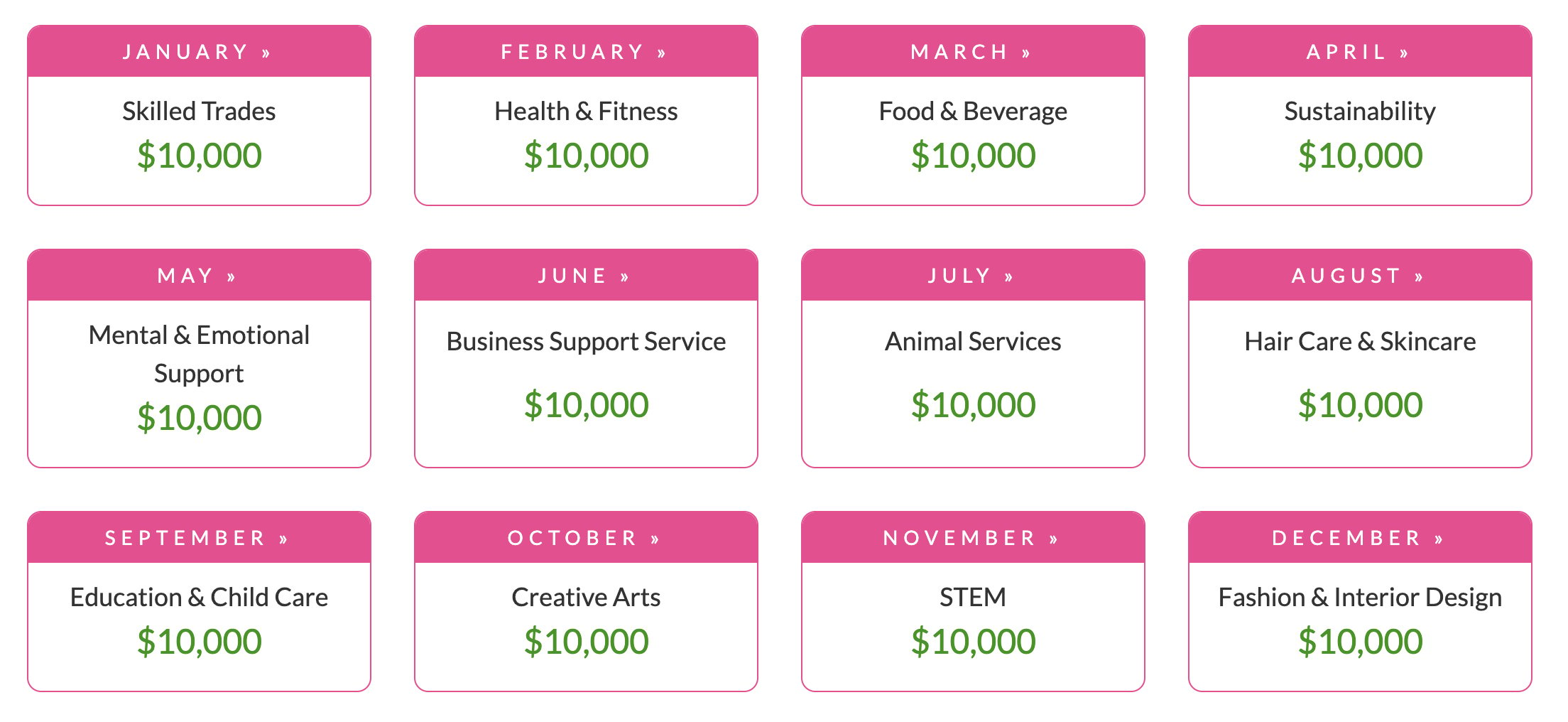
Adminristrated by WomensNet, the Amber Grant awards multiple monthly and annual cash grants specifically to women-owned businesses. The application process emphasizes the founder's story, passion, and business vision rather than complex financial auditing. Massachusetts entrepreneurs frequently apply for these $10,000 monthly grants, which also qualify winners for an end-of-year $25,000 grand prize.
Cartier Women's Initiative
For women-impact entrepreneurs leading businesses that generate strong sustainable revenue and positive social or environmental impact, the Cartier Women's Initiative provides substantial regional and global grant funding. While highly competitive and drawing applicants worldwide, North American regional fellows receive significant capital awards alongside executive coaching and networking opportunities.
Corporate Social Responsibility Programs
Major corporations headquartered in or operating within Massachusetts—such as banks, insurance companies, and retail chains—frequently partner with organizations like the National Association of Women Business Owners (NAWBO) or local chambers of commerce to offer periodic grant cycles. Monitoring announcements from entities like the Boston Foundation or local community foundations provides timely visibility into these rolling opportunities.
Alternative Financial Support: CDFIs and Low-Interest Loans
When outright grants are unavailable or highly oversubscribed, women business owners in Massachusetts can leverage Community Development Financial Institutions (CDFIs) and specialized microloan funds designed to bridge the financing gap. While loans require repayment, these alternative lenders offer flexible underwriting, lower interest rates, and embedded technical assistance that traditional commercial banks rarely provide to early-stage enterprises.
Key Massachusetts-based CDFIs and non-profit lenders include:
- The Center for Women & Enterprise (CWE): Offers comprehensive business training, counseling, and direct connections to microloan programs across Massachusetts.
- Initiative for an Competitive Inner City (ICIC): Provides localized economic support and accelerator programs that connect urban entrepreneurs with growth capital.
- Common Capital: A regional CDFI providing financing to businesses in Western Massachusetts that may not qualify for conventional bank loans.
- Mill Cities Community Investments (MCCI): Focuses on Gateway Cities in Massachusetts, providing capital to historically underserved entrepreneurs.
Leveraging these organizations often serves as a stepping stone to building the financial track record required for larger commercial funding rounds or securing future competitive grants.
Essential Prerequisites and Application Readiness
Securing a business grant in Massachusetts requires rigorous preparation. Grant committees and reviewing panels evaluate applications against strict criteria to ensure fiduciary responsibility and maximum economic impact. Entrepreneurs must assemble a robust documentation package before applying to any open grant cycle.
Core Documentation Requirements
- Registered Business Entity: Active good standing status with the Massachusetts Secretary of the Commonwealth, an Employer Identification Number (EIN), and local business licenses.
- Financial Statements: Up-to-date profit and loss statements, balance sheets, and tax returns (both personal and business, depending on the funder's guidelines).
- Business Plan and Pitch Deck: A clearly articulated growth strategy outlining how the grant funds will be deployed, the projected ROI, and the anticipated job creation or community benefit.
- Demographic and Certification Documents: If applying for certified WBE status-dependent grants, documentation from the Massachusetts Supplier Diversity Office (SDO) or federal certification bodies.
Avoiding common pitfalls—such as submitting incomplete financial records, missing tight submission windows, or applying to programs for which the business is geographically or sector-ineligible—greatly increases the probability of a successful application.
Frequently Asked Questions
Does the State of Massachusetts give free money to start a business?
No state agency in Massachusetts provides direct, no-strings-attached cash grants for the general launch or operation of a private startup. State funding is strictly allocated toward specific public policy objectives, such as technological research, export development, municipal revitalization, or economic recovery in designated sectors.
How do I get Women-Owned Business Enterprise (WBE) certification in Massachusetts?
WBE certification in Massachusetts is managed primarily through the Supplier Diversity Office (SDO) under the Operational Services Division. Applicants must demonstrate that the business is at least 51% owned, controlled, and managed by one or more women who are US citizens or permanent residents. While certification does not automatically grant cash, it unlocks access to state-procurement contracts and specialized corporate supplier-diversity grants.
Are there grants specifically for minority women business owners in Massachusetts?
Yes. Several private foundations, corporate programs, and regional non-profits offer grants specifically targeting women of color. Organizations such as the Boston Ujima Project, Boston Impact Initiative, and various ethnic chambers of commerce in the Commonwealth facilitate targeted funding and investment vehicles for historically underrepresented founders.
How can I avoid grant writing scams targeting women entrepreneurs?
Legitimate government grants and reputable corporate foundations never charge application fees, processing fees, or guaranteed-win retainers. If an organization or individual demands upfront payment to "secure" or "guarantee" a small business grant, it is a fraudulent operation. Always verify the domain and credentials of any funding organization through official state registries or Better Business Bureau records.
Conclusion and Next Actions
While securing a women-owned business grant in Massachusetts requires patience, persistence, and meticulous preparation, numerous genuine resources exist within the Commonwealth. Entrepreneurs should begin by auditing their business readiness, organizing financial statements, and registering with supportive local entities like the Center for Women & Enterprise. Diversify funding strategies by combining local municipal grants, private corporate competitions, and low-interest CDFI microloans to build a resilient, well-capitalized enterprise capable of sustainable growth.