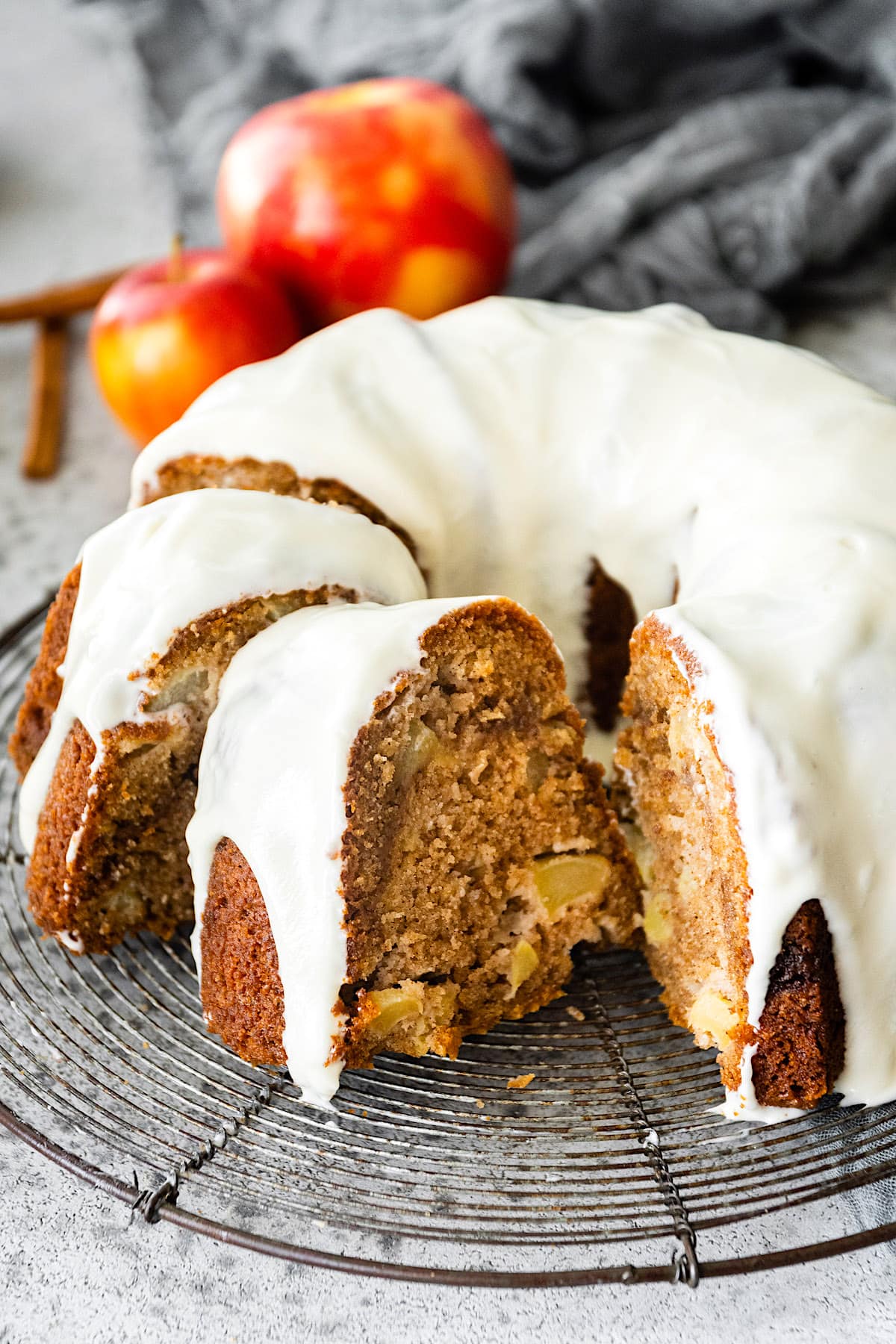
An apple bundt cake with sour cream is a rich, moisture-dense dessert that pairs fresh, tart-sweet apples with warm cinnamon spices and a tender, melt-in-your-mouth crumb. The natural acidity and fat of sour cream break down gluten strands and activate leavening agents, ensuring the heavy batter rises evenly without becoming dense or dry.
Why Sour Cream Is the Secret to the Perfect Apple Bundt Cake
Bundt cakes are inherently challenging to bake evenly due to their large volume and thick, decorative pans. Standard cake batters often dry out around the exterior flutes before the center fully bakes. Adding full-fat sour cream solves this structural issue through a precise chemical interplay of moisture, acid, and fat.
| Role of Sour Cream | Function |
|---|---|
| High Fat Content (18–20%) | Coats flour proteins & prevents dryness |
| Lactic Acid (pH ~4.5) | Weakens gluten for a soft, tender crumb |
| Chemical Leavening Boost | Reacts with baking soda for high rise |
Acidity and Gluten Development
Sour cream contains lactic acid, typically maintaining a pH level between 4.4 and 4.8. When mixed into wheat flour, this acid lowers the overall pH of the batter. A lower pH relaxes gluten proteins (glutenin and gliadin), preventing them from forming tight, elastic networks. This yields a velvety, delicate crumb that easily holds heavy fillings like chopped apples without tearing or becoming rubbery.
Fat and Moisture Retention
Unlike fluid milk or skim buttermilk, full-fat sour cream contains approximately 18% to 20% milkfat. Fat coats the flour proteins during mixing, performing a process known as shortened gluten formation. Because fat remains liquid at room temperature and solidifies less than pure butter when cooled, sour cream locks in moisture long after the cake has cooled, extending its shelf life by several days without relying on excessive vegetable oil.
Activating Chemical Leavening
Because bundt batters are thick enough to support suspended diced fruit, they require robust leavening to lift the heavy mass. Lactic acid in sour cream reacts instantly with sodium bicarbonate (baking soda), producing carbon dioxide gas bubbles. This reaction works alongside baking powder to deliver a double-acting rise: an initial lift during mixing and a secondary rise when heated in the oven.
Selecting and Preparing the Best Apples for Baking
Not every apple performs well inside a bundt cake. The high heat and extended bake time (typically 55 to 65 minutes at 350°F / 175°C) require an apple variety that maintains its structural integrity without turning into mush or weeping excess juice into the surrounding crumb.
- Apple Variety Selector for Baking
- Firm & Tart (Ideal)
- Granny Smith
- Braeburn
- Calville Blanc d'Hiver
- Firm & Sweet (Ideal)
- Honeycrisp
- Pink Lady / Cripps Pink
- Jonagold
- Recommended Dices & Cuts
- Small Dice: 1/4 inch (6 mm)
- Prevents sinking & wet pockets
- Firm & Tart (Ideal)
Recommended Apple Varieties
- Granny Smith: The gold standard for fruit desserts. High acidity balances the sugar in the cake, while high pectin levels help the diced pieces keep a distinct bite.
- Honeycrisp: Delivers an exceptional balance of sweet and tart flavors with a firm cell structure that retains crispness even after an hour in the oven.
- Pink Lady (Cripps Pink): Offers a crisp texture, dense flesh, and a distinct floral-tart profile that resists breaking down during long bakes.
- Braeburn or Jonagold: Excellent heritage options that yield a rich, complex spiced flavor profile without turning soft.
Soft Varieties to Avoid
Avoid soft, mealier varieties such as Red Delicious, McIntosh, or Gala. These apples release excessive moisture as their cell walls collapse under heat. This creates pockets of gummy, unbaked batter around the fruit and causes the cake to sag or sink after cooling.
Preparation: Dicing vs. Shredding
For the best visual presentation and texture, cut the peeled apples into small, uniform 1/4-inch (6 mm) cubes. Large chunks create structural weaknesses where the bundt cake can split upon inversion. Shredding apples, on the other hand, distributes fruit flavor evenly but releases too much free liquid into the raw batter, altering the dry-to-wet ratio.
To prevent browning while assembling dry ingredients, toss the diced apples in one tablespoon of lemon juice or toss them directly with a portion of the recipe's measured flour to absorb surface moisture.
Essential Ingredients and Precise Ratios
A standard 10- to 12-cup bundt pan requires a calibrated ratio of dry to wet ingredients to guarantee structural stability, moisture, and even spice distribution.
| Ingredient | Quantity | Key Purpose |
|---|---|---|
| All-Purpose Flour | 3 cups (360g) | Structural base & gluten matrix |
| Baking Powder | 1 1/2 tsp (6g) | Thermal leavening during baking |
| Baking Soda | 1/2 tsp (3g) | Acid-activated leavening |
| Fine Sea Salt | 3/4 tsp (4g) | Flavor balance & protein control |
| Ground Cinnamon | 2 tsp (5g) | Warm spice backbone |
| Ground Nutmeg & Ginger | 1/2 tsp each (2g) | Flavor depth and aromatic warmth |
| Unsalted Butter | 1 cup (226g) | Aeration via creaming & rich taste |
| Granulated Sugar | 1 cup (200g) | Sweetness, crust formation & air |
| Dark Brown Sugar | 1 cup (200g) | Molasses flavor & moisture |
| Large Eggs | 4 (room temp) | Structure, emulsification & lift |
| Full-Fat Sour Cream | 1 cup (240g) | Tenderness, acid balance & fat |
| Vanilla Extract | 2 tsp (10ml) | Aromatic enhancement |
| Fresh Diced Apples | 2 1/2 cups (300g) | Fruit texture and natural flavor |
Step-by-Step Baking Guide
Executing an apple bundt cake requires strict temperature control of cold ingredients, proper creaming, and precise baking times.
Step 1: Prep the Bundt Pan (The Non-Stick Method)
- Preheat your oven to 350°F (175°C) with a rack positioned in the lower-third position.
- Melt 1 tablespoon of unsalted butter and combine it with 1 tablespoon of all-purpose flour to create a thin paste (cake release paste).
- Using a pastry brush, apply this paste into every groove, center tube, and ridge of a 10- or 12-cup metal bundt pan. Alternatively, use a commercial baking spray that contains flour. Avoid plain cooking sprays, which pool in the crevices and burn.
- Bundt Pan Preparation Paste
- 1 tbsp Melted Butter + 1 tbsp All-Purpose Flour
- Mix to a smooth paste
- Brush thoroughly into all flutes
Step 2: Combine Dry Ingredients and Spices
- In a large bowl, sift together 3 cups (360g) all-purpose flour, 1 1/2 teaspoons baking powder, 1/2 teaspoon baking soda, 3/4 teaspoon salt, 2 teaspoons ground cinnamon, 1/2 teaspoon ground nutmeg, and 1/2 teaspoon ground ginger.
- Whisk for 30 seconds to distribute the leavening agents and spices evenly.
- Remove 2 tablespoons of this dry flour mixture, toss it with your 2 1/2 cups of diced apples in a separate bowl, and set aside.
Step 3: Cream Butter and Sugars
- In the bowl of a stand mixer fitted with the paddle attachment, combine 1 cup (226g) of softened unsalted butter (room temperature, roughly 65°F to 68°F / 18°C to 20°C), 1 cup granulated sugar, and 1 cup packed dark brown sugar.
- Beat on medium speed for 4 to 5 minutes until light, fluffy, and visibly pale. This step incorporates microscopic air bubbles into the butter, establishing the cake's internal structure.
Step 4: Emulsify Eggs and Sour Cream
- Add 4 large room-temperature eggs one at a time, beating for 30 seconds after each addition. Scrape down the sides and bottom of the bowl with a silicone spatula as needed.
- Mix in 2 teaspoons of pure vanilla extract.
- Add 1 cup (240g) of room-temperature full-fat sour cream and mix on low speed until combined. The mixture should look smooth and emulsified. If ingredients are too cold, the emulsion may break slightly; bringing ingredients to room temperature prevents this issue.
Step 5: Combine Wet and Dry Components
- With the mixer on low speed, add the dry ingredient mixture in three additions, alternating with any remaining liquid. Mix only until the flour streaks disappear. Overmixing develops excess gluten, resulting in a tough, rubbery cake.
- Unhook the bowl from the mixer. Gently fold in the flour-coated diced apples using a large spatula until evenly distributed throughout the thick batter.
Step 6: Fill and Bake
- Spoon the thick batter into the prepared bundt pan, pressing it gently into the bottom flutes to remove air pockets. Smooth the top surface with an offset spatula.
- Tap the pan firmly on a counter lined with a kitchen towel 2 to 3 times to release trapped air bubbles.
- Bake at 350°F (175°C) for 55 to 65 minutes.
- Test for doneness by inserting a long wooden skewer or cake tester into the deepest part of the cake. It should come out clean or with a few moist crumbs attached, but no wet batter. The internal temperature on an instant-read thermometer should read between 200°F and 205°F (93°C to 96°C).
- Baking & Cooling Timeline
- 0 min: Bake at 350°F (175°C)
- 55-65 min: Check with Skewer (Target: 200°F/93°C)
- 75-75 min: Cool in Pan (Exactly 10 mins)
- Inverted & Ready: Invert onto Rack (Cool Completely)
Dairy and Apple Substitutions: Impact on Cake Texture
Understanding how alternate ingredients affect the batter's structural properties allows you to substitute items without compromising the final product.
| Dairy / Ingredient Option | Moisture Level | Acid Content | Fat Content | Resulting Cake Texture | Adjustment Required |
|---|---|---|---|---|---|
| Full-Fat Sour Cream (Standard) | Balanced | High (~4.5 pH) | 18–20% | Tender, rich, moist, firm crumb | None (Base Recipe) |
| Plain Whole Milk Greek Yogurt | Moderate | High (~4.5 pH) | 4–5% | Slightly lighter, slightly less tender | Add 1 tbsp oil per cup to replace lost fat |
| Cultured Buttermilk | High (Fluid) | High (~4.5 pH) | 1.5–3.5% | Soft crumb, but risk of dense/soggy bottom | Reduce liquid overall; add 2 tbsp flour |
| Crème Fraîche | Low | Low (~6.0 pH) | 30–45% | Exceptionally rich, velvety, heavy crumb | Reduce butter by 2 tbsp |
| Heavy Cream (Whipped) | High | Neutral (7.0 pH) | 36% | Dense, soft, lacks tangy acid profile | Add 1/2 tsp extra cream of tartar |
Master Troubleshooting: Releasing the Cake and Fixing Common Mistakes
Inverting a bundt cake successfully requires precise timing. Releasing it too quickly causes the hot crumb to collapse, while waiting too long allows sugars to cool and lock the cake onto the pan's metal walls.
- Cake Release Decision Tree
- Cool in pan EXACTLY 10 mins
- Pan feels warm to touch
- Invert onto wire cooling rack
- Tap top gently; slides free
- Cake stuck inside pan
- DO NOT force or pry with knife!
- Set pan in hot water bath for 5 mins OR steam bottom with wet towel
- Pan feels warm to touch
- Cool in pan EXACTLY 10 mins
The 10-Minute Cooling Rule
After removing the cake from the oven, place the pan upright on a wire cooling rack for exactly 10 minutes. During this window, the cake pulls slightly away from the metal sides as its structure sets, while remaining warm enough that caramelized sugars stay fluid.
How to Release a Stuck Cake
If the cake does not slide out when inverted after 10 minutes:
- Place the upright bundt pan into a clean sink filled with 1 inch of hot tap water for 5 minutes. The gentle heat melts solidified butter and sugar stuck to the pan walls.
- Alternatively, saturate a clean dish towel with boiling water, wring it out, and drape it over the upturned bottom of the bundt pan for 3 to 5 minutes to steam the exterior boundaries free.
- Never run a metal knife along the fluted ridges. This gouges the decorative details and ruins the finished aesthetic. Use a flexible silicone spatula only on the smooth center tube if necessary.
Resolving Wet Pockets and Sinking Fruit
- Problem: Apples sink to the bottom of the bundt pan (which becomes the top when inverted).
- Cause: Diced apple pieces are too large, or the batter is too thin.
- Solution: Cut apples into 1/4-inch (6 mm) pieces and toss them in flour before folding into the batter. Ensure butter and eggs are properly emulsified to maintain a thick batter suspension.
- Problem: Dense, gummy ring near the center.
- Cause: Too much sour cream, cold ingredients that broke the emulsion, or underbaking.
- Solution: Use room-temperature sour cream and confirm internal doneness with a digital probe thermometer (200°F to 205°F / 93°C to 96°C).
Glazes and Finishing Touches
Because sour cream and dark brown sugar produce a rich flavor profile, pair this cake with complementary glazes that set firmly over the contours of the bundt design.
- Glaze Options
- Warm Salted Caramel Glaze
- 1/2 cup Dark Brown Sugar
- 1/4 cup Unsalted Butter
- 1/4 cup Heavy Cream
- 1/2 tsp Sea Salt
- (Boil 1 min, cool slightly, pour)
- Spiced Maple Drizzle
- 1 cup Powdered Sugar
- 2 tbsp Pure Maple Syrup
- 1-2 tbsp Milk or Cream
- 1/4 tsp Ground Cinnamon
- (Whisk until smooth, drizzle)
- Warm Salted Caramel Glaze
Warm Salted Caramel Glaze
In a small saucepan, melt 1/4 cup (56g) unsalted butter with 1/2 cup (100g) packed dark brown sugar and 1/4 cup (60ml) heavy cream over medium heat. Bring to a low boil for 1 minute while stirring constantly. Remove from heat, stir in 1/2 teaspoon fine sea salt and 1 teaspoon vanilla extract. Allow to cool for 5 minutes until thickened, then pour over the completely cooled bundt cake.
Spiced Maple Drizzle
Whisk together 1 cup (120g) of sifted powdered sugar, 2 tablespoons of pure maple syrup, 1 to 2 tablespoons of heavy cream or whole milk, and 1/4 teaspoon of ground cinnamon until smooth. Adjust consistency with milk as needed to create an opaque, slow-dripping glaze.
Storage, Shelf Life, and Freezing Protocols
The high fat content of sour cream and the moisture released by the baked apples keep this cake fresh longer than standard sponge cakes.
| Storage Location | Shelf Life | Recommended Method |
|---|---|---|
| Countertop | 3 to 4 Days | Covered cake dome or airtight container |
| Refrigerator | Up to 7 Days | Wrapped tightly in plastic wrap |
| Freezer | Up to 3 Months | Double-wrapped in plastic wrap & aluminum foil |
Room Temperature Storage
Store the completely cooled, glazed cake in a glass cake dome or an airtight cake keeper at room temperature (68°F to 72°F / 20°C to 22°C) for up to 4 days. Avoid using aluminum foil directly over a glazed cake, as trapped moisture will dissolve the sugar crust and make the exterior sticky.
Freezing Whole Cakes or Slices
- Unglazed Cake: Allow the baked cake to cool completely for at least 2 hours. Wrap the unglazed cake tightly in two layers of plastic wrap, followed by a layer of heavy-duty aluminum foil. Freeze flat for up to 3 months.
- Individual Slices: Slice the unglazed or glazed cake into individual portions. Wrap each slice in plastic wrap and store them together in a freezer-safe zip-top bag.
- Thawing Instructions: Thaw frozen cakes or individual slices overnight in the refrigerator while still wrapped, then bring to room temperature on the counter for 1 hour before serving. This prevents condensation from forming directly on the cake crust.
Frequently Asked Questions
Can I substitute Greek yogurt for sour cream in an apple bundt cake?
Yes, plain full-fat Greek yogurt can be substituted in a 1:1 ratio. Because Greek yogurt has slightly less fat than sour cream (4% to 10% vs. 18% to 20%), consider adding 1 tablespoon of neutral vegetable oil to the batter for every cup of yogurt used to maintain maximum crumb tenderness.
Why did my apples sink to the bottom of the bundt cake?
Apples sink when they are cut into pieces that are too large or heavy for the batter's structural matrix to hold. To keep fruit suspended evenly, dice apples small (1/4 inch / 6 mm) and toss them in 2 tablespoons of the measured dry flour mixture before folding them into the batter.
What is the best way to keep a bundt cake from sticking to the pan?
The most reliable method is brushing the interior flutes with a home-made paste of equal parts melted butter and all-purpose flour, or using a commercial baking spray formulated with real flour. Avoid standard cooking sprays, which leave a sticky residue that burns into the grooves and binds the batter to the pan.
Should I peel the apples before adding them to the batter?
Yes, peeling is recommended. Apple skins do not soften fully during baking and can separate from the fruit flesh inside the cake, creating tough, papery pockets that disrupt the smooth texture of the crumb.
Why is my bundt cake wet or gummy around the apple pieces?
Wet pockets occur when high-moisture apple varieties (such as McIntosh or Gala) break down during baking and release liquid into the surrounding batter. Stick to firm, dense baking varieties like Granny Smith, Honeycrisp, or Pink Lady, and ensure the cake reaches an internal temperature of 200°F to 205°F (93°C to 96°C) before pulling it from the oven.
Practical Baking Recommendation
To achieve a professional-quality apple bundt cake, use a 10- or 12-cup heavy cast-aluminum pan, which distributes heat more evenly than thin stamped steel pans. Measure your ingredients using a digital kitchen scale (360 grams of flour, 240 grams of sour cream, and 300 grams of diced Granny Smith apples) to avoid dense batter from over-packed cups. Allow all dairy ingredients and eggs to sit at room temperature for 45 minutes before mixing; this ensures a smooth, stable emulsion that traps air and lifts the heavy spiced fruit batter during baking.