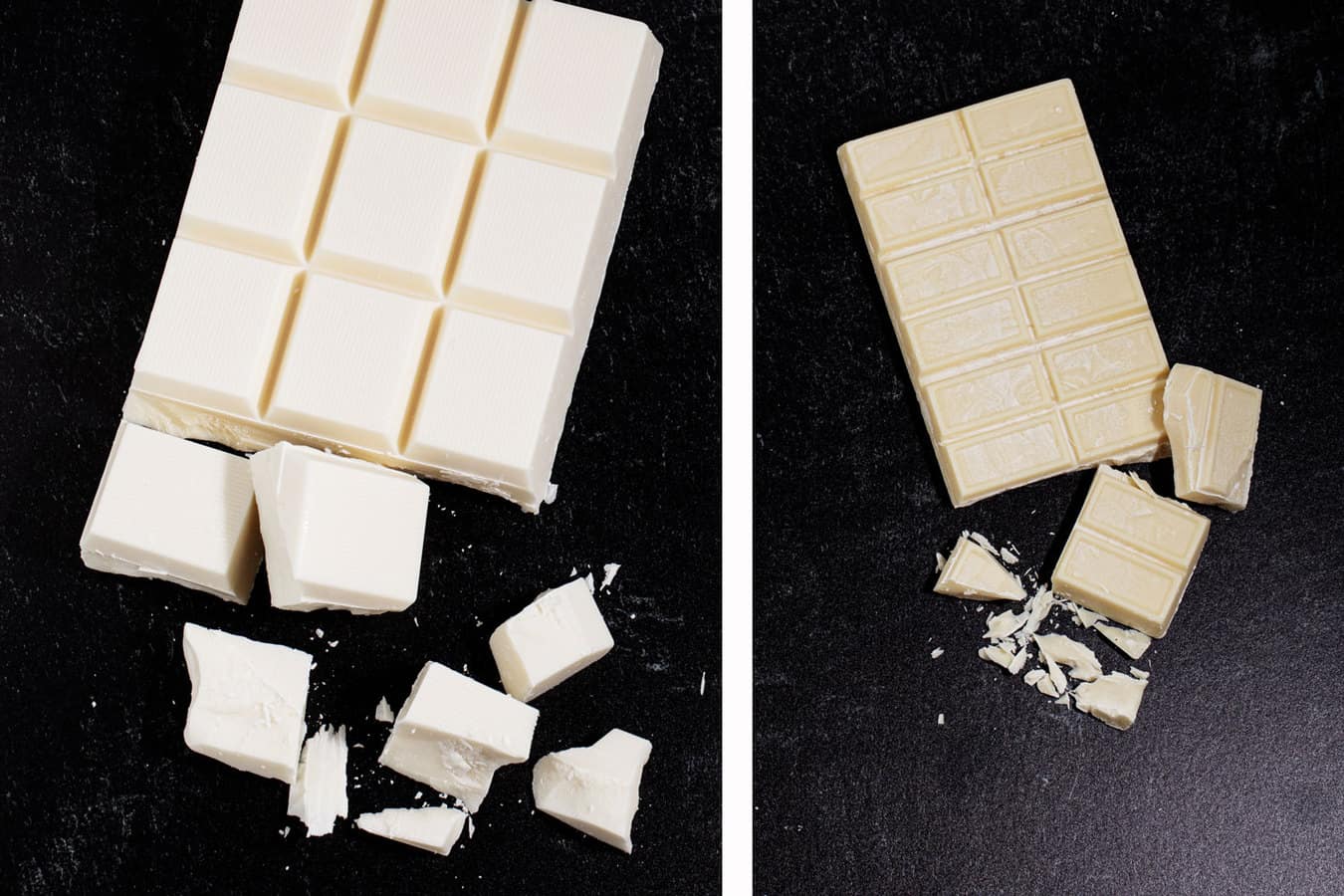
Almond bark does not taste like white chocolate primarily because it contains no cocoa butter, the ingredient that gives real white chocolate its rich, milky flavor and luxurious mouthfeel. Instead, almond bark is a compound confection made from vegetable fats, sugar, emulsifiers, and artificial flavorings, resulting in a sweeter, waxier taste profile.
The Core Difference: Cocoa Butter vs. Vegetable Oils
To understand why almond bark and white chocolate taste completely different, one must examine their foundational ingredients. The identity of true chocolate—whether dark, milk, or white—is defined by the fat extracted from the cacao bean: cocoa butter.
Real White Chocolate Standard of Identity
According to regulatory standards set by government bodies such as the U.S. Food and Drug Administration (FDA under 21 CFR 163.124), authentic white chocolate must contain a minimum threshold of real cacao components:
- At least 20% cocoa butter by weight
- At least 14% total milk solids
- At least 3.5% milkfat
- No more than 55% nutritive carbohydrate sweeteners (sugar)
The presence of real cocoa butter is responsible for the distinct aromatic profile of white chocolate. Cocoa butter contains complex organic volatile compounds that impart subtle cocoa notes, creamy milk nuances, and a delicate floral-nutty backdrop.
Real White Chocolate:
- Cacao Bean
- Cocoa Butter + Milk Solids + Pure Sugar
- Result: Rich melt-in-mouth texture, authentic dairy & cocoa note
Almond Bark:
- Palm Kernel Oil + Whey Powder + Sugar + Vanilla Flavor
- Result: Waxy texture, high heat tolerance, sweet sugary finish
The Composition of Almond Bark
Almond bark is classified as a compound coating or confectionery coating. Its ingredients typically include:
- Vegetable Oils: Hydrogenated or fractionated palm kernel oil, soybean oil, or palm oil.
- Sugar: Usually the first and dominant ingredient by weight.
- Whey Powder or Nonfat Dry Milk: Provides a basic milky color and mild dairy presence without true milkfat richness.
- Emulsifiers: Soy lecithin or polyglycerol polyricinoleate (PGPR) to hold the fat and sugar emulsion together.
- Artificial Flavors: Vanillin or synthetic vanilla compounds engineered to mimic dairy and vanilla scents.
Because vegetable oils lack the naturally occurring aromatic compounds found in cacao fats, almond bark relies heavily on added sugar and synthetic vanillin for its taste. This creates a one-dimensional, sugary flavor rather than the nuanced, butter-rich depth of true white chocolate.
Sensory Breakdown: Flavor Profile, Texture, and Melting Point
The sensory experience of eating chocolate involves three main factors: flavor delivery, melting point, and mouthfeel. The structural differences between cocoa butter and vegetable fat affect every aspect of how these products taste on the palate.
Melting Point Comparison on the Human Palate (Body Temperature: ~98.6°F / 37°C):
- Real White Chocolate: Melts at 86°F–93°F (30°C–34°C) — Melts instantly on the tongue
- Almond Bark: Melts at 95°F–102°F (35°C–39°C) — Requires mastication; leaves waxy film
Flavor Profile
- Real White Chocolate: Delivers a balanced mixture of sweet cream, natural butter, vanilla, and subtle cooked-milk notes. It has a rounded, lingering finish that feels rich rather than sugary.
- Almond Bark: Exhibits an immediate hit of intense sweetness followed by a strong, artificial vanilla aroma. It lacks the subtle caramelized milk notes and rounded fat richness of real dairy fat and cocoa butter.
Melting Point and Mouthfeel
The physical properties of the fats alter how flavor molecules are released in your mouth:
- Instant Dissolve (White Chocolate): Cocoa butter has a narrow melting point range of roughly 86°F to 93°F (30°C to 34°C). Because human body temperature is approximately 98.6°F (37°C), white chocolate melts instantly upon touching the tongue. This rapid phase change creates a cooling sensation and releases flavor compounds quickly across the taste buds without leaving a film.
- Waxy Resistance (Almond Bark): Vegetable fats like palm kernel oil have higher and broader melting ranges, often between 95°F and 102°F (35°C to 39°C). Because this is close to or above human body temperature, almond bark does not melt instantly. It requires physical chewing to break down and often leaves a subtle, greasy, or waxy coating on the roof of the mouth and tongue.
Why Is It Called "Almond Bark" If It Has No Almonds or Chocolate?
A common source of confusion for home cooks is the name itself. Many consumers purchase almond bark expecting either chopped almonds inside the package or a nut-flavored chocolate product.
The Historical Origin
The name almond bark does not describe the ingredients inside the block; rather, it describes the original intended use of the product.
In mid-20th-century American confectionery, home bakers frequently made a popular holiday treat called "nut bark"—a sheet of melted chocolate mixed with toasted whole almonds, peanuts, or pecans, cooled on a tray, and broken into rough, bark-like shards.
Industrial food manufacturers created a cheaper, shelf-stable, and user-friendly vegetable-fat coating specifically designed for home cooks to pour over almonds and nuts without needing to temper real chocolate. The packaging was marketed as "Almond Bark Coating" or simply "Almond Bark" because it was the ideal medium for making almond-covered candy bark. Over time, the name stuck to the raw coating blocks sold in the baking aisle, despite containing zero nuts.
Performance in the Kitchen: Tempering, Melting, and Setting
While real white chocolate wins on flavor and mouthfeel, almond bark was engineered to solve several technical challenges that make real white chocolate notoriously difficult to work with.
| Feature | Almond Bark vs. Real White Chocolate |
|---|---|
| Tempering Required? | No (Almond Bark) vs. Yes (White Choc) |
| Moisture Sensitivity | High Tolerance vs. Seizes Easily |
| Set Speed | Rapid / Hard Set vs. Slow / Soft Set |
| Room Temp Shelf Life | Long / Bloom-Proof vs. Moderate |
Tempering Requirements
- Real White Chocolate: Cocoa butter contains unstable fat crystals (beta crystals). If you melt real white chocolate and let it cool naturally at room temperature, it sets unevenly, turns dull gray or streaky (fat bloom), feels soft, and melts at touch. To achieve a crisp snap and glossy finish, white chocolate must be tempered—a precise heating and cooling process that aligns fat crystals into stable Form V structures.
- Almond Bark: Vegetable fats do not form complex crystal structures like cocoa butter. Almond bark requires no tempering. You simply melt it in a microwave or double boiler, dip your items, and allow it to cool. It sets with a hard, shiny shell every time.
Temperature Tolerance and Seizing
- Real White Chocolate: Highly sensitive to heat and moisture. Exceeding 110°F (43°C) will scorch the milk solids, turning the chocolate grainy and clumped. Adding even a single drop of water causes the sugar and liquid to bind, causing the chocolate to seize into a stiff, unusable paste.
- Almond Bark: Can withstand higher working temperatures (up to 120°F–130°F / 49°C–54°C) without burning easily. It is far more forgiving if exposed to steam or small amounts of liquid, making it ideal for novice confectioners.
Side-by-Side Comparison: Almond Bark vs. White Chocolate vs. White Baking Chips
To help you choose the right product for your recipe, the table below compares almond bark, true white chocolate, and standard white baking morsels.
| Characteristic | Almond Bark (Compound Coating) | Authentic White Chocolate | Standard White Baking Chips |
|---|---|---|---|
| Primary Fat Source | Hydrogenated Palm Kernel / Palm Oil | 100% Cocoa Butter | Palm Kernel Oil or Fractionated Oil |
| FDA Standard Category | Candy Coating / Confectionery Coating | White Chocolate (21 CFR 163.124) | White Baking Morsels / Flavored Chips |
| Flavor Profile | Sweet, artificial vanilla, flat sweetness | Creamy milk, rich butter, subtle floral notes | Very sweet, mild vanilla, milky |
| Texture & Mouthfeel | Firm, slightly waxy, slow melt on tongue | Silky, instant melt-in-mouth finish | Firm, holds shape, slightly waxy |
| Tempering Required? | No | Yes (for dipping/molding) | No |
| Best Uses | Cake pops, dipped pretzels, candy molds | Ganache, gourmet truffles, mousses, eating | Cookies, brownies, pancake toppings |
| Seize Risk with Water | Low | Extremely High | Moderate |
| Cost | Budget-friendly | Premium / Expensive | Moderate |
How to Make Almond Bark Taste Better
If you have almond bark on hand and want to improve its flavor profile for a dessert project, several culinary adjustments can mask its artificial notes and mimic the richness of genuine chocolate.
Flavor Enhancement Strategies:
- Add Pinch of Fine Salt: Cuts intense sugar sweetness
- Mix in Oil-Based Extracts (Vanilla Bean/Almond): Masks synthetic vanillin notes
- Blend 50/50 with Real White Chocolate: Improves taste while retaining easy melt
- Stir in Freeze-Dried Fruit / Toasted Nuts: Adds acidity, crunch, and aroma contrast
1. Add a Pinch of Fine Salt
Almond bark contains a high concentration of refined sugar. Stirring a fine pinch of kosher salt or sea salt (roughly 1/8 teaspoon per 12 ounces of melted bark) balances the sweetness and brings out underlying dairy flavors.
2. Incorporate Oil-Based Flavorings
Do not use water-based food extracts, as they can cause even compound coatings to thicken. Use oil-based concentrated flavorings or pure vanilla bean paste mixed with a few drops of neutral oil:
- Pure Vanilla Bean Paste: Introduces real vanilla specks and natural aromatic compounds.
- Oil-Based Almond Extract: Gives the coating an authentic nut flavor that matches its name.
- Clear Butter Flavoring (Oil-Soluble): Reintroduces the rich dairy aroma missing from vegetable oil.
3. Create a 50/50 Hybrid Blend
Combine equal parts melted almond bark and chopped real white chocolate bar.
This hybrid method gives you the best of both worlds:
- The cocoa butter from the white chocolate vastly improves the flavor, aroma, and melting quality.
- The vegetable fats from the almond bark stabilize the mixture, preventing the need for strict tempering while keeping your coating glossy and firm at room temperature.
4. Pair with Acidic or Roasted Contrast Ingredients
If using almond bark as a dip, pair it with foods that offset its sweetness:
- Tart dried or fresh fruits (freeze-dried raspberries, fresh strawberries, cranberries)
- Dark roasted nuts (salted almonds, toasted pecans, roasted macadamias)
- Pretzels or salty crackers
When to Use Almond Bark vs. White Chocolate
Selecting between almond bark and real white chocolate depends on the functional demands of your recipe.
Decision Matrix — Is Your Goal:
- Rich Flavor, Truffles, Ganache, Fine Pastry: Use Real White Chocolate
- Dipped Cake Pops, Candy Molds, Holiday Bark, High Humidity: Use Almond Bark
- Cookies That Retain Morsel Shape: Use White Baking Chips
Choose Almond Bark When:
- Making Cake Pops or Dipped Pretzels: You need a coating that sets rapidly, produces a hard outer shell, and will not melt or get sticky when guests handle the treats at room temperature.
- Using Complex Plastic Candy Molds: Almond bark pops out of plastic molds effortlessly without sticking or leaving dull residue behind.
- Baking in Warm or Humid Climates: If working in a kitchen without air conditioning, real white chocolate can struggle to set. Almond bark hardens reliably regardless of ambient room humidity.
- Working on a Budget: Large-scale projects (such as dipping hundreds of holiday cookies) are far more economical with compound coatings.
Choose Real White Chocolate When:
- Making Ganache, Mousses, or Truffles: Emulsions like ganache require real cocoa butter fat to combine properly with cream. Using almond bark in a ganache yields a greasy, separated mixture with a unpleasant waxy texture.
- Flavor is the Hero of the Dish: If you are making upscale confections where the chocolate flavor is front-and-center, the synthetic taste of almond bark will compromise the quality of the dessert.
- Dipping High-End Confections: For professional-grade truffles or artisan candy bars, tempered real white chocolate offers a superior snap, brilliant sheen, and delicate melt on the tongue.
Frequently Asked Questions
Why does my almond bark leave a film on the roof of my mouth?
Almond bark leaves a film because it is made with vegetable fats (such as hydrogenated palm kernel oil) that have a melting point higher than human body temperature (98.6°F / 37°C). Unlike cocoa butter, which melts instantly at body heat, vegetable fat stays partially solid on your tongue and palate, creating a waxy sensation.
Can I substitute almond bark for white chocolate 1:1 in baking recipes?
You can substitute them for surface coatings and dipping, but not in recipes that rely on chocolate structure or emulsification, such as ganache, frostings, mousses, or lava cakes. Almond bark lacks cocoa butter, so substituting it in liquid or baked batters will alter the melting mechanics, fat ratio, and overall texture.
Why did my almond bark turn thick and clumpy when I melted it?
Almond bark usually turns thick or clumpy due to overheating or accidental contact with moisture. Although more heat-tolerant than white chocolate, almond bark will scorch if heated above 130°F (54°C). If it thickens, stir in a teaspoon of vegetable shortening or neutral vegetable oil to restore liquidity.
Are white baking chips the same thing as almond bark?
No, but they are closely related. Most standard white baking chips sold in grocery stores are also compound coatings made with vegetable oil rather than cocoa butter. However, baking chips contain added stabilizers so they retain their chip shape inside hot cookie dough during baking, whereas almond bark is formulated specifically to melt smoothly into a fluid dipping liquid.
Does almond bark contain nut allergens?
Standard vanilla or chocolate almond bark typically contains no tree nuts or peanuts in its ingredient list. However, because it is frequently manufactured on equipment that processes tree nuts and peanuts, individuals with severe nut allergies should carefully inspect package cross-contamination warnings before consuming it.
Recommendation for Bakers
When deciding between almond bark and real white chocolate, match the ingredient to the technical requirement of your project:
- For flavor-driven desserts like ganache, mousses, gourmet truffles, or cream fillings, purchase high-quality white chocolate bars containing pure cocoa butter (such as Valrhona, Callebaut, or Ghirardelli Premium Baking Bars).
- For decorating and coating items like cake pops, pretzel rods, or complex candy molds, select almond bark or high-grade compound melting wafers (such as Wilton Candy Melts or Merckens) for an effortless, snap-hard finish.
- For the best balance of convenience and flavor, blend 50% melted almond bark with 50% melted real white chocolate. This combination creates a smooth, easy-dipping coating that hardens reliably at room temperature without tempering while delivering genuine milk-and-cocoa flavor.