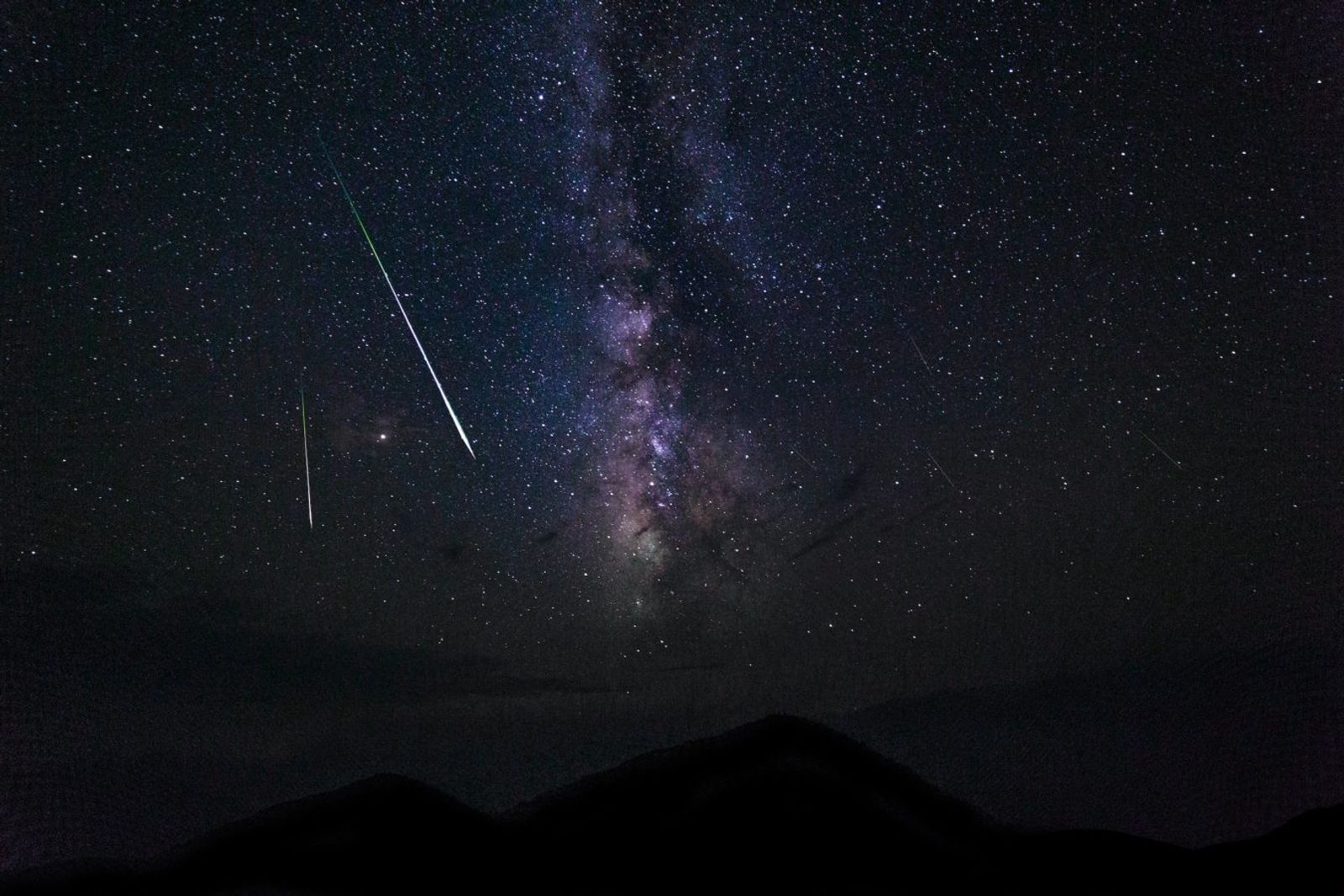
The 2025 Eta Aquariids meteor shower peaked overnight between May 5 and May 6, 2025, with activity spanning mid-April through late May. Originating from debris left behind by Comet 1P/Halley, the display yielded peak rates of 50 to 60 meteors per hour in the Southern Hemisphere and 10 to 30 per hour in Northern latitudes during pre-dawn hours following local moonset.
What Are the Eta Aquariids?
The Eta Aquariids represent one of two annual meteor showers created by debris from Comet 1P/Halley, with the second being the Orionids in October. As Comet Halley traverses its 76-year elliptical orbit around the Sun, it sheds a cloud of ice, dust, and rocky material. Every spring, Earth intersects this ancient debris stream, causing cosmic particles—known as meteoroids—to collide with Earth's upper atmosphere at extreme velocities.
Upon entry into the atmosphere, Eta Aquariid meteoroids travel at speeds of approximately 66 kilometers per second (nearly 148,000 miles per hour). This exceptionally high kinetic energy generates intense atmospheric friction. The surrounding gas glows brightly, creating vivid light streaks across the night sky.
- Stream Entry Velocity: ~66 km/s
- Parent Body: Comet 1P/Halley
- Radiant Constellation: Aquarius (near star Eta Aquarii)
- Special Feature: Persistent ionization trains (glowing trails lasting several seconds)
Because of their immense velocity, a high percentage of Eta Aquariids leave glowing "trains"—incandescent columns of ionized gas that remain visible for several seconds or even minutes after the primary meteor spark has vanished. Occasionally, the shower produces brilliant fireballs, which are meteors bright enough to cast visible shadows on the ground.
2025 Peak Timing and Moon Phase Dynamics
The active window for the Eta Aquariids runs annually from roughly April 15 through May 27. However, peak activity occurs within a tight 24- to 48-hour window when Earth passes through the densest core of Comet Halley's stream. For 2025, this peak occurred during the night of May 5 through the early morning hours of May 6.
2025 Eta Aquariids Timeline
- April 15: Activity Begins
- May 5–6 (PEAK): Pre-Dawn Dark Sky Window (Post-Moonset 2:00 AM+)
- May 27: Shower Concludes
Moonlight is historically the single greatest natural visual obstacle to observing meteor showers. In early May 2025, the Moon reached its First Quarter phase on May 4 and progressed toward a waxing gibbous phase during the May 5–6 peak.
While a bright moon normally diminishes meteor visibility, the timing of the lunar cycle in 2025 worked in favor of pre-dawn observers:
- Early Evening Lunar Interference: The waxing gibbous moon dominated the sky throughout the evening hours, washing out faint stars and early meteors.
- Post-Midnight Moonset: The moon set below the western horizon between 1:30 AM and 2:30 AM local daylight time across most mid-latitude regions.
- Pristine Pre-Dawn Window: Between moonset and the first light of morning astronomical twilight (around 4:00 AM to 4:30 AM), the sky became completely dark. This timing directly aligned with the hours when the radiant point in Aquarius was highest in the sky.
Geographic Differences: Southern vs. Northern Hemisphere
The performance of the Eta Aquariids varies dramatically based on the observer's geographic latitude. This variation is governed by the position of the shower's radiant point—the celestial coordinate from which the meteors appear to originate. For the Eta Aquariids, the radiant lies within the constellation Aquarius, near the star Eta Aquarii.
- Southern Hemisphere (e.g., Australia, South America, Southern Africa)
- Radiant rises high above horizon (45°+ elevation)
- Peak Zenithal Hourly Rate (ZHR): 50 to 60+ meteors/hour
- Extended viewing window before morning twilight
- Northern Hemisphere (e.g., North America, Europe, Asia)
- Radiant stays low near eastern horizon (10° to 25° elevation)
- Peak Zenithal Hourly Rate (ZHR): 10 to 30 meteors/hour
- Meteors sweep upward from horizon ("Earth-grazers" visible)
Southern Hemisphere Dominance
In regions south of the equator—such as Australia, New Zealand, South Africa, and South America—Aquarius rises high into the eastern sky long before dawn. At celestial elevations exceeding 45 degrees, observers see the full density of the meteor stream. Under pristine, dark-sky conditions during the 2025 peak, Southern Hemisphere observers recorded rates of 50 to 60 meteors per hour.
Northern Hemisphere Conditions
For observers in Northern mid-latitudes (such as the United States, Canada, and Europe), Aquarius remains lower on the horizon prior to dawn. Because the radiant sits closer to the horizon, a substantial portion of the meteors travel below the observer's local sky cutoff line or are scattered by thicker atmospheric layers near the ground.
Northern observers typically witness 10 to 30 meteors per hour during the peak window. However, low radiant angles produce a distinct phenomenon known as "Earth-grazers"—meteors that skim horizontally across the upper boundary of the atmosphere, leaving exceptionally long, colorful paths that span vast segments of the sky.
Detailed Stargazing Summary Matrix
The following table summarizes the observational parameter differences recorded during the peak of the 2025 Eta Aquariids meteor shower across major regions.
| Observation Parameter | Southern Hemisphere (Latitudes 20°S to 45°S) | Northern Mid-Latitudes (Latitudes 30°N to 50°N) | Equatorial Regions (Latitudes 10°S to 10°N) |
|---|---|---|---|
| Peak Activity Dates | May 5–6, 2025 | May 5–6, 2025 | May 5–6, 2025 |
| Optimal Viewing Window | 2:00 AM to 5:00 AM local time | 3:00 AM to 4:30 AM local time | 2:30 AM to 4:45 AM local time |
| Peak Zenithal Hourly Rate (ZHR) | 50 – 60+ meteors/hour | 10 – 30 meteors/hour | 30 – 45 meteors/hour |
| Radiant Max Elevation | 45° – 65° above horizon | 10° – 25° above horizon | 30° – 40° above horizon |
| 2025 Moon Interference | None after ~2:00 AM moonset | None after ~2:15 AM moonset | None after ~1:45 AM moonset |
| Dominant Meteor Types | Fast, high-angle streaks, persistent trains | Long horizontal "Earth-grazers", persistent trains | Balanced streaks and medium-length trains |
| Bortle Sky Class Recommended | Class 1 to Class 4 | Class 1 to Class 3 | Class 1 to Class 4 |
Step-by-Step Guide to Optimal Viewing
To maximize the number of meteors observed during any meteor shower display, structured preparation is essential. Optical aids like telescopes and binoculars are counterproductive for meteor watching because their narrow field of view prevents observers from catching unexpected streaks across wide swathes of the sky. Unassisted vision is the superior method.
Step 1: Secure a Dark Location
Light pollution from streetlights, commercial districts, and residential neighborhoods severely degrades sky contrast. Locate a viewing spot classified as Bortle Scale Class 4 or darker using resources from dark-sky maps or the International Dark-Sky Association. Rural parks, high-altitude reserves, and remote coastlines provide optimal conditions.
Step 2: Time the Observation Correctly
Set up early enough to take advantage of the post-moonset window. During the 2025 peak, the optimal interval began around 2:00 AM local time and ended when early dawn light began brightening the eastern sky (roughly 80 to 90 minutes before sunrise).
Step 3: Dark-Adapt Your Eyes
Human eyes require time to build up visual purple (rhodopsin) in the retina for full night-vision sensitivity.
- Allow 20 to 30 minutes in total darkness without looking at bright light sources.
- Avoid looking at mobile phones or vehicle headlights.
- If lighting is required to navigate your setup area, use a low-intensity red LED flashlight, as red wavelengths do not disrupt dark adaptation.
Retinal Dark Adaptation Curve:
- 0 Min: High-light vision (Cones dominant)
- 10 Min: Partial sensitivity transition
- 20 Min: Rods activate; faint stars visible
- 30 Min: Full dark adaptation achieved (Maximum visual sensitivity)
Step 4: Position Your Viewing Area
Lie flat on a reclining camp chair or blanket facing southeast to east. While the meteors radiate from Aquarius, they appear across all regions of the sky. Position your gaze approximately 30 to 45 degrees away from the radiant point rather than staring directly at it. Meteors close to the radiant point exhibit short trails due to perspective foreshortening, whereas meteors seen farther away produce longer, more dramatic streaks.
Astrophotography and Technical Setup Guidance
Capturing high-velocity meteors like the Eta Aquariids requires wide-angle optics, manual exposure settings, and stable positioning. Because meteors appear at unpredictable intervals, automated wide-field intervalometer shooting is the standard photographic strategy.
Astrophotography Setup
- Wide Lens 14-24mm
- Camera: Manual Mode, RAW Format
- Aperture: f/1.4 - f/2.8
- ISO: 1600 - 6400
- Shutter: 10 - 25 Seconds
- Heavy Tripod
- External Intervalometer / Dew Heater Band Attached
Recommended Equipment Specifications
- Camera: Full-frame or APS-C mirrorless/DSLR camera capable of clean performance at high ISO settings.
- Lens: Ultra-wide focal length lens (14mm to 24mm on full-frame) with a fast maximum aperture ($f/1.4$ to $f/2.8$).
- Support: Heavy-duty, stable tripod to withstand night breezes.
- Accessories: External intervalometer (or built-in camera interval timer), lens heater band to prevent dew condensation, and spare high-capacity batteries.
Camera Configuration Parameters
- Focus: Switch the lens to manual focus (MF). Use live-view display zoomed in on a bright star or distant planet to adjust focus until the star point is sharp. Secure the focus ring with painter's tape to prevent accidental shifts.
- Exposure Duration: Set shutter speed between 10 and 25 seconds. Keeping exposures under 25 seconds prevents star trailing caused by Earth's rotation (following the 500 Rule: $500 / \text{focal length} = \text{max shutter duration}$).
- Aperture: Open the lens to its widest setting ($f/1.8$, $f/2.8$) to maximize light gathering.
- ISO Setting: Set ISO between 1600 and 6400, depending on your camera sensor's noise profile and ambient light pollution level.
- Image Format: Capture in uncompressed RAW format to retain shadow detail and color accuracy for post-processing adjustments.
- Continuous Shooting: Program the intervalometer to take photos continuously with a 1-second delay between exposures over a period of 2 to 3 hours.
Common Stargazing Pitfalls and Troubleshooting
Observing low-density or fast-moving meteor showers can present challenges. Below are common mistakes made during observations and solutions to overcome them:
1. Staring Directly at the Radiant
- Problem: Looking directly at the constellation Aquarius limits your visual field to short, foreshortened meteors that appear as small dots or brief bursts.
- Solution: Center your field of view roughly 30 to 60 degrees away from Aquarius (toward regions like Cygnus, Pegasus, or Scorpius). This allows you to catch the full length of the meteor trails as they streak across the sky.
2. Underestimating Thermal Exposure
- Problem: Pre-dawn spring temperatures drop significantly, leading to physical discomfort and early cancellation of your viewing session.
- Solution: Dress in insulated layers rated for colder temperatures than expected. Use sleeping bags, thermal ground pads, and chemical hand warmers to maintain core body heat while sitting immobile for hours.
3. Obstructions on the Eastern Horizon
- Problem: In Northern latitudes where the radiant stays low, trees, hills, or buildings block access to the lower atmosphere where many meteors streak.
- Solution: Choose viewing locations with clear, unobstructed views of the eastern and southeastern horizons, such as elevated hilltops or wide coastal beaches.
4. Intermittent White Light Use
- Problem: Checking smartphone notifications or using bright flashlights instantly resets your eye adaptation, requiring another 20 minutes to recover full night-vision sensitivity.
- Solution: Enable red-filter accessibility modes on mobile devices or keep phones stowed completely throughout the viewing session.
Frequently Asked Questions
What caused the Eta Aquariids meteor shower?
The Eta Aquariids are caused by tiny grains of dust and ice shed by Comet 1P/Halley during its orbits around the Sun. When Earth passes through this stream of space debris every spring, the particles burn up in Earth's upper atmosphere at high speeds, creating bright streaks of light.
How do the Eta Aquariids differ from the Orionids?
Both showers originate from Comet 1P/Halley, but Earth intersects different streams of the comet's orbit at different times of the year. The Eta Aquariids occur in April and May as Earth passes through the inbound trail of Halley's debris, while the Orionids occur in October when Earth passes through the outbound trail.
Why are the Eta Aquariids better in the Southern Hemisphere?
The radiant point of the shower lies in the constellation Aquarius, which sits much higher in the sky before dawn when viewed from the Southern Hemisphere. Higher radiant elevation puts more of the meteor activity above the horizon and outside dense surface atmospheric distortion, resulting in higher visible meteor counts.
Do I need a telescope or binoculars to see the meteor shower?
No, optical equipment like telescopes or binoculars should not be used for meteor showers. These tools narrow your field of view, making it nearly impossible to catch swift meteors that appear unpredictably across broad sections of the sky. The naked eye provides the wide field of view needed for optimal observing.
What should I do if clouds block the sky during the peak night?
Meteor activity remains elevated for several days on either side of the primary peak (May 5–6). If weather interferes with the main peak night, observing during the pre-dawn hours of May 4–5 or May 6–7 will still provide good meteor activity under similar moonless pre-dawn conditions.
Recommended Next Actions for Stargazers
To get the most out of future meteor shower events, consider taking the following practical steps:
- Map Local Dark Sky Spots: Use light pollution mapping applications to identify dark-sky locations within a 1- to 2-hour drive of your home.
- Track the Lunar Phase: Always check the moon phase when planning celestial observations. Prioritize post-moonset or pre-moonrise hours to ensure dark skies.
- Log Your Observations: Consider contributing meteor counts to scientific databases through the International Meteor Organization (IMO). Submitting visual rates helps astronomers monitor density changes and drift in Comet Halley's historical debris stream.