The 103-59 record achieved by the Oakland Athletics during the 2002 Major League Baseball season stands as one of the most famous and studied campaigns in sports history, immortalized by Michael Lewis's book Moneyball and the subsequent film adaptation. Operating with a payroll of roughly $39.8 million—one of the lowest in the league—the Athletics matched the win total of the New York Yankees, who spent over $125 million, proving that advanced analytics and market inefficiencies could level the playing field against big-market franchises.
The Genesis of Moneyball: Financial Constraints and Analytical Innovation
To understand the 103-59 season, one must examine the economic landscape of Major League Baseball at the turn of the 21st century. Small-market teams like the Oakland Athletics faced a severe structural disadvantage. Without the massive local television contracts, lucrative stadium deals, and wealthy ownership groups of clubs like the Yankees, Boston Red Sox, or Los Angeles Dodgers, Oakland general manager Billy Beane and assistant general manager Paul DePodesta could not compete for top-tier talent using traditional financial metrics.
Traditional scouting relied heavily on subjective evaluations of physical tools: how hard a player hit the ball, how fast they ran, and how graceful their defensive mechanics appeared. Beane and DePodesta, heavily influenced by the pioneering baseball research of Bill James, rejected these conventional wisdoms. Instead, they adopted a sabermetric approach that valued objective data over subjective appearance. They sought out players who possessed specific, undervalued skills that directly correlated with run production and prevention, most notably the ability to draw walks and achieve a high on-base percentage (OBP).
Identifying Undervalued Metrics
The cornerstone of the 2002 roster construction was the realization that run scoring was primarily driven by on-base percentage and slugging percentage, while traditional statistics like batting average and runs batted in (RBIs) were often misleading or overpriced on the open market. By shifting their focus to OBP, the Athletics could acquire players who consistently reached base via walks or hits, wearing down opposing pitchers and generating sustained offensive pressure without paying the premium associated with traditional sluggers or high-average hitters.
This analytical shift required a complete overhaul of how the front office evaluated minor league systems, amateur drafts, and veteran free agents. Players who were discarded by other organizations due to defensive liabilities, unconventional swings, or perceived character flaws suddenly became valuable assets if their baseline production metrics fit the mathematical models designed by the Oakland front office.
Constructing the 2002 Roster on a Shoestring Budget
The 103-59 record was not built overnight, nor was it achieved without significant turbulence. Prior to the 2002 season, the Athletics lost three of their biggest stars: Jason Giambi, Johnny Damon, and closer Jason Isringhausen. Replacing production of that magnitude on a fraction of the budget required creative maneuvering and a willingness to exploit market inefficiencies.
Beane utilized a combination of internal promotions, trades for unheralded players, and bargain-bin free agent signings to patch the holes in the roster. The resulting team chemistry combined veteran savvy with emerging youthful talent, managed expertly by field manager Art Howe, who navigated the tensions between traditional baseball philosophies and the front office's analytical mandates.
| Player / Position | Role in 2002 Season | Acquisition Method / Background | Key Sabermetric Strength |
|---|---|---|---|
| Miguel Tejada (SS) | American League MVP | Developed internally / Amateur free agent | Power hitting (34 HR, 131 RBI) |
| Eric Chavez (3B) | Defensive anchor and middle-order bat | Drafted 10th overall in 1996 | Balanced offense and Gold Glove defense |
| Scott Hatteberg (1B) | Converted catcher replacing Giambi | Free agent signing from Boston Red Sox | High on-base percentage (.374 OBP) |
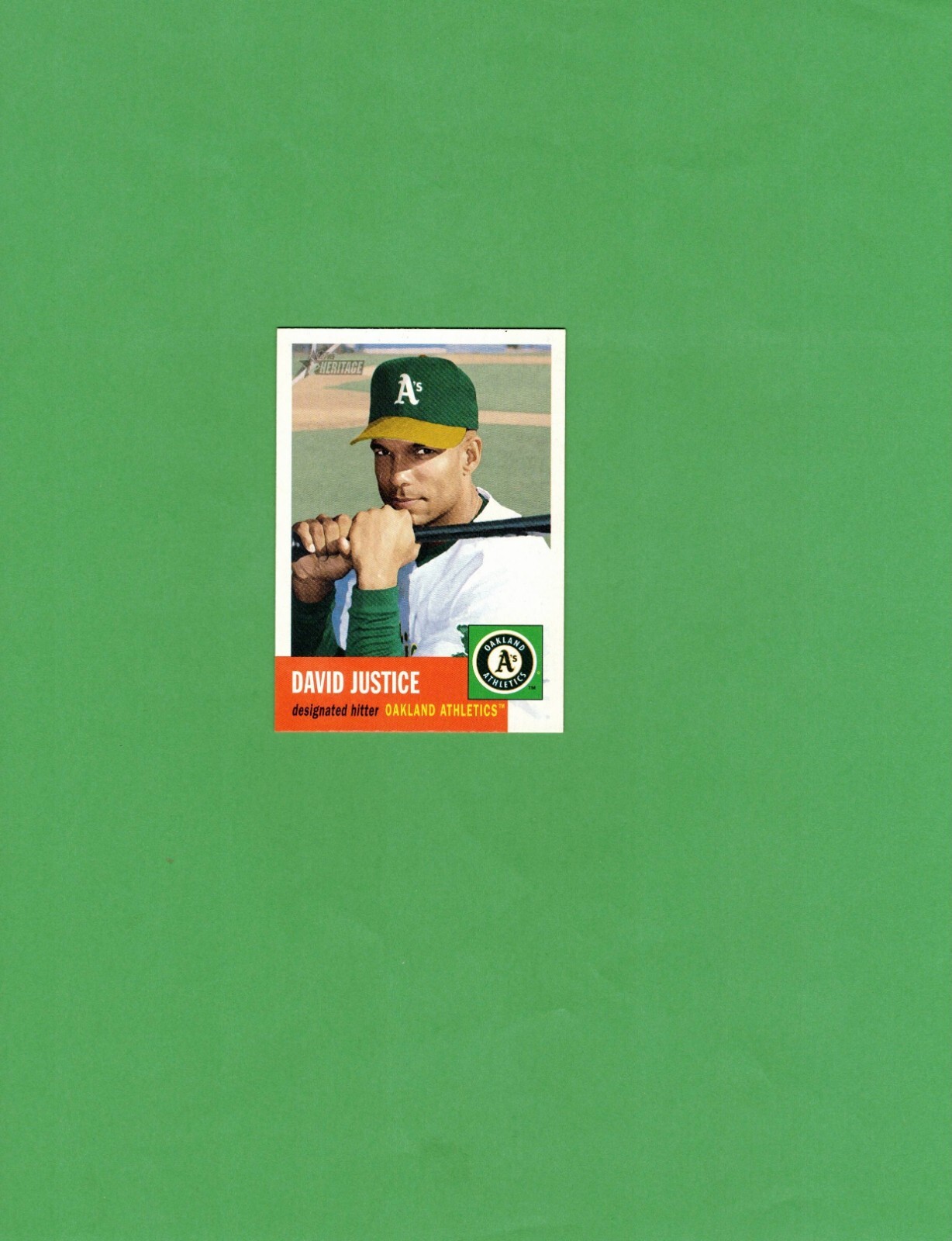
| David Justice (DH/OF) | Veteran leader and designated hitter | Acquired via trade from New York Yankees | Professional plate discipline and clutch hitting |
| Tim Hudson (SP) | Ace starting pitcher | Drafted 6th round in 1997 | Sinkerball specialist, high ground-ball rate |
| Mark Mulder (SP) | Front-line starting pitcher | Drafted 2nd overall in 1998 | Command, strikeouts, and durability |
| Barry Zito (SP) | Cy Young Award winner (23-5) | Drafted 9th overall in 1999 | Devastating curveball and deception |
The Scott Hatteberg Experiment and Defensive Adaptations
One of the most compelling narratives of the 2002 season was the conversion of Scott Hatteberg from a catcher whose career was threatened by elbow injuries into an everyday first baseman. Traditional scouts doubted Hatteberg's ability to play the position defensively, but the front office cared primarily about his elite strike-to-walk ratio and high OBP. Hatteberg’s ability to take pitches wore down opposing hurlers and set the table for power hitters like Miguel Tejada and Jermaine Dye.
Similarly, the outfield and bench were constructed using platoon systems. By strictly utilizing right-handed hitters against left-handed pitchers and vice versa, the Athletics maximized the statistical probability of success for every plate appearance, squeezing maximum value out of minimum salary dollars.
The Pitching Staff: The Big Three and the Bullpen
While the offensive philosophy dominated the headlines, the 103-59 record would have been impossible without a pitching staff that surrendered the fewest runs in the American League (654). The rotation was anchored by the legendary "Big Three"—Tim Hudson, Mark Mulder, and Barry Zito—who combined durability, elite stuff, and contrasting pitching styles.
Barry Zito enjoyed a breakout campaign in 2002, finishing with a 23-5 record and capturing the American League Cy Young Award. Zito's curveball, thrown with exceptional downward break, baffled left-handed and right-handed hitters alike. Tim Hudson relied on a heavy sinker that induced an astronomical number of ground-ball double plays, while Mark Mulder utilized a polished three-pitch mix and exceptional control to pitch deep into games regularly.
The Bullpen and Chad Bradford
Behind the starting rotation, Art Howe managed a bullpen that featured unconventional arms, most notably sidearmer Chad Bradford. Acquired for his unorthodox delivery that made life exceptionally difficult for right-handed batters, Bradford became a vital bridge to closer Billy Koch. Koch saved 44 games during the 2002 campaign, providing stability at the back end of games despite a high-wire pitching style characterized by high velocity and occasional traffic on the base paths.
The Historic 20-Game Winning Streak
The defining moment of the 103-59 season occurred between August 13 and September 4, 2002, when the Athletics reeled off 20 consecutive victories. This streak captured the attention of the entire sports world and showcased the resilience and depth of the roster.
During the streak, the Athletics demonstrated both dominant blowouts and dramatic late-inning heroics. The pinnacle arrived on September 4 against the Kansas City Royals at the Oakland-Alameda County Coliseum. Holding an 11-0 lead, the Athletics watched in disbelief as the Royals mounted a ferocious comeback, tying the game 11-11 in the ninth inning.
With two outs in the bottom of the ninth, Scott Hatteberg stepped to the plate against Kansas City reliever Jason Grimsley. On a 1-0 count, Hatteberg launched a pinch-hit, walk-off home run into the right-field seats, securing a 12-11 victory and etching the 2002 team into baseball lore. The streak set an American League record at the time and proved that the mathematical models driving the front office could produce a team capable of historic hot streaks.
Postseason Heartbreak and Long-Term Legacy
Despite their regular-season dominance and 103-59 record, the Athletics faced the harsh reality of the MLB postseason, where small sample sizes often override large-scale statistical advantages. Facing the Minnesota Twins in the American League Division Series (ALDS), the Athletics dropped a hard-fought five-game series.
Critics of the Moneyball philosophy were quick to point out that despite regular-season brilliance, the team failed to capture a World Series title. However, this critique misses the broader historical impact of the 2002 season. The strategies pioneered by Billy Beane, Paul DePodesta, and their colleagues fundamentally altered the operational blueprint of Major League Baseball.
Within a decade of the 2002 campaign, every single franchise—including high-spending giants like the Yankees and Red Sox—adopted advanced analytics departments, quantitative player evaluation models, and data-driven front office structures. The 103-59 season proved that intelligence, efficiency, and data could successfully challenge generational wealth in professional sports.
Frequently Asked Questions
What was the final record of the Oakland Athletics in 2002?
The Oakland Athletics finished the 2002 regular season with a record of 103 wins and 59 losses. This tied them with the New York Yankees for the best record in the American League that year.
What was the payroll of the 2002 Oakland Athletics?
The opening day player payroll for the 2002 Oakland Athletics was approximately $39.8 million. This ranked near the bottom of Major League Baseball, contrasting sharply with elite teams spending upwards of $100 million to $125 million.
Who won the American League MVP for the 2002 Athletics?
Shortstop Miguel Tejada won the American League Most Valuable Player award for the 2002 season. He batted .308 with 34 home runs and 131 RBIs while playing in all 162 games.
Who was the pitching ace of the 2002 team?
Barry Zito was the standout pitcher for the 2002 Athletics, compiling a 23-5 record with a 2.75 ERA and winning the American League Cy Young Award. He was supported in the rotation by fellow All-Stars Tim Hudson and Mark Mulder.
Did the Oakland Athletics win the World Series in 2002?
No, despite winning 103 games during the regular season, the Athletics lost the American League Division Series (ALDS) 3-2 to the Minnesota Twins, extending their postseason drought in the opening round.
How did the 2002 season influence modern baseball?
The 2002 season popularized "Moneyball," demonstrating that analytical metrics like on-base percentage could help small-market teams compete. Today, every Major League Baseball franchise utilizes advanced analytics and data-driven player evaluation models derived from these principles.
Conclusion and Next Actions
Examining the 103-59 Oakland Athletics 2002 season reveals the profound impact of challenging established norms through data analysis and operational discipline. For students of sports history, economics, and business management, studying this campaign offers enduring lessons in resource allocation and innovation under constraints. To explore this topic further, review historical sabermetric resources, read Michael Lewis’s original book Moneyball, or examine contemporary baseball front-office case studies.